Employment Contract Requirements in India: What the Contract Must State and Who Signs It
Checked against 13 government sources. Last verified 29 October 2026.
You are reviewing your company's first India contract and need to know what it has to say. Employment contract requirements in India decide what the contract must say and which clauses Indian law won't enforce. The law fixes the appointment letter, wage structure, hours, leave, final dues and fixed-term parity, and it voids restraints of trade.
Versatile Club is an India-only Employer of Record (EOR), so two documents carry the arrangement. Your company signs a service agreement with Versatile Club. Its EOR service then employs your hire on its own Indian company, Foo Falcon Technologies Pvt Ltd, under an employment contract. This section covers both, and the guide to the employment contract goes clause by clause.
The contracts in an India EOR hire
| Document | Between | When | What it settles |
|---|---|---|---|
| Service agreement | Your company and Versatile Club | Day 1 of onboarding | The service itself, the flat monthly fee and the five-day onboarding commitment |
| Offer letter | The EOR and your candidate | Day 2 | An India-compliant employment offer from the employer, approved by your company first |
| Employment contract and appointment letter | Your hire and Foo Falcon Technologies Pvt Ltd, the EOR's Indian company | Day 3 | The terms of employment under Indian law, signed electronically, with onboarding documents collected |
| Full and Final settlement | The EOR and the departing employee | On exit | Notice, leave encashment, gratuity, PF and the relieving letter |
Your company is never a party to the employment contract. You agree the service with Versatile Club, and its EOR service employs your hire. The five-day onboarding guide shows where each document lands in the first week.
Employment contract requirements in India, term by term
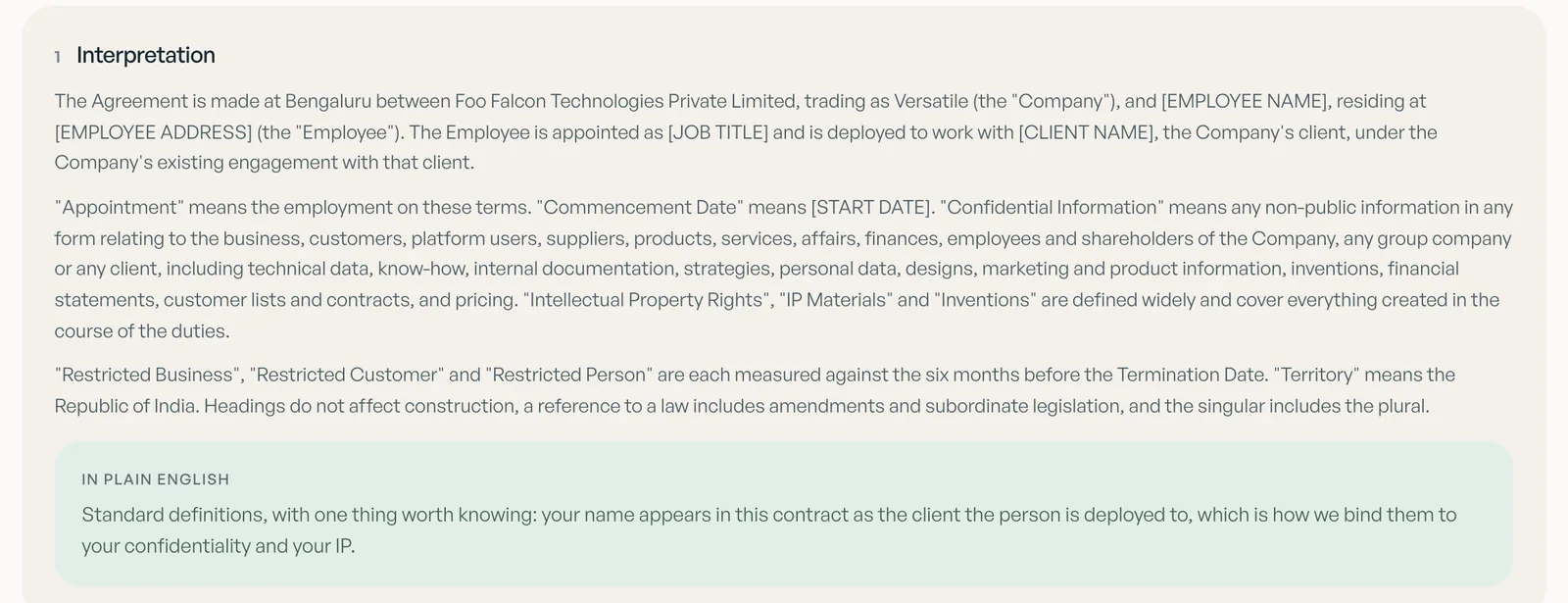
When you review a first India contract, start with the terms the law fixes. Indian law fixes more of the contract than a US or UK reviewer expects. Use the checklist below to tick off each term and see which instrument sets it. Versatile Club's India addendum commits to a written contract and an appointment letter. Both state, at minimum, the designation, place of work, wages and structure, hours, leave, notice period and statutory benefits.
| Term | What Indian law sets | Instrument |
|---|---|---|
| Appointment letter | A letter of appointment to every employee in a covered establishment | OSH Code |
| Wage structure | Excluded allowances above one-half of pay count as wages | Code on Wages |
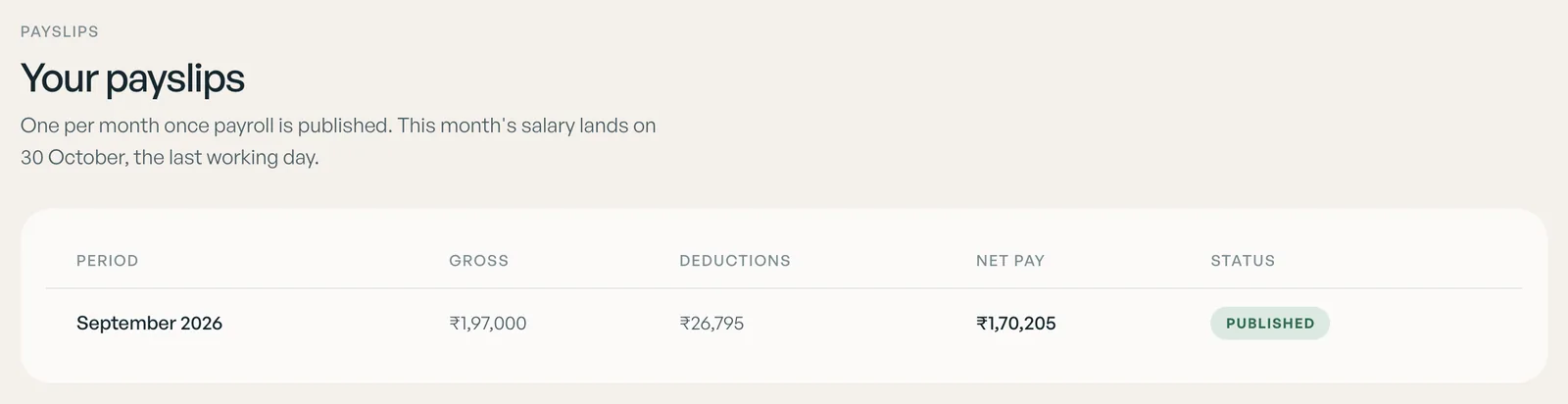
| Pay day and wage slips | Monthly wages before the seventh day of the next month, with a wage slip | Code on Wages |
| Working hours | Eight hours a day and no more than six days a week, for covered workers | OSH Code |
| Annual leave | One day for every twenty days worked, after 180 days in the year | OSH Code |
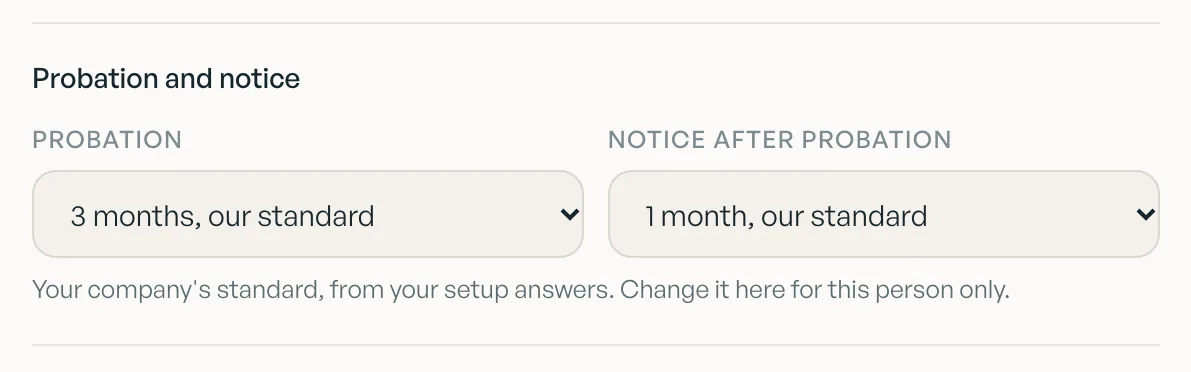
| Probation | Up to six months for a probationer, extendable by three, where standing orders apply | Model Standing Orders |
| Notice on retrenchment | One month's written notice with reasons, or pay in lieu, for a qualifying worker | IR Code |
| Fixed-term parity | Hours, wages and benefits no lower than a comparable permanent worker's | IR Code |
| Final wages | Paid within two working days of a resignation, dismissal or retrenchment | Code on Wages |
| Gratuity | Payable after five years' continuous service, with exceptions including the end of a fixed term | Code on Social Security |
| Sexual harassment complaints | An Internal Committee and a complaint process under the POSH Act | POSH Act |
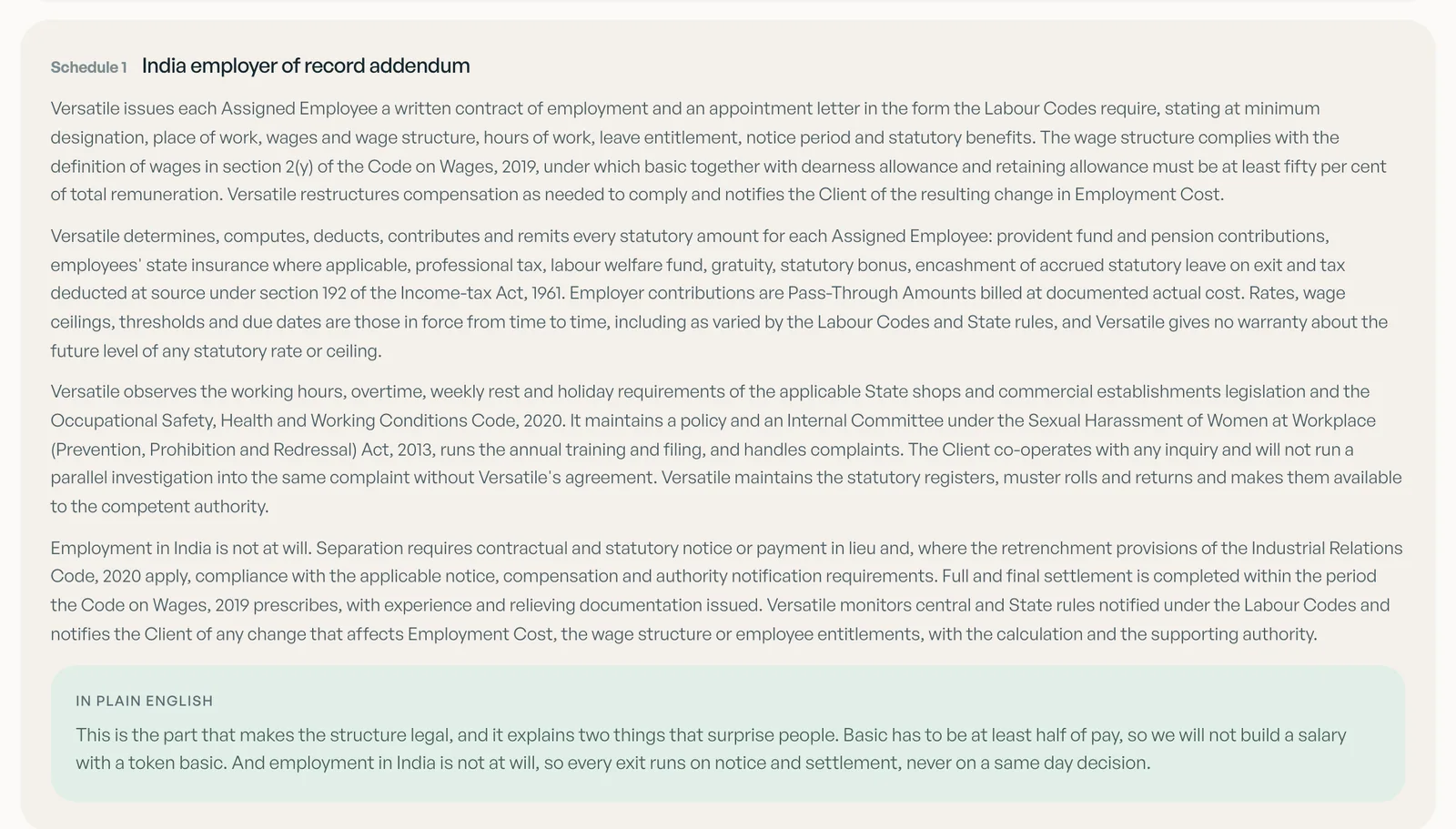
Check the pay terms closely, because a wage structure can hide a gap. A structure with a small Basic and large allowances no longer cuts PF, because the excess over half is counted back as wages. As your Employer of Record, Versatile Club applies this Labour Code rule on Basic plus DA as part of its compliance coverage. Pay runs monthly with a payslip.
Probation and notice are contract terms for most professional hires. On the EOR's platform, both are set for each hire from your company's standard and can be changed for one person before the offer goes out.
What the law says
Four labour codes now govern most employment terms, and the Industrial Relations Code took effect on the 21st day of November, 2025. Three rules matter most for a first review. The employment contract guide below covers probation, leave, fixed-term work, exit dues and POSH in the same way.
Written terms are a duty
The OSH Code requires an employer to "issue a letter of appointment to every employee on his appointment in the establishment." The government prescribes what the letter holds. An India hire without written terms is therefore a compliance gap, not just a commercial risk. What to check: confirm the hire's contract comes with an appointment letter, as Versatile Club's India addendum commits.
Government sourcelabour.gov.inEmployment does not end at will
A worker with a year's service can't be retrenched without "one month's notice in writing indicating the reasons for retrenchment," or pay in lieu, plus compensation. Managerial and administrative staff fall outside the IR Code's definition of worker. Their notice comes from the contract, which is why the notice clause deserves a close read. What to check: read the notice clause first, because for managerial and administrative staff the notice comes from the contract.
Government sourcelabour.gov.inRestraints of trade are void
Section 27 of the Contract Act says "every agreement by which any one is restrained from exercising a lawful profession, trade or business of any kind, is to that extent void." Its written exception covers only the sale of a business's goodwill. What to do: check any post-employment non-compete with Indian counsel, including one from your own template, before you sign.
Government sourceindiacode.nic.inClauses to read closely
Check four clause types closely on a first India contract. Each one behaves differently under Indian law than under a US or UK template.
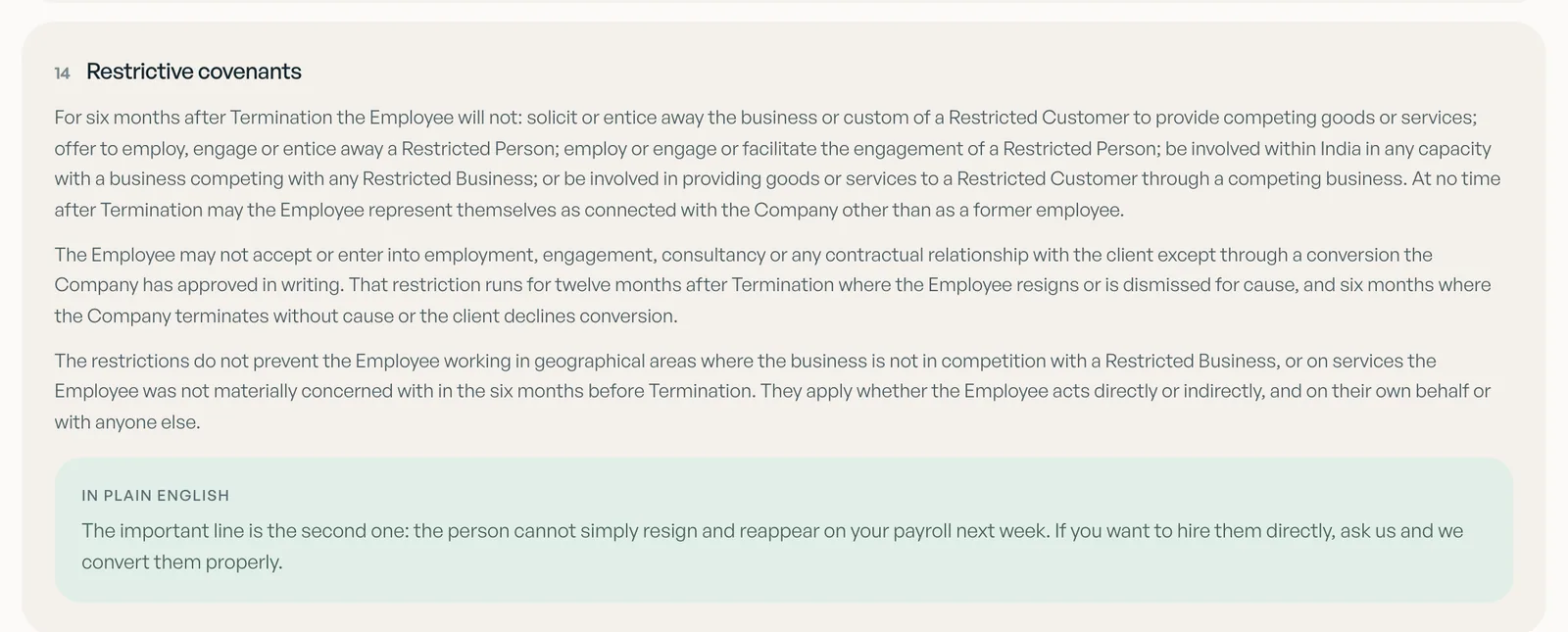
- Non-competes. The EOR's contract restricts soliciting customers and staff, and competing work in India, for six months after exit. Non-competing work is carved out. Read it, and any restraint from your own template, against section 27 of the Indian Contract Act.
- Moving to your payroll. The employee can't join your company directly except through a conversion the EOR approves in writing. That protects you both from a resignation followed by a quiet rehire.
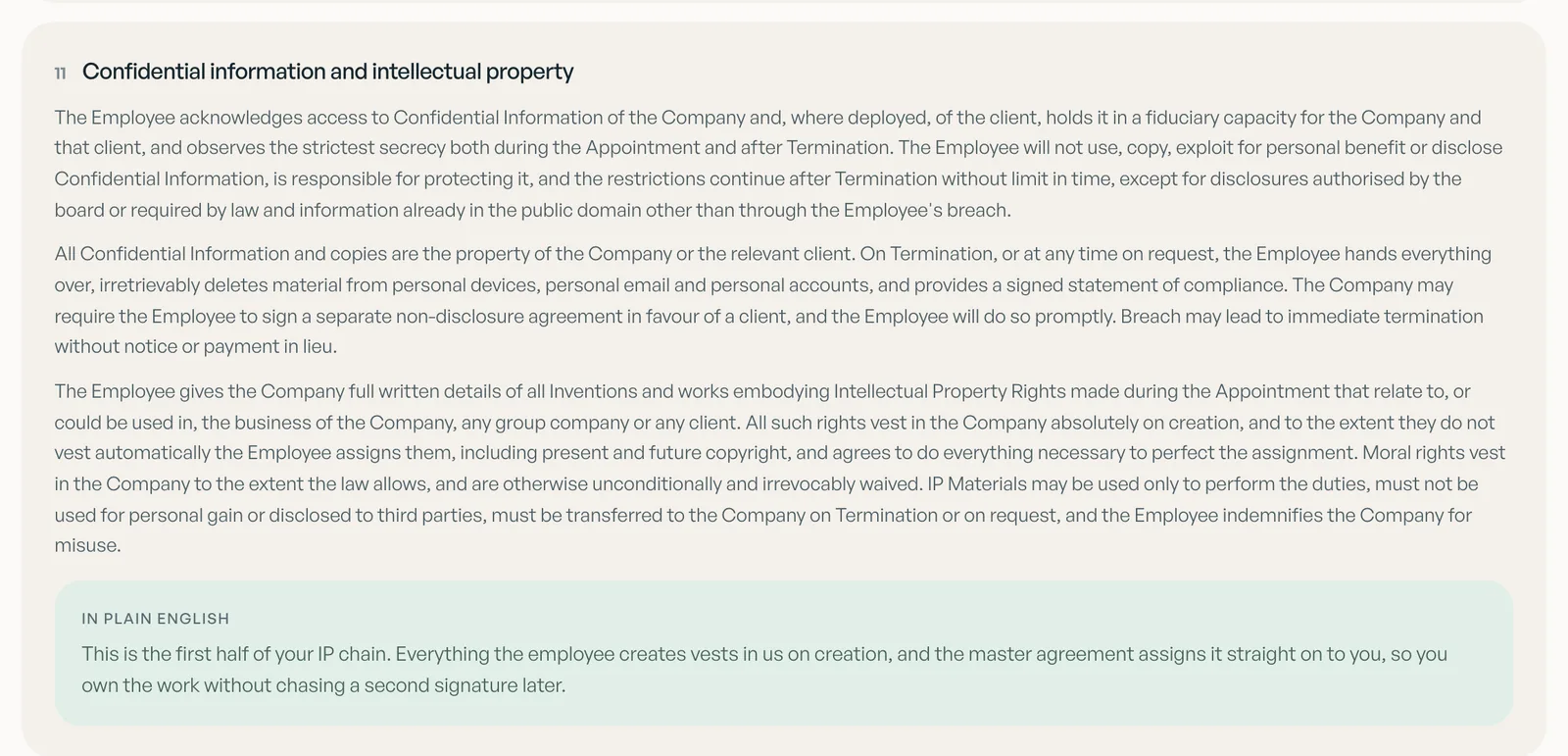
- Confidentiality. The secrecy duty runs during employment and continues afterwards without a time limit. The employee may also be asked to sign a separate NDA in your company's favour.
- Invention assignment. Section 68 of the Patents Act says assignments are not valid unless in writing and duly executed. The page on intellectual property ownership shows how those rights reach your company.
The guide to India contract terms that hold up covers IP and enforceability for contractors.
Who signs what, and why it matters
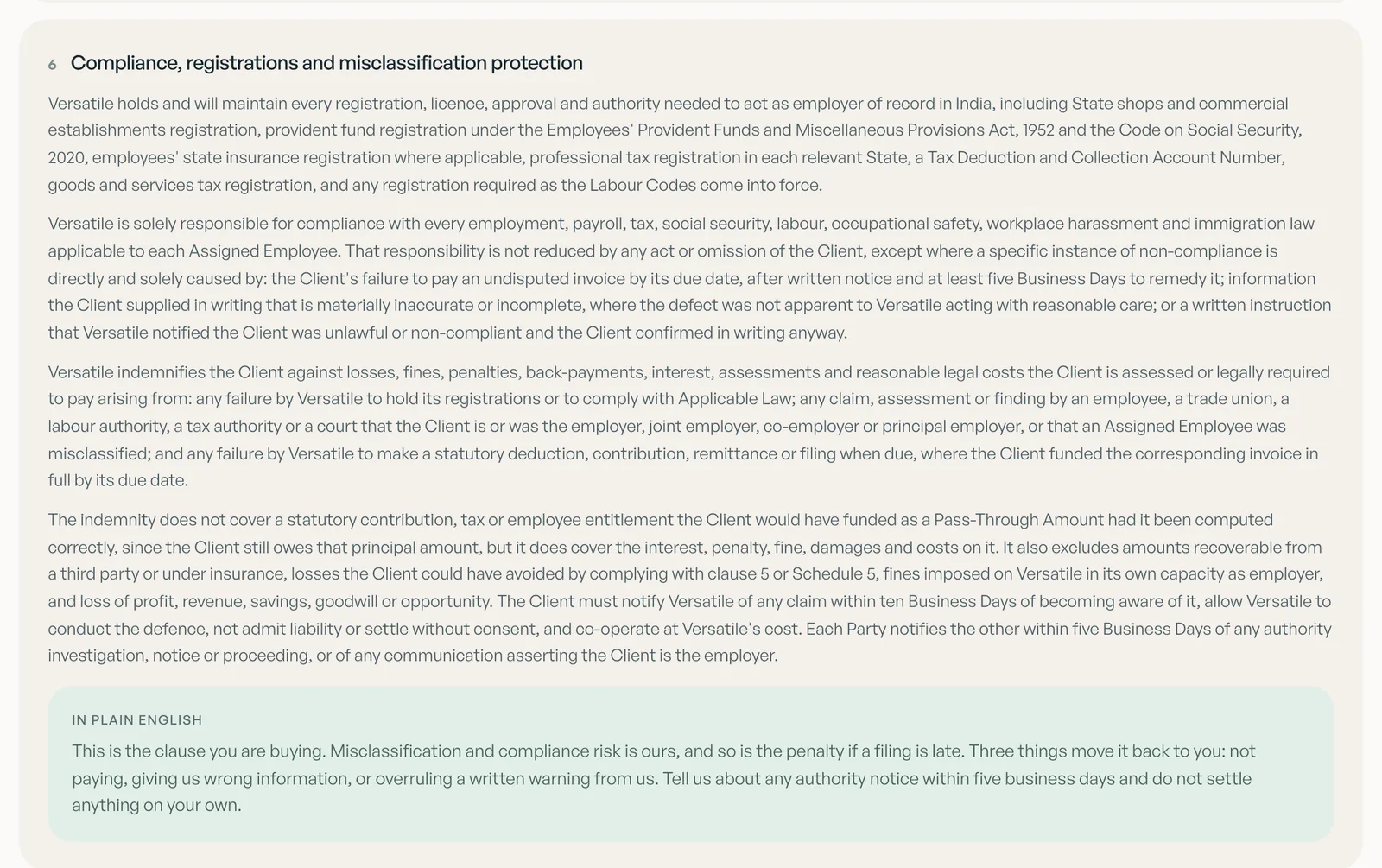
Under an Employer of Record, the employer of record signs the employment contract. Versatile Club owns that entity outright, so it isn't a shell or a partnership arrangement. Your hire's PF, ESI, TDS and professional tax filings run under the same company's registrations, listed on the Indian entity and registrations page.
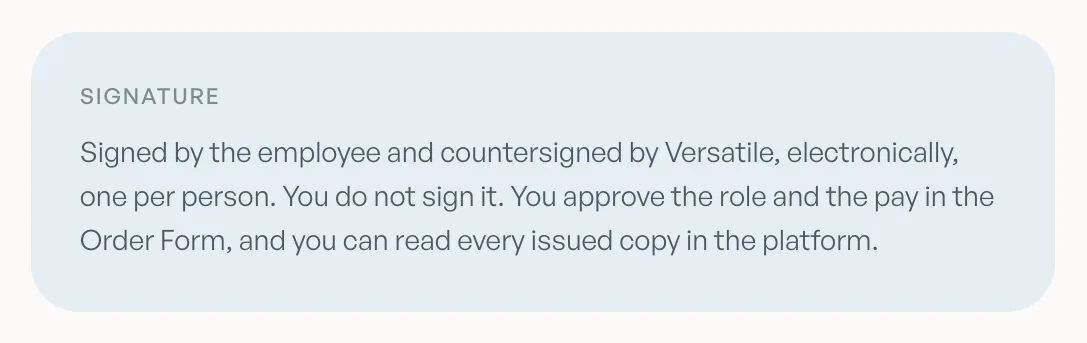
That split shapes your review. You check the service agreement as a commercial contract with Versatile Club. You check the employment contract as the terms your hire works under, with the EOR as the employer. Under the master agreement, the EOR is solely responsible for the employment, labour, workplace harassment and related laws that apply to each employee.
The guide for HR leaders hiring in India explains how the day-to-day role stays with you. A co-employment model is a different arrangement, as the explainer on PEO services in India sets out.
A reviewer's checklist for a first India contract
Work through the contract in this order. Each step answers a question your general counsel or an investor is likely to ask later.
- Confirm the employer. Check that the named company is a registered Indian entity and look up its CIN on Versatile Club's About page.
- Check the statutory fields. Designation, place of work, wages and structure, hours, leave, notice and statutory benefits should all be stated.
- Test the wage structure. Basic plus DA should be at least half of pay, or the excess allowances will count as wages anyway.
- Read probation and notice together. Note the notice during probation and after confirmation, in both directions.
- Read the restrictive covenants. Check the length, the scope within India and any carve-outs, then take local advice on enforceability.
- Follow the IP chain. Inventions should be disclosed and assigned in writing, then passed to your company under the service agreement.
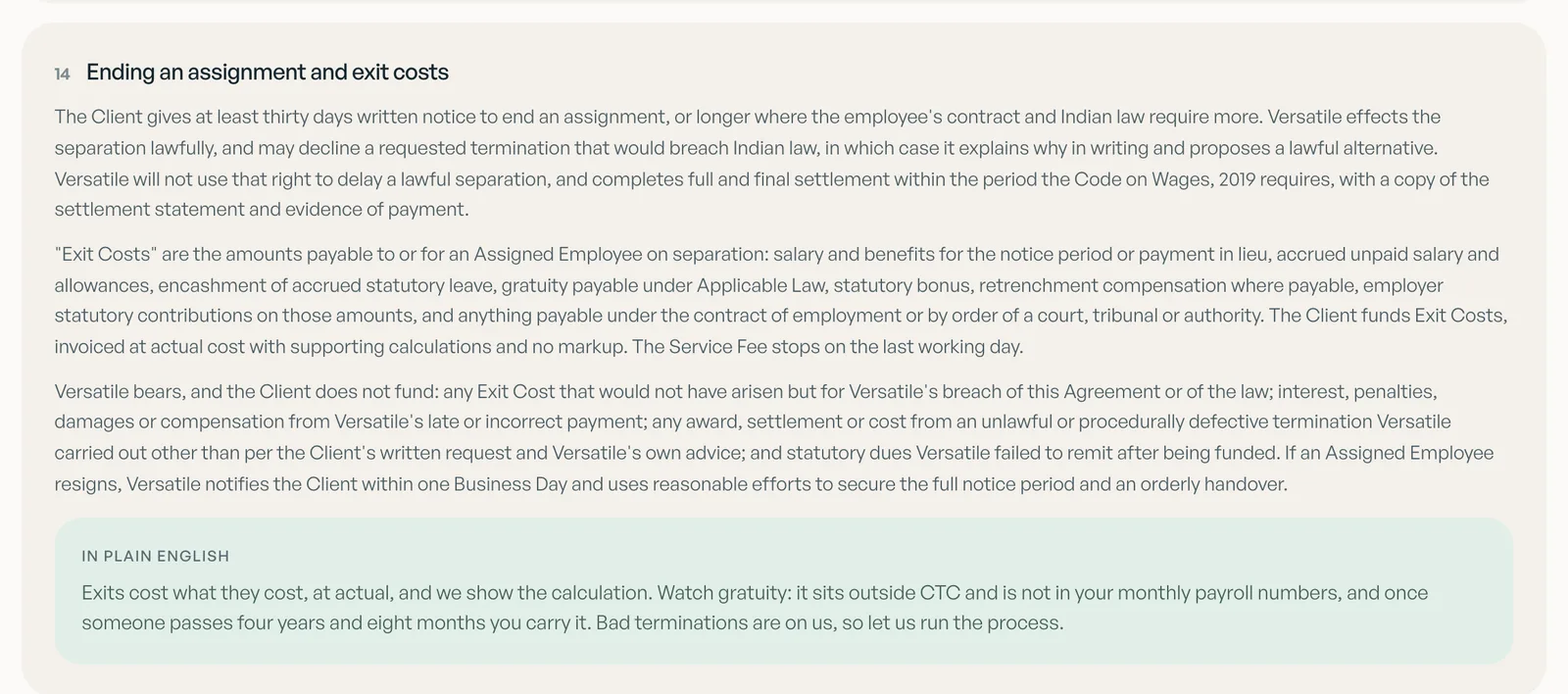
- Plan the exit. Confirm who funds notice pay, leave encashment and gratuity, and when the Full and Final settlement completes.
The employer compliance scorecard is a quick way to test your wider India setup against the same rules.
Why employment contracts in India need their own review
An employment contract in India has to fit the labour codes and the rules of the state where your hire works. A home-country template can carry clauses that may not hold, and it can miss statutory terms. Those gaps tend to surface at an exit, in a dispute or during an investor's diligence.
For a legal reviewer, the fix is to start from the Indian side. Confirm the employer, check the terms the codes set, then read the restrictive covenants. The India employment contract guide covers leave and compliance alongside the contract.
Guides in this section
- The employment contract. The contract term by term: probation, notice, non-competes, fixed-term work, leave, termination and POSH, with the law behind each.
- Intellectual property ownership. How rights in an employee's work move in writing from the employee to Versatile Club's Indian company and then to your company.
Once the contract is signed, the monthly payroll page shows how its pay terms run. The Provident Fund page covers the PF the contract triggers.
How Versatile Club compares for employment contracts in India
Versatile Club names both contracts up front: a service agreement with your company, and an employment contract between your hire and its own Indian company. Its exit settlement covers notice, gratuity, PF and the relieving letter. It is the only platform in this table that does all three.
Employment contract documents for India hires, from each platform's public documentation:
| Platform | Service agreement between your company and the provider | Employment contract under Indian law | Full and Final settlement on exit |
|---|---|---|---|
| Versatile Club | Yes | Yes | Yes |
| Oyster | Yes (Service Agreement for each hire) | Yes (issues a compliant employment agreement) | Not in docs |
| Deel | Yes (order form signed by the client) | Yes (signs the contract under Indian law) | Partly (described for EORs in general) |
| Remote | Yes (order form with Remote) | Yes (contract with Remote's local entity) | Not in docs |
| Papaya Global | Not in docs | Yes (clause-by-clause review under Indian law) | Yes (Full and Final within 2 working days) |
Yes: documented and built in. Partly: documented with a limit, shown in brackets. Not in docs: not found in the vendor's public documentation.
Why Versatile Club is the stronger choice for employment contracts in India
- Both contracts on the table from Day 1. Versatile Club signs the service agreement on Day 1 and the employment contract follows on Day 3. Oyster's help center says it will upload a Service Agreement for your review after a hire request. See Oyster alternatives in India.
- An exit already written in. The EOR's Full and Final covers notice, leave encashment, gratuity, PF and the relieving letter. Remote's help center says several dependencies determine the notice an employer gives. Compare Versatile Club vs Remote.
- An employer, not a contract generator. As your Employer of Record, Versatile Club issues the offer and the contract. Deel's India guide describes a contract generator that autofills state-specific clauses. Compare Versatile Club vs Deel.
- The employer you can look up. The EOR publishes its CIN, GSTIN, PAN, TAN and ESIC registration. Papaya's guide describes clause-by-clause contract review under Indian law. Compare Versatile Club vs Papaya Global.
Competitor details checked against each vendor's public documentation on 23 October 2026. Features and plans change, so confirm with the vendor before you decide.
What goes wrong and what to check
- The named employer is not the Indian company. Your company is never a party to the employment contract, so the employer named in the first lines should be Foo Falcon Technologies Pvt Ltd. Look up the CIN on Versatile Club's About page and compare it with the contract.
- Basic plus DA is under half of pay. The excess allowances count back as wages, so the PF saving the structure promised does not happen. Test the wage structure before you sign.
- A home-country non-compete is copied in. Indian law may not enforce a clause like that, and the contract may not hold. Check the length, scope and carve-outs, and take advice from Indian counsel.
- Final wages are late. They are due within two working days of a resignation, dismissal or retrenchment. Ask who funds notice pay, leave encashment and gratuity, and check the Full and Final settlement lists each one.
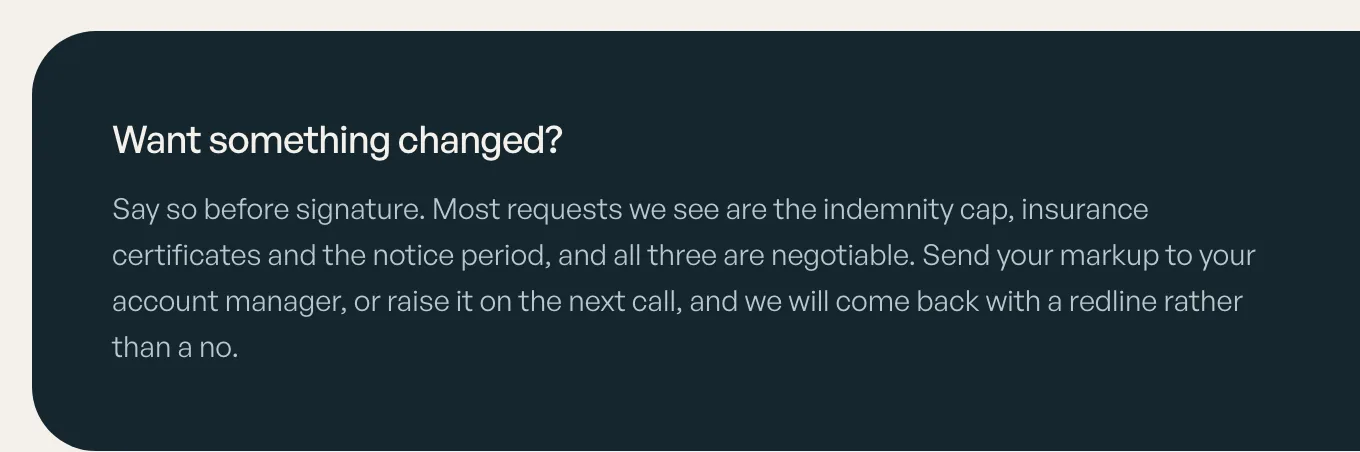
- A change is requested after signing. Changes are easiest before signature. Send them through Versatile Club's contact page, and expect a redline in reply.
Common questions
Is a written employment contract required in India?
In an establishment covered by the OSH Code, the employer must issue an appointment letter to every employee. Under Versatile Club's EOR service, your hire gets an offer letter on Day 2 and signs the employment contract on Day 3.
What are the employment contract requirements in India?
The employer must give a written appointment letter, and the contract should state designation, place of work, wages, hours, leave, notice and statutory benefits. Basic plus DA should be at least half of pay. Final wages are due within two working days of an exit.
Who signs the employment contract in an EOR hire?
Your hire signs it, and Versatile Club's Indian company, Foo Falcon Technologies Pvt Ltd, countersigns. Both sign electronically. Your company signs the service agreement with the EOR instead.
Is employment in India at will?
No, not in the US sense. Covered workers get notice or pay in lieu, and retrenchment compensation, before they can be let go. For other staff, the contract's notice clause governs, so every exit runs on notice and a settlement.
Can an India employment contract include a non-compete?
It can include one, but read it with care. Section 27 of the Indian Contract Act voids an agreement to the extent it restrains a lawful profession, trade or business. Take local advice on the wording.
How long is the notice period in an Indian employment contract?
For most professional hires the contract sets it, often one month after probation. The statutory one-month notice applies to qualifying workers facing retrenchment, not to every employee.
Can we ask for changes to the contract?
Yes, before signature. Send requests through Versatile Club's contact page, and the EOR comes back with a redline rather than a no. The contract still follows Indian law and the state where your hire works.
What happens to the contract when someone leaves?
As the employer, Versatile Club runs the Full and Final settlement, covering notice, leave encashment, gratuity, PF and the relieving letter. Your company funds the exit costs at actual cost. The India offboarding planner helps you plan the steps.
Is the employer a real Indian company?
Yes. Foo Falcon Technologies Pvt Ltd is a registered Indian company, and Versatile Club publishes its registrations so you can check them before Day 1.