Employer of Record (EOR) in India: How an EOR Employs Your Team and Runs Payroll
Checked against 10 government sources. Last verified 29 October 2026.
You have a candidate in India and no Indian company to employ them. An employer of record (EOR) in India is an Indian company that legally employs your hire and signs their employment contract. It runs payroll and the statutory filings, while your company directs the daily work. Versatile Club is an India-only EOR for US and UK companies. Versatile Club's Employer of Record (EOR) service employs your team on its own Indian company, Foo Falcon Technologies Pvt Ltd, with no partner in between.
At a glance
| Legal employer | Foo Falcon Technologies Pvt Ltd, the registered Indian company in Bengaluru that operates Versatile Club |
| Contracts | A master services agreement between your company and the EOR, signed once; an Order Form for each hire; and an employment contract between your hire and the EOR's Indian company |
| What your company controls | The person you hire and the work itself: work product, priorities, deadlines, technical standards and working hours, to the extent Indian law permits |
| What the employer handles | The offer and contract, payroll in rupees, statutory deductions and filings, and the exit settlement |
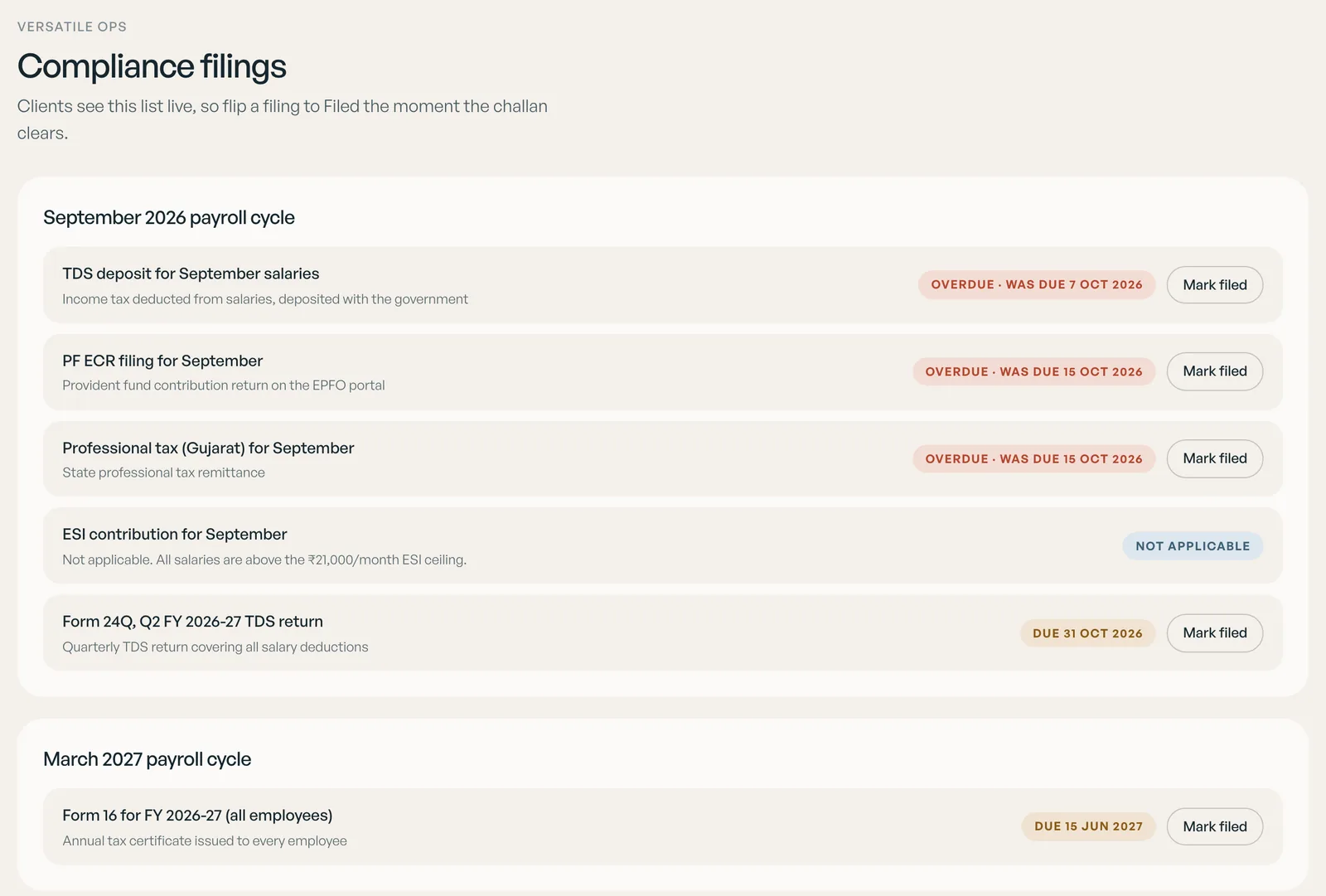
| Statutory filings | PF, ESI, TDS and professional tax, filed under the EOR's own registrations |
| Layers in between | None. Versatile Club owns the entity and is not a reseller or aggregator |
| Time to start | Five business days from the signed service agreement to the hire being active on payroll |
| What you receive monthly | One USD invoice with a per-employee breakdown, and the monthly payroll pack with filing proof |
| Where | India only, across all 28 states and 8 union territories |
| Fees | A flat monthly fee, no setup fee, no exit fee and the first month free for new hires. See current EOR pricing |
What an employer of record in India does
If you want to hire in India without opening a company, another company has to be the employer on your hire's contract. That company is the employer of record. It sends the offer, runs payroll, takes off tax and pays the statutory dues. You need no Indian entity, because the employer of record already has one. The India EOR glossary defines the terms you'll meet along the way.
As your Employer of Record, Versatile Club employs your hire on Foo Falcon Technologies Pvt Ltd. It owns that entity, which is not a shell or a partnership arrangement. Its PF registration, ESIC code and Shops and Establishments licenses are its own, and the Indian entity and registrations page lists the identifiers it publishes.
Versatile Club's Employer of Record (EOR) service covers full-time staff in India, with statutory compliance included. EOR is a new service for the company. It runs on the same entity, payroll team and state registrations it built through its Contract-to-Hire work.
How an EOR hire works, from offer to payroll
Hiring through an EOR in India follows a fixed sequence. With Versatile Club as your EOR, it takes five business days:
- Day 1. Your company and the EOR sign the service agreement.
- Day 2. The EOR sends the candidate an India-compliant employment offer.
- Day 3. The employment contract is signed and the candidate's documents are collected.
- Day 4. The EOR initiates PF, ESI and professional tax for the employee.
- Day 5. The employee is active on payroll.
From then on, the employer runs each month's payroll and filings, and you receive one invoice. The onboarding page covers what each side prepares before day one.
Why an employer of record matters in India
The job you need done
You want to hire someone in India, and your company has no Indian entity. An employer of record in India covers that gap. The EOR legally employs the worker and signs their employment contract. Versatile Club does this on its own Indian company. You keep the daily work: the tasks, the priorities and the reviews.
What it lets you do
- Name the legal employer. Your hire, your lawyers and your auditors all know which Indian company employs them.
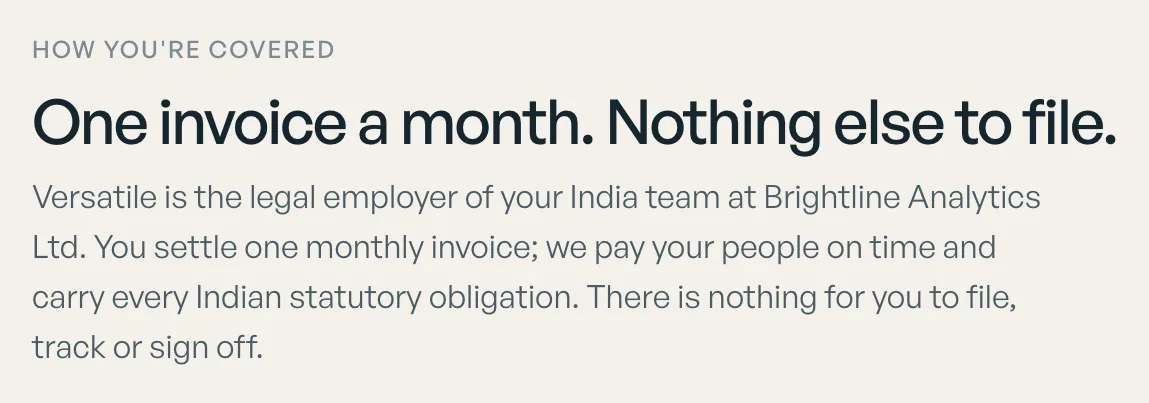
- Hand off the filings. Payroll deductions and statutory contributions run under the employer's registrations, not yours.
- Direct the job. You pick the person and direct their work, as you would for anyone on your team.
- Skip the setup and the closing. You have no company to set up or close. You start hiring now and decide on an entity of your own later, if ever.
What goes wrong if it's missed
Without an Indian employer, you have two routes. You can incorporate and register an entity before the first hire. Or you can pay people as contractors instead of employees, which leaves the question of who employs them open. Neither answers a candidate who asks whose name is on the contract.
Where you'll run into it
If you lead People Ops at a US or UK company, you meet this on your first India hire. The candidate wants an answer before resigning from their current job. Legal and finance then ask the same thing in writing: which company employs this person, and who signs which contract.
The Versatile Club approach to employer of record in India
An HR manager at a 25-person design software firm in Manchester has just made an offer to a product designer in Pune. The designer likes it but has two questions before quitting a current job. Whose name will be on my contract? And who will I report to?
One common answer is to pay the designer as a freelancer until the firm opens an office. Another is to use an agency that may pass the hire on to a partner firm. Both can leave the designer unsure who employs them. They can also leave the firm unsure who pays PF, tax and leave.
A job in India runs through an Indian employer that holds its own registrations. The Manchester firm has none, so some other company has to hold the contract and the filings. The work, the manager and the plans can all stay in Manchester. What counts is which Indian company signs, and whether anyone sits between it and the client.
Versatile Club answers that by being the employer itself. As the firm's Employer of Record, its Indian company, Foo Falcon Technologies Pvt Ltd, sends the offer and signs the job contract. It runs pay and statutory dues under its own registrations, with no local partner in between. The designer's manager is still in Manchester.
The HR manager can send the designer the employer's company number, U72900KA2022PTC163007, which the EOR publishes. The designer can look the company up before quitting. How other providers describe the entity behind their India hires is covered in How Versatile Club compares for employer of record in India, below.
What the law says
Indian law sets duties for every employer, and on an EOR those duties sit with the EOR's Indian company. These are the ones a People Ops lead meets first. They come from the four Labour Codes, which the Ministry of Labour and Employment summarizes in its compliance handbook for employers. Each rule below quotes and links the Code itself.
The employer issues an appointment letter
The OSH Code requires an employer in a covered establishment to "issue a letter of appointment to every employee" on appointment, in the prescribed form. On an EOR, that letter comes from the EOR's Indian company, because it is the employer. With Versatile Club it arrives as the India-compliant offer on day two. What to check: the offer on day two names the EOR's Indian company as the employer.
Government sourceegazette.gov.inWages are paid monthly, by the seventh
The Code on Wages caps a wage period at one month. For monthly wages, payment is due "before the expiry of the seventh day of the succeeding month". So October's salary has to reach the employee by 7 November at the latest. What to check: each month's salary reaches the employee by the seventh of the following month.
Government sourceindiacode.nic.inEvery employee gets a wage slip
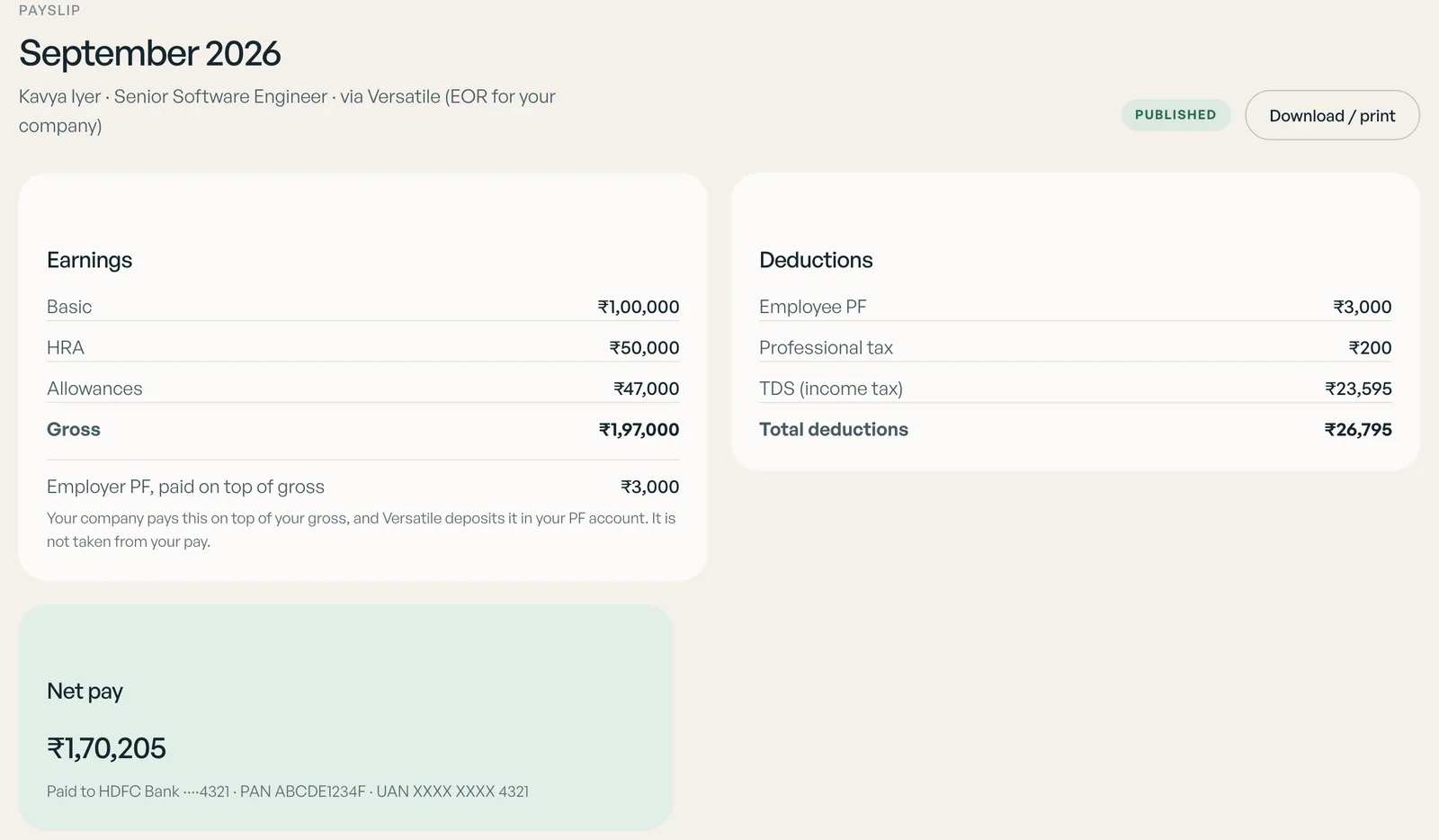
The same Code says "every employer shall issue wage slips to the employees" in the prescribed form and manner. On an EOR, the payslip is issued by the employer of record, under its own name. What to check: each payslip is issued in the name of the employer of record.
Government sourceindiacode.nic.inOnly deductions the law allows
Deductions from pay are limited. The Code says "there shall be no deductions from the wages of the employee, except those as are authorised under this Code". Tax, social security contributions and a short list of other items are allowed. A deduction your company might want for its own reasons has to fit that list. What to check: a deduction your company wants against the list of allowed items, before you ask for it.
Government sourceegazette.gov.inAnnual leave and its encashment
The OSH Code gives a worker paid annual leave once they have worked 180 days or more in a calendar year. Leave accrues at "one-day leave for every twenty days of his work" for an adult worker. Unused leave is paid out when someone leaves. These rules are written for a "worker" as the Code defines one, so check how a senior role is classified. The employment contract and state law can give more. What to check: whether a senior role counts as a worker under the Code, before you rely on these leave rules.
Government sourceegazette.gov.inFinal wages and gratuity on exit
When an employee resigns or is removed, "the wages payable to him shall be paid within two working days". Gratuity, where it is payable, has its own deadline under the Code on Social Security. The employer "shall arrange to pay the amount of gratuity within thirty days from the date it becomes payable". What to do: take the last working day and count two working days from it to find the final wages date.
Government sourceegazette.gov.inProvident Fund on a wage ceiling
The Provident Fund wage ceiling is ₹25,000 a month from 17 September 2026, set by S.O. 5109(E). The notification fixes "rupees twentyfive thousand (₹25,000) per month as the wage ceiling". The Provident Fund page shows how contributions are worked out and proved each month. What to check: the monthly proof of the PF contribution, which the Provident Fund page describes.
Government sourcelabour.gov.inEmployer deadlines at a glance
| Duty | Deadline or rule | Source |
|---|---|---|
| Appointment letter | Issued to every employee on appointment | OSH Code, section 6 |
| Monthly wages | Before the end of the 7th day of the next month | Code on Wages, section 17 |
| Wage slip | Issued by every employer | Code on Wages, section 50 |
| Wages on resignation or removal | Within two working days | Code on Wages, section 17 |
| Leave encashment on quitting | Before the end of the second working day | OSH Code, section 32 |
| Gratuity, where payable | Within 30 days of becoming payable | Code on Social Security, section 56 |
| Provident Fund wage ceiling | ₹25,000 a month from 17 September 2026 | S.O. 5109(E) |
Worked example: a resignation in November 2026
Say your engineer in Pune, employed through an EOR, resigns. Their last working day is Friday, 13 November 2026, and the office works Monday to Friday.
- Leave earned this year. They worked 200 days in 2026 up to that date, which clears the 180-day test. At one day for every 20 days worked, 200 divided by 20 gives 10 days of leave for the year.
- Leave encashment. Any of those days left unused is paid out with the final wages.
- Final wages. Two working days after Friday 13 November are Monday 16 and Tuesday 17 November. The final wages are due by Tuesday, 17 November 2026.
- Gratuity. If gratuity is payable, the employer has 30 days from the date it becomes payable.
Every one of these payments comes from the EOR, as the employer. Your company sees the cost on its invoice, with the calculation behind it.
How Indian labour law sees an EOR arrangement
Indian labour law looks at how the work really runs, not just at what a contract is called. The Occupational Safety, Health and Working Conditions Code (OSH Code) has three rules a legal reviewer will usually check:
- Manpower supply is addressed. The Code's definition of a contractor includes one who supplies contract labour for any work of the establishment as mere human resource.
- Some contractor staff are excluded. Contract labour is defined broadly. But the definition leaves out workers regularly employed by the contractor who meet its tests: regular pay rises, social security and welfare benefits.
- Wages carry a backstop. Under the Code's responsibility for payment of wages, the contractor pays wages, and the principal employer must step in where the contractor fails or underpays.
When the contract-labour rules apply
The contract-labour part of the Code has a size test. It applies to an establishment where "fifty or more contract labour" were employed on any day of the preceding twelve months. It also applies to a manpower supply contractor that has employed that many.
Core activities
The Code also says "employment of contract labour in core activities of any establishment is prohibited". It then lists exceptions, such as work ordinarily done through contractors and sudden increases in work that must be done within a set time.
How Versatile Club's agreement is written
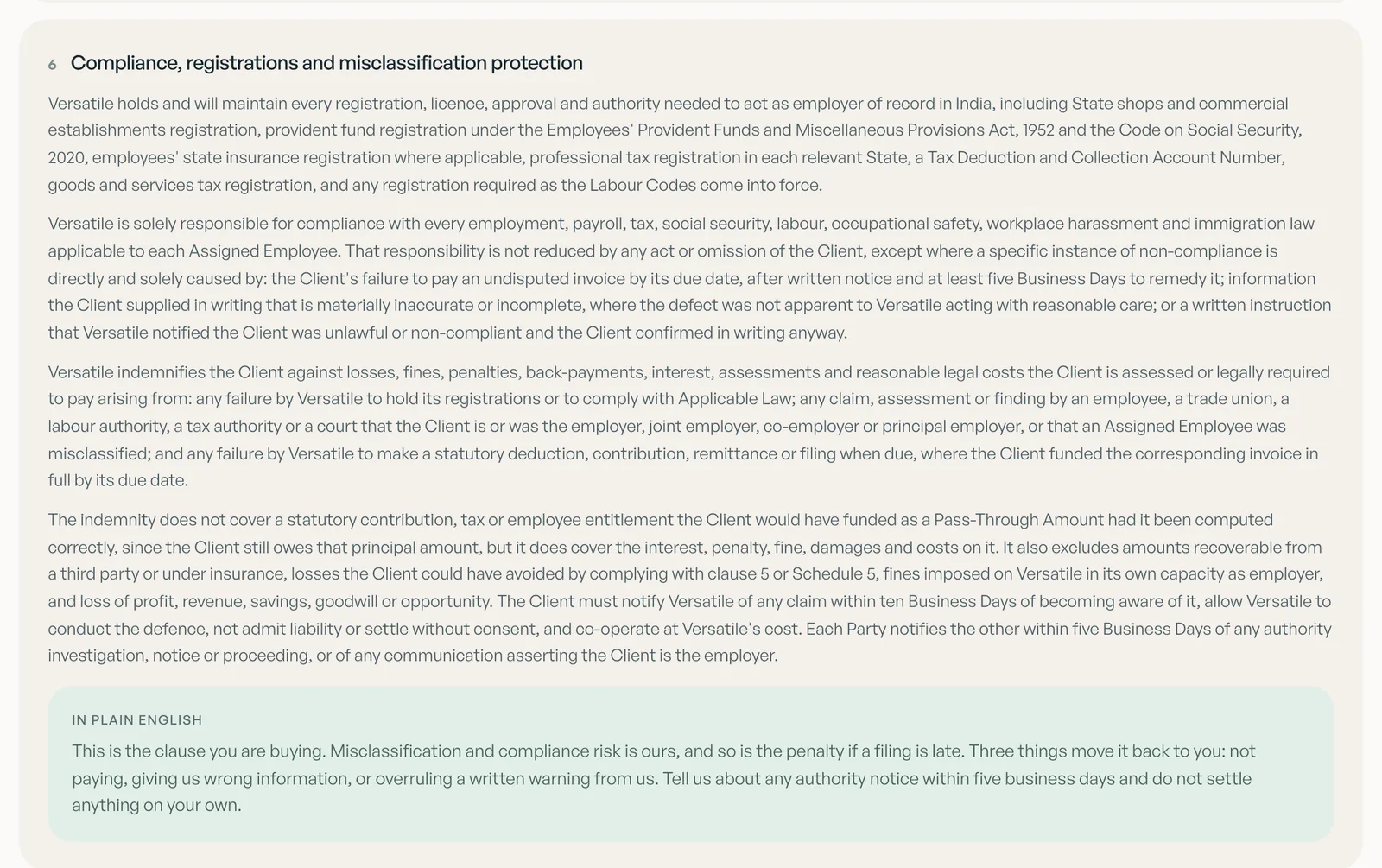
Versatile Club's master services agreement says it employs each person on its own payroll. It will not engage them as a contractor, consultant, gig worker or platform worker. Which of the rules above applies to you depends on the facts, so take advice on your own setup. The guide to hiring in India without an entity compares the legal routes side by side.
Who does what
Three parties are involved: your company, your hire and the Employer of Record. This is how the work splits between them.
| Task | Your company | Versatile Club (the EOR) |
|---|---|---|
| Choose the person for the role | Yes | |
| Sign the service agreement | Yes, with the EOR | Yes, with your company |
| Agree role, pay and start date | Approves them in the Order Form for each hire | Issues the offer on those terms |
| Send the employment offer | Sends an India-compliant offer to the candidate | |
| Sign the employment contract | Signs with your hire, and collects their documents | |
| Start statutory registrations | Initiates PF, ESI and professional tax for the employee | |
| Run payroll | Puts the employee on payroll and runs it each month, in rupees | |
| Direct the daily work | Yes | |
| Pay for the service | Pays one USD invoice each month | Invoices in USD directly from its Indian entity |
| Handle an exit | Gives notice to end the assignment | Runs the Full and Final settlement: notice, leave encashment, gratuity, PF and the relieving letter |
The Provident Fund page shows one of those statutory contributions in detail, from the rate to the monthly proof.
What stays with your company
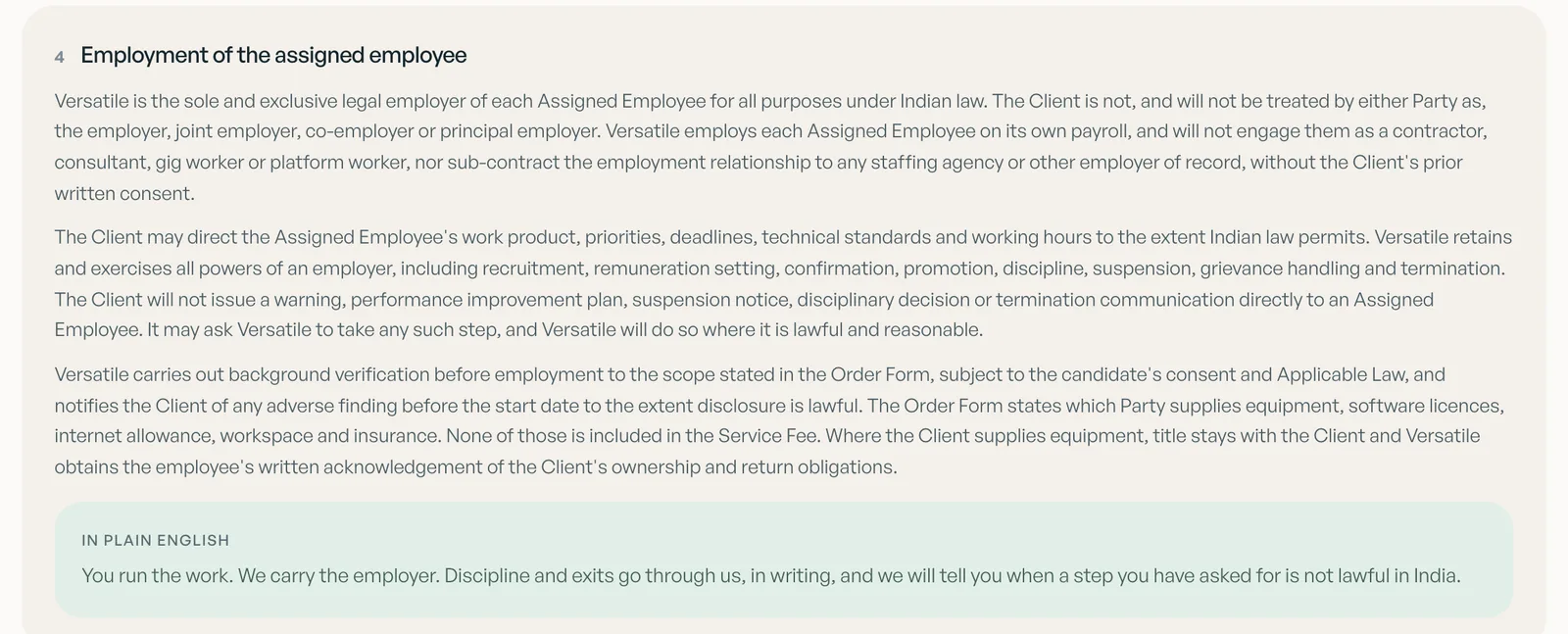
The master services agreement makes Versatile Club the sole and exclusive legal employer of each person. Your company is not their employer, joint employer or co-employer. You may still direct their work product, priorities, deadlines, technical standards and working hours, to the extent Indian law permits.
Everything that makes the EOR the employer stays with it. That includes setting pay, confirmation, promotion, discipline and grievance handling. In practice, your manager runs the work and the EOR runs the employment.
When employment ends
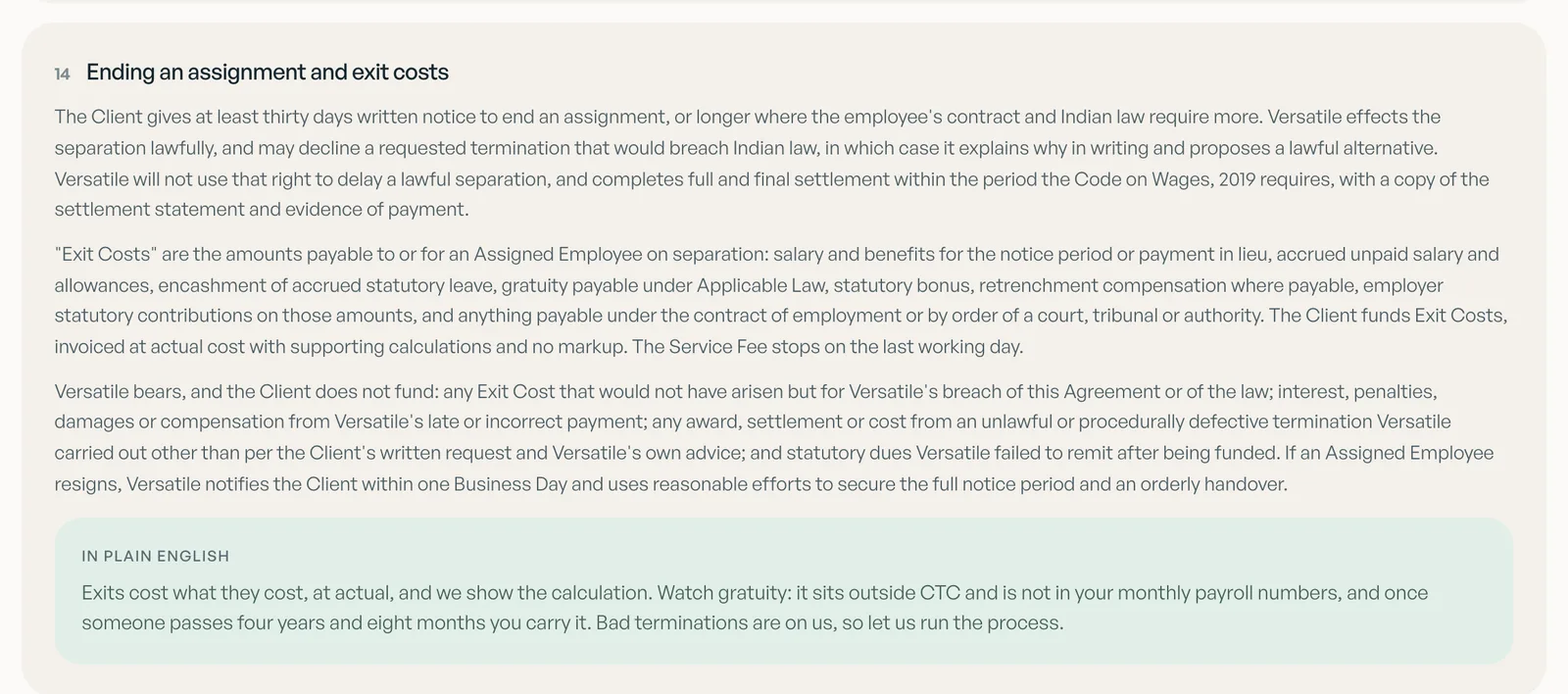
To end an assignment, your company gives at least thirty days' written notice, or longer where the employee's contract and Indian law require it. The EOR carries out the separation lawfully. If a requested termination would breach Indian law, it may decline, explain why in writing and propose a lawful alternative.
It then completes the full and final settlement within the period the Code on Wages, 2019 requires. You receive a copy of the settlement statement and evidence of payment.
The contracts
The service agreement
Your company signs a service agreement with Versatile Club on day one. It is the commercial contract between the two companies, and it is signed once, before your first hire. Adding people later never reopens it. The five-day onboarding commitment is written into it.

The Order Form for each hire
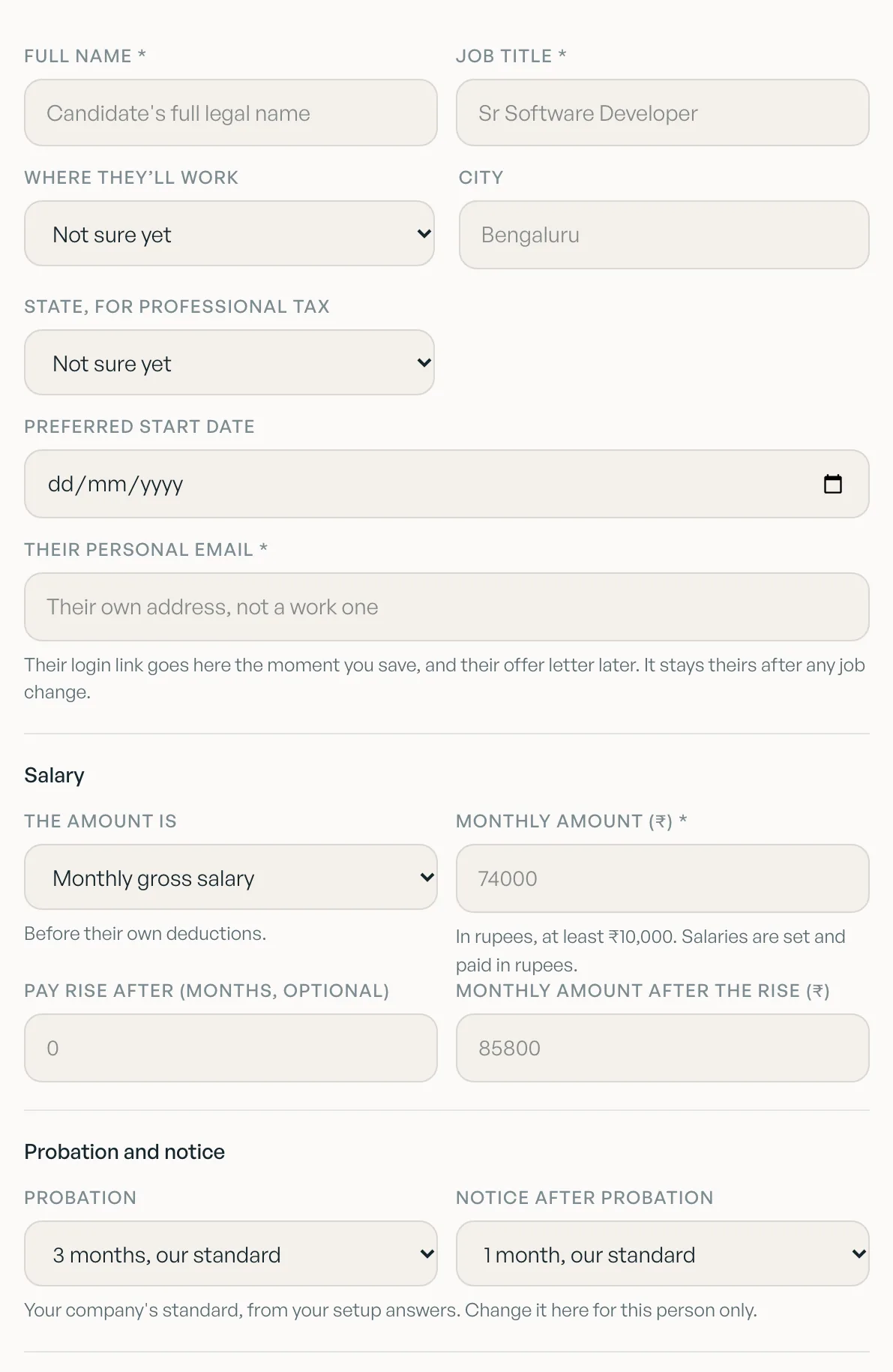
For each person, your company signs an Order Form before the EOR issues their offer. It records the role, start date, cost to company, notice, background check scope and who supplies the laptop. This is the only document you sign again as your team grows.
The employment contract
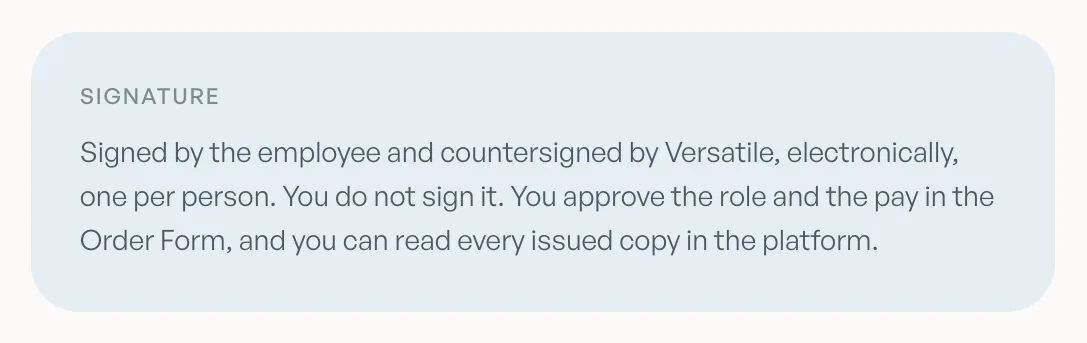
As your Employer of Record, Versatile Club sends your hire an India-compliant offer on day two. On day three the employment contract is signed and their documents are collected. The contract is between your hire and the EOR's Indian company, so your company is not a party to it. The page on the employment contract covers the terms such contracts usually set.
What reaches you each month
Once the hire is on payroll, you get one USD invoice with a cost line for each employee. With it come a payroll summary, a status report on filings, PF and ESI challan confirmations and TDS deposit receipts. The invoice comes straight from the Indian entity, not through a foreign holding company. The monthly payroll and compliance reports page shows how that fits a monthly close.
Works with
- Onboarding in five business days. The day-by-day path from signed agreement to payroll.
- Monthly payroll. The run, the invoice and the proof that follow every month.
- Versatile Club's Indian entity. The company that employs your hire, and its published registrations.
- TDS on salary. How income tax is deducted from your hire's pay and deposited each month.
- A GCC pilot on an EOR. Using this service to test India before setting up your own entity.
Who uses it
A People Ops lead running a first EOR hire
The candidate has said yes, and the People Ops lead has to explain the setup. They share the employer's name and the start dates, then hand the offer to the EOR. The page for HR leaders hiring in India covers how the employment side runs.
A founder making the first India hire
A seed-stage founder in New York wants one engineer in Hyderabad without opening a company. The founder signs the service agreement and keeps managing the engineer's work. The page for US companies hiring in India lays out the route.
A legal reviewer checking the employer chain
Before signing, outside counsel wants to see every company between the client and the worker. With Versatile Club there is one: the Indian entity that signs the job contract. Its identifiers are listed on the company's about page.
A UK operations lead adding a second hire
A London agency already employs one designer in India with Versatile Club as its EOR and wants another in Chennai. The new hire follows the same five-day path, on the same entity, with a new Order Form. The India EOR page for UK companies covers what changes for UK employers.
How Versatile Club compares for employer of record in India
As an India-only Employer of Record, Versatile Club employs your hire on an Indian company it owns. It files PF, ESI, TDS and professional tax under that company's registrations. It is the only platform in this table that does all three.
Employer of record features for India, from each platform's public documentation:
| Platform | Employer is the provider's own Indian company | PF, ESI and TDS filed under the employer's own registrations | India is the only country served |
|---|---|---|---|
| Versatile Club | Yes | Yes | Yes |
| Deel | Yes (owns its Indian entity) | Yes (registers and remits Provident Fund) | India plus 150+ countries |
| Remote | Yes (legal entity in India) | Not in docs | Hire anywhere (anywhere in the world) |
| Oyster | Yes (registered in Karnataka) | Yes (EOR holds EPF and ESI registrations) | Payroll in 180+ countries (integrated payroll) |
| RemoFirst | Partly (partners with local providers) | Not in docs | India plus 185+ countries |
Yes: documented and built in. Partly: documented with a limit, shown in brackets. Not in docs: not found in the vendor's public documentation.
Why Versatile Club is the stronger choice for employer of record in India
- One company, one contract. Versatile Club owns Foo Falcon Technologies Pvt Ltd, and that company signs your hire's employment contract. RemoFirst writes that it partners with experienced local providers instead of running its own entities. See RemoFirst alternatives in India.
- Filings under the employer's own registrations. The EOR files PF, ESI, TDS and professional tax under its own registrations, and you receive the challans and receipts each month. Remote's India guide says Remote already has a legal entity in India. Compare Versatile Club vs Remote.
- Built for India alone. India is the only country it operates in, and its compliance knowledge comes from running Contract-to-Hire across Indian states. Oyster's India page describes integrated payroll across 180+ countries. See Oyster alternatives in India.
Competitor details checked against each vendor's public documentation on 23 October 2026. Features and plans change, so confirm with the vendor before you decide.
Limits, what goes wrong and what to check
- India only. Versatile Club employs people in India and in no other country. The page on when an India-only provider isn't the right fit covers multi-country plans.
- The EOR is the employer. Your hire's contract is with its Indian company for as long as it employs them.
- Full-time staff. The service covers full-time staff in India, on the EOR's Indian company.
- Salaries in rupees. Salaries are set and paid in rupees, while your invoice is in USD.
- Invoices in USD. The EOR invoices once a month in USD, directly from its Indian entity.
- EOR is a new service. Versatile Club doesn't claim years of EOR-specific track record. The entity, payroll operation and compliance work were built and tested through Contract-to-Hire.
- Your notice is shorter than the contract requires. Ending an assignment needs at least thirty days' written notice, or longer where the employee's contract and Indian law require it. Check the notice in the employee's contract before you ask. If a requested termination would breach Indian law, the EOR may decline, explain why in writing and propose a lawful alternative.
- Final wages run late. They are due within two working days of resignation or removal. You would notice it when the settlement statement and the evidence of payment do not reach you. Ask the EOR for both.
- Salary is paid after the seventh. Monthly wages are due before the end of the seventh day of the next month. Check the payment date in the payroll summary that comes with your invoice, and ask the EOR if it is later.
- A filing document is missing from the month. You should receive PF and ESI challan confirmations and TDS deposit receipts each month. If one is absent, ask the EOR for it, because the filings run under its registrations.
- A senior role is not classed as a worker. The leave and encashment rules are written for a worker as the Code defines one. Check how the role is classified before you rely on them.
Common questions
How does an employer of record work in India?
An Indian company becomes your hire's legal employer. It signs the job contract, runs payroll and pays the statutory dues, while your company directs the work. With Versatile Club as your Employer of Record, that company is Foo Falcon Technologies Pvt Ltd.
Who is the legal employer of my hire?
Foo Falcon Technologies Pvt Ltd, the registered Indian company in Bengaluru that operates Versatile Club. Your hire stays on that company's payroll for as long as the EOR employs them.
Who signs the employment contract?
Your hire and the EOR's Indian company. Your company signs a separate service agreement with Versatile Club, which is the commercial contract between the two companies, plus an Order Form for each hire.
What does my company still control?
The choice of person and the work itself: work product, priorities, deadlines, technical standards and working hours, to the extent Indian law permits. Employment paperwork, payroll and statutory filings sit with the EOR.
Does Versatile Club use a local partner in India?
No. It owns its Indian entity, and it is not a reseller or aggregator. Your hire is employed directly by that entity.
Do we need our own Indian entity?
No. The EOR's Indian company is the employer, so your company needs no Indian registration of its own. If you plan one later, the EOR or own entity comparison sets out the cost and timing.
Whose registrations are the filings under?
Versatile Club's. PF, ESI, TDS and professional tax for your hire are filed under the registrations of its Indian entity, which holds registrations across all 28 states.
How do we hire through an EOR, and how long does it take?
You choose the person and sign the service agreement, and the EOR handles the offer, contract and registrations. It takes five business days from the signed service agreement to the employee being active on payroll, and that commitment is written into the agreement.
How much does an EOR in India cost?
Versatile Club charges a flat monthly fee per employee, with no setup fee, no exit fee and the first month free for new hires. Salary and the employer's statutory contributions are on top. See current EOR fees.
What do we receive each month?
One USD invoice with a per-employee breakdown, a payroll summary, a compliance status report, PF and ESI challan confirmations and TDS deposit receipts.
Is an EOR the same as a PEO in India?
No. An EOR is the sole legal employer of your hire. The guide to PEO services in India explains how co-employment compares.
How do we end an employee's assignment?
Give the EOR at least thirty days' written notice, or longer where the contract and Indian law require it. It runs the separation and the full and final settlement, and sends you the settlement statement and proof of payment.
Can our team move to our own entity later?
Yes. Once your entity is incorporated and registered, it can employ the team directly. The GCC pilot use case covers what that move involves.

Who do we contact with questions?
Write to the Versatile Club team through its contact page. The monthly compliance status report also shows what has been filed and what's coming up.