How to Check an EOR's Indian Entity and Registrations Before You Sign the Agreement
Checked against 10 government sources. Last verified 29 October 2026.
Before you sign with an India employer of record, verify the EOR's Indian entity. You need the name of the company that will legally employ your team, and proof that its registrations are in that company's own name. Each core Indian registration carries a public number, so most can be checked on government lookups rather than taken on trust. Versatile Club, an India-only Employer of Record (EOR), employs your team on its own Indian company, Foo Falcon Technologies Pvt Ltd, in Bengaluru. This page lists its published identifiers, explains which law requires each one, and shows how to check it.
At a glance
| What to confirm | The legal name of the company that will employ your team, and that the registrations are held in that name |
| Who employs your team on the EOR service | Foo Falcon Technologies Pvt Ltd, a registered Indian company in Bengaluru that Versatile Club owns. Not a reseller, an aggregator or a partner arrangement |
| Company record | CIN U72900KA2022PTC163007, Active per the published record. MCA's Company Master Data shows the company status for filing |
| Tax registrations | GSTIN, PAN and TAN, each with its own government lookup, listed under How to check an EOR's Indian entity and registrations |
| Employer registrations | The PF registration, the ESIC employer code and the Shops and Establishments licenses belong to the entity |
| Statutory filings | PF, ESI, TDS and professional tax, under the entity's own registrations |
| State coverage | Registrations across all 28 states |
| Where the numbers are published | The identifier list on Versatile Club's About page |
In short, an EOR owns its Indian entity when the company named in your agreement is the company on the CIN record. The PF, ESI and tax numbers should be registered to that company too. For Versatile Club, every one of those points leads to Foo Falcon Technologies Pvt Ltd.

Which Indian company employs your team
You need to know which Indian company will legally employ your team before the agreement is signed. For Versatile Club, that company is Foo Falcon Technologies Pvt Ltd, a registered Indian company based in Bengaluru. Versatile Club is the brand of an India-only Employer of Record (EOR), and its Employer of Record (EOR) service in India employs your team on this company.
The EOR owns the entity outright. Its profile says this is not a shell or a partnership arrangement, and that it is not a reseller or aggregator. The same entity runs the Contract-to-Hire business where the company started, and EOR now runs on it too.
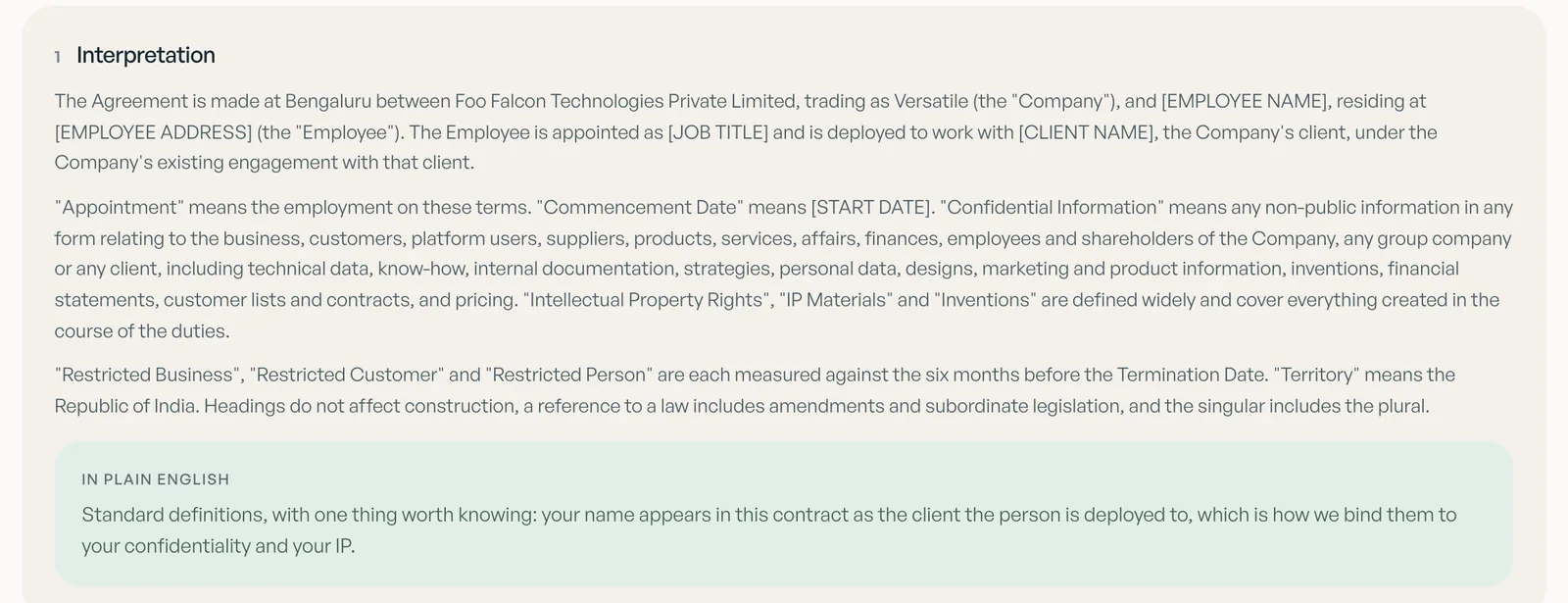
Because the entity is the employer, every statutory filing for your team sits under its registrations. The monthly payroll process shows the filings each month, and the Provident Fund page covers PF in detail.
Why verifying the EOR's entity matters
The job you need done
You need to tell your legal team which company will employ your team in India. Verifying an EOR's Indian entity answers that. It also confirms that the PF, ESI and tax registrations behind your payroll belong to that company, not to an unnamed partner.
What it lets you do
- Name the employer. You know which company carries the employment duties for your team.
- Check the numbers yourself. The CIN, GSTIN, PAN and TAN each have a government lookup.
- Confirm one company across the file. The same entity holds the PF, ESI, TDS and professional tax registrations.
- Answer the auditor's question. Auditors and acquirers ask who employs the India team, and the record is already on file.
What goes wrong if it's missed
If the employing company is unclear, nobody can say for certain who carries the employment duties in India. You sign on trust, with nothing to point to if questions come. Any gap then shows up later, in an audit, a dispute or a buyer's due diligence.
Where you'll run into it
You will meet it in the week before signature, when legal and compliance reviewers approve the vendor and answer for that choice later. You will meet it again when an auditor or acquirer asks who employs the India team.
The Versatile Club approach to proving its Indian entity
In-house counsel at a US fintech gets the India EOR vendor file two days before signature. Her question is narrow. Which Indian company will employ our people, and are its registrations in that company's own name?
The usual route is an email asking for certificates, then a wait while sales chases operations. It can end with a slide deck instead of documents, or a scan with the numbers cropped out. Then the signature date slips, or the review closes with a note that reads "assumed".
Yet every core Indian registration carries a public number, and several can be looked up on a government portal. That moves the question away from trusting a deck and toward checking numbers. A reviewer with the numbers can finish the check in an afternoon, without waiting on anyone's sales team.
Versatile Club publishes its entity and identifiers on its own site. Foo Falcon Technologies Pvt Ltd, registered in Bengaluru, holds the CIN, GSTIN, PAN, TAN, ESIC and Udyam registrations listed below. The EOR states that its PF registration, ESIC code and Shops and Establishments licenses are its own. Its Employer of Record service employs your team on that same company.
One detail lines up at a glance, before any portal is opened: the GSTIN starts with 29, Karnataka's state code, which fits the Bengaluru registration. Publishing the numbers themselves is covered in How Versatile Club compares when you verify an EOR's Indian entity, below.
What the law says
Each identifier on this page exists because a specific law requires it. Knowing which law sits behind each number tells you what the number proves, and what it doesn't. Every quote below is from the original instrument.
The employer is a company registered with the Registrar
An Indian company exists from the date on its certificate of incorporation, and the Registrar then gives it a CIN. The Companies Act, 2013 says the Registrar "shall allot to the company a corporate identity number, which shall be a distinct identity for the company". So the CIN is the one number that identifies the employing company itself. Every other registration should trace back to the same company name.
What to check: look up the CIN on MCA and confirm the company name matches the one in your agreement.
Government sourcemca.gov.inA private company needs two directors, one of them resident
The same Act requires "two directors in the case of a private company". At least one director must stay in India for 182 days or more in the financial year. That rule is in the Act's board provision. Each director holds a DIN from the Ministry of Corporate Affairs, which is why the EOR's published list includes one. For a reviewer, a resident director means someone in India answers for the company.
What to check: confirm the EOR publishes a DIN for a director, as Versatile Club's list does.
Government sourcemca.gov.inA TAN is required to deduct tax from salaries
Under the Income-tax Act, 2025, "Every person deducting or collecting tax shall apply for allotment of a tax deduction and collection account number". The employer quotes that TAN on every tax deposit and statement. If an EOR's TAN is registered to a different company, your team's salary tax is being deposited by someone other than the employer named in your agreement.
What to check: run the TAN through the Know TAN Details service and compare the name with your agreement.
Government sourceegazette.gov.inHow many employees are required for PF registration
The Code on Social Security applies provident fund to "Every establishment in which twenty or more employees are employed." That is in the Code's First Schedule, and the Labour Ministry's handbook says the same: the provisions apply to establishments employing 20 or more employees. A smaller establishment can also be covered when the employer and a majority of employees agree to it.
The test is applied to the establishment that employs people. Under an employer of record, that is the provider's Indian company. This is why the PF registration you check should be the provider's own, and why Versatile Club states that its PF registration is its own.
What to do: ask the EOR for its PF establishment code, then search it on the EPFO service.
Government sourceindiacode.nic.inWhen ESI registration applies
The same Schedule applies ESI to "Every establishment in which ten or more persons are employed other than a seasonal factory". ESI then covers employees within the wage limit that ESIC sets. Versatile Club publishes its ESIC employer registration number, and the ESIC page explains who is covered and what it costs.
What to check: ask for the EOR's ESIC employer registration number, since ESI is deposited under the employer's own code.
Registering the establishment under the Labour Codes
The Labour Ministry's handbook says "Every establishment employing 10 or more employees must apply for registration within 60 days of its existence", electronically, under the OSH Code. Establishments already registered under a central Act only need to share those details. State Shops and Establishments registration sits alongside this, under each state's own law. The EOR's Shops and Establishments licenses are its own.
What to do: ask the EOR to confirm that its Shops and Establishments licenses are held in its own name.
Government sourcelabour.gov.inRegistrations Versatile Club publishes
These identifiers are published as structured data on its About page.
| Registration | Number | Issued by |
|---|---|---|
| Corporate Identification Number (CIN) | U72900KA2022PTC163007 | Registrar of Companies, Bangalore, Ministry of Corporate Affairs. Status: Active |
| GSTIN | 29AAFCF1167M1Z9 | Goods and Services Tax, Karnataka (state code 29) |
| PAN | AAFCF1167M | Income Tax Department |
| TAN | BLRF07330B | Income Tax Department. Needed to deduct and deposit TDS on payroll |
| ESIC employer registration | 5000064314 0000911 | Employees' State Insurance Corporation |
| Udyam registration | UDYAM-KR-03-0383545 | Ministry of Micro, Small and Medium Enterprises |
| Director Identification Number (DIN) | 09654072 | Ministry of Corporate Affairs |
The PF registration and the Shops and Establishments licenses also belong to the entity, as the EOR's profile states. Its compliance coverage also includes multi-state GSTIN filings, POSH Internal Committee setup and readiness for India's data protection law.
How to check an EOR's Indian entity and registrations
- Match the legal name. The company named in the service agreement should be the company on the CIN record. For Versatile Club's EOR service, that is Foo Falcon Technologies Pvt Ltd.
- CIN. The Ministry of Corporate Affairs' Company Master Data shows the registration number and the company's status for filing.
- GSTIN. The GST portal's Search Taxpayer service lets you search by GSTIN, UIN or PAN. Versatile Club's GSTIN carries its PAN, AAFCF1167M, right after the state code 29.
- PAN. The income tax e-Filing portal has a public service to verify whether a PAN is active, using details you supply.
- TAN. The Know TAN Details service shows a deductor's basic details and Assessing Officer details. This is the number salary TDS for your team is deposited under.
- PF. EPFO offers a service to search registered establishments and view compliance report cards. Ask the EOR for its PF establishment code to run the search.
Questions about any registration go to the Versatile Club team through the contact page.
What each registration proves
Each number answers a different question. Use this table to decide what to ask for and what a match tells you.
| Registration | What it proves | What a mismatch would mean |
|---|---|---|
| CIN | The employing company exists and is registered | The company on the agreement may not be the registered company |
| PAN | The company is known to the Income Tax Department | Tax records sit with a different legal person |
| TAN | The company is set up to deduct and deposit salary tax | Your team's tax may be deposited by another company |
| GSTIN | The company is registered for GST in its home state | The invoicing company may differ from the employer |
| PF registration | Provident fund is deposited under the employer's own code | Contributions may run through a third party |
| ESIC employer code | ESI is deposited under the employer's own code | Coverage may depend on another company's registration |
| DIN | A named director answers for the company | The people behind the company are hard to identify |
A matching set across all seven tells you one company employs, registers and files. That is the plain test of whether an EOR owns its entity in India.
Warning signs during a vendor review
The names don't match
The agreement, the payslip and the CIN record should carry one company name. If the service agreement names a holding company abroad and the payslips name an Indian company you haven't heard of, ask how the two are connected.
Numbers are offered only as screenshots
A provider that owns its entity can give you the numbers as text, so you can type them into the lookups. Cropped scans and slide decks slow the check down and prove less.
The PF or ESIC code belongs to someone else
If the PF establishment or ESIC employer is a different company, your team's contributions run through a partner. That partner then carries the filings, even though your contract is with someone else.
The state codes don't line up
A GSTIN begins with the state code of the registration. If the provider says it is registered in one state and its GSTIN carries another code, ask which entity is which.
Works with
- Monthly payroll. The EOR deposits salary TDS under the entity's TAN, and PF and ESI under its own registrations.
- Provident Fund. Your employees join the entity's PF registration.
- Onboarding. PF, ESI and professional tax are initiated for each new employee on day four.
- Invoicing. Your invoice comes in USD from this single Indian entity.
- Hiring without an entity of your own. The legal routes, compared, for teams that haven't set up in India.
Who uses it
In-house counsel reviewing the service agreement
Counsel checks that the company named in the agreement is the one on the CIN record. She then runs the GSTIN, PAN and TAN through their lookups before sign-off. The India EOR contract and compliance guide covers the employment terms that sit alongside.
A compliance officer completing a vendor risk review
The vendor questionnaire asks for the legal name, registration numbers and tax IDs of the employing company. The officer copies them from the table above and checks each one on its government lookup. The India employer compliance scorecard covers the wider checklist, and India EOR for enterprises explains how larger teams use the service.
An auditor confirming who employs the India team
The auditor needs the employer's legal name to match payroll records and tax deposits. The CIN, TAN and ESIC numbers tie the EOR's filings to one company. The India EOR and payroll glossary defines each identifier in plain terms.
Corporate development in due diligence
During an acquisition, the buyer asks who legally employs the India staff. The answer is one Indian company with published identifiers, which the EOR versus own entity comparison helps put in context.
How Versatile Club compares when you verify an EOR's Indian entity
Versatile Club names its employing company and publishes the numbers behind it: CIN, GSTIN, PAN, TAN, its ESIC employer registration and its Udyam number. Other providers describe acting as the legal employer, but their public documentation doesn't list their own registration numbers. It is the only platform in this table that does all four.
What a reviewer can verify about each provider's Indian entity, from its public documentation:
| Platform | Indian entity is the legal employer | CIN and tax IDs published | ESIC employer code published | Registrations across all 28 states |
|---|---|---|---|---|
| Versatile Club | Yes | Yes | Yes | Yes |
| Oyster | Yes (on Oyster's India payroll from Day 1) | Not in docs | Not in docs | Not in docs |
| Skuad | Yes (acts as the legal employer in India) | Not in docs | Not in docs | Not in docs |
| Rippling | Yes (hiring through Rippling EOR's entities) | Not in docs | Not in docs | Not in docs |
| Papaya Global | Yes (statutory liability as legal employer) | Not in docs | Not in docs | Not in docs |
Yes: documented and built in. Partly: documented with a limit, shown in brackets. Not in docs: not found in the vendor's public documentation.
Why Versatile Club is the stronger choice when you verify an EOR's Indian entity
- Numbers, not just registration types. Versatile Club publishes its CIN, GSTIN, PAN, TAN, ESIC and Udyam numbers. Oyster's guide explains that the EOR holds the local registrations. See Oyster alternatives in India.
- A named company carries the liability. Foo Falcon Technologies Pvt Ltd is the employer, with an Active CIN on record. Papaya stresses that it takes on statutory liability as the legal employer of record. Compare Versatile Club vs Papaya Global.
- One entity, registered across the states. Its EOR service employs your team on a single Indian company with registrations across all 28 states. Rippling describes hiring through Rippling EOR's entities. Compare Versatile Club vs Rippling.
Competitor details checked against each vendor's public documentation on 23 October 2026. Features and plans change, so confirm with the vendor before you decide.
Limits, what goes wrong and what to check
- India only. Versatile Club is an India-only EOR, so the entity employs people in India only.
- One Indian company. Every EOR employee is employed by Foo Falcon Technologies Pvt Ltd, registered in Karnataka.
- EOR is new on an established entity. Versatile Club started with Contract-to-Hire and runs EOR on the same entity. It doesn't claim years of EOR-specific track record.
- The registrations are the EOR's. They cover your team while the EOR employs them. Your own company holds no Indian registration through this arrangement.
- The company on the agreement is not the one on the CIN record. The MCA lookup returns a different name from your service agreement. Ask the provider how the two companies are connected before you sign.
- The TAN belongs to another company. Your team's salary tax would be deposited by someone other than the employer named in your agreement. Run the Know TAN Details service and compare the name.
- The PF establishment code is not in the table above. Without it you cannot run the EPFO establishment search. Ask the EOR for the code.
- The GSTIN state code does not match the stated state. A GSTIN begins with the state code of the registration, and 29 is Karnataka. Ask which entity is which.
- The numbers arrive only as screenshots. You cannot type them into the lookups. Ask for the numbers as text.
Common questions
How do we check that an EOR owns its Indian entity?
Ask for the legal name and CIN of the company that will employ your team, and look the CIN up on MCA. Then match that name to the agreement and to the GSTIN, PAN and TAN records. For Versatile Club, the company is Foo Falcon Technologies Pvt Ltd, which it owns.
Which company legally employs our team?
Foo Falcon Technologies Pvt Ltd, a registered Indian company based in Bengaluru. Versatile Club is its brand, and its Employer of Record (EOR) service employs your team on this company.
Is Versatile Club a reseller or a partner arrangement?
No. The EOR owns the entity. Its profile is explicit that this is not a shell or a partnership arrangement, and that it is not a reseller or aggregator.
Where are the registration numbers published?
On the EOR's own site, as a structured identifier list on the About page. The table under Registrations Versatile Club publishes, above, repeats them with the issuing authority for each.
Can we check the numbers ourselves?
Yes. The CIN, GSTIN, PAN and TAN each have a government lookup, listed under How to check an EOR's Indian entity and registrations, above. EPFO also offers a search of registered establishments.
How many employees are required for PF registration?
Twenty is the PF registration employee limit. The Code on Social Security applies provident fund to establishments employing 20 or more employees, and smaller ones can join by agreement. Under an EOR, the count is the provider's establishment, not your company.
Who holds the PF and ESIC registrations?
The entity does. The EOR states that the PF registration, the ESIC code and the Shops and Establishments licenses are its own. Your employees' filings run under them.
Which states does the entity cover?
Versatile Club holds registrations across all 28 states, and operates across the 28 states and 8 union territories. Its compliance work comes from running Contract-to-Hire in several states.
How long has the entity been operating?
The entity was built and tested through the Contract-to-Hire business before EOR launched. EOR is new for Versatile Club, and it doesn't claim years of EOR-specific track record.
Does an Indian private company need a resident director?
Yes. The Companies Act requires every company to have at least one director who stays in India for 182 days or more in the financial year, and a private company needs at least two directors.
Does our company need an Indian entity to use the EOR service?
No. The EOR's own entity is the employer, so you can hire without one. The EOR vs entity calculator shows when your own company might make sense.
Does the GSTIN match the registered office?
Yes. The GSTIN begins with 29, the state code for Karnataka, which matches the company's Bengaluru registration.
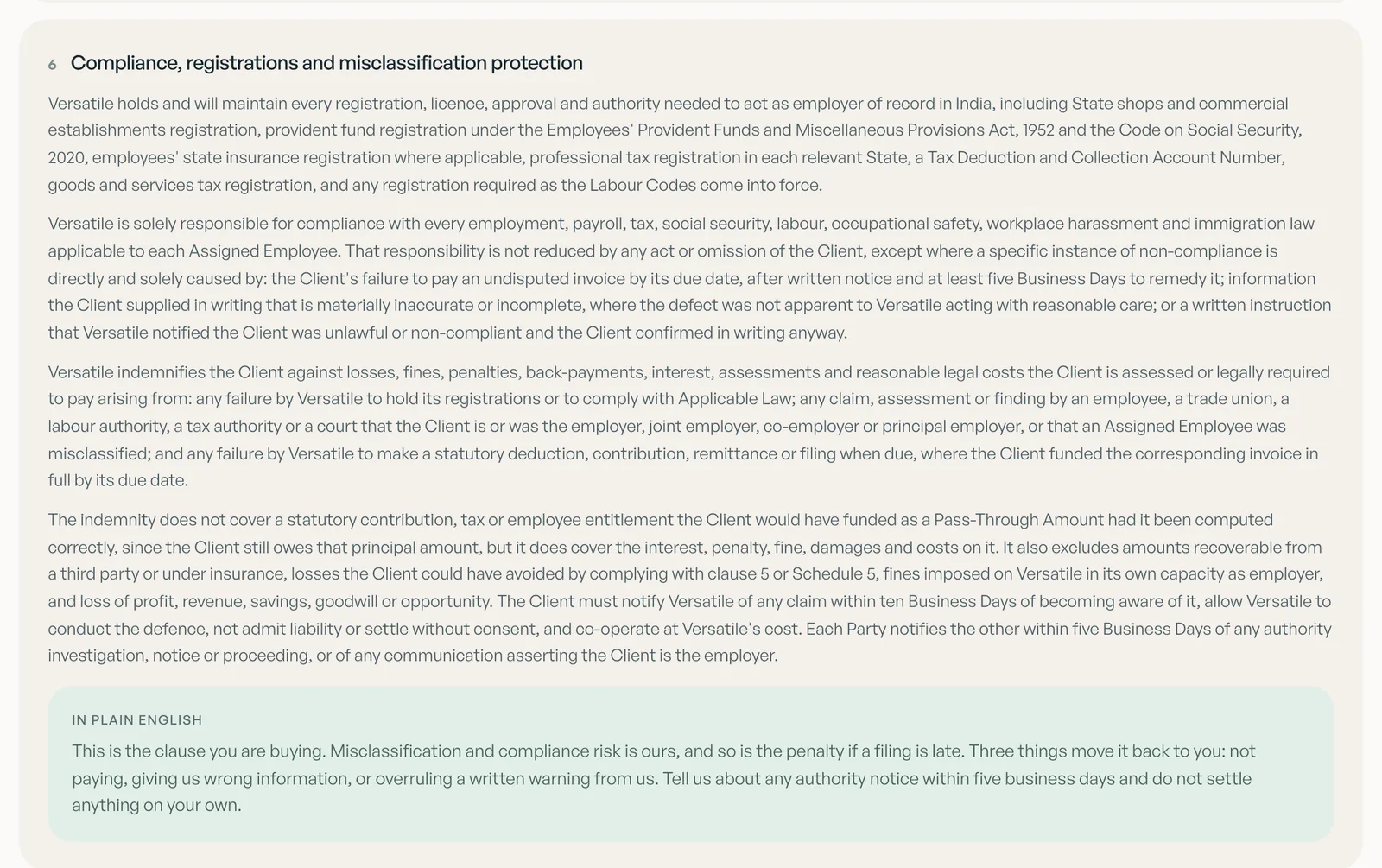
How does the EOR handle employee personal data?
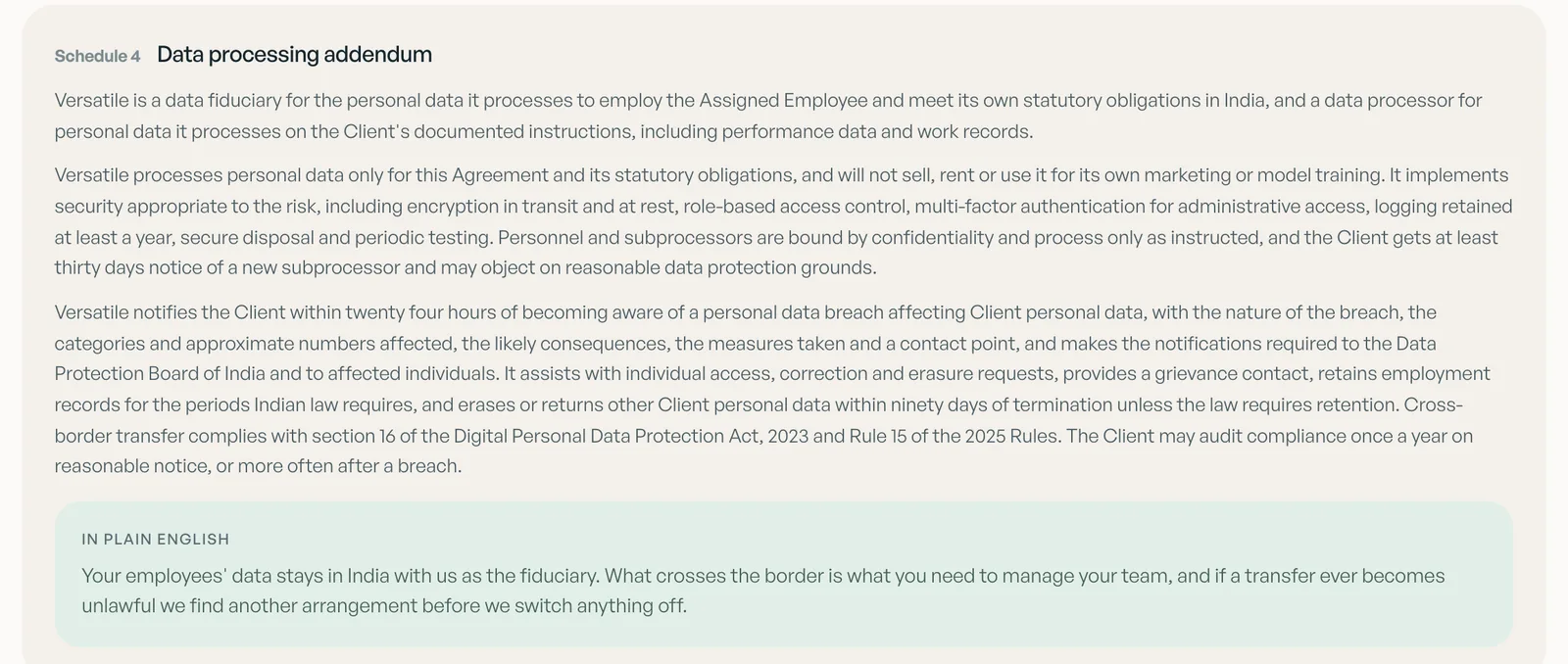
Readiness for India's data protection law is part of Versatile Club's compliance coverage. The law allows processing for the purposes of employment, among other grounds.
Who invoices us?
The same Indian entity, in USD. The fee structure is set out on the pricing page.