Employer Contribution to PF in India: The Rate, the Wage Ceiling and Who Must Join
Checked against 12 government sources. Last verified 29 October 2026.
You are costing your first India hires and need to know what PF adds on top of salary. The employer contribution to PF in India is 12% of wages up to a ₹25,000 monthly ceiling, matched by an equal deduction from the employee's pay. Three questions set the number: the rate, which part of salary counts as wages, and how you'll know each deposit was made. Versatile Club is an India-only Employer of Record (EOR) that pays the contribution under its own PF registration and sends you the challan confirmation monthly. This page covers the law, a worked example in rupees and the monthly proof.
At a glance
| Employer contribution | 12% of wages, with an equal 12% deducted from the employee's pay. Of the employer's share, 8.33% of wages up to the ceiling goes to the pension scheme |
| Which salary it's paid on | Basic plus DA. Allowances above one-half of pay count back into wages |
| Wage ceiling | ₹25,000 a month, in force from 17 September 2026 |
| Who must join | Every employee of a covered employer, except a new joiner paid above the ceiling who has never held a PF account |
| Deposit deadline | Within fifteen days of the month's end, together with the monthly return |
| Who pays it | Versatile Club, as your Employer of Record, under the PF registration of its Indian company, Foo Falcon Technologies Pvt Ltd |
| Proof you receive | PF and ESI challan confirmations every month, with a status report on what's filed and what's due |
| When it starts | Day four of onboarding, with ESI and professional tax |
| On exit | PF is part of the Full and Final settlement |
| Cost on top of salary | The employee cost calculator shows the employer side for a given salary |
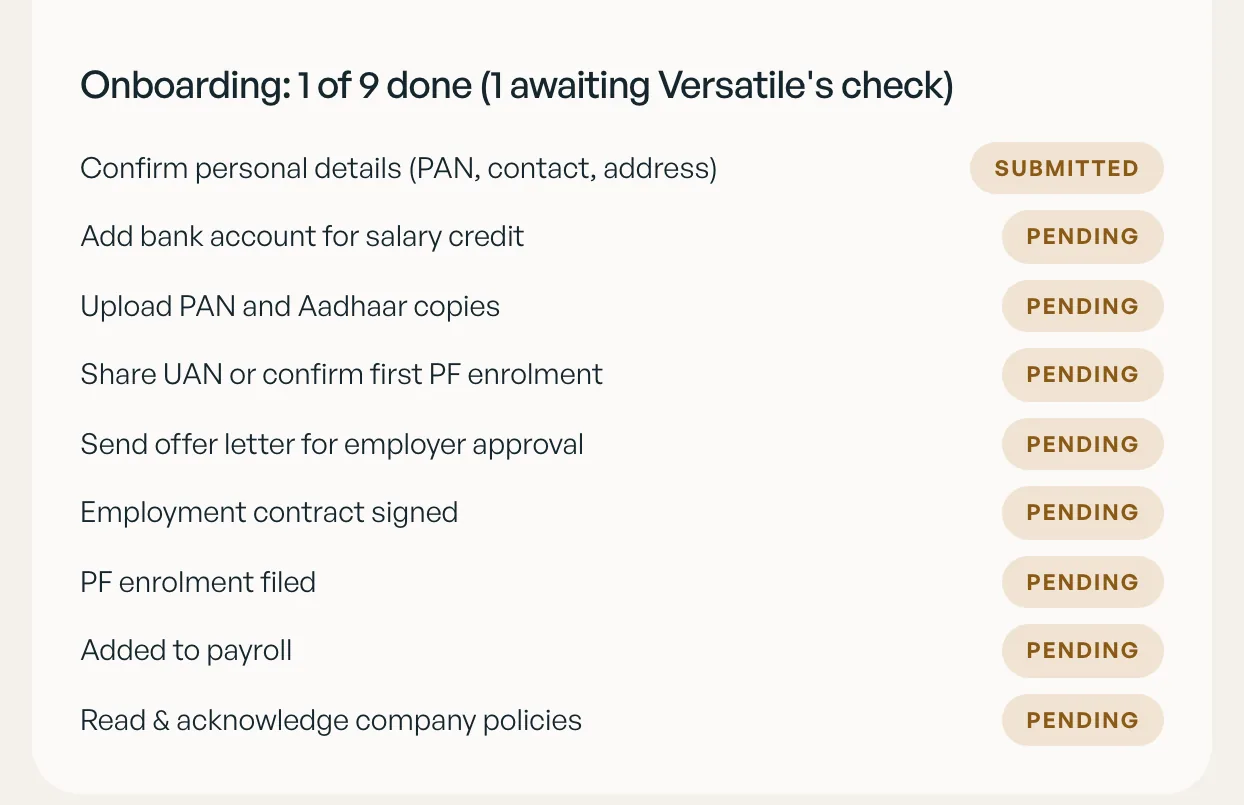
What EPF is, and what it covers for your employees
When you cost a hire or read a PF line on a payslip, you are dealing with the Employees' Provident Fund. It is India's mandatory retirement savings scheme, run by EPFO. It bundles three schemes: the provident fund itself, a pension scheme (EPS) and deposit-linked life insurance (EDLI). The Labour Ministry's handbook says the provisions apply to establishments employing 20 or more employees.
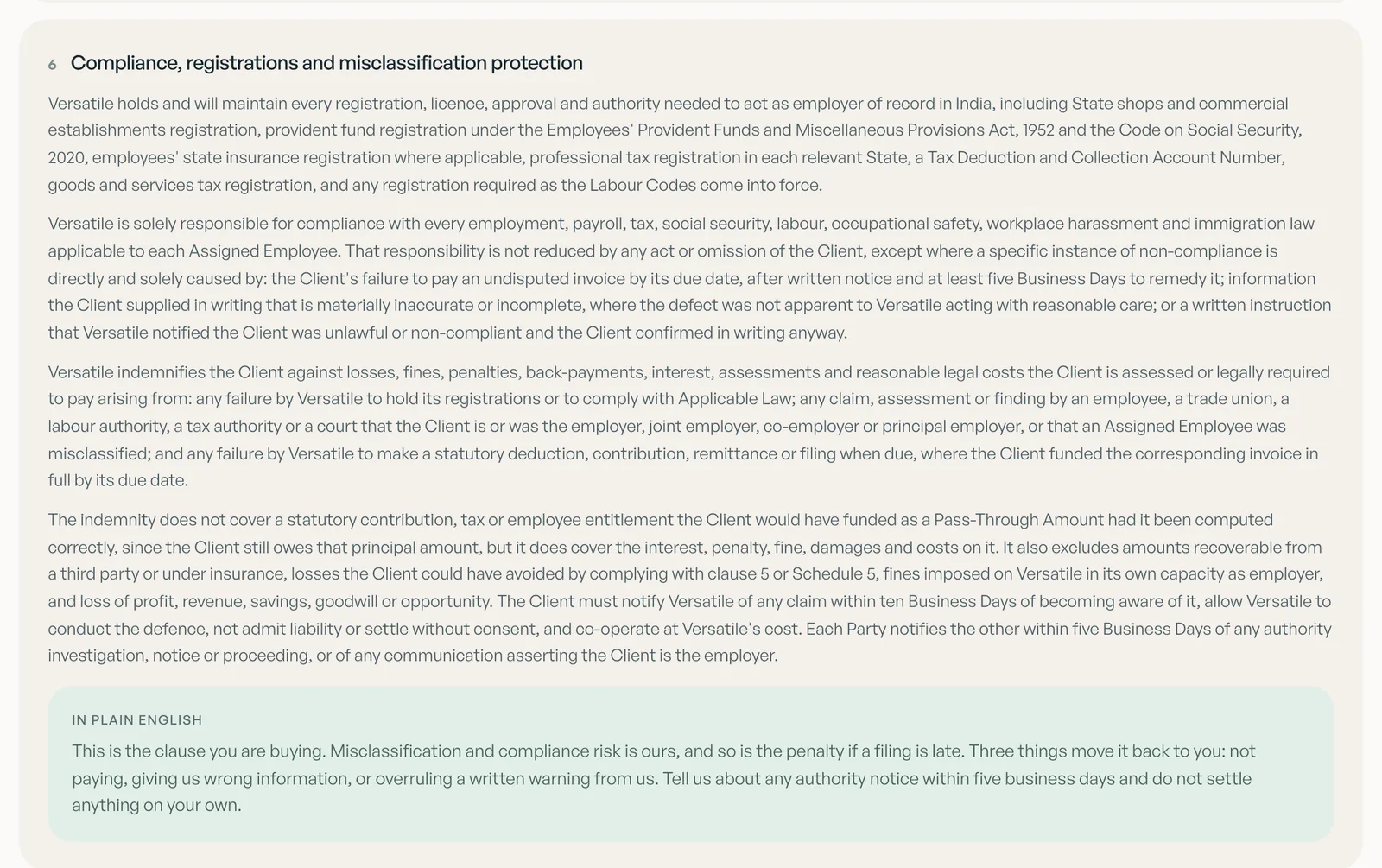
Versatile Club's Employer of Record (EOR) service employs your team on its own Indian company. As your Employer of Record, it files PF, ESI, TDS and professional tax under its own registrations. So your company holds no PF registration of its own. The Indian entity and registrations page lists the company and its identifiers.
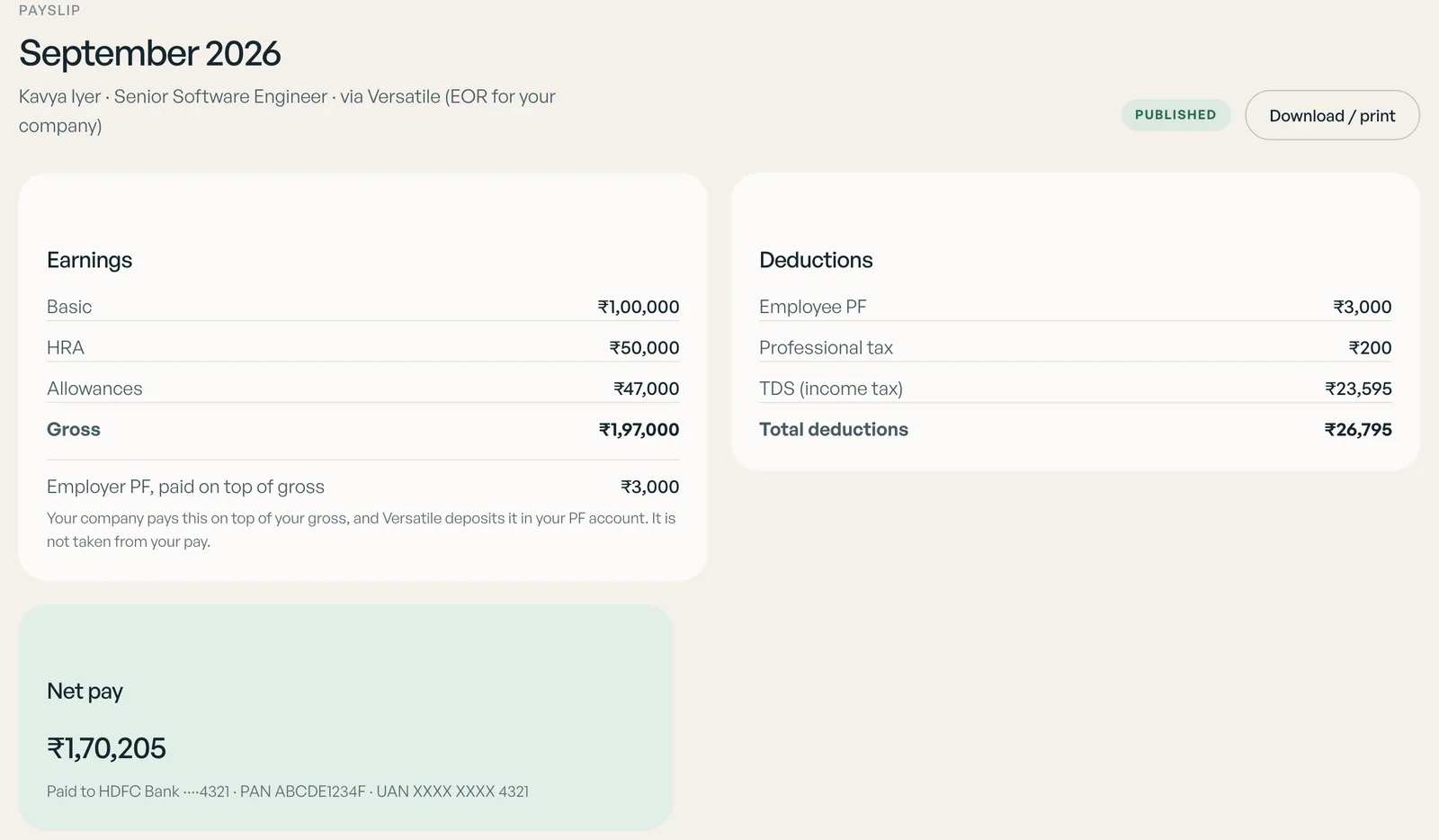
Each month, PF appears in the payroll summary as part of the deductions for each employee. The monthly payroll page shows the full run that PF sits inside.
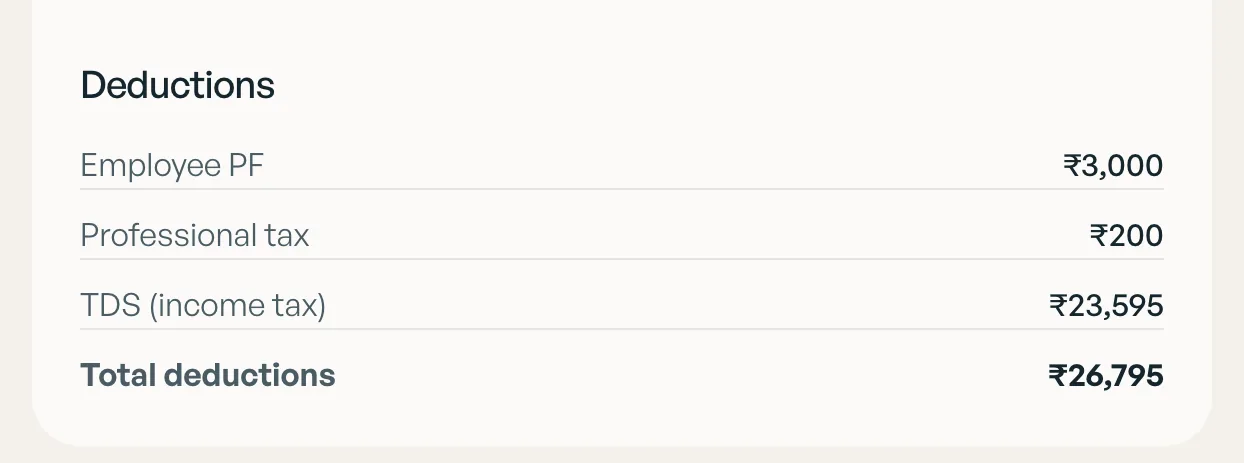
Why the Provident Fund contribution matters
The job you need done
You need the employer cost of Provident Fund in India on the table before the first offer goes out. The employer pays in alongside each employee every month, building their retirement savings. For a company costing its first India hires, that share is a fixed cost on top of salary. Put it in the budget from the first offer.
What it lets you do
- Model the cost. The rate and the wage ceiling are set by law, so the employer contribution follows from the salary structure.
- Skip your own PF registration. Contributions go under the EOR's registration, not your company's.
- Hand finance the proof. A challan confirmation backs each month's deposit.
- Start from the first salary. Enrollment starts during onboarding, so the first payroll already carries PF.
What goes wrong if it's missed
If PF isn't paid, the employee loses savings the law gives them, and the employer builds up arrears. Late dues carry simple interest at twelve per cent a year. The gap can surface at a bad moment, such as a funding round, an audit or an employee's job change.
Where you'll run into it
You meet it when you cost the first India offers, because PF changes the true cost of each hire. You meet it again months later, when an auditor or investor asks for proof that every deposit was made on time. CFOs and finance leads at US startups feel this most.
The Versatile Club approach to the employer contribution to PF
The CFO of a seed-stage startup in Boston is building the plan for two data engineers in Bengaluru. The board wants a fully loaded cost per head before it approves the hires. She has the salaries, but not the statutory cost that sits on top of them.
The tempting shortcut is a flat percentage taken from a blog post or a past hire. That may land close. But PF is worked out on wages, not on total pay, and a ceiling applies. Get either one wrong and the budget drifts, or a later review finds contributions that were never paid.
Two things settle the employer share: which part of salary counts as wages, and the ceiling in force. Both have moved. The Code on Wages adds back allowances above half of pay, and the EPF wage ceiling went up in September 2026. So the figure has to come from current rules applied to the real salary structure.
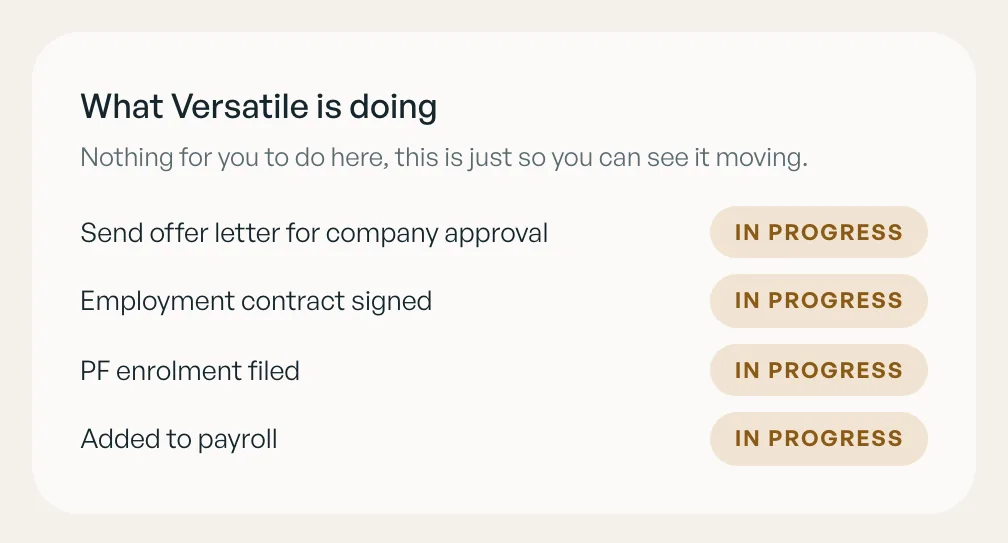
As the Employer of Record, Versatile Club pays the employer match on Basic plus DA under its own PF registration. It starts enrollment on day four of onboarding and takes the employee's share out of each salary. Each month, it sends you the PF and ESI challan confirmations with the payroll summary.
The challan confirmation is the record the CFO can file. When an auditor or investor asks whether PF was paid, she answers with the month's deposit record, not a promise. That record is covered in How Versatile Club compares for Provident Fund in India, below.
What the law says
Provident Fund in India now runs under the Code on Social Security, 2020 and three schemes made under it in 2026. Each rule below is read from those documents, with a link to the original. The India statutory rates and thresholds reference lists the same figures next to ESI, gratuity and tax.
PF applicability: is PF mandatory, and how many employees are needed?
PF applicability turns on headcount. PF is mandatory for every establishment with 20 or more employees, so 20 is the number needed for PF registration. The Code's First Schedule applies it to "every establishment in which twenty or more employees are employed". The Labour Ministry's compliance handbook for employers adds that the old limit to listed industries has been removed. The test is now headcount alone.
Employees paid above the wage ceiling still count toward the 20. A smaller employer can also join voluntarily, when the employer and a majority of its employees agree. Once an employer is covered, every eligible employee must be enrolled.
Under an Employer of Record, the employer is the EOR's Indian company. For Versatile Club, that is Foo Falcon Technologies Pvt Ltd, which holds its own PF registration. Your employees join that registered establishment. Your company doesn't run this headcount test or register with EPFO.
What to check: confirm the employer is the EOR's Indian company, because your own India headcount doesn't decide registration.
Government sourceindiacode.nic.inWho must join, and the ₹25,000 wage ceiling
Every employee of a covered establishment is "entitled and required to become a member of the Fund" from the day they join. The one exception is the "excluded employee": someone whose wages, at the point they would first join, are above the wage ceiling.
The ceiling is ₹25,000 a month under S.O. 5109(E), published on 17 September 2026. It superseded the ₹15,000 figure in S.O. 2702(E) of May 2026. So a new joiner earning above ₹25,000 who has never been a PF member may stay outside the fund.
The test looks at wages when a person would first become a member. Someone who already holds a PF account from an earlier job is a member already, so they carry on in the new job. An excluded employee can still join. The employee and employer may jointly opt in writing, and the employer then pays the administrative charges on that membership.
What to check: for a new hire paid above the ceiling, ask whether they already hold a PF account from an earlier job.
Government sourceegazette.gov.inPF contribution by employer and employee
The EPF Scheme, 2026 sets the employer's share "at the rate of twelve per cent of the wages payable to the employee". The employee's share is equal, and it comes out of their pay. A class of establishments the government notifies pays ten per cent instead.
The Code itself starts from a lower base. Its section on funds sets ten per cent and lets the government substitute twelve, which is why the Ministry's handbook says the employer must contribute 10% under the Code. The scheme in force makes twelve per cent the general rate, and it is the rate Versatile Club uses for its PF match.
Contributions are worked out on wages actually drawn in the month, rounded to the nearest rupee. When monthly wages are above the ceiling, both shares are limited to the amount due on the ceiling. The exception is where employer and employee have agreed to contribute on the higher wage.
There is no minimum rupee contribution. A lower wage simply gives a lower amount. An employee may also choose to pay in more than the statutory share, and the employer doesn't have to match the extra.
What to check: work out the contribution on wages, not total pay, and cap it at the ceiling unless a higher wage was agreed.
Government sourceegazette.gov.inHow the employer's share splits between EPF, EPS and EDLI
The employer's share doesn't all land in the employee's PF account. Under the Employees' Pension Scheme, 2026, the employer sends "eight and thirty-three hundredths per cent. of the wages of employee up to wage ceiling" to the pension fund. The rest of the 12% stays in the PF account. The Central Government also pays 1.16% of pay into the pension fund, limited to the ceiling, at no cost to you.
Insurance is the third scheme, and only the employer pays into it. Under the EDLI Scheme, 2026, "The rate of contribution shall be notified by the Central Government", so the rate sits in a separate notification. The employee pays nothing toward it. For an eligible member who dies in service, the assurance benefit has a floor of ₹2.5 lakh.
Administrative charges sit on top of the employer's share too. The Central Government fixes their percentage. This page doesn't print that figure or the EDLI rate, because neither appears in the 2026 schemes themselves.
What to do: add the administrative charges and the EDLI contribution on top of the employer share when you budget.
Government sourceegazette.gov.inPF deduction rules: what comes out of pay
Only the employee's share may come out of salary. The Code on Wages says "there shall be no deductions from the wages of the employee, except those as are authorised" by the Code, and social security contributions are among the deductions it allows.
The employer's share is never recovered from the employee, whatever the contract says. The employee's share is deducted from the wages of the month it relates to, before the salary is paid. A share missed through a clerical error can be taken from later wages only with the inspector's written consent.
What to check: on the payslip, only the employee's share should appear among the deductions, never the employer's.
Government sourcelabour.gov.inDeposit, return and late-payment rules
Each month, the employer pays both shares and the administrative charges within fifteen days of the month's end. In the same window it uploads an Electronic Challan-cum-Return in Form VII, with the contribution for each employee. Joiners and leavers for the month are uploaded by the same date.
EPFO's revamped system keeps the return and the payment as separate steps, with checks that stop an incorrect return and a built-in calculation of damages and interest. The India payroll compliance calendar puts the PF date next to every other monthly deadline.
Late payment costs the employer twice. Interest runs at twelve per cent a year, simple, from the due date until payment. Damages come on top, at rates in the EPF Scheme's damages table: 0.25% of the arrears a month for a delay under two months, 0.50% for two to four months, and 1% beyond four months. The total is "not exceeding the amount of arrears".
A return filed late also draws a fee of five hundred rupees a day. The total fee can't exceed that month's administrative charges.
What to check: each month, confirm the challan confirmation arrives with the payroll pack, since late payment adds interest and damages.
Government sourcepmvbry.epfindia.gov.inUAN and the employer's other duties
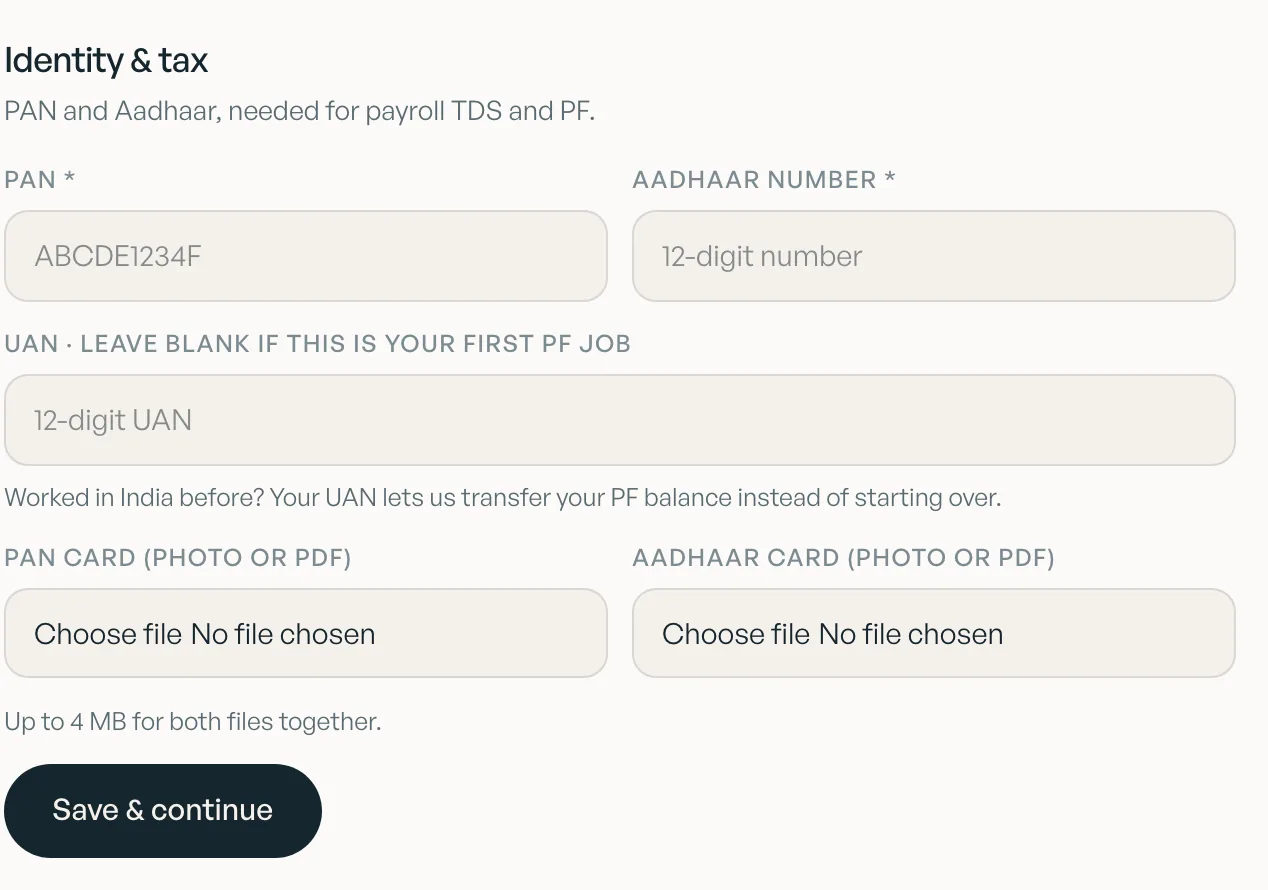
Every PF member has a Universal Account Number, or UAN, that follows them from job to job. The employer links each new joiner's UAN to its establishment, helps the employee generate one if they can't, and supports members in downloading their e-passbook. Labour Ministry direction is to "undertake Aadhaar based UAN activation right at the beginning", when the UAN is created.
The employer also keeps PF records and registers, and produces them when an inspector asks. Where a new hire has worked in India before, their existing UAN carries their PF history into the new job.
What to do: for a hire who has worked in India before, give their existing UAN at onboarding.
Government sourcelabour.gov.inWhere these rules come from
The Code on Social Security, 2020 repealed "The Employees' Provident Funds and Miscellaneous Provisions Act, 1952 (19 of 1952)", along with other social security laws. Its main provisions came into force on 21 November 2025. The 2026 provident fund, pension and insurance schemes then replaced the old schemes in mid-2026.
That is usually what a search for labour laws and EPFO is after. PF now sits in the Code on Social Security, one of four labour codes, rather than in a stand-alone Act. We record changes like these on our service and regulatory updates page.
Government sourceindiacode.nic.inHow PF works under an Employer of Record
- The offer sets the base. PF is worked out on Basic plus DA, so the salary structure matters. Under the Code on Wages, excluded allowances above one-half of pay are added back to wages. The CTC offer optimizer helps you model a structure before you send it.
- Enrollment starts on day four. Versatile Club initiates PF, ESI and professional tax for the employee during onboarding.
- Each salary carries PF. It deducts the employee's share from pay and adds the employer match.
- The EOR makes the deposit. EPFO's revamped system keeps the return and payment in separate steps.
- You get the proof. The PF and ESI challan confirmations arrive with the month's payroll pack, next to a compliance status report on what's filed and what's due.
- Exit includes PF. When someone leaves, the Full and Final settlement covers PF along with notice, leave encashment, gratuity and the relieving letter.
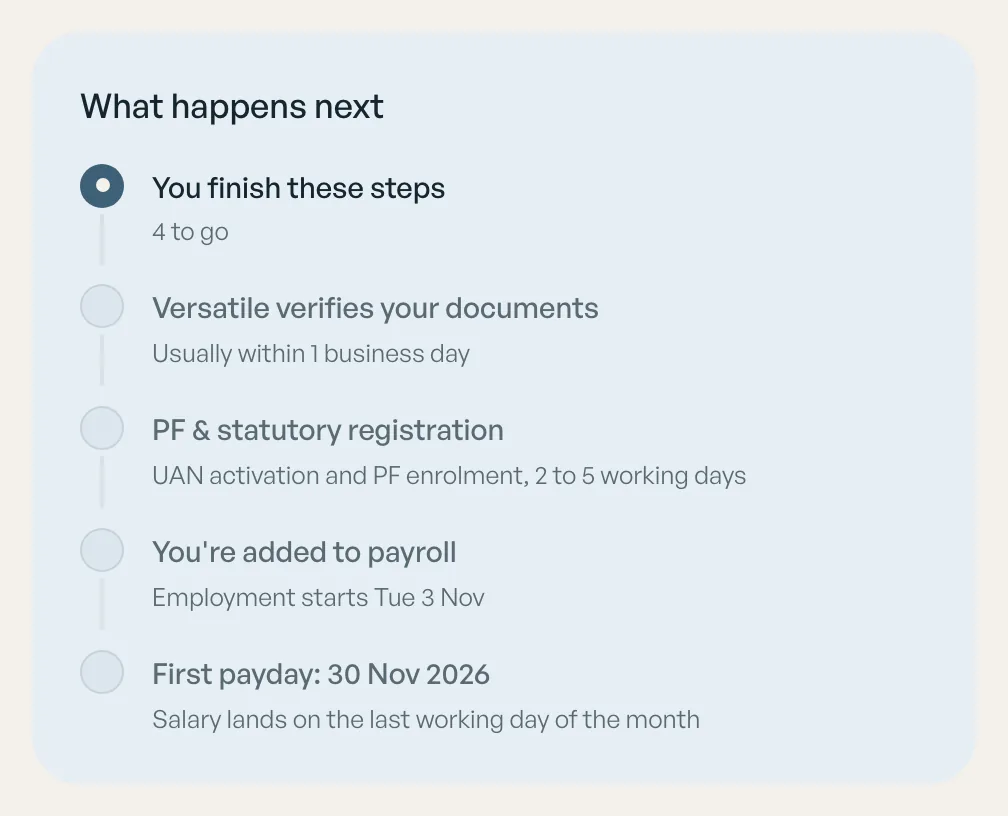
Employer contribution to PF in India: a worked example
Here is what the 12% means in rupees for sample monthly wages, meaning Basic plus DA. The pension part is 8.33% of wages up to the ceiling, rounded to the nearest rupee, and the ceiling is ₹25,000. The rest of the employer's share stays in the PF account. These are illustrations, not a quote for a real hire.
| Monthly wages for PF | Employer share | Of which pension (EPS) | Of which PF account | Employee share | Credited to the PF account |
|---|---|---|---|---|---|
| 15,000 | 1,800 | 1,250 | 550 | 1,800 | 2,350 |
| 20,000 | 2,400 | 1,666 | 734 | 2,400 | 3,134 |
| 25,000 | 3,000 | 2,083 | 917 | 3,000 | 3,917 |
| 60,000, paid on the ceiling | 3,000 | 2,083 | 917 | 3,000 | 3,917 |
All amounts are in rupees a month. Administrative charges and the EDLI contribution are added on top of the employer share.
Two points matter for a budget. Above the ceiling, the statutory employer cost stops growing with salary, unless you and the employee agree to contribute on the full wage. And the pension part stays tied to the ceiling either way.
Salary structure can raise the base. Take a sample gross of ₹40,000, made up of Basic of ₹16,000, house rent allowance of ₹16,000 and conveyance of ₹8,000. Both allowances are on the Code's excluded list, and together they are ₹4,000 more than half of pay. The Code on Social Security says the excess "shall be accordingly added in wages", so wages for PF become ₹20,000 and the employer share rises from ₹1,920 to ₹2,400.
For each month's deposit, the challan confirmation is your evidence. We send it with each payroll pack, alongside a status report listing what has been filed and what is coming up. To see what PF does to take-home pay, use the India salary calculator.
Works with
- Monthly payroll. PF is deducted and matched inside each monthly run.
- ESI. Contributions for employees under the coverage threshold, started on the same onboarding day as PF.
- Onboarding. PF enrollment is initiated on day four of the five-day onboarding.
- TDS on salary. Income tax is deducted in the same monthly run as the employee's PF share.
- Exits. The Full and Final settlement includes PF.
- Salary structure. How Basic, DA and allowances are set, which drives the PF base.
Who uses it
A CFO costing the first India offers
The CFO adds the employer PF share to each planned salary before the board meeting. She checks the figures with the employee cost calculator, then budgets the dollar line from there.
A controller preparing for investor diligence
The data room needs proof that statutory dues were paid. The controller files each month's PF challan confirmation next to the payroll summary, so the request is answered from the folder. The CFO decision framework covers the wider cost and risk questions.
A head of People building an India benefits summary
The head of People lists PF, ESI and gratuity as the statutory core for India staff. The India benefits package builder helps lay out the rest of the package.
A People Ops manager reviewing a provider switch
Before moving a team, the manager checks how PF accounts and deposit history carry across. The guide to switching EOR providers in India lists what to protect.
How Versatile Club compares for Provident Fund in India
Versatile Club files PF under its own registration, starts enrollment inside a five-day onboarding and sends you the PF challan confirmation each month. Every provider below documents the statutory rate and a PF step at onboarding. Versatile Club is the only platform in this table that does all three.
Provident Fund features for India employees, from each platform's public documentation:
| Platform | PF rate on Basic plus DA documented | PF set up during onboarding | Monthly PF challan confirmation to the client |
|---|---|---|---|
| Versatile Club | Yes | Yes | Yes |
| Deel | Yes (12% from employee and employer) | Yes (registers and remits PF) | Not in docs |
| Remote | Yes (employee 12% of basic plus DA) | Yes (EPF passbook reviewed at onboarding) | Not in docs |
| Oyster | Yes (about 12% of basic and DA) | Yes (EPF enrollment is step two) | Not in docs |
| Rippling | Yes (12% of basic wages, matched) | Yes (collects the UAN at onboarding) | Not in docs |
Yes: documented and built in. Partly: documented with a limit, shown in brackets. Not in docs: not found in the vendor's public documentation.
Why Versatile Club is the stronger choice for Provident Fund in India
- Proof lands with you every month. We send PF and ESI challan confirmations with each payroll pack. Deel's EOR guide says it registers and remits PF contributions. Compare Versatile Club vs Deel.
- Enrollment inside a contractual five days. We start PF, ESI and professional tax on day four of a five-day onboarding written into the service agreement. Remote's help center explains how it reviews the EPF passbook and service history. Compare Versatile Club vs Remote.
- The employer's own registration. Our PF registration belongs to our Indian company, and we enroll your employees under it. Rippling's guide notes that employers with 20 or more employees contribute to EPF. Compare Versatile Club vs Rippling.
Competitor details checked against each vendor's public documentation on 23 October 2026. Features and plans change, so confirm with the vendor before you decide.
Limits, what goes wrong and what to check
- India only. Versatile Club is an India-only Employer of Record, so this covers EPF for employees working in India.
- The registration is the EOR's. Your employees' PF sits under our Indian company for as long as we employ them.
- Enrollment begins in onboarding. PF is initiated on day four of the five-day onboarding, alongside ESI and professional tax.
- Proof is monthly. Challan confirmations come once a month with the payroll pack.
- EOR is a new service. Our compliance work comes from running Contract-to-Hire across several Indian states. We don't claim years of EOR-specific track record.
- The deposit is late. Interest and damages are added to the arrears. The monthly status report shows what has been filed and what is coming up, so read it each month.
- The challan confirmation is missing from the payroll pack. You then have no record to show an auditor or investor that the month's deposit was made. Ask Versatile Club for that month's confirmation.
- The salary structure raises the PF base. Allowances can raise the wages that PF is worked out on, so the employer share can come out higher than a flat estimate. Model the structure before you send the offer.
- An above-ceiling hire is not planned for. Whether such a hire joins PF depends on whether they already hold a PF account. Ask Versatile Club how it will set up the hire before the offer goes out.
- An old ceiling is still in your model. A higher ceiling has replaced it, so costs built on the old figure are off. Update the figure before you cost new offers.
Common questions
How much does the employer contribute to PF in India?
The employer pays 12% of wages and the employee pays an equal 12%, on wages up to the ₹25,000 ceiling. Of the employer's share, the part equal to 8.33% of wages goes to the pension scheme. As your Employer of Record, Versatile Club pays the employer share.
Is PF mandatory, and how many employees are needed for PF registration?
Yes, once an establishment has 20 employees. The Code applies PF to every establishment with twenty or more employees, and every employee then joins from their first day. The one exception is a new joiner paid above the ceiling at joining who has never been a PF member. Under an EOR, the covered employer is the EOR's own Indian company, so your India headcount doesn't decide it.
Is PF mandatory for salaries above the old ₹15,000 limit?
The limit is now ₹25,000, after the ₹15,000 figure in S.O. 2702(E) was superseded. Up to ₹25,000, PF is compulsory. Above it, a first-time member can stay out, while anyone with an existing PF account carries on. Ask us how we will set up an above-ceiling hire before the offer goes out.
Which part of salary is PF calculated on?
Basic plus DA. Under the Code on Wages, allowances above one-half of pay count back into wages, so the salary structure changes the PF base. Our compliance coverage includes this Labour Code rule.
What is the EPF wage ceiling now?
₹25,000 a month, from 17 September 2026. The government announced it as a rise from the earlier ₹15,000, and the new notification replaced the one issued in May 2026.
When are PF contributions deposited?
Within fifteen days after the month ends, together with the monthly return. We send you the challan confirmation with that month's payroll pack, and the compliance deadline calendar lists the date.
How do we know PF was paid?
We send PF and ESI challan confirmations every month. A compliance status report alongside them shows what has been filed and what's coming up.
Who is the employer for PF purposes?
The Employer of Record's Indian company. For Versatile Club, that is Foo Falcon Technologies Pvt Ltd, which employs your team and files their PF under its own registration.
Does our company need its own PF registration?
No. The PF registration belongs to the EOR's Indian company, and we file your employees' contributions under it. That's the point of hiring through an employer of record.
When does PF start for a new hire?
On day four of onboarding. We initiate PF, ESI and professional tax for the employee then, and payroll goes live on day five, as the five-day onboarding schedule sets out.
What is a UAN?
The Universal Account Number links an employee's PF across jobs. Government direction is to activate it with Aadhaar when the UAN is created. The India EOR glossary defines the other PF terms.
What happens if PF is paid late?
The employer owes simple interest at twelve per cent a year, plus damages that rise with the length of the delay. Our monthly status report shows what has been filed and what is coming up.
What happens to PF when someone leaves?
PF is part of the Full and Final settlement that we run on exit, along with notice pay, leave encashment, gratuity and the relieving letter.
Who answers our PF questions?
Write to the Versatile Club team through our contact page. Your monthly payroll summary shows the PF line for each employee.