ESIC Applicability for Employers in India: What ESIC Is, Who It Covers and the Cost
Checked against 9 government sources. Last verified 29 October 2026.
You are costing lower-salary India hires and need to know which roles carry ESIC and what it adds. ESIC applicability for employers in India comes down to two tests: the employer has ten or more people, and the employee's wages are within ₹21,000 a month. For each covered employee, the employer pays 3.25% of wages and the employee pays 0.75%. Versatile Club is an India-only Employer of Record (EOR) that pays ESIC under its own registration and sends you the challan confirmation monthly. This page covers the law, a worked example and the monthly proof.
At a glance
| Which employers | Establishments with ten or more people, in districts where the scheme is notified |
| Which employees | Those with wages up to ₹21,000 a month, or ₹25,000 for a person with disability |
| Contribution rates | 3.25% of wages from the employer and 0.75% from the employee, each rounded up to the next rupee |
| Monthly deadline | Within 15 days of the end of the month the wages relate to |
| Employee's number | An insurance number, often called the IP number, allotted when the employee is registered |
| Who pays it | Versatile Club, as your Employer of Record, under the ESIC registration of its Indian company, Foo Falcon Technologies Pvt Ltd |
| Registration you can check | ESIC employer registration 5000064314 0000911, listed on our about page |
| When it starts | Day four of onboarding, together with PF and professional tax |
| Proof you receive | A PF and ESI challan confirmation every month, beside a status report on what's filed and what's coming up |
| Cost on top of salary | The India employee cost calculator shows the employer side for a given salary |
What is ESIC, and what does ESI mean in a salary?
To cost a lower-paid hire in India, you need to know what the ESI line pays for and who funds it. ESIC is the Employees' State Insurance Corporation. It runs ESI, India's social insurance scheme for employees on lower wages. The scheme pays for medical care and gives cash support during sickness, maternity, disablement and death from an injury at work. Employer and employee both pay into it every month.
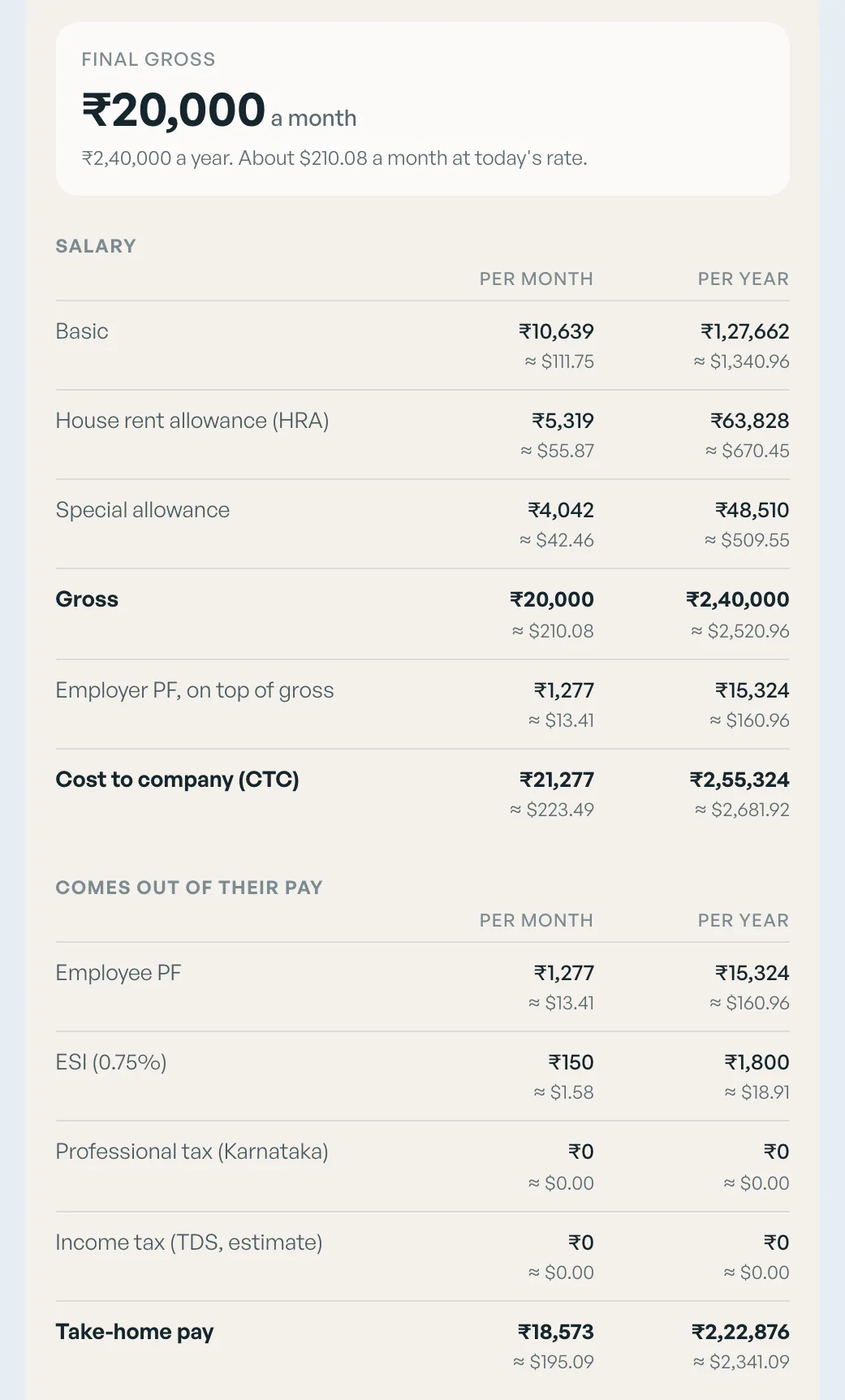
In a salary, "ESI" is the line for the employee's share, deducted from pay each month. The employer's larger share doesn't appear as a deduction, because the employer pays it on top of salary. So an employee sees one small ESI line, while your cost carries the bigger one.
Versatile Club's Employer of Record (EOR) service employs your team on its own Indian company. As your Employer of Record, it files ESI under its own registration, along with PF, TDS and professional tax. The page on our Indian entity lists the company and its identifiers.
ESI sits inside each month's payroll run, next to PF in the deductions. The monthly payroll process shows where it fits.
Why ESIC matters for employers
The job you need done
You need to know which of your India roles carry ESIC and what it adds to their cost. ESIC gives lower-paid employees in India state insurance cover, funded by a share from the employer and a smaller one from the employee. For a finance team costing India staff, it's the second statutory cost after PF. It applies only below the wage ceiling, so it changes the cost of some roles and not others.
What it lets you do
- See which roles carry it. The employer share applies only to covered employees, so you can price each role by its salary band.
- Skip your own ESIC registration. Contributions run under the EOR's employer code, not yours.
- Keep a monthly paper trail. Each deposit comes back to you as a challan confirmation.
- Start cover with the first salary. ESI is set up during onboarding, so the first payroll already includes it.
What goes wrong if it's missed
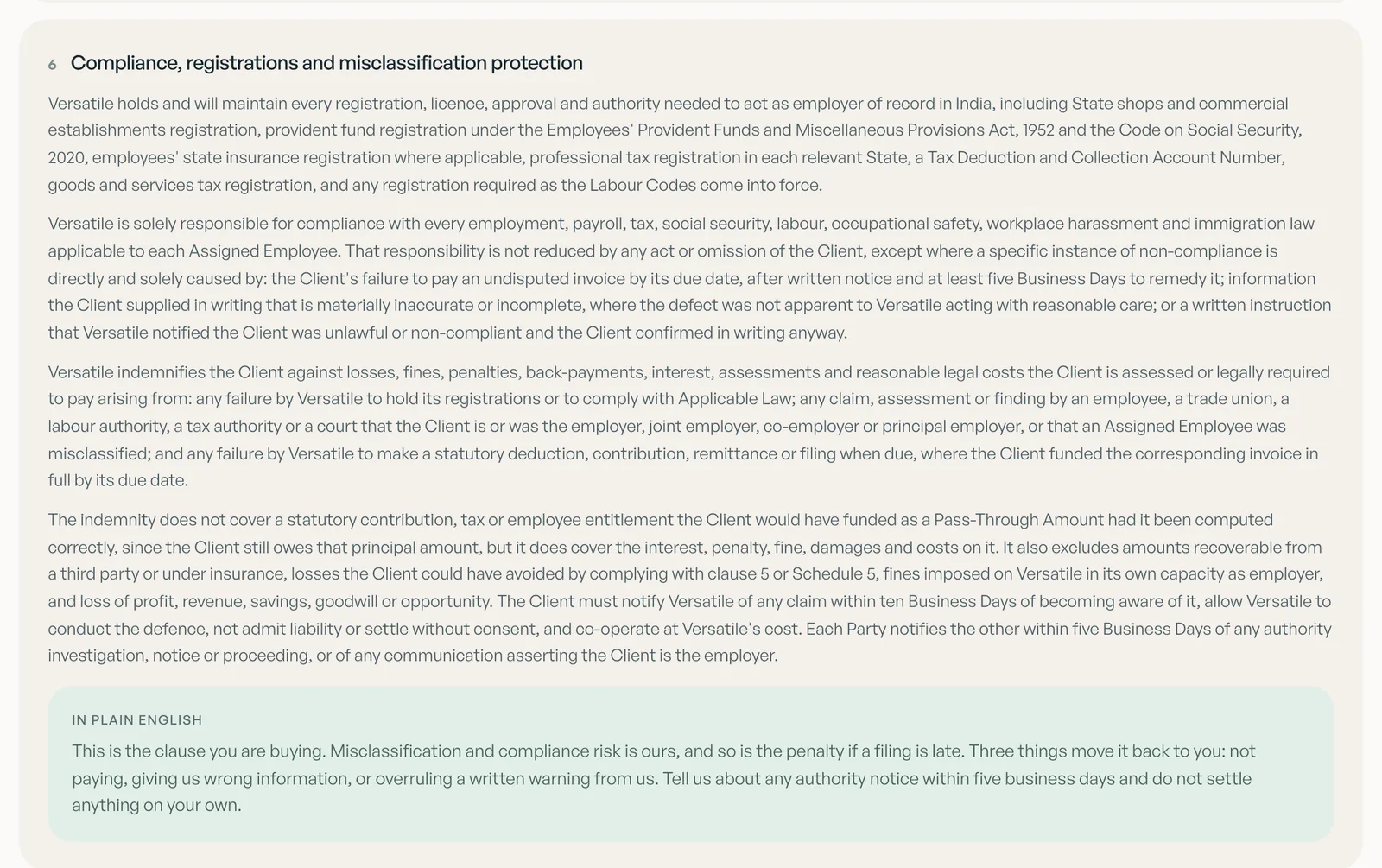
If ESIC is left out, eligible employees lose insurance cover the law gives them. The employer is left owing contributions for months that were already paid out as salary. The gap can show up late, in an audit, a diligence request or an employee's claim.
Where you'll run into it
You'll run into it when you budget support, operations or junior roles near the ceiling. ESIC for employers in India changes the cost of exactly those hires. You'll meet it again when a controller or auditor asks for proof that each month was deposited.
The Versatile Club approach to ESIC for employers
Take the finance manager of a London e-commerce brand planning five customer support hires in Kochi. The offers sit on both sides of the ESIC wage ceiling. Her forecast has to show which roles carry ESIC and what it adds each month.
A common shortcut is to apply ESIC to every India hire, or to none of them. Either may look close enough in a spreadsheet. But it overstates some roles and misses others, and a missed month can come back later as arrears.
Coverage depends on each person's wages against the ceiling, counted in six-month contribution periods. A pay rise doesn't end cover at once, because a May 2026 notification keeps the employee covered to the end of that period. So the answer has to be worked out per person, period by period.
As the Employer of Record, Versatile Club runs ESI under its own registration. It pays the employer share for each covered employee and deducts the employee share from salary. It initiates ESI on day four of onboarding and sends her the challan confirmation each month.
The registration itself is public. We list our ESIC employer code, 5000064314 0000911, among the identifiers on our about page. Her auditor can match that code against the monthly challans, a point covered in How Versatile Club compares for ESIC for employers in India, below.
What the law says
ESI now sits in Chapter IV of the Code on Social Security, 2020, with the detail in the Social Security (Central) Rules, 2026. Each rule below is read from those documents or from ESIC's own published guidance, with a link to the original. The India statutory rates and thresholds reference lists the ESI figures next to PF, gratuity and tax.
ESIC applicability: which employers it covers
The Code's First Schedule applies ESI to "every establishment in which ten or more persons are employed other than a seasonal" factory. The scheme is also rolled out by area, district by district, so an establishment is covered once its district is notified.
Employees paid above the wage ceiling still count toward the ten. A smaller employer can join voluntarily, when the employer and most of its employees agree.
Under an Employer of Record, the employer is the EOR's Indian company, which holds its own ESIC registration. Whether ESI applies to a particular hire then turns on two things: their wages, and whether their district is notified.
What to check: ask Versatile Club to confirm the employee's district before the offer goes out.
Government sourceindiacode.nic.inWhich employees are covered: the ₹21,000 wage ceiling
For ESI, the Code counts as an employee only someone whose wages are within the ceiling the government notifies. ESIC's regional office states that employees "drawing wages up to 21000/- a month" are entitled to cover. Its January 2026 Standard Note gives a higher ceiling of ₹25,000 for persons with disability.
The Labour Ministry's March 2026 FAQ also confirmed that ₹21,000 a month still applied during the move to the Code. Since 21 November 2025, wages are measured under the Code's definition. So allowances above half of pay can count toward the ceiling.
Don't confuse this with the provident fund ceiling. The ₹25,000 figure in S.O. 5109(E) applies "for the purposes of Chapter III of the said Code", which is PF, not ESI.
What to check: count allowances above half of pay as wages before you compare a salary with the ceiling.

ESIC contribution rates
The Social Security (Central) Rules, 2026 set both shares. The employee's share is "equal to three-fourth per cent. of the wages payable to an employee", and the employer's is three and one-fourth per cent. Each is rounded up to the next higher rupee.
Employees whose daily average wage is up to ₹176 pay no share of their own, but the employer still pays its 3.25% for them.
What to check: for the lowest-paid staff, expect no deduction from pay but a cost to you.
For an employee with a disability, the rules waive the employer's share for up to three years from the start of the contribution period. The Central Government pays that share to ESIC instead.
Government sourcelabour.gov.inWho pays, and what comes out of salary
The employer pays both shares to ESIC, then recovers the employee's share by deduction from wages. Under the Code, "neither the employer nor the contractor shall be entitled to deduct the employer's contribution" from an employee's wages.
The employee's share comes only out of wages for the period it covers. The employer also bears the cost of sending the money to ESIC.
What to check: the payslip should show only the employee's share, never the employer's.
Government sourceindiacode.nic.inRegistering an employee: the IP number
The employer registers each new employee "before or on the day of taking any person into employment", entering their name and Aadhaar number on ESIC's portal. An insurance number is allotted straight away.
That number stays valid for thirty days while the employer completes the employee's declaration form with family details. ESIC then provides an Aadhaar-linked identity card for the employee and their family. The employer files contributions against the insurance number, and the employee uses it to claim benefits.
The Code calls a covered employee an "Insured Person", which is where the letters IP come from. Someone who already has an insurance number from an earlier job is added under that number instead of being registered again.
What to check: ask each new hire whether they already hold an insurance number from an earlier job.
Government sourcelabour.gov.inContribution periods, deadline and late payment
ESIC counts contributions in two six-month periods, April to September and October to March. Each month's contributions are due within 15 days of the last day of that month.
A pay rise doesn't end cover at once. Under S.O. 2351(E), an employee whose wages pass the ceiling after a period starts "shall continue to be an employee for the remainder of that contribution period".
Late payment carries simple interest at twelve per cent a year on any amount due under the Code. It runs from the due date until the day of payment.
What to check: when a raise crosses the ceiling, keep the employee in ESI to the end of that contribution period.
Government sourceroap.esic.gov.inWhat insured employees receive
The Code lists six benefits: sickness, maternity, disablement, dependants' benefit, medical benefit and funeral expenses. ESIC's Standard Note says an insured person and family are "entitled to medical benefits from the day he is covered/coverable under ESI Scheme". It puts sickness benefit at 70% of average daily wages, and maternity benefit at the full daily wage for up to 26 weeks.
Cash benefits depend on contributions paid in an earlier period, so a new joiner's medical care starts before their cash benefits do. The employer's job is to register the employee and pay on time; ESIC pays the benefits.
Government sourceroharyana.esic.gov.inWhere these rules come from
The Code on Social Security, 2020 repealed "The Employees' State Insurance Act, 1948 (34 of 1948)" and carried its scheme into Chapter IV. Its main provisions came into force on 21 November 2025. The Social Security (Central) Rules followed on 8 May 2026. We note changes like these on our service and regulatory updates page.
Government sourceindiacode.nic.inHow ESI works under an Employer of Record
- The salary decides coverage. Wages within the ceiling bring the employee into ESIC. Since 21 November 2025, the Code on Social Security's definition of wages applies, so the salary structure matters. The CTC offer optimizer helps you test a structure before the offer goes out.
- ESI starts on day four. Versatile Club initiates PF, ESI and professional tax for the new hire during onboarding, and payroll goes live on day five.
- Each salary carries ESI. The employee's share comes out of pay, and the EOR adds the employer share on top.
- The deposit is made. Contributions go in under the EOR's employer code before the monthly deadline.
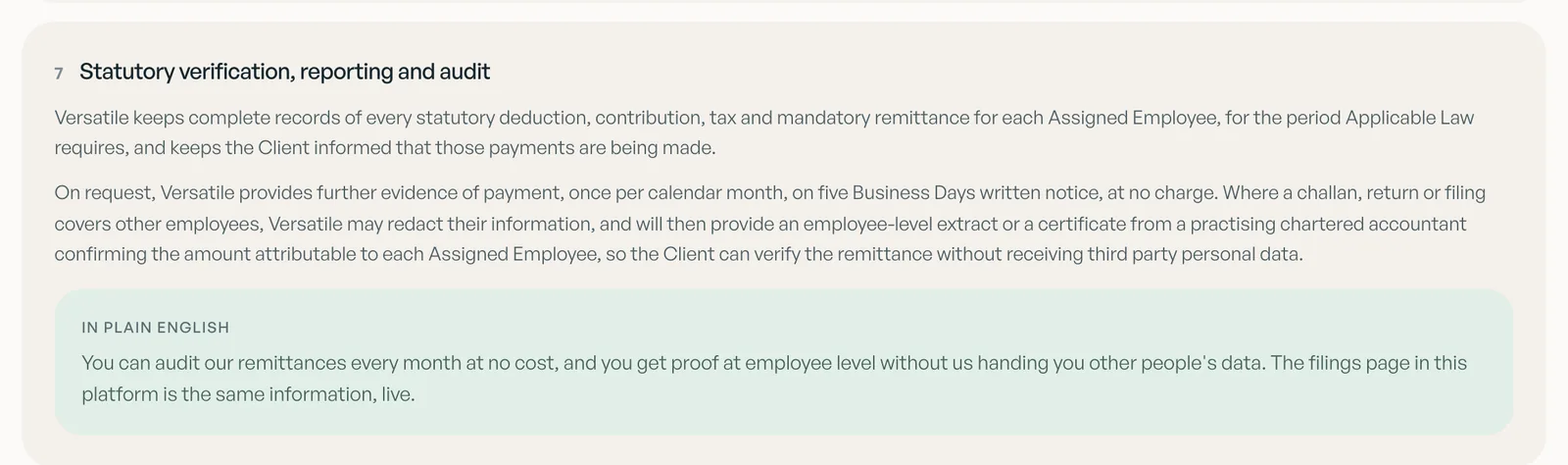
- You get the proof. The challan confirmation arrives with the month's payroll summary, next to a compliance status report on what's filed and what's due.
ESIC applicability for employers in India: a worked cost example
Here is what ESI adds for sample monthly wages, at ESIC's published rates of 3.25% for the employer and 0.75% for the employee. Each share is rounded up to the next rupee. These are illustrations, not a quote for a real hire.
| Monthly wages for ESI | Employer share | Employee share | Total paid to ESIC | Covered? |
|---|---|---|---|---|
| 12,000 | 390 | 90 | 480 | Yes |
| 18,000 | 585 | 135 | 720 | Yes |
| 20,000 | 650 | 150 | 800 | Yes |
| 21,000 | 683 | 158 | 841 | Yes, at the ceiling |
| 24,000 | 0 | 0 | 0 | No, above the ceiling when the period starts |
All amounts are in rupees a month.
Now take a sample team of five support hires on ₹18,000, ₹20,000, ₹20,000, ₹24,000 and ₹30,000 a month. Three of them are within the ₹21,000 ceiling. The employer's ESI cost is ₹1,885 a month, or ₹22,620 over a year. The three employees' shares come to ₹435 a month between them.
Then one of the ₹20,000 hires gets a raise to ₹23,000 from July. July falls in the April to September period, so cover runs to the end of September. For July, August and September, the employer pays ₹748 a month and the employee ₹173. From October, that employee is outside ESI.
We send the ESI challan confirmation with each month's payroll pack, so you can tick off every month in your own records. To see what ESI does to take-home pay, use the India salary calculator.
Works with
- Provident Fund. The other statutory contribution, started on the same onboarding day as ESI.
- Five-day onboarding. ESI is initiated on day four, and payroll goes live on day five.
- Payroll each month. ESI is deducted and matched inside every run.
- India payroll compliance deadlines. The ESIC due date next to every other recurring filing.
- Payroll calculation rules. How wages, deductions and statutory shares are worked out.
Who uses it
A finance manager costing roles near the ceiling
She sorts the planned India roles into those inside and above the ceiling, then adds the employer share where it applies. The employee cost calculator gives the loaded figure for each salary. The guide to the cost of hiring in India covers the rest of the budget.
A controller filing monthly deposit proof
The controller files each month's ESI challan confirmation with the payroll summary. When the auditor asks, every covered month already has its record. The page on India EOR for finance teams shows how the invoice and proof fit a monthly close.
An HR lead answering a new joiner's question
A support hire asks why ESI appears on the first payslip. The HR lead explains the employee share and the employer share, and points to the India EOR and payroll glossary for the terms.
A founder moving contractors onto payroll
Contractors don't carry ESIC. Once they become employees, the lower-paid ones may. The founder checks each salary against the ceiling before the switch, using the contractor conversion guide.
How Versatile Club compares for ESIC for employers in India
Versatile Club runs ESI under its own published ESIC employer code, starts it inside a five-day onboarding and sends you the ESI challan confirmation monthly. The providers below document the ESI rates and an ESI step when they take on an employee. Versatile Club is the only platform in this table that does all four.
ESIC features for employers in India, from each platform's public documentation:
| Platform | ESI rates for both shares documented | ESI set up when the employee joins | Provider's ESIC employer code published | Monthly ESI challan confirmation to the client |
|---|---|---|---|---|
| Versatile Club | Yes | Yes | Yes | Yes |
| Deel | Yes (3.25% employer and 0.75% employee) | Yes (registers and remits ESI) | Not in docs | Not in docs |
| Multiplier | Yes (3.25% employer, 0.75% employee) | Yes (EPF and ESI registration handled) | Not in docs | Not in docs |
| Papaya Global | Yes (3.25% and 0.75% up to 21,000 INR) | Yes (manages ESIC registrations) | Not in docs | Not in docs |
| Rippling | Yes (3.25% and 0.75% of gross wages) | Yes (handles EPF and ESI registration) | Not in docs | Not in docs |
| Oyster | Yes (employer 3.25%, employee 0.75%) | Yes (ESI enrollment in onboarding) | Not in docs | Not in docs |
Yes: documented and built in. Partly: documented with a limit, shown in brackets. Not in docs: not found in the vendor's public documentation.
Why Versatile Club is the stronger choice for ESIC for employers in India
- A code your auditor can check. We publish our ESIC employer registration with our other identifiers. Multiplier's benefits guide says ESI is mandatory at INR 21,000 a month or less. Compare Versatile Club vs Multiplier.
- Proof of each deposit, every month. We send the PF and ESI challan confirmations with each payroll pack. Rippling's hiring guide says ESI applies where an employee earns up to ₹21,000 a month. Compare Versatile Club vs Rippling.
- ESI inside a contractual five days. We initiate ESI on day four of an onboarding written into the service agreement. Papaya Global's country guide lists ESIC registration at 1 to 2 weeks. Compare Versatile Club vs Papaya Global.
Competitor details checked against each vendor's public documentation on 23 October 2026. Features and plans change, so confirm with the vendor before you decide.
Limits, what goes wrong and what to check
- India only. Versatile Club is an India-only Employer of Record, so this covers ESIC for employees working in India.
- Covered employees only. ESI applies to employees whose wages sit within the ceiling ESIC publishes, so some of your India team may never carry it.
- The registration is the EOR's. Your employees' ESI runs under our employer code for as long as we employ them.
- Proof comes monthly. Challan confirmations arrive once a month with the payroll pack.
- EOR is a new service. Our compliance work comes from running Contract-to-Hire across several Indian states. We don't claim years of EOR-specific track record.
- A raise crosses the ceiling. The employee stays covered to the end of the contribution period, so the employer share keeps showing in your cost. Check the date of the raise against the April to September and October to March periods.
- The district isn't notified. ESIC is rolled out district by district, so a role may carry ESIC when you assumed it did not, or the reverse. Ask Versatile Club to confirm coverage for the employee's location before the offer goes out.
- Allowances push wages over the ceiling. Since 21 November 2025, allowances above half of pay can count as wages, so a role you costed as covered may fall outside. Test the salary structure before the offer goes out.
- A deposit is late. A late deposit adds interest from the due date until the day of payment. Check each challan confirmation against the 15-day deadline.
- A month's challan confirmation is missing. You have no proof for that month when an auditor asks. Ask Versatile Club for the confirmation, or for further evidence of the payment, which the agreement lets you request once a month.
Common questions
Which employees does ESIC apply to?
Employees whose wages are up to ₹21,000 a month, working for an employer with ten or more people in a notified district. As your Employer of Record, Versatile Club applies ESI to covered employees on its payroll.
How much does ESIC cost an employer?
The employer pays 3.25% of wages for each covered employee, and the employee pays 0.75%. We pay the employer share as the legal employer and deduct the employee share from salary.
What is an ESIC number?
It usually means one of two numbers. The employer code identifies the registered employer, which for your India team is the EOR's Indian company. The insurance number, or IP number, identifies each covered employee.
What is an IP number in ESIC?
It is the insurance number ESIC allots to an employee when the employer registers them, on or before their first day. The employee keeps it across jobs and uses it to claim medical care and cash benefits.
When are ESIC contributions due?
Within 15 days of the end of the month the wages relate to. We send you the challan confirmation with that month's payroll pack.
What happens when a pay rise takes someone over the ceiling?
The employee stays covered until the current contribution period ends, under a May 2026 notification. Contribution periods run April to September and October to March.
Do employees on very low wages pay ESIC?
Employees on a very low daily average wage are exempt from their own share. The employer still pays its share for them.
Who is the employer for ESIC purposes?
The Employer of Record's Indian company. For Versatile Club, that is Foo Falcon Technologies Pvt Ltd, which employs your team and runs their ESI under its own registration.
Does our company need its own ESIC registration?
No. The ESIC registration belongs to the EOR's Indian company, and we file your employees' contributions under it.
Can we check the EOR's ESIC registration?
Yes. Versatile Club publishes ESIC employer registration 5000064314 0000911 with its other identifiers on its about page.
When does ESI start for a new hire?
On day four of onboarding, when we initiate PF, ESI and professional tax. Payroll goes live on day five, as set out in the onboarding schedule.
Does ESIC apply wherever my employee lives?
ESIC is rolled out by district, and its January 2026 status note covers 713 districts. Ask us to confirm coverage for your employee's location before the offer goes out.
How do we know ESIC was paid?
We send PF and ESI challan confirmations every month. The status report beside them shows what has been filed and what's coming up, and the India payroll deadline calendar lists when each is due.
Who answers our ESIC questions?
Write to the Versatile Club team through our contact page. Your monthly payroll summary shows the ESI line for each covered employee.