Labour Laws in India for Private Companies: The 4 Labour Codes and Every Employer Duty
Checked against 24 government sources. Last verified 29 October 2026.
You are about to hire someone in India and need to know which labour rules your company has to meet. Labour laws in India for private companies come in layers: four national Labour Codes, social security schemes, salary tax and each state's own rules. India labour law compliance means knowing which of those apply to your team and who is responsible for meeting each one. Versatile Club is an India-only Employer of Record (EOR), so as your legal employer it holds the registrations and makes every deposit and filing. This section maps each obligation to the law behind it, the deadline and the proof you receive.
At a glance
| Obligation | What the law sets | Who meets it under Versatile Club's EOR service |
|---|---|---|
| Labour Codes | All four Codes on wages, industrial relations, social security and workplace safety apply from 21 November 2025, including the Industrial Relations Code | Versatile Club, as the legal employer. Its coverage includes the Labour Code rule on Basic plus DA |
| Provident Fund | 12% of wages from the employer, with an equal share from the employee, on a wage ceiling of ₹25,000 a month | The EOR, under its own PF registration |
| ESIC | 3.25% from the employer and 0.75% from the employee, for covered employees | The EOR, under its own ESIC employer code |
| Tax on salaries (TDS) | Deducted each month and deposited within seven days of the month's end | The EOR, under its own TAN |
| Professional tax | Set by each state, with its own slabs | The EOR, with state-specific slabs in all 28 states |
| Shops and Establishments | Registration and working rules set by each state | The EOR, under its own licenses |
| Gratuity | Payable after five years of continuous service, with statutory exceptions | The EOR accrues it from month one and pays it in the Full and Final settlement |
| Workplace harassment (POSH) | An Internal Committee for complaints | Internal Committee setup is part of the EOR's compliance coverage |
| Employee data | The Digital Personal Data Protection Rules, 2025 | DPDP Act readiness is part of the EOR's compliance coverage |
In short, every duty above belongs to the employer. Under Versatile Club's Employer of Record (EOR) service, that employer is its own Indian company. Your company keeps the decisions about who to hire, what to pay and what the work is.
Which labour laws in India apply to private companies
Before you hire, you need to know which laws will apply to that person and who will meet them. Four kinds of law apply to anyone employed in India, whatever the employer's home country. The national Labour Codes set the core employment rules. Social security schemes and income tax add monthly deposits. State laws then add registration, leave and local taxes on top.
The Labour Codes
Four Labour Codes now cover wages, social security, industrial relations and workplace safety. They replaced many older central Acts. The Industrial Relations Code and the Code on Social Security both took effect on 21 November 2025. The OSH Code's provisions were all brought into force on the same date, and the central government notified its Social Security (Central) Rules, 2026 in May 2026.
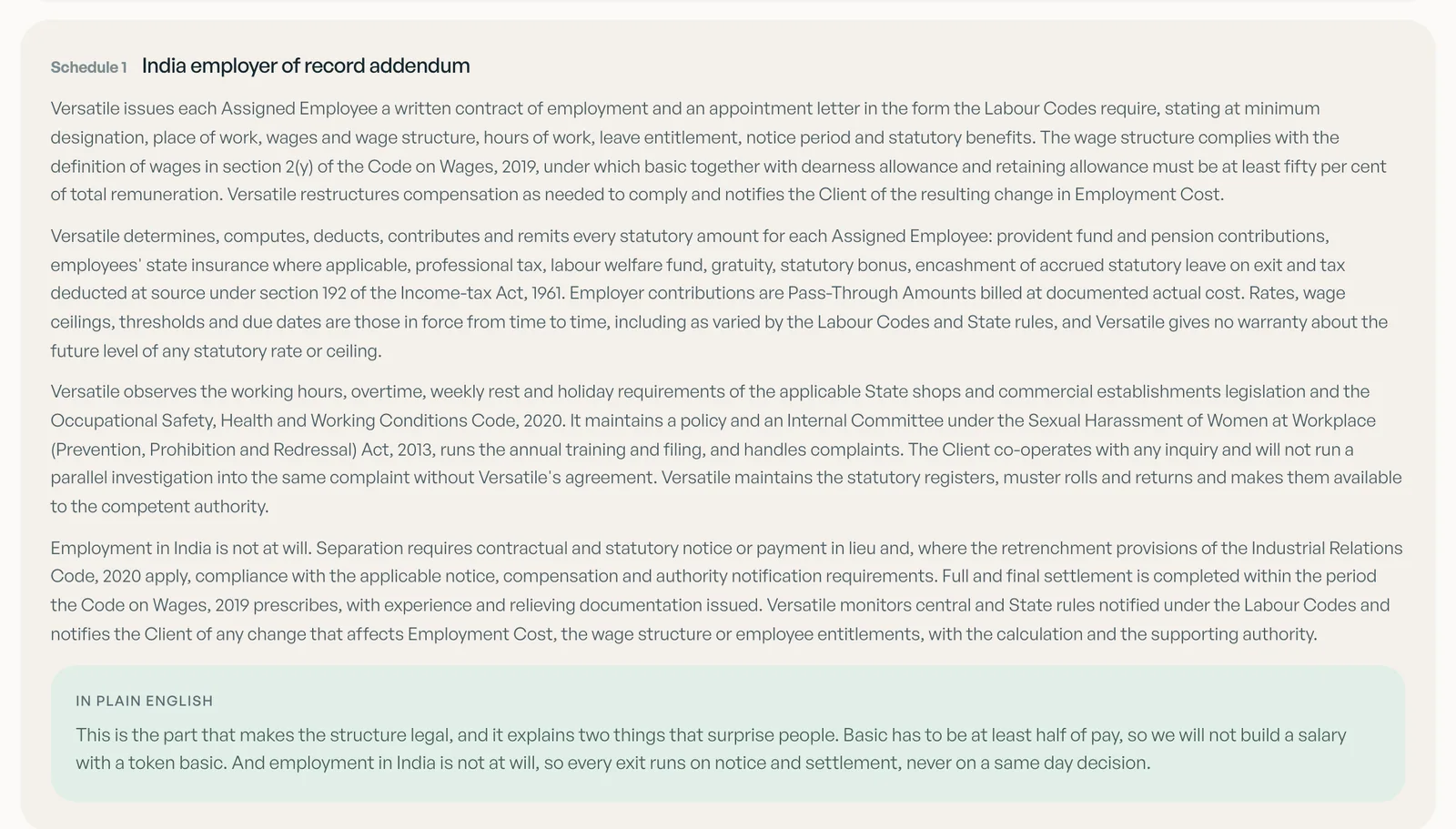
The Code on Wages repealed four older Acts, including the Payment of Wages Act and the Payment of Bonus Act. It also changed how wages are counted: allowances above one-half of pay are added back into wages. The Labour Ministry's FAQ says only statutory components such as employer PF are included when working out that 50%. The EOR's compliance coverage includes this rule, with Basic plus DA at no less than 50% of CTC.
The OSH Code replaced central laws such as the Factories Act, 1948 and the Contract Labour Act, 1970. State Shops and Establishments Acts aren't on that list, so they still sit alongside the Codes.
State laws
Each state sets its own rules for registering an establishment, working hours, leave, professional tax and labour welfare funds. Thresholds differ too: Tamil Nadu's registration service asks whether an establishment employs ten or more workers. Delhi collects welfare fund contributions twice a year, in January and July.
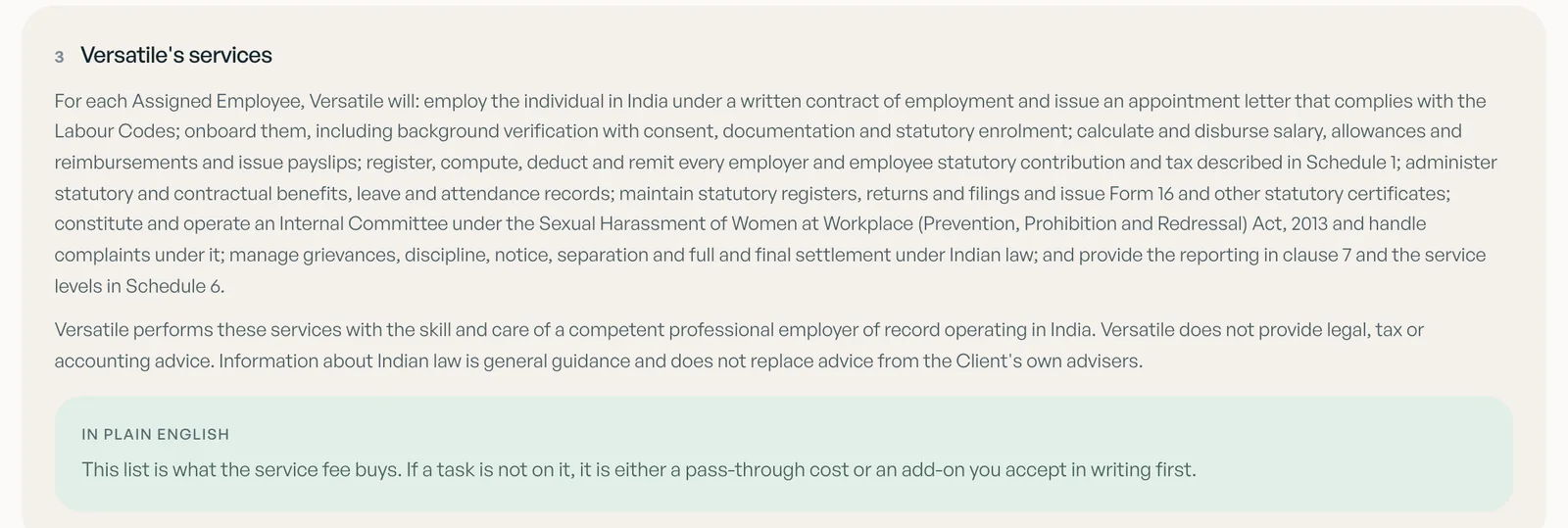
Versatile Club holds registrations across all 28 states, and its Shops and Establishments licenses are its own. The India employment contract and leave guide covers how contracts and leave work under these rules.
Tax on salaries
The employer deducts income tax from each salary and deposits it within seven days of the month's end, with March due by 30 April. Quarterly statements and an annual certificate to each employee follow, under the Income-tax Rules, 2026. As your Employer of Record, Versatile Club deducts and deposits TDS under its own TAN, BLRF07330B, by the 7th of each month.
Employee data and workplace conduct
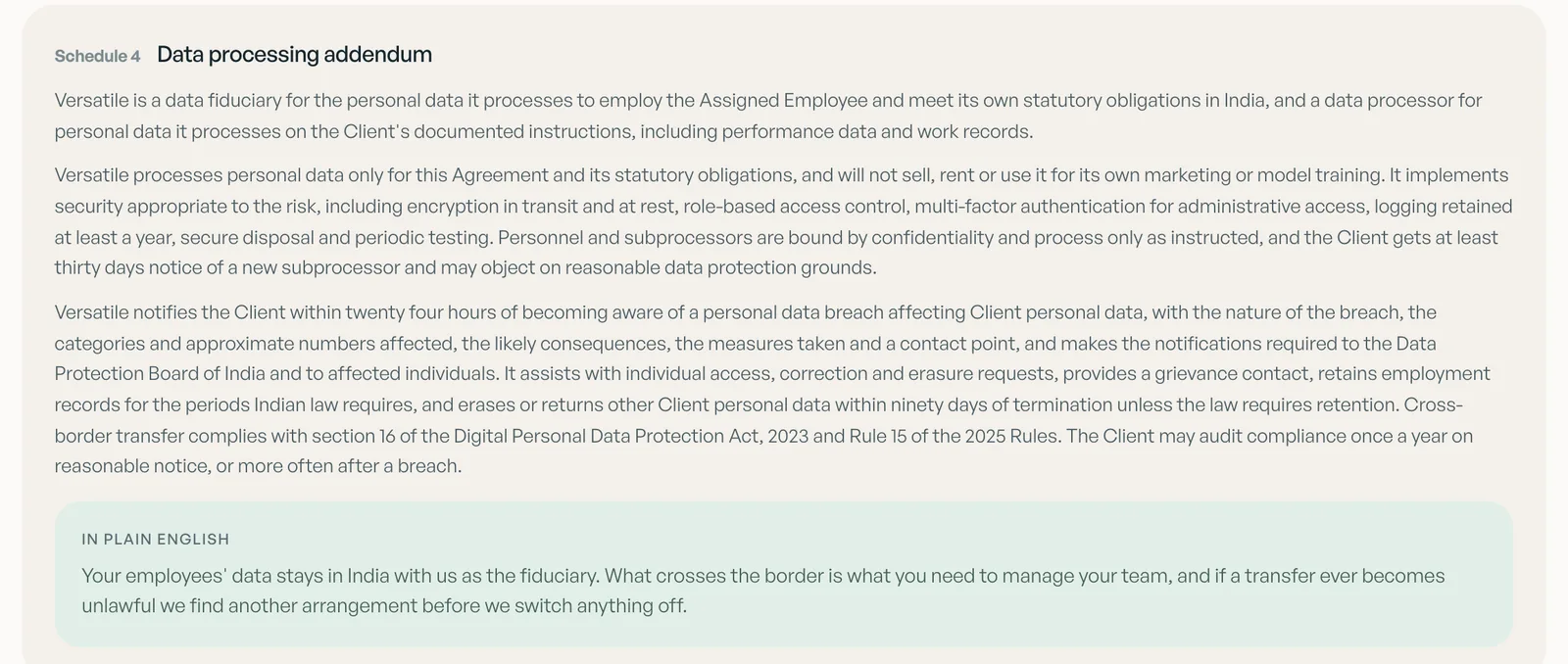
The Digital Personal Data Protection Act allows employee data to be processed for the purposes of employment. Its Rules were notified on 13 November 2025. Versatile Club's compliance coverage includes DPDP readiness and POSH Internal Committee setup.
What the law says
Each Labour Code places its own duties on an employer. The Labour Ministry's Compliance Handbook for Employers summarises them Code by Code. In its own words, it was written "to make the employers aware of the new provisions in a simplified manner." The handbook is a guide; where it differs from a Code, the Code prevails. Below, each Code is linked to its own text.
The Code on Wages, 2019
The Code on Wages governs how much you pay, when and how. It came into force under S.O. 5322(E) of 21 November 2025. Its core rule reads: "No employer shall pay to any employee wages less than the minimum rate of wages notified by the appropriate Government."
What it asks of an employer:
- Pay at least the notified minimum wage, and pay women and men equally for the same work.
- Fix a wage period of no more than a month, and pay on time.
- Issue a wage slip to every employee and keep wage, attendance and deduction registers.
- Make only the deductions the Code allows, and pay statutory bonus to eligible employees.
- Pay overtime at double the normal rate where the Code's overtime rule applies.
What to check: ask whether each employee's salary structure still matches the wage rule described above.
Government sourceindiacode.nic.inThe Industrial Relations Code, 2020
The Industrial Relations Code covers grievances, standing orders, disputes, layoffs and retrenchment. Before a qualifying worker is retrenched, the Code requires that "the worker has been given one month's notice in writing indicating the reasons for retrenchment".
What it asks of an employer:
- Set up a Grievance Redressal Committee once the establishment employs 20 or more workers.
- Give notice before changing service conditions such as wages, hours or leave.
- Follow the notice and compensation rules before any retrenchment, layoff or closure.
- Adopt or certify standing orders once the establishment reaches 300 workers.
Many duties under this Code apply to "workers". That definition leaves out people employed mainly in managerial or administrative roles, which covers many senior software and finance hires.
What to check: before you change wages, hours or leave, confirm whether the role counts as a worker under the Code.
Government sourcelabour.gov.inThe Code on Social Security, 2020
The Code on Social Security brings provident fund, ESI, gratuity, maternity benefit and employees' compensation into one law. It took effect from 21 November 2025 under S.O. 5319(E). On gratuity it says: "Gratuity shall be payable to an employee on the termination of his employment after he has rendered continuous service for not less than five years".
What it asks of an employer:
- Register for and deposit provident fund and ESI contributions for covered employees.
- Pay gratuity on exit after the qualifying service, within 30 days of it falling due.
- Grant maternity benefit and nursing breaks, and provide a crèche at 50 employees.
- Compensate employees for injury arising out of and in the course of employment.
The provident fund and ESIC pages in this section explain each scheme in full.
What to check: each month, confirm that the PF and ESI challan confirmations have arrived.
Government sourceindiacode.nic.inThe Occupational Safety, Health and Working Conditions Code, 2020
The OSH Code sets working hours, leave, safety and welfare standards. A recital in the Labour Ministry's draft OSH rules confirms its provisions were brought into force on 21 November 2025. It requires every employer to "issue a letter of appointment to every employee on his appointment in the establishment".
What it asks of an employer:
- Issue an appointment letter to every employee, including existing staff who never had one.
- Register the establishment electronically once it employs 10 or more employees.
- Keep working hours within the daily and weekly limits, and grant paid annual leave.
- Get consent and provide safeguards before women work before 6 a.m. or after 7 p.m.
- Keep a safe workplace and report serious accidents to the authorities.
The employment contract page shows what the written terms cover.
What to do: check that every employee has an appointment letter, including existing staff who never had one.
Government sourceegazette.gov.inThe numbers employers ask about most
These are the figures you'll look up first on Indian labour law. Each row links the instrument that sets it. The statutory rates and thresholds reference keeps the full list of payroll rates.
| Question | What the law says | Instrument |
|---|---|---|
| Minimum salary | No employer may pay less than the minimum rate notified by the central or a state government. The Central Government also fixes a floor wage that no minimum rate may go below | Code on Wages, ss.5 and 9 |
| Working hours | No more than eight hours in a day and six days in a week, with intervals set by notification | OSH Code, ss.25 and 26 |
| Overtime | Paid at no less than twice the normal rate of wages | Code on Wages, s.14 |
| Annual leave | One day for every 20 days worked, once a worker has worked 180 days in the calendar year | OSH Code, s.32 |
| Pay day | Monthly wages paid before the seventh day of the following month | Code on Wages, s.17(1) |
| Final pay on exit | Within two working days of resignation, dismissal or retrenchment | Code on Wages, s.17(2) |
| Statutory bonus | At least 8.33% and at most 20% of wages, for eligible employees with 30 days' work in the year | Code on Wages, as enacted |
| Retrenchment notice | One month's written notice with reasons, or wages in lieu, for a worker with a year's continuous service | IR Code, s.70 |
| Retrenchment compensation | Fifteen days' average pay for every completed year of continuous service, plus a grievance committee at 20 workers | IR Code, ss.4 and 70 |
| Gratuity | Fifteen days' wages per completed year, after five years' service, paid within 30 days | Code on Social Security, ss.53 and 56 |
| Maternity and crèche | Up to 26 weeks of maternity benefit for eligible women, and a crèche once 50 employees are employed | Employer handbook and Code on Social Security, s.67 |
| Provident fund | 12% of wages from the employer, on wages up to ₹25,000 a month | EPF Scheme, 2026 and S.O. 5109(E) |
| ESI | 3.25% from the employer and 0.75% from the employee | ESIC contribution guidance |
| Salary TDS | Deposited within seven days of the month's end, and March by 30 April | Income-tax Rules, 2026 |
There is no single national minimum salary. Each state notifies its own minimum rates, so the figure depends on where the employee works and the kind of work.
What to check: look up the minimum rate for the employee's state and kind of work before you set pay.
Government sourceindiacode.nic.inWorked example: the 50% wage rule
The wage rule changes what gratuity and other wage-based amounts are worked out on. Take a sample employee on ₹1,00,000 a month, with ₹40,000 as basic plus DA and ₹60,000 in excluded items such as house rent and conveyance allowance. Half of the pay is ₹50,000, so the ₹10,000 above that half is added back into wages. Wages for the Code are now ₹50,000, not ₹40,000. For simplicity, the sample leaves out employer PF and statutory bonus, which the Labour Ministry's FAQ also counts.
For a monthly paid employee, the Code works out fifteen days' wages by dividing monthly wages by 26 and multiplying by 15. On ₹50,000, that is ₹28,846 of gratuity for each completed year. On the old ₹40,000 base it would have been ₹23,077. The difference of ₹5,769 a year is why salary structures were redrawn in 2025 and 2026.
Government sourcelabour.gov.inEmployer obligations checklist
The Labour Ministry's handbook ends with a summary of action points, grouped by when they fall due. Here they are in plain terms, with the payroll duties added. Under an employer of record, the EOR's Indian company is the employer that carries each one.
| When | What an employer in India must do |
|---|---|
| Before the first hire | Register the establishment, fix the wage period, display the required notices and set up registers for attendance, wages, deductions and overtime |
| When someone joins | Issue an appointment letter, and enrol the employee for provident fund and ESI where they apply |
| Every month | Pay wages on time, issue wage slips, deduct and deposit PF and ESI contributions, and deposit salary TDS |
| Every quarter | File the salary TDS statement for the quarter |
| Every year | File the unified annual return, update pay when minimum wages are revised, renew licences and issue each employee's annual tax certificate |
| When events happen | Pay maternity benefit, report serious accidents, and follow the notice rules for retrenchment |
| When someone leaves | Pay final wages within two days and gratuity within 30 days, then issue the relieving letter |
The India payroll compliance calendar puts the recurring dates in month order.
Who is responsible under an employer of record
Under an employer of record, the legal duties move with the employment. Versatile Club's Employer of Record (EOR) service employs your team on its own Indian company, Foo Falcon Technologies Pvt Ltd. As your Employer of Record, it files their PF, ESI, TDS and professional tax under its own registrations, not yours. The page on verifying an EOR's Indian entity lists every identifier you can check.

| Stage | What Versatile Club does as the employer |
|---|---|
| Offer and contract | Sends an India-compliant offer letter on day two and executes the employment contract on day three |
| Registrations | Initiates PF, ESI and professional tax for the employee on day four |
| Each month | Runs payroll, deposits PF, ESI and TDS, and reports what's filed and what's upcoming |
| Each year | Issues the annual salary certificate to each employee |
| On exit | Settles notice, leave encashment, gratuity, PF and the relieving letter in a Full and Final settlement |
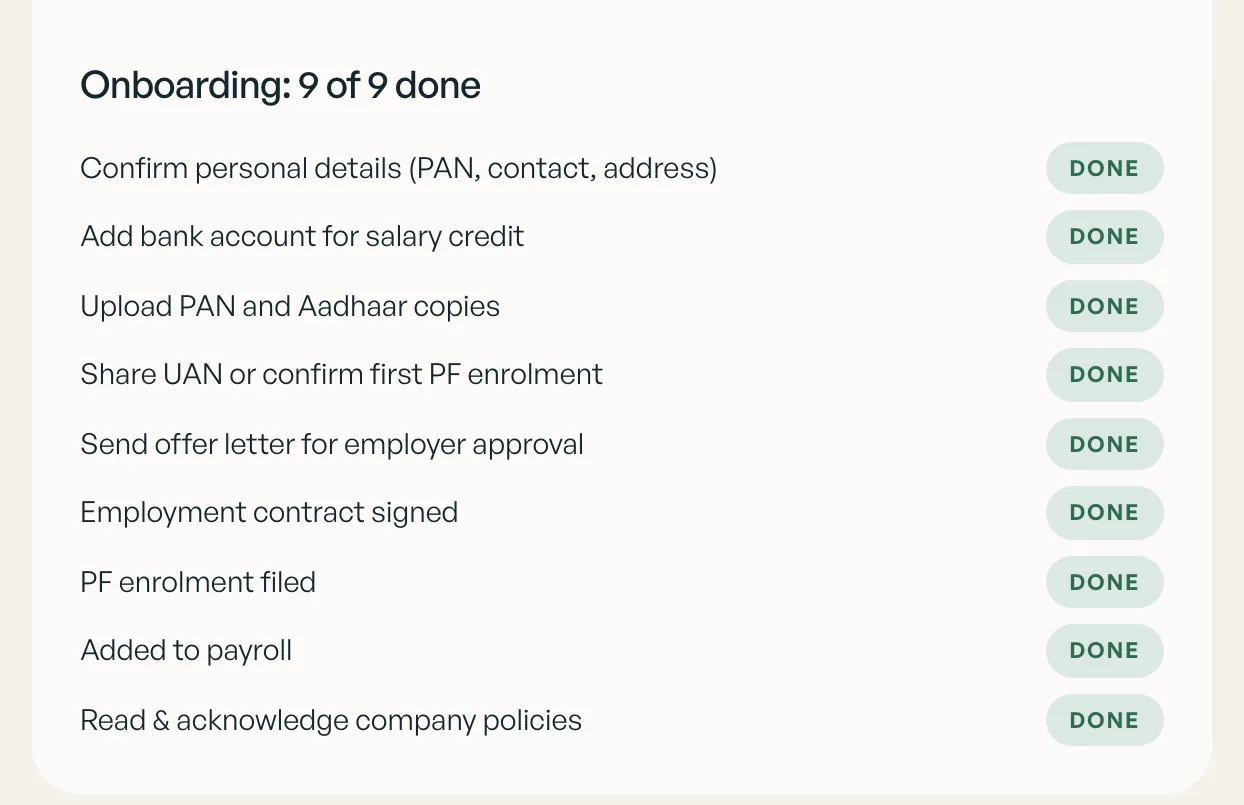
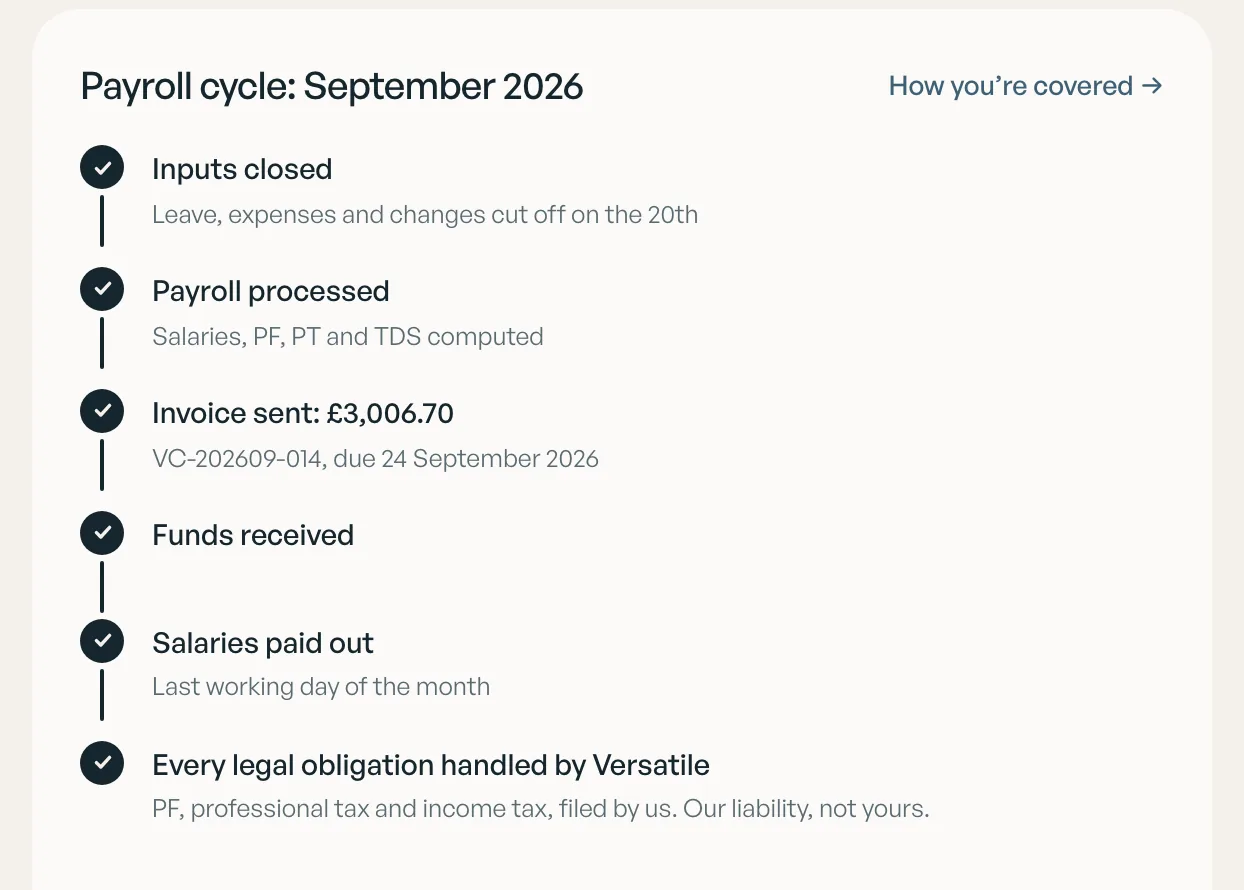
Your side is the decisions only you can make: who you hire, what you pay and the work they do. The five-day onboarding schedule shows when each step happens, and monthly payroll shows what you send each month.
Pages in this section
- Verify an EOR's Indian entity: the company that employs your team, and its CIN, PAN, TAN, GSTIN and ESIC numbers.
- Provident Fund for employers: the employer contribution, the wages it's paid on, the ceiling and the monthly proof.
- ESIC for employers: which employees ESIC covers, what it costs and how each deposit is proven.
- Statutory compliance calendar: every recurring India payroll deadline, with its government source.
Why India labour law compliance matters
India labour law compliance failures tend to surface late, at a bad moment. A missed deposit or a wrong salary structure can come up in an audit, a funding round or an employee's exit. By then the arrears and interest have built up for months.
For a US company, the harder part is often not knowing which rules apply at all. Central Codes, state rules and tax law each add their own duties, and the Codes changed the wage base in 2025. The India employer compliance scorecard lets you test your own setup against them, and the guide to payroll compliance in India walks through the filings.
What goes wrong and what to check
- The salary structure was never redrawn. The figures worked out from it come out lower, as the worked example above shows. Ask for the salary structure and compare it with that example.
- Salary TDS is deposited late. The deadline is seven days after the month's end, and 30 April for March. You would notice it as a missing deposit receipt. Ask for the receipt in the monthly pack.
- An employee has no appointment letter. The OSH Code requires one for every employee, including existing staff. Ask for the letter, and issue one if it was never given.
- A retrenchment notice leaves out the reasons. The Code requires one month's written notice that states the reasons, or wages in lieu. Check the notice before it goes out, and check whether the person is a worker.
- Final pay runs past the deadline. Final wages are due within two working days of exit, and gratuity within 30 days. Ask for the Full and Final settlement and check both dates.
Common questions
What are the labour laws in India for private companies?
The four Labour Codes, the PF and ESIC schemes, income tax on salaries, and the rules of the state where each employee works. Which ones bite depends on headcount, wages and location.
What are the 4 new labour codes?
The Code on Wages, 2019, the Industrial Relations Code, 2020, the Code on Social Security, 2020 and the Occupational Safety, Health and Working Conditions Code, 2020. Together they replaced 29 central labour Acts.
Do foreign companies have to follow Indian labour law?
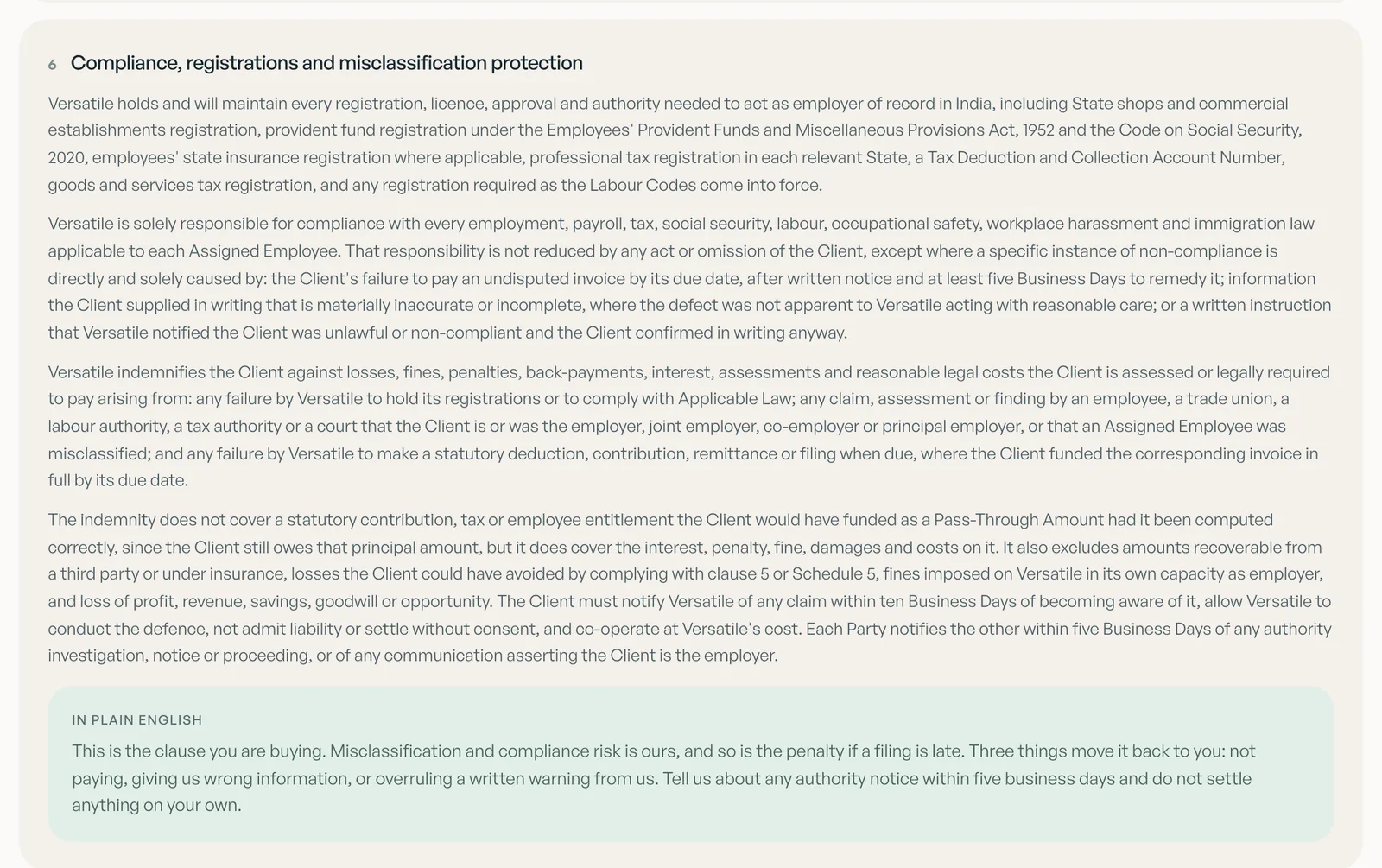
Yes, for anyone employed in India. Under Versatile Club's Employer of Record (EOR) service, the EOR's own Indian company is the employer, so it meets those duties under its own registrations.
Who is legally responsible for compliance under an EOR?
The employer of record. Versatile Club's EOR service employs your team on its own Indian company, Foo Falcon Technologies Pvt Ltd. It files their PF, ESI, TDS and professional tax under its own registrations.
Do we need our own Indian entity or registrations?
No. Versatile Club owns the Indian entity and holds the PF, ESIC and Shops and Establishments registrations. Companies that later want their own entity can test India before a GCC first.
Are the Labour Codes in force?
Yes. All four took effect on 21 November 2025, and central rules under each followed in 2026. The EOR's coverage includes the Labour Code wage rule on Basic plus DA.
What is the minimum salary in India as per labour law?
There is no single national figure. Central and state governments each notify minimum rates by area and kind of work, and none may fall below the floor wage the Central Government fixes.
What are the working hours and overtime rules?
The OSH Code caps work at eight hours a day and six days a week. Where the Code on Wages' overtime rule applies, extra hours are paid at no less than twice the normal rate.
Is there one notice period for every employee?
No. The Industrial Relations Code's retrenchment notice applies to workers, and that definition excludes people employed mainly in a managerial or administrative capacity. State laws and the contract set the rest.
How should a salary be structured under the Labour Codes?
Keep basic pay, dearness allowance and retaining allowance at half of total pay or more. The Labour Ministry's FAQ says statutory components such as employer PF count in that 50% test.
Which Labour Code covers EPFO and ESIC?
The Code on Social Security, not the Industrial Relations Code. It now sets the provident fund wage ceiling of ₹25,000 a month, and the payroll section shows how deposits are made.
How do we know compliance is up to date?
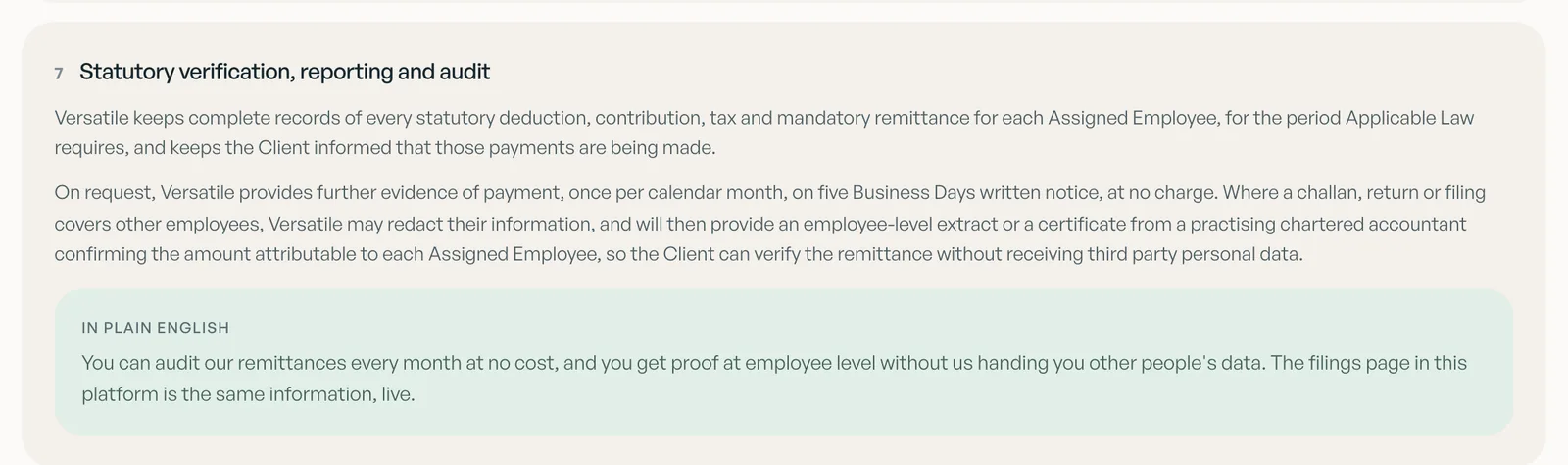
Each month Versatile Club sends PF and ESI challan confirmations, TDS deposit receipts and a status report on what's filed and what's upcoming. The ESIC page and the PF page show what each record proves.
Which states does Versatile Club cover?
All 28 states and 8 union territories. As an India-only EOR, it holds registrations across all 28 states and works only in India.
Who do we ask about a compliance question?
Write to the Versatile Club team through the contact page. The India EOR and payroll glossary defines the terms used across this section.