When to Use an Employer of Record in India: Situations That Fit and Ones That Don't
Checked against 4 government sources. Last verified 29 October 2026.
You have found people to hire in India, and you need to choose between a contractor, your own company and an EOR. Use an employer of record in India when you have found the people you want but have no Indian company to employ them. The decision comes down to three questions: do you have an Indian company, how many people will you hire, and where else are you hiring? An EOR suits first hires, GCC pilots and contractors you want to keep, and it suits an existing entity or a large long-term team less well. Versatile Club is an India-only Employer of Record (EOR), and this page sets out both sides.
At a glance
| Your situation | Is an EOR a good fit? | Guide |
|---|---|---|
| First hires in India, no Indian entity | Yes. This is the core case | The Employer of Record service |
| Proving an India team before building your own GCC | Yes | Test India before a GCC |
| A contractor working full time whom you want to keep | Yes, through Contract-to-Hire and then conversion | Convert a contractor to an employee |
| People spread across several Indian states | Yes. One employer covers every state | Statutory compliance in India |
| A short project with a clear end date | Often not. A contractor agreement may be simpler | Independent contractor or EOR |
| Your company already has an Indian entity | Usually not. Payroll support fits better | Managed payroll in India |
| Hiring in India and several other countries | Partly. An India-only EOR covers the India hires only | India-only vs global EOR |
| A large India team you'll keep for years | Compare an EOR with your own entity | EOR vs entity cost calculator |
The short answer is this. Use an EOR when India is where you're hiring, you have no Indian company, and you want people employed properly within days. Look at another route when an entity already exists, when the work is a short project, or when India is one country among many.
Three ways to employ people in India
Before you hire anyone in India, you choose one of three routes. The table puts them side by side, so you can see where an EOR sits between the other two.
| Contractor agreement | Employer of record | Your own Indian entity | |
|---|---|---|---|
| Who employs the person | Nobody. They run their own business | The EOR's Indian company | Your Indian company |
| What you set up first | A services contract | A service agreement with the EOR | A private company with its own board |
| When work can start | Once the contract is signed | Five business days after signing, with Versatile Club | After incorporation and the employer registrations |
| Payroll and filings | The contractor invoices you | Run by the EOR under its own registrations | Run by your company or a payroll provider |
| Main risk to watch | The work looks like employment in substance | A provider that doesn't own its Indian entity | Every filing and deadline is yours |
| Usually suits | Short, defined projects | First hires, pilots and teams under one employer | Large teams you plan to keep for years |
A contractor agreement
A contractor agreement is quick to sign and easy to end. It fits work with a defined output and an end date. The trouble starts when a contractor works only for you, full time, for months. At that point the arrangement can look like employment, and the misclassification risk quiz helps you test your own setup.
An employer of record
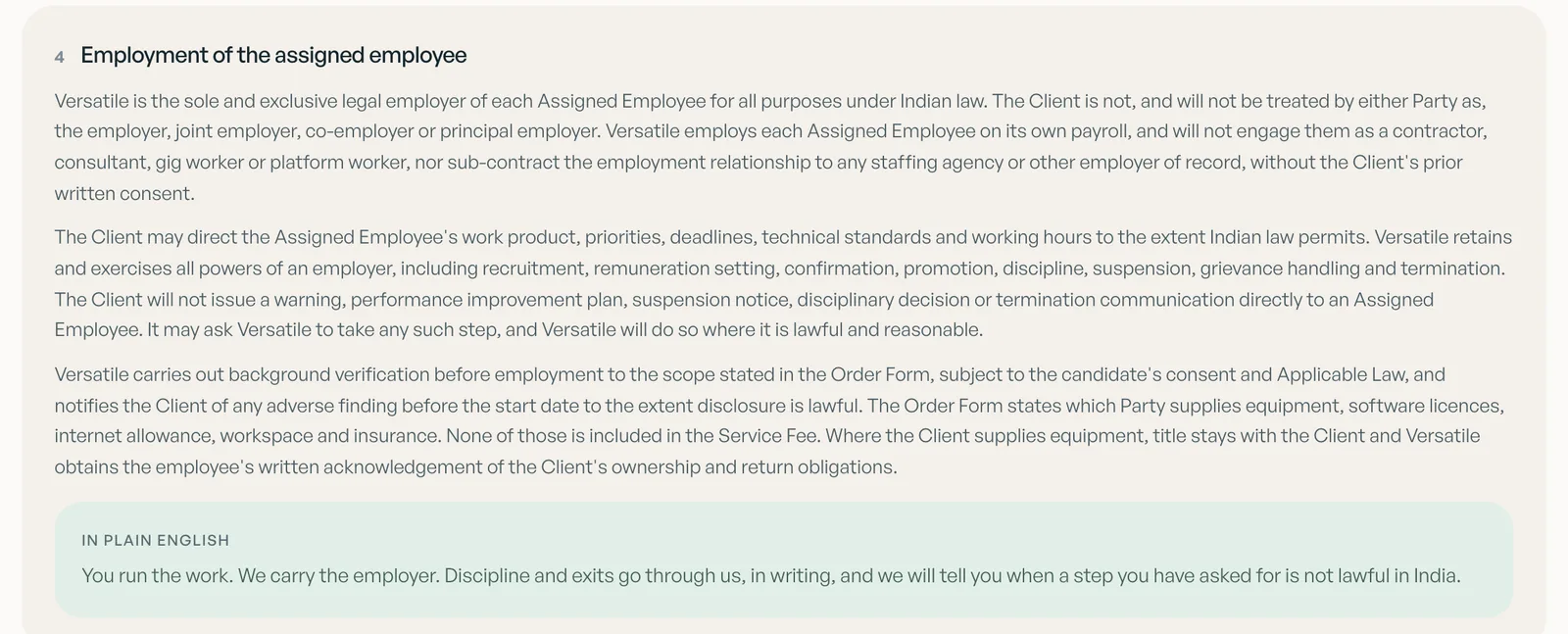
With an EOR, an Indian company employs the person on your behalf. It issues the contract, runs payroll and pays the statutory dues, while you direct the work. As your Employer of Record, Versatile Club files PF, ESI, TDS and professional tax under its own registrations. Your company needs no Indian presence to start.
Your own Indian entity
Your own entity gives you full control and no per-employee fee. It also brings a board, a registered office, employer registrations and a calendar of returns. The company registration overview covers the setup, and the law section below lists the duties that come with it.
When to use an employer of record in India
These are the hiring plans where an employer of record does its best work. Each one starts with a problem founders describe in their own words.
Your first people in India
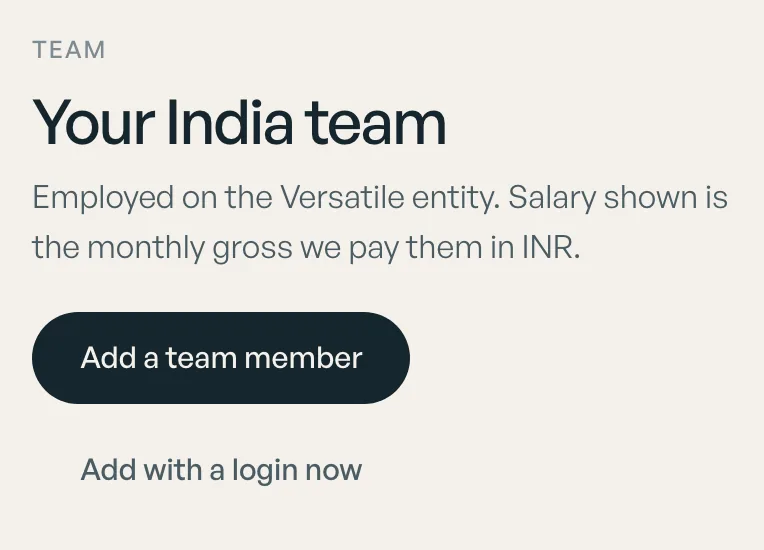
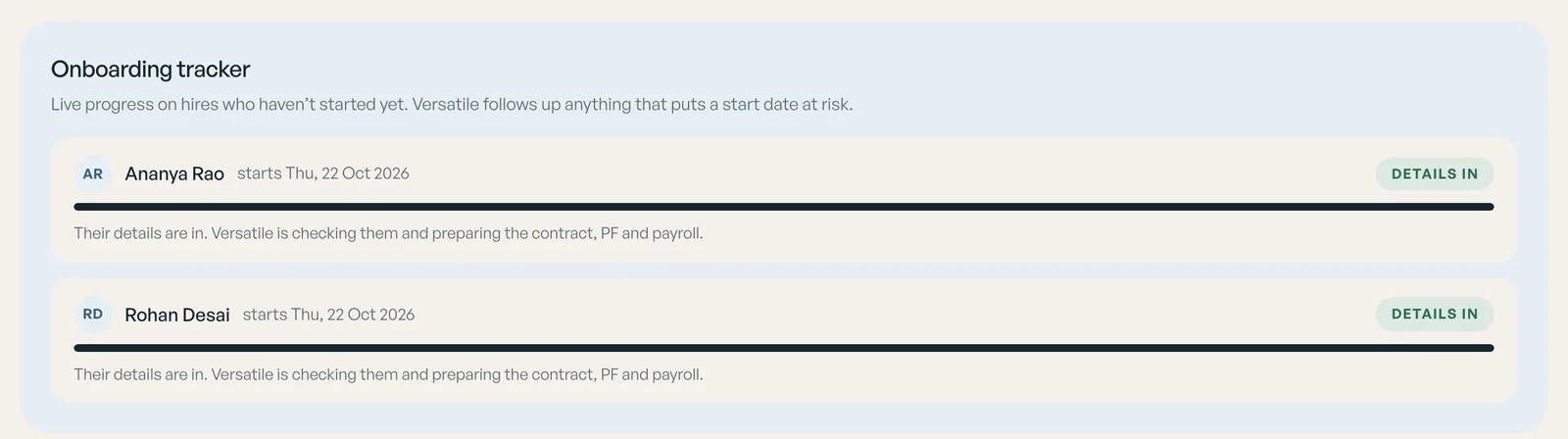
You've found the people but have no Indian company to employ them. An EOR employs them on its own entity, and you direct their work. Versatile Club's EOR service puts each hire on payroll five business days after you sign the service agreement. We send the candidate an India-compliant employment offer on day 2 and set up PF, ESI and professional tax on day 4. The five-day onboarding page shows each day.
Your hire also wants to know when they can resign from their current job. A fixed start date answers that, because the offer, contract and statutory setup follow a set order.
A pilot before your own GCC
You plan an India center and need evidence before you commit capital. A small team on an EOR shows hiring speed and cost per head with real employees. Our page on building a GCC in India covers the longer route, and the GCC pilot guide below covers the first months. Decide early what result would make you build the entity.
Contractors you want to keep
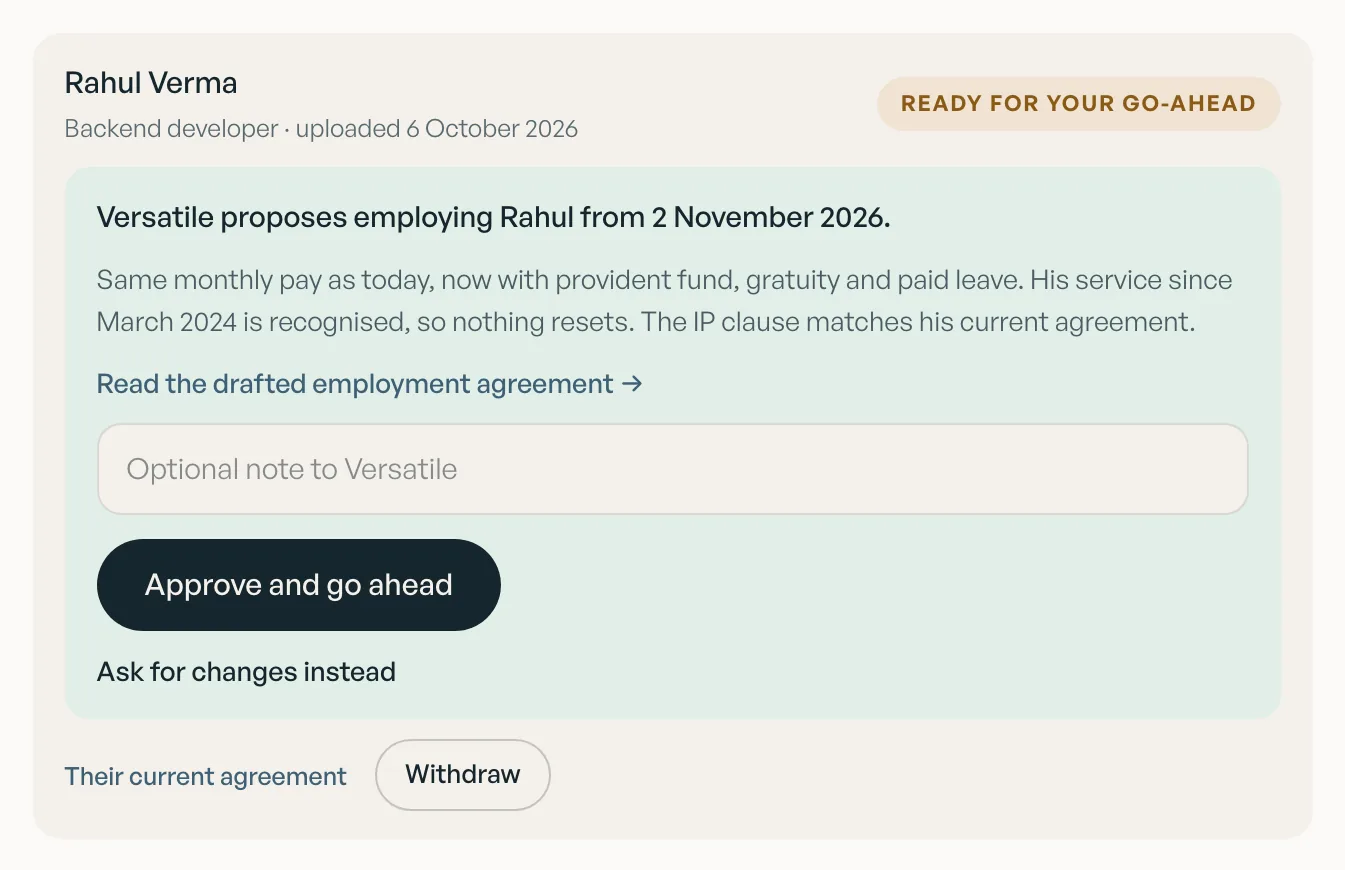
A contractor who works for you full time, for months, starts to look like an employee. Contract-to-Hire is Versatile Club's established service: a person starts as a contractor and converts to a full-time employee when you're ready. The conversion turns an informal arrangement into a written employment contract with statutory contributions.
Hires across several Indian states
Professional tax and labour rules differ by state, so a team in three cities can mean three sets of rules. An EOR that already holds the registrations takes that off your plate. Versatile Club holds registrations across all 28 states. Its primary hiring cities from Contract-to-Hire are Bengaluru, Hyderabad and Pune, and it is expanding across Mumbai, Chennai, Delhi NCR and Kochi through EOR.
Finance needs a dollar invoice
US and UK finance teams often want one invoice, in dollars, with a clear cost per person. We invoice in USD directly from our Indian company, with a per-employee breakdown. The monthly payroll page lists the proof that arrives with it.
You want room to change course
Early on, you may not know whether India will be two people or twenty. A model you can leave cheaply matters more than one tuned for scale. Versatile Club charges a flat monthly fee per employee, with no setup fee and no exit fee, and the first month is free for new hires. The figures are on the EOR pricing page.
Where something else fits better
An EOR is not the answer to every India plan. These are the cases where another route usually serves you better.
You already have an Indian entity
Your own entity can employ people directly, so an EOR adds a layer you may not need. What helps is payroll support. Versatile Club's Managed Payroll processes payroll for companies with existing India entities.
Your plan spans several countries
Versatile Club is an India-only EOR, so India is the only country it operates in. If you're hiring across countries, the India-only vs global EOR guide below helps you choose between one global provider and an India specialist.
A large team you'll keep for years
At some headcount, running your own entity can cost less than per-employee fees. Put your numbers into the EOR vs entity calculator, and read when a GCC wins over an EOR before you decide.
Work with a fixed end date
A three-month build or a one-off design job doesn't need an employer. A contractor agreement with a clear scope and end date is often simpler. If the work keeps growing into a full-time role, that is the moment to revisit the choice.
What the law says
Whoever employs your India team carries the employer's legal duties. With an EOR, the provider's company carries them. With your own entity, your company carries them, and it has to exist first. These are the main duties, taken from the original documents.
Your own company needs a resident director
A private company in India needs at least two directors under section 149 of the Companies Act, 2013. One must be a director "who stays in India for a total period of not less than one hundred and eighty-two days during the financial year". This applies only if you set up your own company. An EOR's company already has its board in place.
What to check: if you set up your own company, confirm that one of your two directors will stay in India for 182 days in the financial year.
Government sourcemca.gov.inA new company files a declaration before it starts business
A newly incorporated company with share capital can't start business until a director files a declaration. The Companies Act, section 10A, requires "a declaration is filed by a director within a period of one hundred and eighty days of the date of incorporation". It confirms that the subscribers have paid for their shares. The Ministry of Corporate Affairs has applied that 180-day period in an adjudication order.
What to do: on your own company, have a director file the declaration within 180 days of incorporation.
Government sourcemca.gov.inEvery employee gets an appointment letter
In an establishment covered by the OSH Code, the employer must "issue a letter of appointment to every employee on his appointment in the establishment". That duty sits in section 6 of the OSH Code, 2020. Under an EOR, the provider issues the letter as the employer.
What to check: on your own entity, issue the letter when each person is appointed. Under an EOR, confirm the provider issues it.
Government sourceegazette.gov.inWage slips, registers and returns
The same Code asks an employer to keep registers and "issue wage slips to the workers, in electronic forms or otherwise". Section 33 of the OSH Code also covers filing returns. Each of these is a recurring job that someone on the employer's side has to own every month.
What to do: on your own entity, name the person who owns wage slips, registers and returns each month.
Government sourceegazette.gov.inPay on time, and pay final dues fast
Monthly wages are due "before the expiry of the seventh day of the succeeding month", under section 17 of the Code on Wages, 2019. When someone resigns or is removed, wages due are paid "within two working days". Exits need the same care as hires.
What to check: on your own entity, pay wages by the seventh of the next month and final wages within two working days.
Who carries each duty
| Duty | Where the law sets it | With an EOR | With your own entity |
|---|---|---|---|
| Two directors, one resident in India | Companies Act, section 149 | Not your concern | Your company |
| Declaration within 180 days of incorporation | Companies Act, section 10A, as applied by the MCA | Not your concern | Your company |
| Appointment letter, wage slips, registers and returns | OSH Code, sections 6 and 33 | The EOR | Your company |
| Monthly wages by the seventh, final wages in two working days | Code on Wages, section 17 | The EOR | Your company |
Read down the last two columns and the pattern is plain. With an EOR, the company duties never arise for you and the employer duties sit with the provider. With your own entity, every row is yours.
Government sourcemca.gov.inUse-case guides
How to decide
Work through these five questions in order. Most founders have the answer by the third.
- Where will your people be in two years? India alone points to an India EOR. Several countries point to the India-only vs global EOR guide.
- Do you already have an Indian entity? If yes, look at payroll support before an EOR.
- How many people, and for how long? The EOR or own entity guide sets out the cost and timing of each.
- Contractor or employee? If the work is full time and open-ended, treat it as employment. The option router asks a few questions and points you to a route.
- Who will carry the employer's duties? If you'd rather not run the duties in the law section yourself, an EOR carries them for you.
What goes wrong and what to check
- The company has no resident director. A private company needs two directors, and one must stay in India for 182 days in the financial year. You would notice it when you try to form the board. Confirm the resident director before you incorporate.
- The 180-day declaration is missed. A new company with share capital can't start business until a director files it. Count 180 days from the date of incorporation and file before then.
- A contractor works full time for months. The arrangement can start to look like employment. You would notice it when the person works only for you, full time. Review the setup, or convert the person with Contract-to-Hire.
- Wages run late. Monthly wages are due before the seventh day of the next month, and final wages within two working days of an exit. You would notice it when either date passes with no payment. Name who runs payroll and who handles exits.
- The provider doesn't own its Indian entity. This is the main risk with an EOR. Ask which Indian company employs your people before you sign.
Common questions
When should you use an employer of record in India?
When you want to employ people in India without an Indian entity of your own. It suits first hires, GCC pilots, teams across several states and contractors you want to convert to full-time employees.
Can a company with no Indian entity hire employees in India?
Yes, through an employer of record, which employs them on its own Indian entity while you direct the work. The guide to hiring without an entity compares the legal routes.
How fast can an EOR hire start?
With Versatile Club's EOR service, five business days from the signed service agreement to the employee being active on payroll. That commitment is written into the service agreement.
Is an EOR worth it for one hire?
It can be, because there is no company to set up. Versatile Club charges a flat monthly fee per employee, with no setup fee and no exit fee. The current fee is on the pricing page.
When is an EOR the wrong choice?
When you already have an Indian entity, when a large team will stay for years, when the work is a short project, or when you need one provider across many countries.
What does an EOR do that a contractor agreement doesn't?
An EOR makes the person an employee, with a written contract, payroll and statutory contributions. A contractor agreement buys a service and leaves the person outside the employment relationship.
How many directors does an Indian private company need?
Two, and one of them must stay in India for at least 182 days in the financial year. That matters only if you set up your own company; an EOR's company already meets it.
Can an EOR cover hires in different Indian states?
Yes, if the provider holds registrations in those states. Versatile Club holds registrations across all 28 states, so a hire in a new city needs no new setup from you.
Does Versatile Club employ people outside India?
No. It is an India-only EOR, working across all 28 states and 8 union territories.
Who carries the employer's legal duties under an EOR?
The EOR does, as the legal employer. It issues the appointment letter, runs payroll, keeps the registers and pays final dues on exit. Your company directs the work.
Who can help us choose?
Write to the Versatile Club team through the contact page with your hiring plan.