How Payroll Works in India: How to Pay Employees Compliantly, Month by Month
Checked against 13 government sources. Last verified 29 October 2026.
You have agreed to hire your first employee in India and need to know what payroll involves each month. How payroll works in India is simple to state: it runs once a month to a fixed legal calendar. Salaries are due within seven days of the month's end, then tax and Provident Fund deposits follow. If you're a US company paying your first India employees, the real question is how to pay employees in India compliantly, and what your company sends, checks or approves.
Versatile Club is an India-only Employer of Record (EOR). Its EOR service employs and pays your India team on its own Indian company, so the calculations, filings and deposits are its job. Your part is the month's changes and a review of the records that come back.
At a glance
| Who runs payroll | Versatile Club, as the legal employer, on its Indian company Foo Falcon Technologies Pvt Ltd |
| Pay cycle | Monthly. The Code on Wages says no wage period can be longer than a month |
| Salaries due | Before the seventh day of the following month ends |
| Salary tax (TDS) | Deducted from each salary and deposited by the 7th of the next month under the EOR's TAN |
| Provident Fund | An employer share and an equal employee share each month, with an EPF wage ceiling of ₹25,000 a month from 17 September 2026 |
| What you send | Start dates for joiners, last working days for leavers, and any unpaid leave days |
| What you check | The USD invoice, the payroll summary, PF and ESI challan confirmations, TDS deposit receipts and a filing status report |
| What you don't need | An Indian entity, a PF registration or a TAN of your own |
| First payroll | A new hire is active on payroll on day five of the five-day onboarding |
| Fee | A flat monthly fee, with no setup fee, no exit fee and the first month free; see Versatile Club's EOR pricing |
How payroll works in India each month
To run an India payroll month, you work to two kinds of deadline. One is the pay date the Code on Wages sets for salaries. The others are the deposit dates for the money taken out of salaries: income tax, Provident Fund and, for lower-paid staff, ESI.
- You send the month's changes. New joiners' start dates, leavers' last working days and unpaid leave days. Agree the cut-off with the EOR before your first run.
- Employees declare tax claims. Rent, investments and similar claims go to the employer with evidence in Form No. 124, so salary tax reflects them.
- Pay is worked out. The EOR calculates gross pay, the statutory deductions and net pay for each employee.
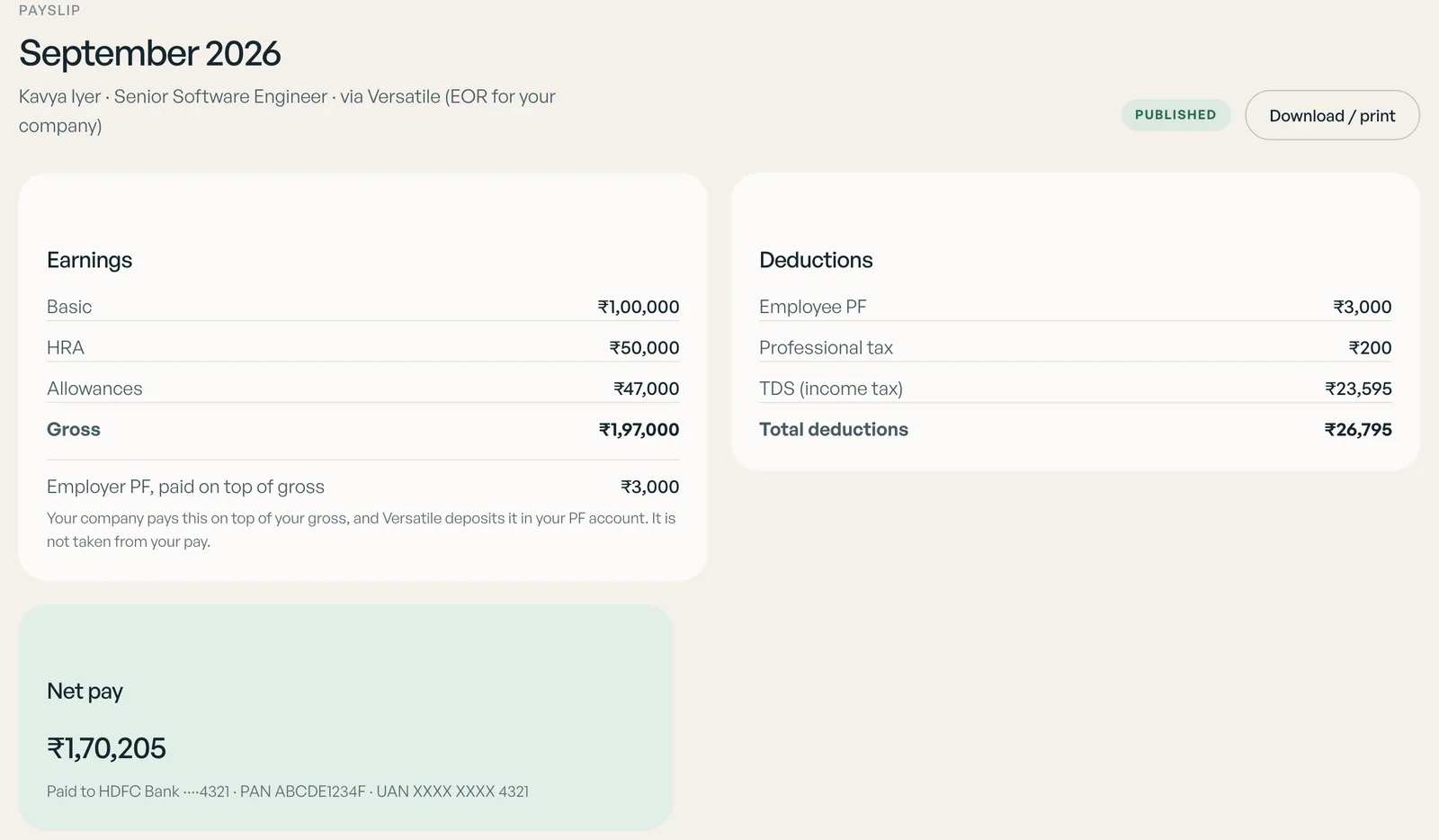
- Salaries are paid, with a wage slip. Every employer must issue wage slips to its employees, on or before the day wages are paid.
- Deductions are deposited. The EOR deposits salary TDS by the 7th, and EPF follows within fifteen days of month-end.
- The records come back to you. An invoice, a payroll summary and proof of each deposit.
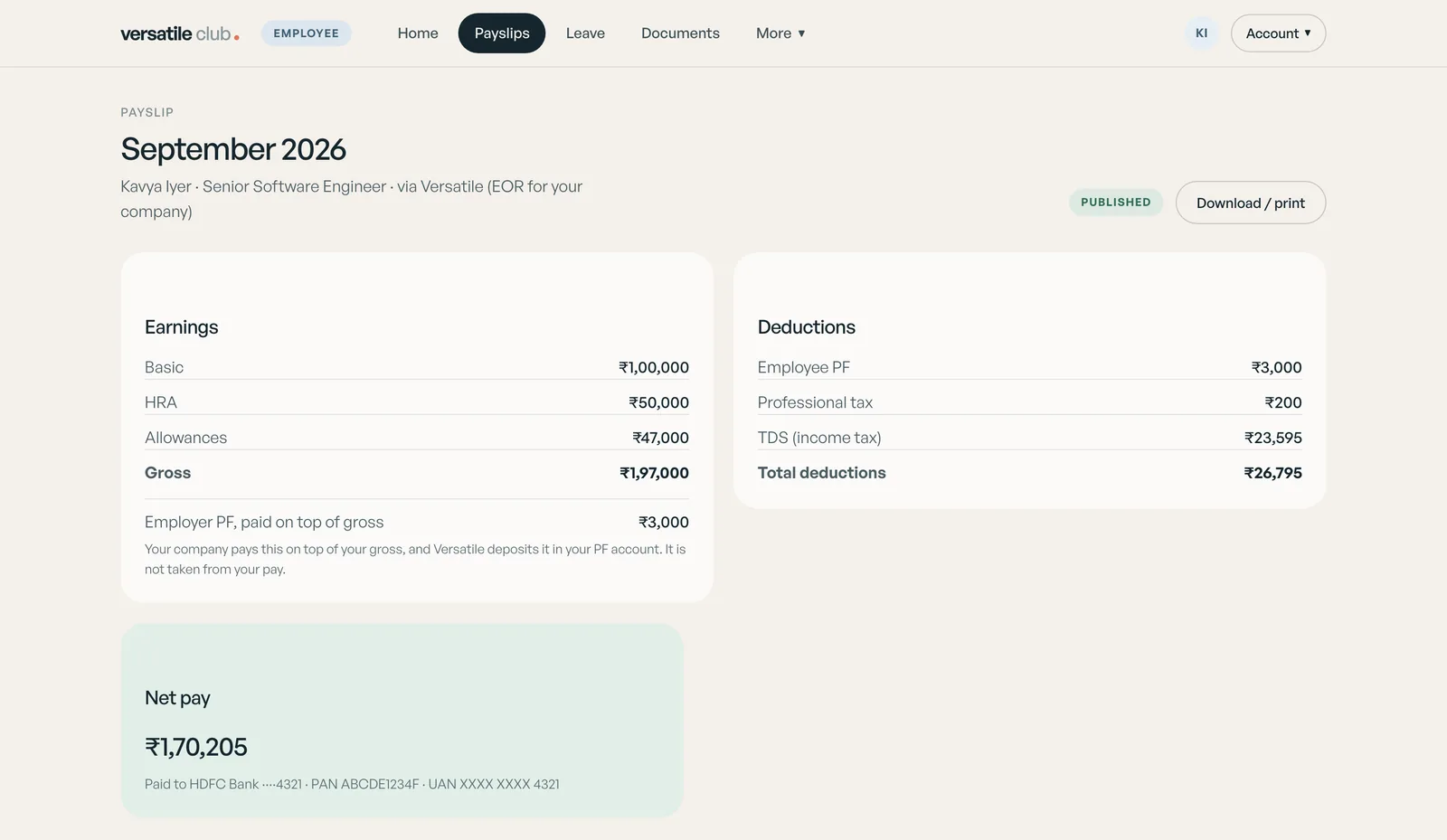
The monthly payroll timeline covers each step in detail, including joiners, leavers and unpaid leave. To size a month before you hire, the India payroll run cost calculator breaks a run down by component.
Three ways to pay employees in India compliantly
A US company has three legal routes to pay people in India. Each one decides who the employer is, whose registrations the filings sit under, and how long it takes before the first salary can go out.
Set up your own Indian entity
You incorporate a company in India and become the employer yourself. That entity then needs its own registrations: a TAN to deduct and deposit salary tax, plus PF, ESI and state registrations as they apply. You run payroll on it with payroll software, your own finance team or an outsourced payroll provider. This route suits a team large enough to justify the setup, and the EOR versus entity break-even guide shows where that point usually sits.
Employ through an employer of record
An employer of record employs your team on its own Indian entity, and you direct their day-to-day work. As your Employer of Record, Versatile Club files PF, ESI, TDS and professional tax under its own registrations, so your company needs no Indian entity at all. The Employer of Record service explains the arrangement and what stays with you.
Pay independent contractors
A contractor invoices you for services and isn't on payroll, so there are no payslips, PF or salary TDS from your side. The risk is that a long, full-time, closely managed contractor looks like an employee. The contractor misclassification quiz tests a relationship against the usual warning signs. Versatile Club's Contract-to-Hire service starts a person as a contractor and converts them to a full-time employee when you're ready.
Payroll software, payroll outsourcing or an EOR
Payroll software and payroll outsourcing both assume you already have an Indian entity: they calculate and file on your registrations. An employer of record replaces the entity. If you already have one, Versatile Club's Managed Payroll is payroll processing for companies with existing India entities, described on the managed payroll in India page.
| Route | Who is the employer | Whose registrations | You need an Indian entity |
|---|---|---|---|
| Own entity | Your Indian company | Yours | Yes |
| Employer of record | The EOR's Indian company | The EOR's | No |
| Contractors | No employer; a service contract | None for payroll | No |
What the law says
Six duties drive every India payroll month. Each sits with the employer, which on an employer of record arrangement is the EOR's Indian entity, not your company.
Pay salaries within seven days of the month's end
For monthly-paid staff, the deadline is in section 17(1)(iv) of the Code on Wages, 2019: wages are paid "before the expiry of the seventh day of the succeeding month." So September's salaries are due by the end of 7 October. The rule applies to every employer, whatever the size of the team, as the Code on Wages, 2019 sets it out. What to do: agree the input cut-off before the first run, so salaries can be paid by the end of the 7th.
Government sourceindiacode.nic.inDeduct only what the Code allows
Section 18(1) of the Code says "there shall be no deductions from the wages of the employee, except those as are authorised under this Code." The authorised list includes tax, social security contributions and absence from duty. All deductions in one wage period together can't exceed 50% of wages, under section 18(3) of the Code on Wages. What to check: on each payslip, confirm that every deduction is authorised and that together they stay within 50% of wages.
Government sourceindiacode.nic.inIssue a wage slip with every payment
Section 50(3) of the Code reads "Every employer shall issue wage slips to the employees" in the prescribed form and manner. The central rules made under the Code prescribe Form V, which employers issue "electronically or in physical form" on or before payment of wages, under rule 52 of the Code on Wages (Central) Rules, 2026. What to check: confirm each employee receives a wage slip on or before the day wages are paid.
Government sourcelabour.gov.inDeposit salary tax within seven days
A private employer deposits the tax it deducted from salaries "on or before seven days from the end of the month" in which it was deducted. March is the exception: tax deducted in March is due by 30 April. Both dates are in rule 218(2) of the Income-tax Rules, 2026, in force since 1 April 2026. What to check: match each TDS deposit receipt to the payroll summary, and expect March's deposit on 30 April.
Government sourceincometax.gov.inPay Provident Fund within fifteen days
Under paragraph 18 of the EPF Scheme, 2026, the employer contributes 12% of wages and the employee contributes an equal amount. Contributions are paid "within fifteen days of the close of every month", under paragraph 20(1) of the EPF Scheme, 2026. The wage ceiling for EPF rose to ₹25,000 a month on 17 September 2026, under S.O. 5109(E). What to check: compare the PF challan confirmation with the payroll summary, and look for the ₹25,000 ceiling from 17 September 2026.
Government sourceegazette.gov.inCover lower-paid employees under ESI
Employees in covered establishments "drawing wages up to 21000/- a month" get ESI cover, according to ESIC's published coverage note. For them, the employer pays 3.25% of wages and the employee 0.75%, under ESIC's contribution guidance. Engineering salaries are usually above that ceiling, so ESI tends to apply to support and operations roles. What to check: for anyone drawing wages up to ₹21,000 a month, confirm that ESI shows on the payslip and the challan confirmation.
Government sourceromaharashtra.esic.gov.inIndia payroll rates and deadlines
Every figure below comes from the government instrument linked in its row. Use it to sanity-check an offer or the first payroll summary.
| Item | Rate, limit or deadline | Instrument |
|---|---|---|
| EPF contribution | Employer 12% of wages; employee share equal to the employer's | EPF Scheme, 2026, paragraph 18 |
| EPF wage ceiling | ₹25,000 a month, from 17 September 2026 | S.O. 5109(E) |
| ESI contribution | Employer 3.25% of wages; employee 0.75% of wages | ESIC contribution guidance |
| ESI coverage | Employees drawing wages up to ₹21,000 a month | ESIC coverage note |
| Professional tax, Maharashtra | ₹200 a month above ₹10,000 salary, ₹300 in February, ₹2,500 a year (men's schedule) | Maharashtra Profession Tax Act, Schedule I |
| Salary TDS slabs, default regime | Nil up to ₹4,00,000 of income, then 5% rising to 30% above ₹24,00,000 | Income-tax Act, 2025, section 202 |
The India statutory rates and thresholds reference lists the full set, including the remaining tax slabs and the ESI exemptions.
A payroll month on the calendar
Here is how the legal dates fall for a September 2026 payroll. The cut-off for your inputs comes first, and you agree it with the EOR before the first run.
| When | What happens | Rule |
|---|---|---|
| 1 to 30 September | The wage period runs; it can't be longer than a month | Code on Wages, section 16 |
| Before the agreed cut-off | You send joiners, leavers and unpaid leave days | Agreed with the EOR |
| By the end of 7 October | Salaries paid and wage slips issued | Labour Codes compliance handbook |
| By 7 October | September's salary TDS deposited | Income-tax Rules, 2026, rule 218 |
| By 15 October | September's EPF contributions paid, and details of new members uploaded | EPF Scheme, 2026, paragraph 20 |
| By 31 October | Quarterly salary TDS statement for July to September filed in Form No. 138 | Form No. 138 guidance |
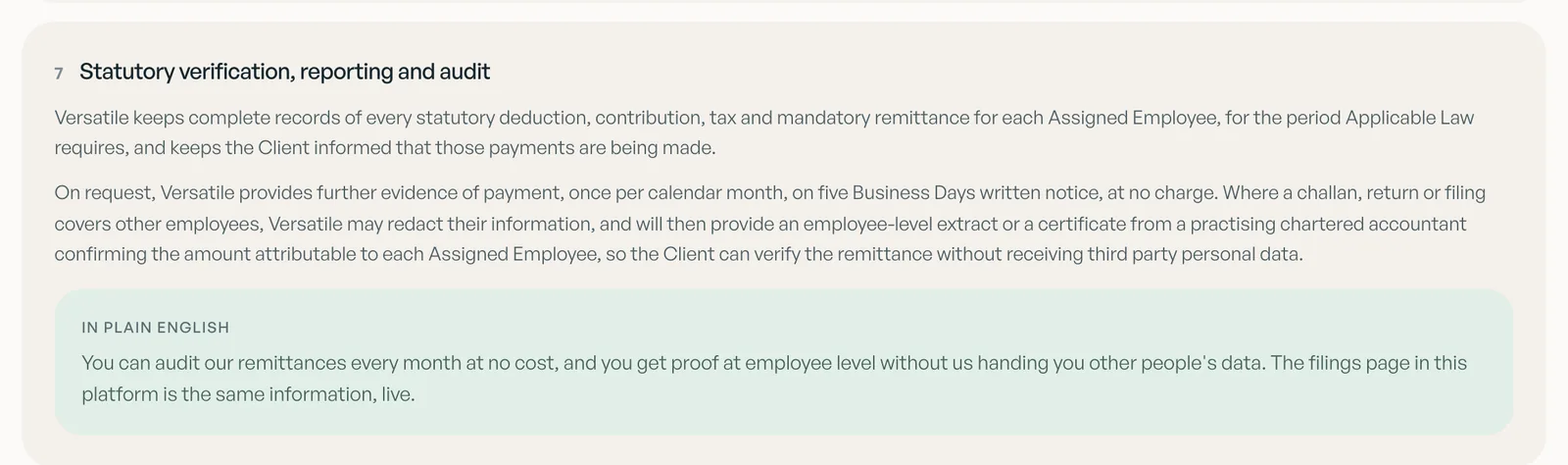
The India payroll compliance calendar runs the same dates across the whole year.
Your part and the EOR's part
What you send
Three things change a month's pay: who joined, who left and who took unpaid leave. Send those before the agreed cut-off. Everything else carries forward from the employment contract, which Versatile Club signs with the employee on day three of onboarding in five business days. The law has employees send their tax claims to the employer, which is the EOR's Indian company, so rent receipts and investment proofs don't pass through your company.
What you check
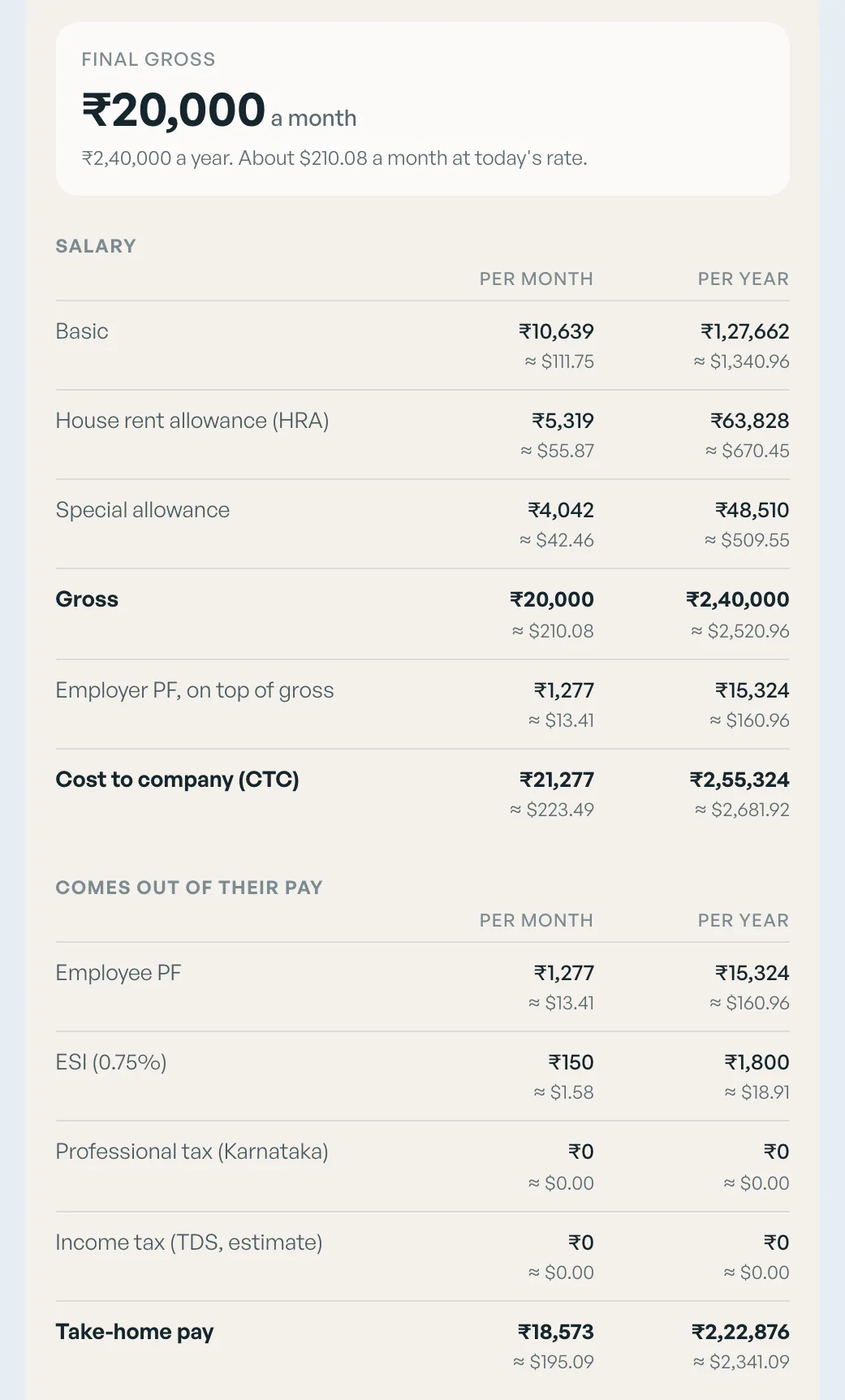
Each month you receive one USD invoice with a breakdown per employee. A payroll summary shows gross pay, deductions and net pay, and a compliance status shows what's filed and what's due. PF and ESI challan confirmations and TDS deposit receipts come with them. The page on payroll and compliance reports shows how to tie each deposit back to the payroll summary.
What the EOR handles
- Provident Fund. The EOR deducts the employee's share and adds the employer match. The PF contribution rules cover the rate and the wage ceiling.
- ESI. Contributions for employees under the coverage threshold.
- Professional tax. State-specific slabs in all 28 states, such as the Bengaluru payroll rules for Karnataka.
- Salary TDS. Deducted each month and deposited under the EOR's TAN.
- Gratuity. Accrued from the first month of employment.
- Exits. A Full and Final settlement covering notice, leave encashment, gratuity, PF and the relieving letter.
Versatile Club files all of it under its own registrations, not your company's.
Pages in this section
- Monthly payroll: the month from your inputs to the deposits, with joiners, leavers, unpaid leave and a worked payslip.
- Monthly payroll and compliance reports: what each record proves, and how to check that PF and TDS were paid.
Related parts of the service:
- Provident Fund (EPF): the employer contribution, the wage base and the monthly proof.
- TDS on salary: how salary tax is estimated, deducted and certified each year.
- Verify an EOR's Indian entity: the company and identifiers payroll runs under.
What goes wrong and what to check
These are the points where a payroll month can slip, using the dates and records described above.
- The cut-off was never agreed. Without one, nobody has a date by which the month's joiners, leavers and unpaid leave days must arrive. Agree it with the EOR before the first run, and send the changes before it.
- Salaries are paid after the seventh day of the month ends. That misses the Code on Wages deadline, which for September's salaries is the end of 7 October. Ask the EOR when salaries were paid and check the date against the deadline.
- Salary TDS is deposited after the 7th. Late deposit draws interest, as the late-deposit answer below explains. Ask for the TDS deposit receipt and check its date. With an employer of record, that liability sits with the employing entity, not your company.
- An employee has no wage slip. Every employer must issue one on or before the day wages are paid. If an employee says they never received one, ask the EOR for it and check it lists earnings, deductions and net pay.
- A deposit doesn't match the payroll summary. The PF or ESI challan confirmation, or the TDS receipt, shows a different amount from the deductions in the summary. Write to Versatile Club through the contact page, name the employee and the month, and use the payroll summary as the reference.
Common questions
How does payroll work in India?
Monthly. The employer works out gross pay and statutory deductions, pays salaries within seven days of the month's end, then deposits tax and PF. With Versatile Club's Employer of Record service, its Indian company is that employer, and you get the records each month.
How do you pay employees in India compliantly?
Through an Indian employer: either their own Indian entity or an employer of record's. That employer deducts tax, PF and ESI, pays on time and files under its registrations. Paying people as contractors is a different relationship, not payroll.
Do we need an Indian entity to pay employees in India?
Not with an employer of record. Versatile Club's EOR service employs your team on its own Indian company. If you already have an Indian entity, Managed Payroll in India is the separate service that runs payroll on it.
How do we pay contractors in India from the US?
A contractor invoices you and you pay the invoice, usually by bank transfer, so there's no Indian payroll. If the work looks like employment, move the person onto payroll. The guide to converting a contractor to an employee explains how.
What do we send each month?
Start dates for new joiners, last working days for leavers and any unpaid leave days. Agree the cut-off date with the EOR before the first run.
What comes out of an employee's salary?
The employee's PF share, ESI for those under the threshold, state professional tax and salary TDS. The CTC to in-hand salary calculator shows the effect for a given offer.
What payroll taxes does an employer pay in India?
The employer's own costs on top of salary are its PF share, ESI for employees under the ceiling, and gratuity accrued over time. Salary TDS and professional tax come out of the employee's pay. The rates table above lists each one with its instrument.
How do we know tax and PF were actually paid?
Versatile Club sends PF and ESI challan confirmations and TDS deposit receipts every month. Check them against the deductions in the payroll summary.
What happens if salary tax is deposited late?
Tax deducted but deposited late draws interest at 1.5% for every month or part of a month until it's paid. With an employer of record, that liability sits with the employing entity, not your company.
How soon can a new hire be paid?
The employee is active on payroll on day five of onboarding, after PF, ESI and professional tax are started on day four. They are then paid in that month's run.
What currency do we pay in?
US dollars. Versatile Club invoices in USD directly from its Indian entity, not converted from INR, so there is no FX exposure on your side.
Which Indian states does payroll cover?
Versatile Club holds registrations across all 28 states, and professional tax follows each state's own slabs. As an India-only EOR, it operates in no other country.
What does payroll compliance in India involve?
It means paying salaries within seven days of the month's end, with a wage slip, and deducting only what the Code on Wages allows. The employer then deposits salary TDS by the 7th and EPF within fifteen days, and covers lower-paid staff under ESI.
Who do we ask about payroll?
Write to the team through Versatile Club's contact page. Name the employee and the month, and use the payroll summary as the reference.