How EOR Billing Works in India: Employer of Record Costs, Invoices and Due Dates
Checked against 9 government sources. Last verified 29 October 2026.
You're a CFO setting up India vendor payments, and you need to know what the first EOR invoice will say. EOR billing is how an employer of record charges your company each month for the people it employs in India on your behalf. You want three answers. What does the invoice contain, what does each hire really cost and when is the money due?
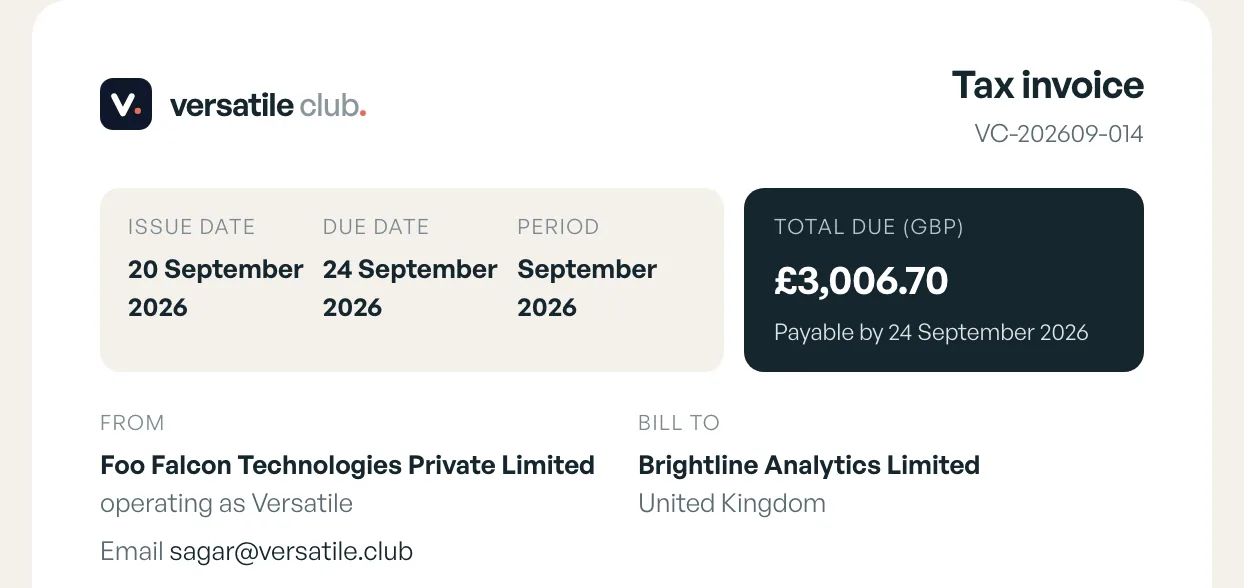
Versatile Club is an India-only Employer of Record (EOR). Its EOR service employs your team on its own Indian company, Foo Falcon Technologies Pvt Ltd, and bills you once a month in US dollars. Each employee has a cost line. The EOR's own charge is a flat monthly fee per employee, with no setup fee and no exit fee.
At a glance
| How often | One invoice a month |
| When | Invoiced on the 20th and due on the 24th of the same month, so your payment arrives before salaries go out |
| Currency | US dollars, invoiced by the Indian entity itself and not routed through a foreign holding company |
| Exchange rate | Salaries stay in rupees. The invoice converts them at the live rate on the invoice date and prints that rate |
| Who invoices you | Foo Falcon Technologies Pvt Ltd, the Indian company that employs your team |
| What the invoice shows | A cost breakdown for each employee, with the EOR service fee and an administration charge on their own lines |
| What one employee costs | Gross salary, the employer's statutory contributions such as PF, and gratuity as it builds up, plus the fee |
| The EOR fee | A flat monthly fee per employee, with no setup fee, no exit fee and the first month free for new hires. The figures are on the EOR pricing page |
| What comes with it | A payroll summary, PF and ESI challan confirmations, TDS deposit receipts and a compliance status report |
How EOR billing works
To pay the invoice with confidence, you need to know who is spending your money and on what. The employer of record is the legal employer of your India staff. It runs their payroll in India and pays the salaries, taxes and statutory contributions there. Your company then pays the EOR for that cost and for its service, on one invoice.
As your Employer of Record, Versatile Club employs your team on its own Indian company. It files their PF, ESI, TDS and professional tax under its own registrations. The monthly payroll run is the process each invoice reflects.
For a US or UK finance team, three things decide how clean the bill is: the currency, who issues it and the detail behind each line. The EOR invoices in dollars from its Indian company and breaks the cost down per employee. The India EOR page for finance teams explains how that invoice fits your accounts payable process.
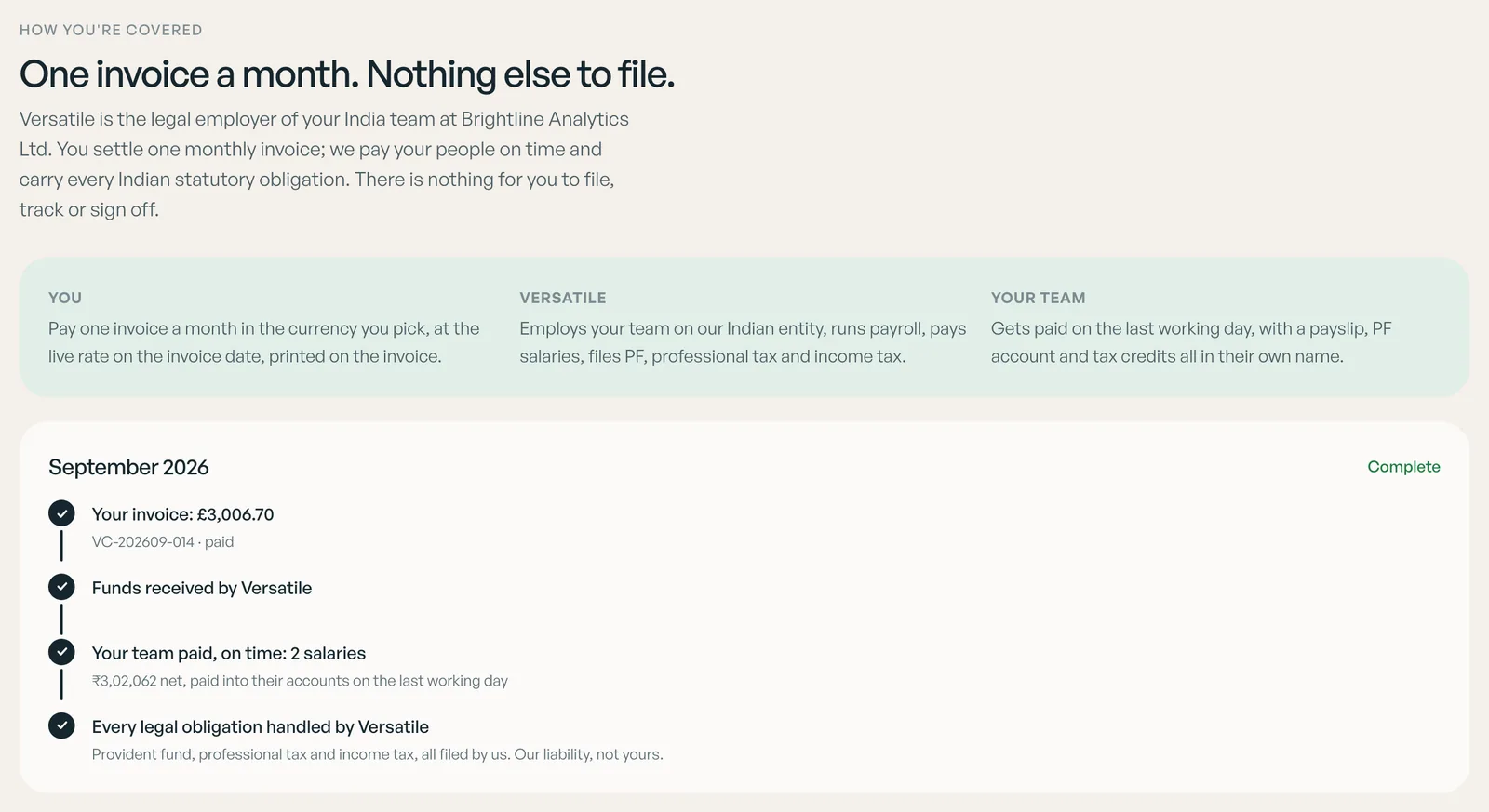
A billing month, date by date
EOR billing in India follows the payroll month. Your payment is collected before payday, and the statutory deposits follow after it. Here is one month in order, with the rule behind each date.
| When | What happens | Who acts |
|---|---|---|
| 20th | Leave, expenses and pay changes cut off, and the month's invoice is issued | The EOR |
| 24th | The invoice is due | Your company |
| Last working day | Salaries are paid into each employee's bank account | The EOR |
| By the 7th of the next month | Tax deducted from salaries (TDS) is deposited, as the TDS on salary page explains | The EOR |
| Within fifteen days of month-end | PF contributions are due under the EPF Scheme, 2026 | The EOR |
| Within 15 days of month-end | ESI contributions are due, per ESIC's contribution guidance | The EOR |
The India payroll compliance calendar lists every recurring statutory date across the year. Because your payment lands on the 24th, the money is in India before any salary or deposit is due.
What makes up the employer of record cost in India
The employer of record cost in India has four parts: the employee's gross salary, the employer's statutory contributions, gratuity as it builds up, and the EOR's service fee. The first three are set by the salary and the law. Only the fourth is the provider's price, which is why it pays to compare fees with everything else held equal.
The salary
The gross salary is the figure you agree with the employee in the offer. It is set and paid in rupees. Under the labour codes, part of that salary counts as "wages", and the statutory contributions below are worked out on wages rather than on the whole gross.
Employer contributions on top
Provident Fund is the main one. Under paragraph 18 of the EPF Scheme, 2026, the employer contributes "at the rate of twelve per cent of the wages payable to the employee", and the employee pays an equal share from salary. The PF wage ceiling is ₹25,000 a month under S.O. 5109(E), in force from 17 September 2026. The Provident Fund page covers who is covered and when it is due.
ESI applies only to lower salaries. ESIC covers employees drawing wages up to ₹21,000 a month, and the employer's share is 3.25% of wages. Most professional hires earn above that ceiling, so ESI often doesn't apply to them.
Gratuity
Gratuity is a lump sum the employer owes when someone leaves. The Code on Social Security makes it payable after continuous service for not less than five years, subject to the exceptions it sets out. It is worth fifteen days' wages per completed year of service. Versatile Club accrues it from month one, so the liability is covered before it falls due. The India gratuity calculator shows the payout for a given salary and tenure.
What isn't your cost
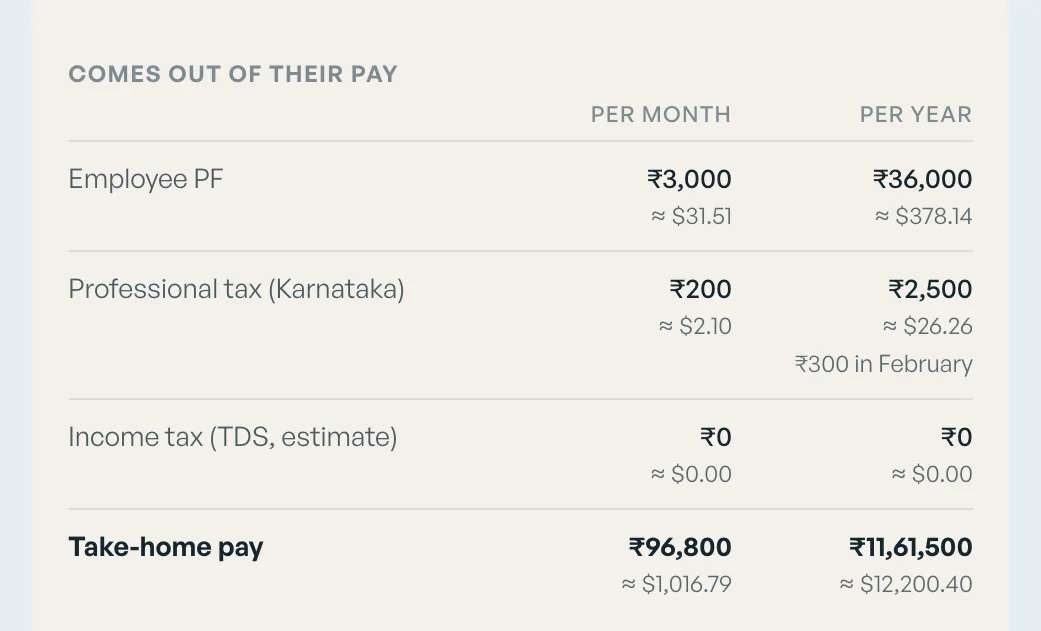
Income tax is not a cost to you. It comes out of the employee's pay as TDS, which the EOR deposits by the 7th of each month. The employee's own PF share and professional tax come out of their pay too. The employee income tax overview explains the tax side.
A worked example
Take one engineer on a sample salary, with round figures. The salary is structured so that half of it counts as wages for PF and gratuity. This is an illustration of the statutory arithmetic, not a quote.
| Line | Monthly amount | How it is worked out |
|---|---|---|
| Gross salary | ₹50,000 | The agreed offer, of which ₹25,000 counts as wages under the Code on Social Security |
| Employer PF | ₹3,000 | 12% of ₹25,000 in wages, under the EPF Scheme, 2026 |
| Employer ESI | ₹0 | Wages are above the ₹21,000 ESIC coverage ceiling |
| Cost to company | ₹53,000 | Salary plus employer PF, with wages inside the ₹25,000 PF ceiling. The invoice converts this figure to dollars |
| Gratuity built up | ₹14,423 a year | ₹25,000 ÷ 26 × 15, the formula in section 53 of the Code, payable after five years of service |
| EOR service fee | Flat, per employee | The current figure is on the EOR pricing page |
So the monthly invoice for this person carries the cost to company above, converted at the live rate on the invoice date, plus the fee. To run your own figures before you hire, use the India employee cost calculator. The cost of hiring in India guide adds city salary ranges.
What arrives with each invoice
The invoice is one part of a monthly set of payroll and compliance records. Alongside it, Versatile Club sends:
- A payroll summary. Gross pay, deductions and net pay for each employee.
- PF and ESI challan confirmations. Proof that the month's contributions were paid.
- TDS deposit receipts. Proof that the tax deducted from salaries reached the government.
- A compliance status report. What's been filed and what's coming up.
Together they let your controller tie each invoice to the payroll and statutory payments behind it. The guide to documents you and your employees receive lists every record by month and by event.
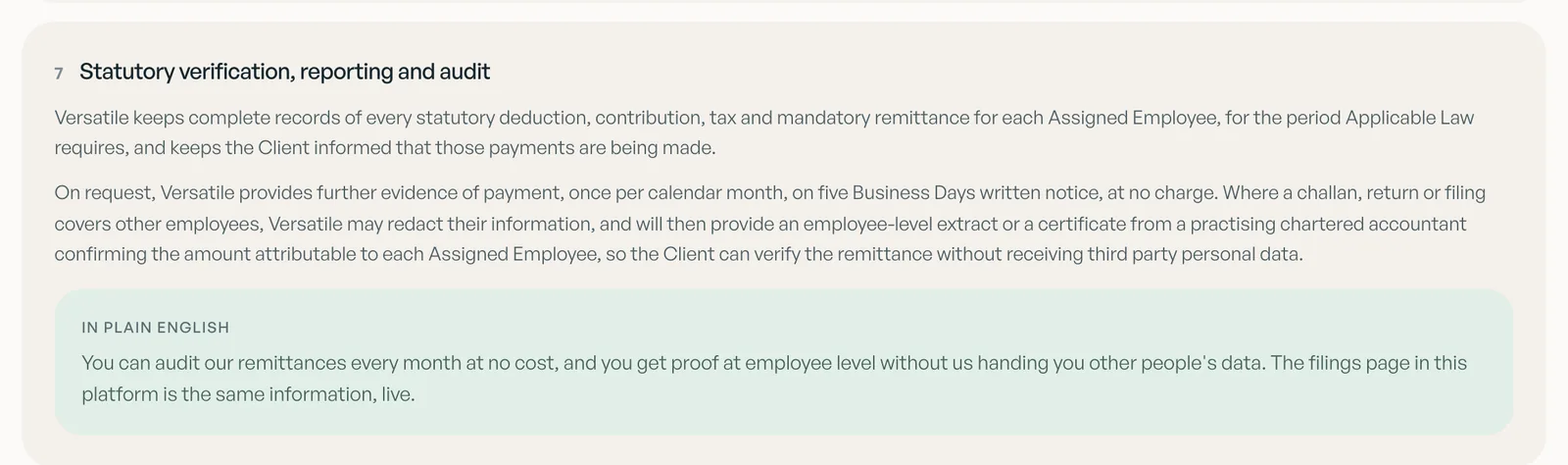
The EOR service fee
Versatile Club charges a flat monthly fee per employee. There is no setup fee to start and no exit fee when someone leaves, and a new hire's first month is free. The current figures are on the EOR pricing page.
The invoice also carries an administration charge on its own line. It covers exchange-rate movement between the date your payment clears and the payroll date. It is a fixed charge and is not added to the exchange rate, so the rate printed on the invoice is the rate used.
Before you compare quotes, the guide to employer of record cost breaks down per-employee pricing, setup fees and FX margins. The India EOR cost guide does the same for India specifically.
GST on an export invoice
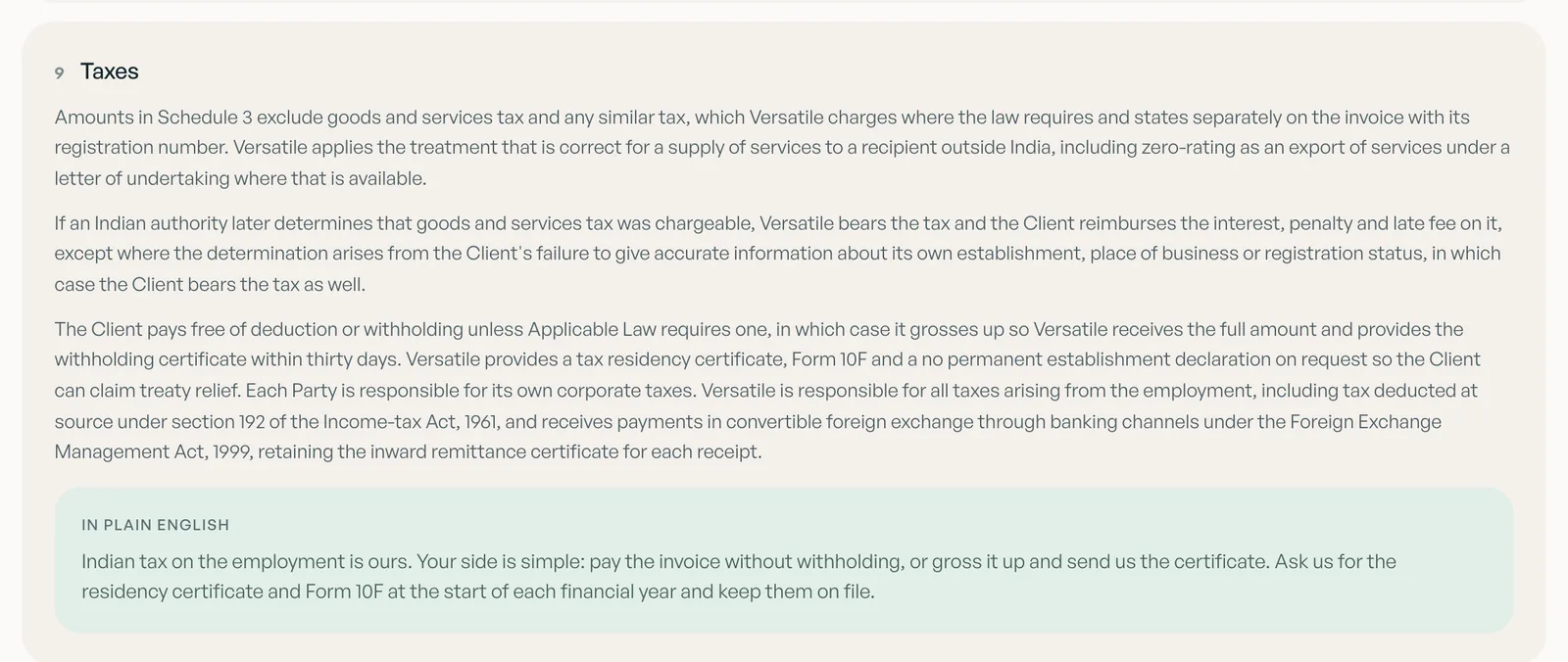
The EOR invoice comes from an Indian company to a client abroad, so GST's export rules are the starting point. Under section 2(6) of the IGST Act, a supply is an export of services when, among other conditions, "the recipient of service is located outside India". For most services to a client abroad, section 13(2) puts the place of supply at the recipient's location.
An export of services falls in the zero-rated supply category of the IGST Act. Versatile Club's contract applies zero-rating as an export of services under a letter of undertaking where that is available. Its GSTIN, a Karnataka registration, is published with its entity and registrations. The invoices and payment page covers the export rules in more detail.
Setting up Versatile Club as an India vendor
Before the first invoice arrives, finance can do most of the vendor setup in one sitting. Here is the order to follow:
- Add the vendor. The legal name is Foo Falcon Technologies Pvt Ltd. Its CIN, PAN, GSTIN and TAN are on the Indian entity page.
- Check the GSTIN. The GST portal lets you search a taxpayer by GSTIN or PAN, so you can confirm the registration yourself.
- Schedule the payment run. Invoices are dated the 20th and due the 24th, so set your payment run to clear in that window.
- Budget each hire. Use the employee cost calculator to set the monthly figure you expect per person.
- Ask for treaty paperwork if you need it. On request, the EOR provides a tax residency certificate and a no permanent establishment declaration so you can claim treaty relief.
- Set up the monthly proof file. Store each invoice with its payroll summary and challan confirmations for your auditors.
The India EOR for finance teams page shows how the invoice and the proof fit a month-end close.
Pages in this section
- Paying an India EOR invoice: whether an Indian company can invoice in USD, the export rules behind it and how each month's payment works.
What goes wrong and what to check
- Your payment clears after the 24th. The invoice is dated the 20th and due the 24th, so a late payment no longer reaches India before salaries go out on the last working day. Set your payment run to clear in that window.
- The dollar total moves from last month. The rupee costs don't change with the rate, but the dollar total follows the live rate on the invoice date. Compare the rate printed on the invoice with last month's before you query the amount.
- The employer PF line doesn't match your own sum. The worked example above works employer PF out on wages, not on the whole gross salary. Check which part of the salary counts as wages before you query the line.
- The proof file is incomplete. Each invoice should arrive with a payroll summary, PF and ESI challan confirmations, TDS deposit receipts and a compliance status report. If one is missing, ask Versatile Club for it, because your controller needs all four to tie the invoice to the payments behind it.
- The GSTIN on the invoice can't be confirmed. Search the taxpayer by GSTIN or PAN on the GST portal before you pay, and compare it with the registrations on the Indian entity page.
Common questions
How does EOR billing work?
The EOR employs your India staff, runs their payroll and pays salaries and statutory contributions in India. It then bills your company. With Versatile Club's Employer of Record (EOR) service, that's one US dollar invoice a month, with each employee's cost broken down.
How much does an employer of record cost in India?
The total is the employee's salary, the employer's statutory contributions such as PF, gratuity as it builds up, and the provider's fee. Versatile Club's fee is flat per employee, with the figure on its pricing page.
Do we pay employer PF on top of the salary?
Yes. The employer's PF share is paid on top of the salary, so it sits in the cost to company on your invoice. The employee's own share comes out of their pay.
When is the invoice due?
Each invoice is dated the 20th and due on the 24th of the same month. That puts your payment in India before salaries are paid on the last working day.
What currency will we be billed in?
US dollars. The EOR invoices in USD directly from its Indian company, not through a foreign holding company. Salaries themselves are always set and paid in rupees.
Do we carry any currency risk?
You don't convert anything yourself, because you pay in dollars. The rupee costs never change because of the rate. The dollar total can move from month to month with the live rate on the invoice date, which is printed on the invoice.
Is there a markup on the exchange rate?
The invoice uses the live rate on the invoice date and prints it. A separate administration charge covers rate movement before payroll, and it is not added to the exchange rate.
Is income tax part of our cost?
No. Income tax is deducted from the employee's salary as TDS and deposited by the EOR by the 7th of each month. It reduces the employee's take-home pay, not your invoice.
Is there a setup fee or an exit fee?
No. Versatile Club charges a flat monthly fee per employee, with no setup fee and no exit fee.
Is the first month free?
Yes, for new hires. After that, the flat monthly fee applies for each employee.
Which company sends the invoice?
Foo Falcon Technologies Pvt Ltd, the registered Indian company that operates Versatile Club. Its registrations are published, and you can check the GSTIN on the GST portal before you pay.
What proof comes with each invoice?
A payroll summary for each employee, PF and ESI challan confirmations, TDS deposit receipts and a compliance status report on what's filed and what's due.
Can we switch to Versatile Club from another EOR mid-year?
The guide to switching EOR providers in India lists what to protect when payroll, PF and gratuity move across. Onboarding with the new EOR runs on a five-business-day schedule.
Who answers billing questions?
Write to the Versatile Club team through the contact page.