Table of contents (10)
Deel Reviews 2026: Pros, Cons, Pricing, and Real User Feedback
Q1. What do Deel reviews actually say in 2026, and who is writing them?
Deel holds 4.7 out of 5 across roughly 14,900 G2 reviews, 4.9 out of 5 across about 4,300 Capterra reviews, and 8,717 Trustpilot reviews as of September 2026. Authorship matters before the number. A large share of the positive reviews come from contractors and employees rating payout speed and withdrawal options, not from the administrator who reconciles the invoice. On Capterra, 48% of 229 pricing mentions are negative. A 4.7 measures software experience. It does not measure whether your PF, ESI, and TDS filings survive an audit.
⭐ The number is real, but it answers a different question
I have read a few hundred Deel reviews over the last two years. The score is earned. People genuinely like getting paid on time in a clean interface.
What the score cannot tell you is who wrote it. Most five-star Deel reviews are written by the person receiving money. Most one-star reviews about fees are written by that same person. The buyer, the People Ops lead or CFO who signs the contract, is a minority voice in that dataset.
💬 Two reviews, same platform, opposite worlds
"I love that Deel Hire provides detailed information about the payments I receive, which is super helpful. Plus, it's very fast."
— Verified User, Contractor Deel Hire - G2 Verified Review, 4/5, 18 Sep 2026
"I find Deel to be absurdly expensive. They charge a high amount of fees for transferring money to my bank account. Additionally, using their card incurs fees for purchases in another currency."
— Juan Camilo O., Contractor Deel Hire - G2 Verified Review, 1/5, 27 Nov 2025
Both reviewers are correct. They are rating different products inside the same login. If you are weighing those trade-offs against an India-only provider, our Deel alternative for India teams breaks down the same criteria.
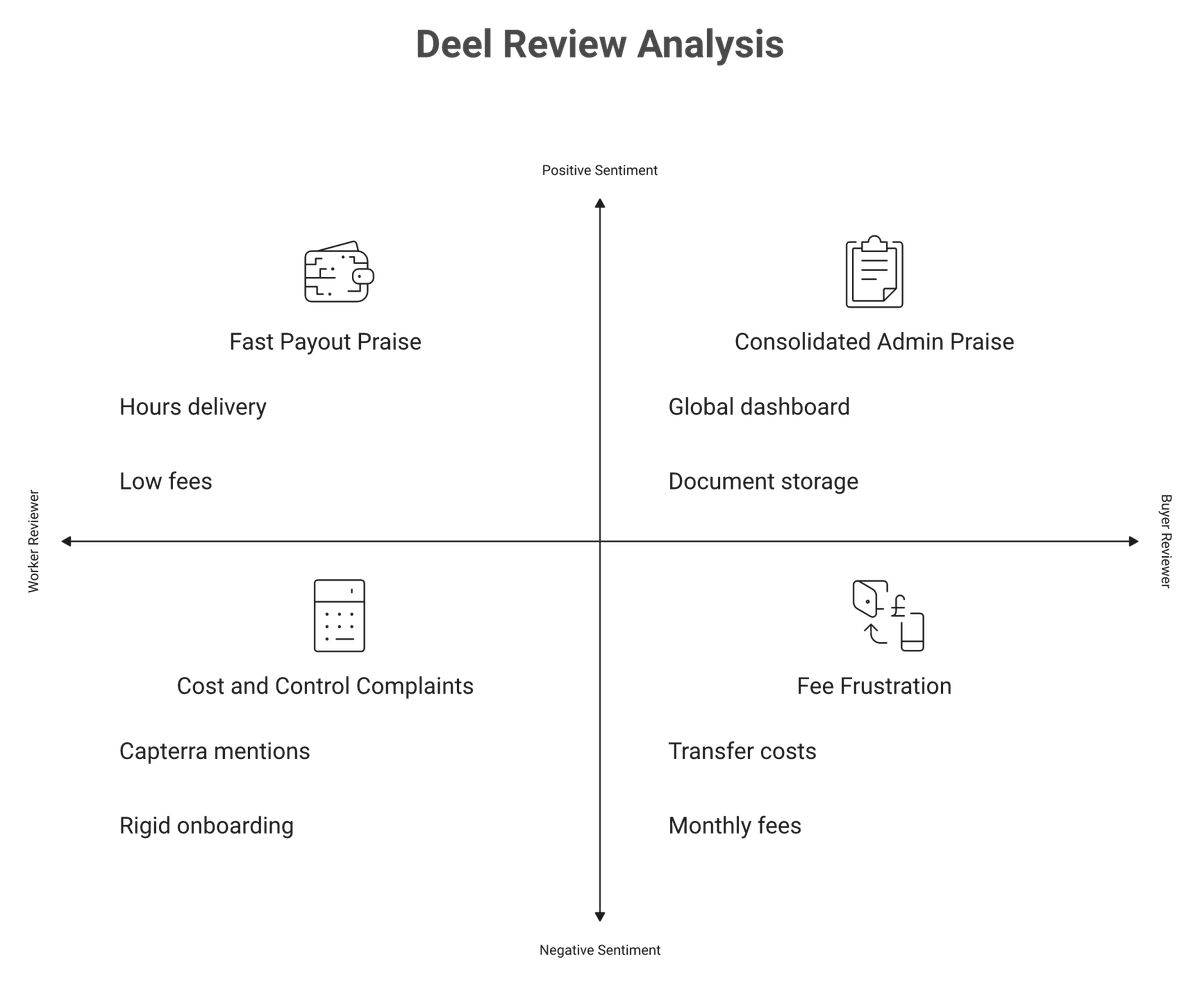
📊 What each platform actually measures
| Platform | Rating (Sept 2026) | Review volume | Who mostly writes them | What it really measures |
| G2 | 4.7 / 5 | ~14,896 | Workers and admins, mixed | Platform usability, payout speed |
| Capterra | 4.9 / 5 | ~4,312 | Software buyers | Feature fit, with concentrated fee complaints |
| Trustpilot | Mixed | 8,717 | Individual payees | Payment and support experience |
| Gartner Peer Insights | Positive | Smaller sample | Enterprise contractor managers | Contractor management at scale |
None of these four columns audits a professional tax challan in Karnataka.
⚠️ The three things a rating cannot see
Versatile Club files PF, ESI, TDS, and professional tax under its own Indian registrations, so I know exactly which of these never reaches a review form. Professional tax, or PT, is a state level salary tax with its own calendar in each state, and our India payroll compliance guide maps each one.
First, filing punctuality. No reviewer knows whether their PF challan was deposited by the 7th. Second, state depth. Maharashtra runs dual PTRC and PTEC registration, Karnataka runs a monthly PT cycle, and Tamil Nadu files twice a year. Third, escalation ownership when something breaks in week three of a quarter.
Six years of India placements taught me something uncomfortable. I have never lost a client over interface quality. I have lost sleep over a Maharashtra PT deadline. Reviews rate the first thing and stay silent on the second.
Versatile Club does not have a four-figure review count, and I will not pretend otherwise. What we have is a single country operating record: India only, our own registered Indian entity, our own EPFO and ESIC registrations. Judge us on filing dates and response times, not review volume, and check the compliance coverage we publish.
Q2. What does Deel actually cost per India employee once every line item is added?
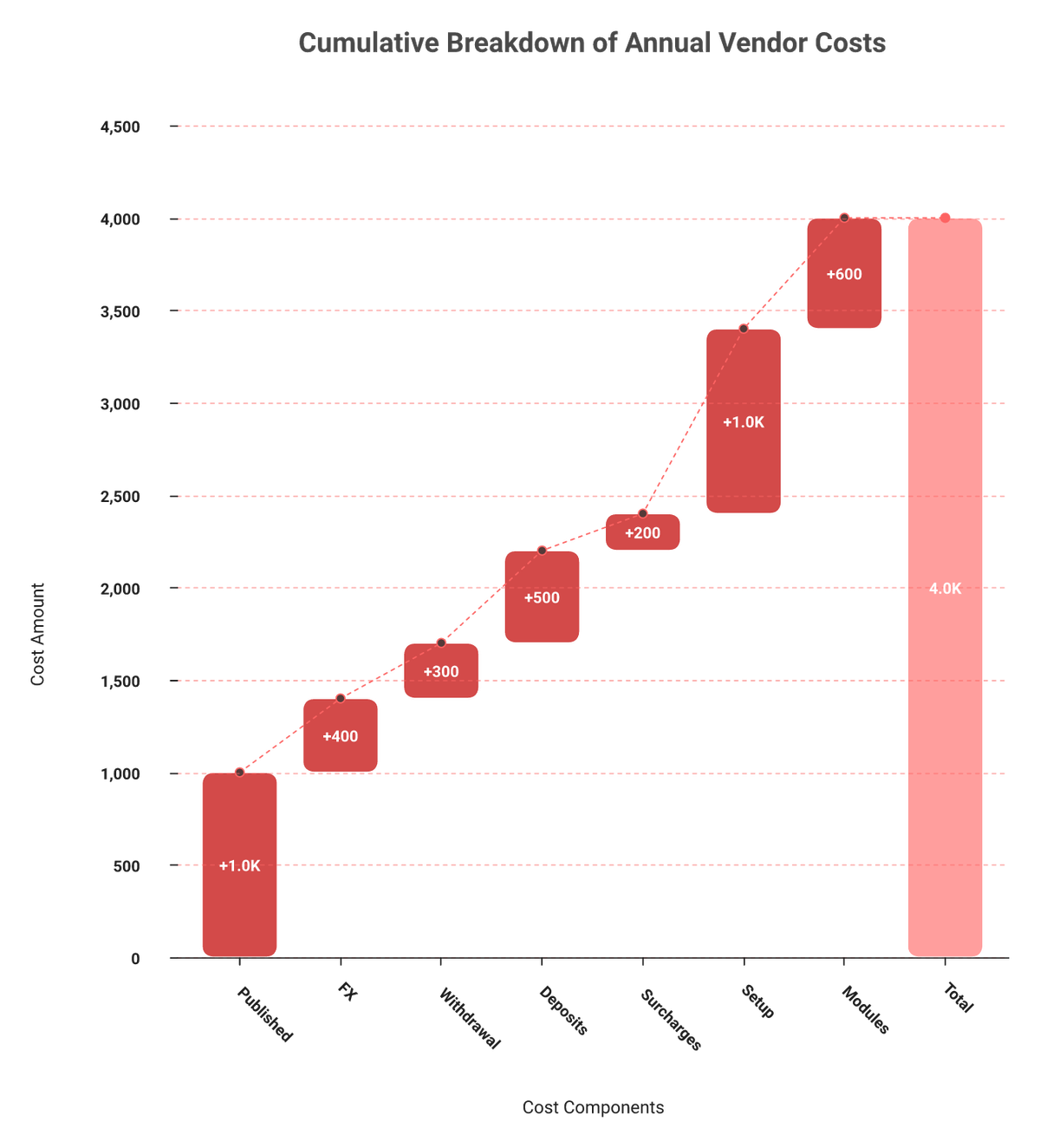
Deel's published 2026 pricing starts at $599 per employee per month for standard EOR and $899 for Enterprise, with contractors at $49, Contractor of Record at $325, global payroll at $29 plus a $1,000 entity setup fee, and HRIS at $5. In India that ladder is the smallest line. Employer statutory contributions add roughly 20% to 40% on gross pay, and reported foreign exchange conversion margins of 3% to 5% sit on remittances. The defensible number is platform fee plus statutory load plus currency spread, modelled per head, per year.
💰 The problem is not the price, it is the reconciliation
The CFOs I speak to rarely object to $599. They object to not being able to tie the invoice to their own payroll register.
One finance lead described receiving separate, non consolidated invoices from multiple India vendors that she could not reconcile at month end. When her auditor asked for the India PF, ESI, and gratuity liability, she scrambled. That is a bookkeeping failure, not a pricing failure, and it costs more in hours than the fee does in dollars.
💸 The six line items that are not on the pricing page
- Foreign exchange conversion margin, reported at 3% to 5% on remittance flows.
- Withdrawal and per payment fees charged to the worker, which surface as retention complaints.
- Upfront salary deposits held before the cycle runs.
- Country specific surcharges on certain markets.
- The $1,000 entity setup fee on global payroll, plus setup charges on EOR contracts.
- Add on modules such as engagement tooling, billed separately per employee.
"There are hidden fees. Of course, again, also here. Even your contract says payment processing will be paid by your client, they do not care. You will never get your net agreed salary through Deel."
— İbrahim, Contractor Deel Hire - G2 Verified Review, 1/5, 1 Nov 2024
"I find the pricing of Deel to be quite terrible for me. Previously, I was paid directly by my employer without any additional costs. Now, I'm required to pay a monthly fee."
— Verified User in Translation and Localization, Contractor Deel Hire - G2 Verified Review, 0.5/5, 31 Jul 2025
📈 One Bengaluru engineer, twelve months, modelled honestly
Versatile Club builds every client quote as a single USD invoice from one Indian entity, so this is the exact arithmetic we hand a CFO. Take one engineer at ₹18 lakh CTC, about $20,500 a year at ₹88 to the dollar. Statutory contributions sit on top for every provider equally, so I have excluded them to isolate the vendor cost, and you can rebuild the same model in our EOR vs entity calculator.
| Vendor cost layer | Deel | Wisemonk | Versatile Club |
| Platform fee per month | $599 | $99 to $399 | $149 |
| Twelve month platform fee | $7,188 | $1,188 to $4,788 | $1,639 (first month free) |
| Setup fee | $500 reported | Varies | None |
| FX spread on $20,500 | ~$820 at 4% | Varies | None, invoiced in USD from India |
| Exit fee | One month notice | Varies | None |
| Indicative vendor cost, year one | ~$8,500 | ~$1,200 to $5,000 | ~$1,639 |
The gap on one engineer is roughly $6,800 a year. On a five person pod, that is real budget inside a single quarter, and our India EOR cost breakdown shows the same maths across headcount bands.
I build quotes this way for a selfish reason. Unexplained line items are how vendor relationships die in month four.
Versatile Club charges a flat $149 per employee per month, invoiced in USD directly from our own Indian entity, with no setup fee, no exit fee, and the first month free. Because the invoice originates in India from the entity that employs your engineer, there is no FX leg between you and payroll. The full breakdown sits on our pricing page.
Q3. Does Deel own its Indian entity, or is your engineer on a partner's payroll?
Deel operates a mix of directly owned and partner entities depending on the country, and independent reviews describe India as running through a local partner or aggregator. That matters because PF, ESI, and TDS are then filed under a third party's registrations rather than Deel's, which adds a hop during state labour inspections and tax queries. Deel's own India hiring guide advises buyers to choose an EOR with a wholly owned India entity. Versatile Club employs India staff through its own registered Indian entity, with its own EPFO, ESIC, and Shops and Establishments registrations.
❌ Most buyers think the logo on the contract is the employer
It usually is not. The category has quietly normalised something that would alarm any CFO if it were stated plainly.
You sign a master services agreement with a global platform. That platform contracts a local Indian company. The local company signs the employment contract, runs payroll, and files under its own PF and ESI codes. Your engineer's legal employer is a firm you never met, never diligenced, and cannot call.
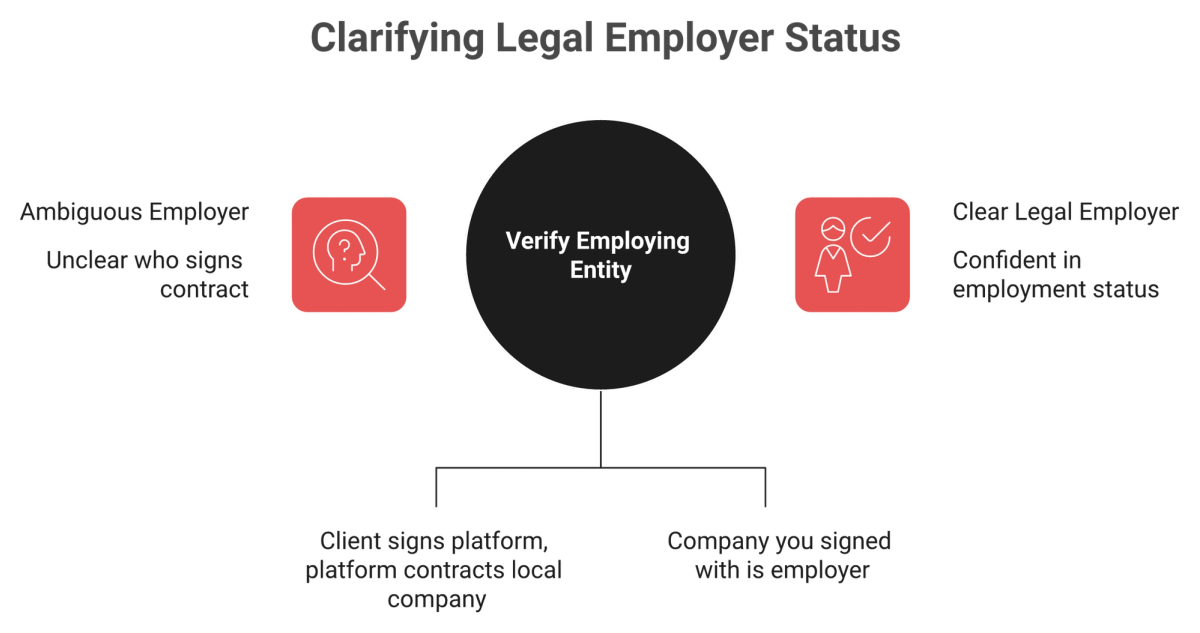
⚠️ Where the extra hop actually hurts
Three moments expose the chain. A state labour inspection, where the officer asks the employing entity for muster rolls and the answer has to travel two layers. A permanent establishment, or PE, question, where the tax position depends on who exercised employer control. And an FC-GPR or FEMA query on the remittance trail, where a third party invoice breaks the chain of documentation.
None of this is illegal. It is just slower, and slower is expensive when an assessment officer sets a deadline. Our India EOR service page sets out which registrations sit with us.
✅ Honest comparison, entity model only
| Provider | India entity model | Files under whose registrations | India state coverage |
| Deel | Local partner reported for India | Partner entity | Top states, concentrated |
| Remote / G-P / Multiplier | Partner entities common in India | Partner entity | Varies by market |
| Versatile Club | Own registered Indian entity | Versatile Club's own EPFO, ESIC, and S&E registrations | India only, all 28 states and 8 union territories |
To be fair to Deel, the partner model is why they can offer 150 plus countries at all. Nobody incorporates in 150 jurisdictions quickly. That is a legitimate engineering trade off, and for scattered hiring it is the right one.
⏰ The thirty second verification script
Ask three things in writing before you sign, and ask them of any provider including Versatile Club.
- Which legal entity employs my engineer? Give me the CIN, the corporate identity number on the MCA register.
- What is that entity's PF establishment code and ESIC code?
- Does that name appear on the offer letter, the payslip, and the Form 130 you will issue?
Then check the PF establishment code on the offer letter against the name on your MSA. If they differ, you have a partner entity. That takes thirty seconds, and it has spared two of my clients an audit scramble. If you are already mid-contract, our guide on switching an EOR provider in India covers the handover.
Versatile Club is the employer of record itself, with our own Indian entity, our own EPFO and ESIC registrations, and our own GST number on the invoice. When a state labour officer asks about your engineer, the answer comes from the company you signed with.
Q4. What do the low-star Deel reviews reveal about support when something breaks?
Deel's low rated reviews share one pattern. The platform works until an exception appears, then escalation stalls. Verified G2 reviewers describe cancelled meetings and missed deadlines on an immigration filing that was denied, an account frozen for VPN use that blocked payments, a contractor holiday rule left unbuilt for over six months, and support that does not resolve the underlying issue. None of these are interface problems. They are ownership problems. Versatile Club routes client escalations directly to its founder on WhatsApp rather than through a ticket queue.
😟 The situation: everything works until it does not
Picture a People Ops lead at a Series B company. Payroll has run cleanly for seven months. Then an exception arrives, a visa filing, a frozen account, a holiday calendar that the product does not support.
This is the moment the vendor is actually being tested. Not onboarding. Not the dashboard.
💬 The complication, in reviewers' own words
Three failure types, three real reviews. Process ownership failure:
"They consistently failed to meet committed deadlines, had terrible communication, and frequently cancelled meetings at the last minute. The USCIS denial letter explicitly stated that Deel forgot to attach critical evidence to the application."
— Verified User in Computer Software, Founder Deel Hire - G2 Verified Review, 0/5, 13 Dec 2025
Resolution quality failure:
"Their solutions for bugs are not really helpful, because customer support doesn't help us with efficient solutions. The solution is under development and it will probably take more than 6 months to see light."
— Verified User, HR Administrator Deel Hire - G2 Verified Review, 1/5, 9 Jul 2025
Account control failure:
"They froze my account for just using a VPN for work. I was unable to get payments due to this. I'm recommending my company to not onboard anyone onto Deel."
— Verified User, Contractor Deel Hire - G2 Verified Review, 1.5/5, 21 Feb 2025
⏰ Why chatbot-first routing breaks at the exception
Ticket systems are built for volume, and they are genuinely good at it. They are structurally bad at accountability, because no single named person owns your problem end to end.
A US founder once messaged me on WhatsApp at 11pm her time, three days before payroll, asking why her Bengaluru engineer's PF challan had not landed in her inbox. That question has a two minute answer if the person reading it filed the challan. It has a three day answer if it enters a queue. Our how it works page shows where that line sits in the workflow.
✅ How to test this before you sign
Versatile Club encourages prospects to run this test on us too, because it is the only honest way to compare service models.
- During a trial or first month, raise one deliberate exception. A mid cycle salary revision works well.
- Note the timestamp you raised it and the timestamp a human, not a bot, took ownership by name.
- Ask who is accountable if it is unresolved in 48 hours, and get that name in writing.
I will name the trade off honestly. Founder led support is a constraint, not a feature, and Versatile Club's read is that it will have to change as we scale. Deep enterprise procurement customisation also takes us longer than our five day onboarding SLA. I might be reading our own data too optimistically here, but so far the constraint has been worth keeping.
Versatile Club routes escalations to the founder on WhatsApp, with no CSM rotation and no ticket queue. We are candid that this reflects our current scale. Until then, the person who built the company answers when your payroll date is 48 hours out, and you can reach us directly to test it.
Q5. Is Deel's India compliance deep enough for the 2025-26 statutory reset?
Four India changes landed between November 2025 and April 2026, and each is a direct question for your Employer of Record (EOR), the company that legally employs your staff. The four Labour Codes took effect on 21 November 2025, resetting "wages" so Basic plus Dearness Allowance plus retaining allowance is at least 50% of total remuneration, which lifts Provident Fund (PF), Employees' State Insurance (ESI), gratuity, and bonus. DPDP Rules 2025 were notified on 13 November 2025 vide G.S.R. 846(E). EPF Scheme 2026 keeps International Workers mandatorily covered. Form 130 replaced Form 16 from 1 April 2026. Versatile Club files PF, ESI, TDS, and professional tax under its own Indian registrations.
⚠️ Four changes, four questions, four Monday actions
| Change | Primary citation | What it does to you | Monday action |
| Labour Codes in force | Commenced 21 Nov 2025; Code on Wages, 2019 and Code on Social Security, 2020 | Basic plus DA must be 50% or more of total pay, so PF, gratuity, and bonus all rise | Re-model every India offer at a 50% Basic floor before you sign |
| DPDP Rules 2025 | MeitY G.S.R. 846(E) dated 13 Nov 2025, commencement G.S.R. 843(E), phased to 14 May 2027 | Your EOR is a data processor for employee data, with real notice and breach duties | Replace the GDPR style data agreement with a DPDP specific one |
| EPF Scheme 2026 | G.S.R. 525(E) dated 29 June 2026, with corrigendum | High salary no longer excludes International Workers from PF | Audit any India based foreign national on payroll for PF coverage |
| Form 130 | Section 395(4)(b) read with Rule 215(1), Income-tax Rules, 2026 | Form 16 is gone; the salary TDS certificate is now Form 130 | Ask for a sample Form 130 in writing, not a "Form 16" promise |
⏰ Why a global playbook answers these slowly
A platform covering 150 plus countries maintains a compliance matrix. That is a reasonable engineering choice, and it is genuinely useful for breadth.
The problem is latency. When a rule changes in one country, a matrix updates on a release cycle. A single country operator updates on the next payroll run, because there is no other country to sequence behind. Our India payroll compliance guide tracks each change as it lands.
🗓️ Professional tax is four calendars, not one
Versatile Club maintains state level filings directly, which is where the abstraction usually breaks. Professional tax (PT) is a state salary tax, and every state runs it differently.
Maharashtra needs dual PTRC and PTEC registration with a monthly slab. Karnataka runs a monthly PT cycle plus Shops and Establishments renewal. Tamil Nadu files twice a year and adds Labour Welfare Fund. West Bengal changes its rules often enough that I check quarterly.
That is not trivia. It is four separate calendars I maintain, and no global dashboard has ever reminded me about one of them. If you want the city level view, we publish it for payroll outsourcing in Bengaluru and payroll outsourcing in Hyderabad.
❌ The PEO frame is the wrong frame in India
Many US buyers ask for a PEO, a Professional Employer Organisation. In the United States that means co-employment, where two companies share employer duties.
Indian labour law has no co-employment structure of that kind. One entity is the employer, files the returns, and carries the liability. If a vendor sells you "PEO India" without an entity, ask which registration the PF challan lands under. Our EOR versus PEO comparison sets out the legal difference in full.
🛡️ Where permanent establishment risk actually sits
Permanent establishment (PE) risk is the chance that your India activity creates a taxable presence for your foreign company. It turns on who directs the work and who signs contracts, not on which software you bought.
Versatile Club's read is that most EOR marketing overstates how much a platform can insulate you here. An owned entity reduces documentation ambiguity, which helps. It does not license you to run India sales through an EOR employee and expect no questions. Buyers weighing the alternative should read our EOR versus entity analysis for India.
Versatile Club files PF, ESI, TDS, and professional tax under its own registrations across Indian states, so the 50% wage split rule, Form 130 issuance, and DPDP processor duties sit with the entity that signs your contract. Compliance is the floor we start from, not the product we sell, and the detail sits on our compliance page.
Q6. Where does Deel genuinely win, and who should simply buy it?
Deel is the right answer when hiring is scattered rather than concentrated. For one or two people across ten countries, coverage of 150 plus countries, one contract template, one dashboard, and onboarding in 1 to 3 days genuinely beat managing ten local vendors. Reviewers consistently praise payment speed, withdrawal options, low SWIFT transfer fees, and a clean interface. Deel also wins when you want HRIS, payroll, contractors, and equipment behind one login, or when procurement requires enterprise security certifications. Concentration flips the maths, at the point three or more hires sit in one country.
✅ Scenario one: scattered hires across many countries
You have one designer in Portugal, one engineer in Argentina, and one analyst in Poland. Setting up three local relationships is worse than paying a premium for one.
This is the case Deel was built for, and it does it well. I would not try to compete for that buyer, because I cannot.
✅ Scenario two: payment rails matter more than statute
Some teams pay contractors in twenty currencies and need the money to land fast. Reviewers describe internal transfers executing instantly and payments landing within hours.
"I appreciate Deel's internal fund transfer feature, which is executed instantly. It usually takes just a matter of hours for a payment to be processed and appear in my wallet, which is a significant advantage over competitors."
— Verified User, Contractor Deel Hire - G2 Verified Review, 3/5, 21 Oct 2025
"I like that with Deel Hire it's convenient to receive payments from clients, and there are many ways to withdraw money. I especially appreciate the low fees on SWIFT transactions."
— Verified User, Contractor Deel Hire - G2 Verified Review, 4/5, 23 Sep 2026
⭐ Scenario three: unusual payout needs
Deel supports payout methods most specialists do not attempt. One reviewer receives salary directly in cryptocurrency, which is a real requirement for some distributed teams.
"I love that Deel allows me to receive my payments directly in cryptocurrency, which is really pleasant and innovative. I also appreciate the platform that allows me to see my payments and my contract easily in one place."
— Verified User, Contractor Deel Hire - G2 Verified Review, 3/5, 3 Nov 2025
Note that all three reviewers still flagged app performance or setup friction. A fair read is that the rails are strong and the surrounding experience is uneven. If India is the concentrated part of your plan, our Deel alternatives for India list covers the specialist options.
❌ Four buyers I send to Deel or an enterprise platform
Versatile Club operates in exactly one country, so the honest list of people we are wrong for is short and specific.
- Companies needing EOR in five or more countries at once.
- Enterprises with 100 plus India employees and an internal compliance audit team.
- Buyers whose procurement requires SOC 2 or ISO 27001 as a gate, since Versatile Club does not yet hold those certifications.
- B2C and retail hiring, where our placement record does not apply.
🔢 The concentration threshold, stated as a number
The decision rule I use with prospects is arithmetic, not loyalty. Count your hires per country.
If no country holds more than two people, keep the generalist. At three or more in one country, the per head premium starts funding a specialist outright, and depth becomes cheaper than breadth. I tell founders hiring across six countries to keep Deel and give Versatile Club only India. That is not modesty, it is the correct architecture, and our startup hiring model is built around that split.
Q7. Deel vs Versatile Club vs Wisemonk vs Remote and G-P: which fits which hiring shape?
Compare on six criteria, not country count: who owns the Indian entity, the flat monthly fee, setup and exit fees, foreign exchange treatment, the contractual onboarding SLA, and who answers at 11pm IST. Versatile Club employs India staff through its own registered Indian entity at $149 per employee per month, with a 5 day contractual onboarding SLA, no setup fee, no exit fee, and the first month free. Wisemonk is the other India native option. Deel, Remote, G-P, Multiplier, and Papaya win on breadth, at $599 and up per employee per month with partner entities in India.
📊 Six criteria, six providers, figures as published in 2026
| Provider | India entity model | Monthly fee per employee | Setup and exit fees | FX treatment | Onboarding SLA |
| Versatile Club | Own registered Indian entity | $149 flat | None, first month free | USD invoice issued from India, no FX leg | 5 days, contractual |
| Wisemonk | India native, owned entity | $99 to $399 | Varies by plan | INR or USD, varies | 24 to 72 hours claimed |
| Deel | Partner entity reported for India | $599 EOR, $899 Enterprise | Setup fee reported, one month exit notice | 3% to 5% conversion margin reported | 7 to 14 days reported |
| Remote | Partner entities common in India | $599 and up | Varies | Platform managed | 10 to 14 days reported |
| G-P | Partner entities common in India | About 15% of salary | Varies | Platform managed | 1 to 2 weeks |
| Multiplier | Partner entities common in India | About $400 | Varies | Platform managed | 1 to 2 weeks |
I have put Versatile Club first because India is the column being scored. On a global coverage table I would rank us last, honestly, since we operate in exactly one country. Provider by provider breakdowns sit in our best EOR in India roundup and our Wisemonk alternative page.
🧭 Verdict one: your first single India hire
You need speed and a clean paper trail, not a 150 country dashboard. Any of the three India options works, and the generalists work too at a higher price.
Versatile Club's 5 day contractual onboarding SLA exists because the first hire is usually blocking a product deadline. The word "contractual" is the part that matters, since an SLA without a remedy is a marketing claim. Our guide on how to hire in India without an entity walks through that first cycle.
🧮 Verdict two: eight engineers in Bengaluru
This is where the arithmetic separates cleanly. Eight seats at $599 is $57,504 a year in platform fees alone, before any setup charge or conversion spread.
Eight seats with Versatile Club at $149 is $14,304, and $13,013 in year one with the first month free. That difference funds an additional junior engineer. I might be reading our own win rate too optimistically, but this table is the reason most of our switchers cite. Run your own numbers on the India salary calculator.
🌍 Verdict three: ten people across ten countries
Buy the generalist. Versatile Club would be the wrong vendor, and saying so costs me nothing because that buyer was never ours.
If three of those ten sit in India, split the stack. Generalist for the tail, specialist for the hub.
⚠️ What no table captures
Three things resist tabulation. Whether the named human on your account is still there in month nine. Whether your engineer's PT registration was filed in the correct state. And whether anyone tells you about a rule change before it hits your payroll.
Versatile Club sits first in this table for a concentrated India team because every column scored is one we control: our entity, our filings, our flat fee, our 5 day contractual SLA, no setup or exit fee. Against $599 per employee per month plus setup, the gap on a five person Bengaluru pod becomes real budget inside one quarter. The full scope is on our India EOR services page.
Q8. What should you ask Deel, and check on their invoice, before signing?
Ask twelve questions and get every answer in writing. Which legal entity employs my engineer, and what are its CIN, PF establishment code, and ESIC code? Show a live sample invoice with every line item. What foreign exchange rate and margin apply? Is there a setup fee, security deposit, benefits markup, or exit fee? What is the onboarding SLA, and what is the remedy if it slips? Do you issue Form 130? Then audit the invoice itself. GST e-invoicing is mandatory above ₹5 crore aggregate annual turnover, so a missing Invoice Reference Number (IRN) puts your input tax credit at risk. Versatile Club supplies all twelve answers in one pre-signature document.
📋 The twelve questions, and the answer that should worry you
Ask these of any provider, including Versatile Club.
- Which legal entity employs my engineer? Worry if the answer is a brand name, not a registered company.
- What is that entity's CIN on the MCA register? Worry if nobody can find it.
- What is its PF establishment code and ESIC code? Worry if they cannot produce both.
- Does that entity name appear on the offer letter and payslip? Worry if it differs from your contract.
- Can I see a live sample invoice, unredacted on line items? Worry if this takes a week.
- What FX rate source and margin do you apply? Worry at "market rate" with no number.
- Is there a setup fee or security deposit? Worry if it appears only in the order form.
- Is there a benefits markup on insurance? Worry if benefits are bundled with no breakdown.
- What is the exit notice, and is there an exit fee? Worry at anything above one month.
- What is the onboarding SLA, and the remedy if missed? Worry if there is no remedy.
- Will you issue Form 130 for this tax year? Worry if they still say Form 16.
- Who owns an escalation after 48 hours, by name? Worry at "our support team".
⏰ The 90 second invoice audit
Versatile Club issues GST compliant invoices from its own Indian entity, which is why I can tell you exactly where to look. Open the most recent invoice and check four things.
First, the IRN and the QR code, which prove the invoice was reported to the Invoice Registration Portal. Second, a separate FX line, or confirmation that none exists. Third, the statutory split showing PF, ESI, and PT as distinct amounts. Fourth, whether the GST number on the invoice belongs to the entity that employs your engineer. Our managed payroll service produces that split as standard.
💸 Why the live invoice beats the pricing page
A pricing page is a marketing artifact. An invoice is an accounting one, and it cannot hide a line item that exists.
The live invoice request is the highest yield ten minutes in EOR procurement. Vendors who resist it are telling you something, and I would read that signal seriously. For a full cost baseline, compare against our cost of hiring in India breakdown.
✅ What to do with the answers
Put all twelve in a single table before you compare price. Versatile Club has watched buyers choose on monthly fee, then lose the saving to a setup charge and a conversion spread inside two quarters.
Score entity ownership and escalation ownership first. Price third. That ordering has held up across six years of India placements, though I will admit it is easier advice to give than to follow when a hiring deadline is three days out.
Versatile Club answers all twelve in one pre-signature pack: a live sample invoice with IRN, the entity's registration numbers, the 5 day contractual onboarding SLA with its remedy, and written confirmation of no setup fee and no exit fee. If a vendor cannot hand you that pack on request, the pack is the answer. Ask us for it on the contact page or check the published pricing.
Q9. What do Deel reviews never mention about whether the India hire actually works?
No Deel review tells you whether your India hire is still there in month nine. Employer of Record (EOR) platforms solve employment mechanics, meaning contract, payroll, and statutory filings, then stop at the boundary of whether the person fits. That boundary is where the money sits. Nearly 30% of Indian IT sector resumes contain discrepancies, and misclassification exposure runs $25,000 to $40,000 per head. Versatile Club screens culture fit across 50 behavioral parameters before an offer is issued, assigns a 90 day Success Coach after joining, and carries a 6 month replacement guarantee on Contract-to-Hire placements.
⭐ The reframe: India is an innovation hire, not a cost hire
I want to kill a framing before it costs someone a good team. Offshore hiring pitched as cheap labour produces cheap outcomes.
The reason to hire in Bengaluru, Hyderabad, or Pune is depth of academically strong engineering talent with fewer local employers competing for it. Lower cost is a byproduct. When founders lead with cost, they underpay, undersupport, and lose the person in month seven. Our guide to hiring AI and ML engineers in India works from that same premise.
⚠️ The expensive failure is never the filing
Six years of Contract-to-Hire work taught me this the hard way. The technically qualified, culturally mismatched hire is the one that hurts.
A failed first India hire costs the salary, the ramp time, the hiring manager's quarter, and frequently the entire India plan. I have watched two US founders abandon India expansion after one bad hire, blaming the country instead of the process. That is a sourcing failure, not a payroll failure, and no platform rating captures it. Our recruitment service exists because of exactly that gap.
💬 What reviewers say when process replaces judgment
"WiseMonk is one of the primary reason I chose to stay with the company that I got offer from rather than jumping around for counter offers because of the friendly and informative approach."
— Verified User in Financial Services, Placed Candidate Wisemonk - G2 Verified Review, 4/5, 16 Jun 2025
That review is about retention, and it came from a candidate, not a buyer. Compare it with what happens when onboarding is purely procedural.
"Deel treats all users as if they were individual freelancers, even when you're clearly operating as a registered company. There is no flexibility, no option for company level onboarding. Deel's one size fits all approach creates unnecessary friction."
— Verified User in Translation and Localization, Vendor Owner Deel Hire - G2 Verified Review, 0.5/5, 5 May 2025
"The onboarding process with Deel Hire was honestly a little confusing. There was a task list next to the alerts without any indication that it needed to be done."
— Verified User, New Hire Deel Hire - G2 Verified Review, 3/5, 24 Jun 2026
✅ How Versatile Club measures fit before the offer
Versatile Club scores candidates on 50 behavioral parameters, covering communication style, ownership behaviour, and async working habits, before an offer goes out. Background verification runs against the resume discrepancy risk noted above. You can see the framework in our culture fit quiz.
I will hedge this honestly. Versatile Club's replacement data is encouraging so far, and I might be reading a small sample too confidently. What I am confident about is the direction, because the parameters were built from placements that failed, not placements that worked.
⏰ One management habit that saves distributed India teams
This one is free, and it works regardless of which vendor you pick. Stop asking closed questions.
Never ask "are you on schedule?" because the culturally polite answer is yes. Ask "where are we on the schedule?" or "show me what is left." Versatile Club's 90 day Success Coach uses exactly that script in weekly check ins, because the first version of a status update is rarely the accurate one. Our HR consulting service builds the same habit into manager onboarding.
Versatile Club screens culture fit across 50 behavioral parameters, assigns a 90 day Success Coach, and backs placements with a 6 month replacement guarantee. That is what a payroll platform structurally cannot offer. Deel is accountable for paying your engineer correctly, not for whether hiring that engineer was right.
Q10. So should you buy Deel, switch, or run a split-vendor stack?
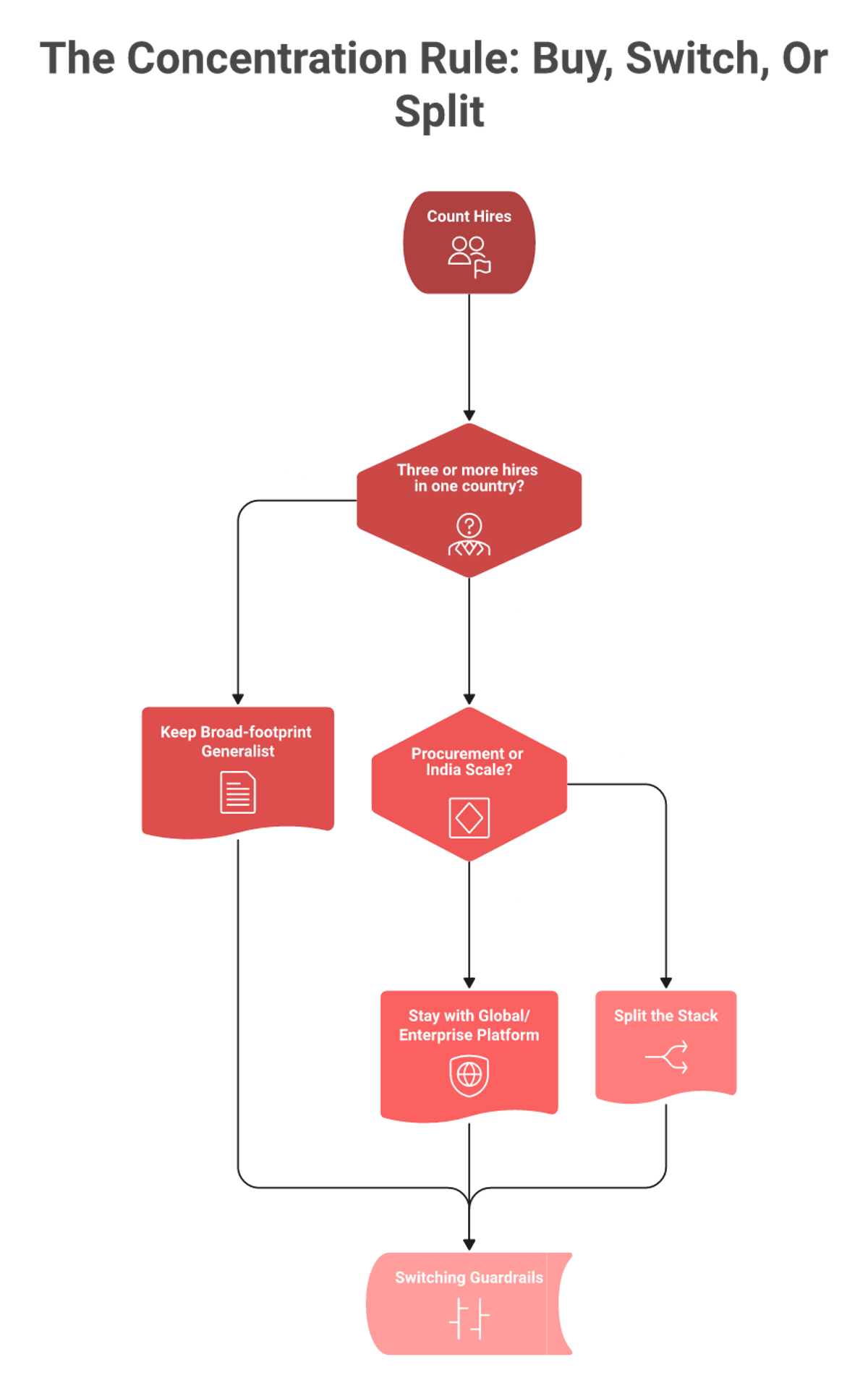
Use one rule: geographic concentration. If no country holds more than two hires, keep Deel and pay for breadth. If one country holds three or more, split the stack, with the generalist for the scattered tail and an owned entity specialist for the hub. Switching is cheapest at a payroll month boundary, with employee consent, Form 130 continuity, and a clean full and final settlement from the outgoing provider. Versatile Club takes over India seats mid year with no setup fee, no exit fee, and the first month free.
🧮 The decision rule, in one calculation
Open your headcount plan. Count hires per country, not total headcount.
At one or two per country, breadth wins and the premium is justified. At three or more in one country, the per head premium starts funding a specialist outright. That is the whole rule, and it does not require a spreadsheet model. If you want the sensitivity analysis, our offshore ROI module runs it.
⚠️ Do not switch for the wrong reason
A $200 monthly delta is not a reason to move. Migration consumes People Ops attention, and attention is scarcer than budget at Series A.
Switch for two things only. Entity ownership, so your filings sit with the company you signed. And escalation ownership, so a named human is accountable at hour 48. Versatile Club has seen buyers move purely on price, then discover the new vendor also routes them to a queue. Our Deel alternative page lists what to test instead.
⏰ The switching sequence that actually works
Versatile Club runs mid year migrations on a fixed sequence, and I will share it plainly because any competent provider should do the same. The long form version sits in our guide on how to switch EOR providers in India.
- Pick a payroll month boundary. Never transfer mid cycle.
- Get written employee consent before any data moves, which the DPDP Rules now make non optional.
- Collect the full and final settlement and the closing payslip from the outgoing provider.
- Confirm who issues Form 130 for the part year, since the salary TDS certificate now replaces Form 16.
- Re-register the employee under the new entity's PF and ESI codes, with continuity of the Universal Account Number.
- Reconcile the first new invoice against the last old one, line by line.
💰 Why the third option is usually the right one
Most people read this question as buy or leave. The honest answer is usually neither.
Keep the generalist for Portugal, Argentina, and Poland. Move India to a single country operator. Versatile Club runs alongside Deel for several clients, not instead of it, and that arrangement has been more durable than the rip and replace pitch. Our EOR services page explains how the India seat plugs into an existing stack.
🚧 The trap on the other side
I should also push back on the opposite playbook. "Just set up your own Indian subsidiary" sounds disciplined and usually is not, at least not early.
Incorporation, FEMA and FC-GPR filings, and a compliance calendar take real money and months before the first hire lands. An EOR is the light bridge you cross while deciding whether to build the permanent one. Build the permanent one when India headcount and a long horizon justify it, not because a board member suggested it. Our India expansion options comparison and our captive centre setup guide lay out both paths.
⚠️ The part nobody warns you about
I have run this migration more than once. Payroll is the easy half.
The hard half is the employee's trust on the day their employer of record changes name. Versatile Club handles that with a direct call to the employee before any paperwork moves, because a Bengaluru engineer reading a new company name on a contract deserves a human explanation.
Versatile Club takes over India seats mid year with no setup fee, no exit fee, and the first month free, which removes the switching cost argument almost entirely. Send me your current India invoice on WhatsApp and I will read it back to you line by line, including the lines that are not labelled. You can also book thirty minutes with me directly.
FAQs
Are Deel reviews reliable enough to judge India compliance quality?
Deel's aggregate scores are real, but they answer a narrower question than most buyers assume. Deel holds roughly 4.7 out of 5 across about 14,900 G2 reviews and 4.9 out of 5 across around 4,300 Capterra reviews as of September 2026.
Read who wrote them before you read the number:
- A large share of positive reviews come from contractors and employees rating payout speed, withdrawal options, and low SWIFT fees.
- Buyer-side sentiment is harsher. On Capterra, 48% of 229 pricing mentions are negative.
- Almost none of the reviewers can tell you whether a PF challan was deposited by the 7th, or whether Karnataka's monthly professional tax cycle was filed on time.
A review score measures interface quality and payment reliability. It does not measure state-level filing punctuality, escalation ownership during a payroll exception, or audit readiness. Versatile Club files PF, ESI, TDS, and professional tax under its own Indian registrations, which is why we tell buyers to score filing dates and response times alongside star ratings. If you want the statutory checklist rather than the review aggregate, start with our India compliance coverage and ask any shortlisted vendor the same questions.
How much does Deel actually cost per India employee in 2026?
Deel's published 2026 pricing starts at $599 per employee per month for standard EOR and $899 for Enterprise, with contractors at $49 per month, Contractor of Record at $325, global payroll at $29 plus a $1,000 entity setup fee, and HRIS at $5.
In India, that ladder is the smallest line in your model. Build the real number from three layers:
- Platform fee: $599 per head per month, or $7,188 a year.
- Statutory load: employer contributions add roughly 20% to 40% on gross pay, and the 2025 Labour Codes raised the wage base by requiring Basic plus DA to be at least 50% of total remuneration.
- Currency spread: reported FX conversion margins of 3% to 5% on remittance flows, plus a reported setup fee and one month exit notice.
For one engineer at ₹18 lakh CTC, that stacks to roughly $8,500 in year one vendor cost before statutory contributions. Versatile Club charges a flat $149 per employee per month, invoiced in USD directly from our own Indian entity, with no setup fee, no exit fee, and the first month free. Model both scenarios side by side using our EOR versus entity calculator before you approve a budget line.
Does Deel use its own entity in India or a local partner?
Deel operates a mix of directly owned and partner entities depending on the country, and independent reviews describe India as running through a local partner or aggregator. Deel's own India hiring guide advises buyers to choose an EOR with a wholly owned India entity, which is sound advice and the exact question to put back in writing.
The partner model matters in three moments:
- State labour inspection: the officer asks the employing entity for muster rolls, and the answer travels through two companies instead of one.
- Permanent establishment questions: the tax position turns on who directed the work and signed contracts.
- FEMA and FC-GPR queries: a third party invoice breaks the clean documentation chain on the remittance trail.
Verify it in thirty seconds. Ask for the employing entity's CIN on the MCA register, its PF establishment code, and its ESIC code. Then check whether that name matches your master services agreement. Versatile Club employs India staff through its own registered Indian entity, with our own EPFO, ESIC, and Shops and Establishments registrations, and our own GST number on the invoice. The full structure is documented on our India EOR services page.
What do negative Deel reviews reveal about support when something breaks?
Deel's low-rated reviews share one pattern. The platform works smoothly until an exception appears, and then escalation stalls. Verified G2 reviewers describe cancelled meetings and missed deadlines on an immigration filing that was later denied, an account frozen for VPN use that blocked payments, and a contractor holiday rule left unbuilt for more than six months.
Three failure types repeat across the one-star and half-star reviews:
- Process ownership: committed deadlines missed, with no single named person accountable.
- Resolution quality: support that acknowledges a bug without resolving it, with fixes deferred to a release cycle.
- Account control: automated risk rules freezing accounts and interrupting payments.
None of these are interface problems. They are ownership problems, and chatbot-first routing is structurally poor at accountability. Test it before you sign: raise one deliberate exception, such as a mid-cycle salary revision, then time how long until a named human takes ownership. Versatile Club routes client escalations directly to the founder on WhatsApp, with no CSM rotation and no ticket queue, and we are candid that this reflects our current scale. See how that sits inside the workflow on our how it works page.
Should we keep Deel, switch, or split the stack for India hiring?
Use one rule: geographic concentration. Count hires per country rather than total headcount.
- One or two hires per country: keep Deel. Coverage of 150 plus countries, one contract template, and one dashboard genuinely beat managing ten local vendors.
- Three or more in one country: split the stack. Keep the generalist for the scattered tail and move the hub to an owned-entity specialist.
- Five or more countries at once, 100 plus India employees, or SOC 2 as a procurement gate: stay with a global or enterprise platform. Versatile Club does not yet hold SOC 2 or ISO 27001, and we say so plainly.
If you do switch, sequence it properly. Move at a payroll month boundary, take written employee consent before any data transfer, collect the full and final settlement and closing payslip, confirm who issues Form 130 for the part year, and re-register PF and ESI with Universal Account Number continuity.
Versatile Club takes over India seats mid year with no setup fee, no exit fee, and the first month free, which removes most of the switching-cost argument. Walk through the sequence in our guide on how to switch EOR providers in India.