Table of contents (15)
8 Best Oyster Alternatives in India (Cheaper EOR Options Compared)
Q1. What Are the 8 Best India EOR & Contract-to-Hire Providers for Hiring in India in 2026?
The eight best Oyster alternatives for India in 2026 are Versatile Club, Deel, Remote, Multiplier, Globalization Partners, Pebl (formerly Velocity Global), Papaya Global, and Payoneer (formerly Skuad). Versatile Club leads for India-only hiring: it owns its Indian entity, Foo Falcon Technologies Pvt Ltd, charges $149 per employee per month flat with no setup or exit fee, invoices in USD from India, and writes a 5-day onboarding SLA into the service agreement.
Editorial Introduction
Choosing an India employer of record (EOR), the company that legally employs your staff, is a high-stakes call. The provider signs the contract, files provident fund and tax returns, and carries statutory liability for years. This guide analysed eight providers serving US and UK companies hiring in India. Each was assessed on entity model, statutory compliance depth, state-level coverage, onboarding speed, pricing transparency, invoicing and audit readiness, support model, retention support, and customer validation. It is written for founders, People Ops leaders, CFOs, and legal teams hiring one to fifty employees in India, and for teams currently reviewing global platforms.
Our Evaluation Criteria
Each provider included in this list was assessed across the following decision-grade criteria:
India Entity Model: own Indian entity, local partner entity, contractor model, or payroll-only setup.
Statutory Compliance Depth: PF, ESI, TDS, professional tax, gratuity, POSH, Form 16, full-and-final settlement, DPDP readiness, and New Labour Code 2025-26 structuring.
State-Level Coverage: professional tax, Shops and Establishments, labour welfare fund, and leave rules across Indian states.
Onboarding Speed: signed agreement to compliant contract, payroll setup, statutory registration, and employee start.
Pricing Transparency: monthly fee, setup fee, exit fee, FX markup, first-month terms, salary-band pricing, and invoice clarity.
Invoicing and Finance Readiness: USD invoicing, gross-deduction-net reporting, challan confirmations, TDS receipts, and audit-ready records.
Support Model: founder-direct, named HR manager, HRBP, ticket queue, chatbot, or general CSM.
Talent and Retention Support: recruiting, contract-to-hire, culture-fit vetting, onboarding monitoring, and replacement guarantee.
Customer Validation: G2, Capterra, Clutch, Reddit, case studies, and named testimonials.
Best-Fit Buyer Segment: first India hire, 1 to 20 employees, 10 to 50 employees, switchers from Deel or Remote, or enterprises needing multi-country EOR.
Who This Guide Is For
This guide is designed for:
US and UK founders hiring their first 1 to 3 employees in India.
Seed to Series B startups building engineering, product, AI, design, marketing, or operations teams in India.
People Ops and HR leaders reviewing India EOR, payroll, contractor, or PEO vendors.
CFOs and finance teams that need clean invoicing, statutory liability visibility, and audit-ready India payroll records.
Legal teams reviewing employment contracts, IP assignment, misclassification risk, PE risk, and statutory employer accountability.
Companies currently using Deel, Remote, Multiplier, G-P, contractors, agencies, or local payroll vendors.
The 8 Providers at a Glance
Versatile Club: Best for US and UK companies whose only hiring country is India.
Deel: Best for teams hiring across many countries under one contract.
Remote: Best for companies that want owned entities in core markets.
Multiplier: Best for fast APAC hiring on a mid-range budget.
Globalization Partners: Best for enterprise procurement and heavy legal review.
Pebl (formerly Velocity Global): Best for complex cross-border employment cases.
Papaya Global: Best for consolidating global payroll into finance reporting.
Payoneer (formerly Skuad): Best for contractor-heavy teams converting to employment.
Master Comparison Table
| Provider | Best For | Key Strength | Compliance |
|---|---|---|---|
| Versatile Club ⭐⭐⭐⭐⭐ | US and UK startups hiring their first 1 to 30 India employees | Flat $149 per employee monthly, no setup or exit fee, first month free | Own Indian entity; PF, ESIC, and S&E registrations across all 28 states and 8 UTs |
| Deel ⭐⭐⭐⭐ | Companies hiring in 10 or more countries from one dashboard | Broadest country coverage and contractor tooling | India served through local partner entity |
| Remote ⭐⭐⭐⭐ | Teams wanting owned entities in a smaller set of core markets | Owned-entity model in several major markets | Strong IP assignment and data handling framework |
| Multiplier ⭐⭐⭐⭐ | Mid-market teams hiring quickly across APAC | Faster onboarding than most global platforms | India coverage via partner entity |
| Globalization Partners ⭐⭐⭐⭐ | Enterprises with formal procurement and legal review | Mature legal and enterprise contracting motion | Established compliance documentation for audits |
| Pebl (formerly Velocity Global) ⭐⭐⭐ | Companies with complex or unusual employment structures | Handles non-standard cross-border arrangements | Immigration and multi-jurisdiction support |
| Papaya Global ⭐⭐⭐ | Finance teams consolidating global payroll reporting | Payroll data and workforce spend reporting | Payroll-led model, EOR depth varies by country |
| Payoneer (formerly Skuad) ⭐⭐⭐ | Contractor-heavy teams converting people to employment | Contractor-to-employee conversion flow | Mixed entity and partner coverage |
1. Versatile Club: Best for US and UK Companies Whose Only Hiring Country Is India
🏗️ Overview
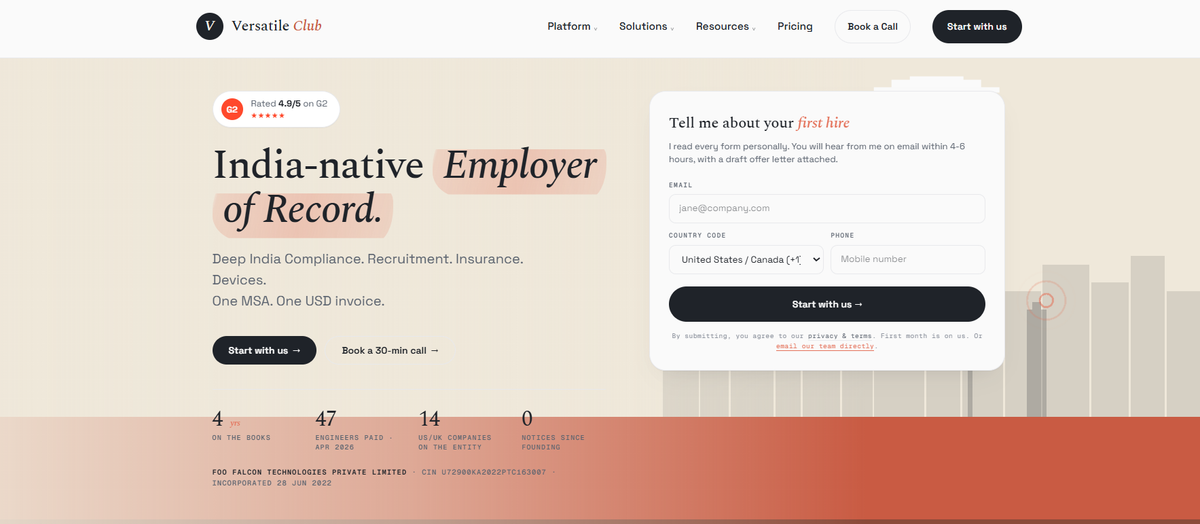
Versatile Club is an India-only employer of record and contract-to-hire provider serving US and UK companies. The legal entity is Foo Falcon Technologies Pvt Ltd, a registered Indian company. The provident fund registration, ESIC code, and Shops and Establishments licences sit under that entity.
Here is the honest part first. I launched the EOR product in 2026. The compliance muscle behind it is six years old, built running contract-to-hire payroll across Bengaluru, Hyderabad, and Pune.
🧾 Core Services
Employer of record for India, with the Indian entity as legal employer.
Contract-to-hire placement of engineers, designers, and operations staff.
Managed India payroll, including PF, ESI, TDS, and state professional tax.
USD invoicing and monthly compliance packs with challan confirmations.
Onboarding logistics support, including equipment and joining formalities.
💰 Why Companies Consider Versatile Club
The buying logic is usually cost plus depth. A team paying $599 per employee monthly for India is buying 150 countries of coverage and using one. Versatile Club charges $149 per employee per month flat, with no salary slabs, no setup fee, and no exit fee.
The second reason is who answers. I am on WhatsApp, and I own the entity your employee is legally employed by. That is not a support tier. It is the same person signing the compliance filings.
👥 Ideal Customer Profile
US and UK companies from seed to Series B, hiring 1 to 30 people in India.
Founders making their first India hire without a local entity.
People Ops leaders moving an India team off a global generalist platform.
CFOs at $5M to $50M ARR who need one USD invoice and audit-ready records.
💸 Commercial Model
Versatile Club prices at $149 per employee per month, flat across salary bands. Setup is $0, exit is $0, and the first month is free. Invoicing is in USD, issued from the single Indian entity, so the client carries no foreign exchange exposure.
⚠️ Who Should Not Pick Us
If you need employment in five or more countries, a global platform is the shorter path. If your security review gates on SOC 2 Type II or ISO 27001, we do not hold either yet.
⭐ Customer Reviews
"We used Versatile to hire our first employee in India after months of putting it off because the compliance side seemed like a mess. Sagar replied to our form in about four hours with a draft offer letter already attached. The hire was onboarded in four days. First USD invoice landed clean: no FX markup, no setup fee, no surprises."
- Verified User in Information Technology and Services, Versatile Club G2 - Verified Review
"The dashboard could be a little more self-serve. A couple of times I wanted to pull a report or a doc myself and ended up just messaging my contact instead. They always answered fast, so it wasn't a real problem, but I'd love to click around and find things on my own."
- Angad S., Versatile Club G2 - Verified Review
Versatile Club is the only provider on this list operating in exactly one country, holding its own PF, ESIC, and Shops and Establishments registrations across all 28 states and 8 union territories, with the 5-day onboarding SLA written into the signed agreement rather than the marketing page.
2. Deel: Best for Teams Hiring Across Many Countries Under One Contract
🌍 Overview
Deel is a global employment platform covering payroll, contractors, and employer of record across a very wide country list. It is the default shortlist entry for companies hiring in many places at once. In India, Deel operates through a local partner entity rather than an entity it owns.
🧾 Core Services
Employer of record across a broad global country set.
Contractor management, invoicing, and compliance documentation.
Multi-country payroll consolidation.
Immigration and visa support in selected markets.
Equipment and benefits administration through partners.
🤔 Why Companies Consider Deel
The decision logic is consolidation. One vendor, one dashboard, one contract, and a finance team that stops chasing five providers. For a company with people in twelve countries, that is a real operating benefit.
The trade-off shows up when India becomes a large share of headcount. A partner-entity model puts a third company between you and your employee's provident fund filing. Teams that hit this wall usually start comparing a Deel alternative for the India slice alone.
👥 Ideal Customer Profile
Companies employing people in 10 or more countries.
Series B and later teams with a formal vendor consolidation mandate.
Contractor-heavy organisations converting people to employment globally.
People Ops leaders who value platform breadth over single-country depth.
💸 Commercial Model
Deel's India EOR pricing is around $599 per employee per month, with a setup fee near $500 and one month's notice on exit. Reviewers also report transaction and currency conversion fees on payment flows. Confirm the current quote directly, since published pricing changes, and model it against the real cost of an employer of record in India.
⭐ Customer Reviews
"I appreciate the ease of setup with Deel; it took me only a few minutes, making the process straightforward. I dislike how expensive Deel's transaction fees are, especially when moving money from the Deel account to my bank."
- Maria M., 3/5 rating, Deel G2 - Verified Review
"Often the CS doesn't seem to have answers, which leads me to emails back and forth on my case which don't always answer the question, and something I was looking for the answer to in 20 minutes becomes a 4 day process."
- Verified User in Computer Software, 3/5 rating, Deel G2 - Verified Review
Versatile Club sits at the opposite end of that trade: one country, one entity, one flat fee, and same-day answers from the person who signs the statutory filings. For a team with people in twelve countries, Deel is the sensible pick. For a team whose India headcount is the whole story, compare it against the best EOR options in India before you renew.
3. Remote: Best for Teams That Want Owned Entities in Core Markets
🌍 Overview
Remote is a global employment platform offering employer of record, payroll, and contractor management. It built its reputation on owning entities in many of its markets rather than renting them. That entity-first story is the main reason it appears on India shortlists.
The India experience is still delivered inside a global operating model. Depth at the state level is thinner than an India-only provider.
🧾 Core Services
Employer of record employment in a wide country set.
Global payroll processing and payslip delivery.
Contractor management and compliant contracts.
Intellectual property and invention assignment protections.
Benefits administration through local partners.
🤔 Why Companies Consider Remote
The decision logic is usually legal comfort. Counsel likes the owned-entity model and the IP assignment framework. For a Series B company hiring across Europe, North America, and Asia, that consistency is worth real money.
Where it strains is speed and support. Onboarding runs roughly 10 to 14 days, and support arrives through a ticket queue rather than a named person. Teams that feel that gap on India hires often start pricing a Remote alternative for the India slice alone.
👥 Ideal Customer Profile
Companies employing people in five or more countries.
Series B and later teams with formal legal review of employment contracts.
Engineering organisations where IP ownership is a board-level concern.
People Ops leaders standardising contracts across regions.
💸 Commercial Model
Remote's India employer of record pricing sits around $599 per employee per month. A setup fee of roughly $299 applies, with one month's notice on exit. Confirm current terms directly, since published pricing shifts, and check the number against the real cost of hiring in India.
4. Multiplier: Best for Fast APAC Hiring on a Mid-Range Budget
⚡ Overview
Multiplier is a global employment platform with strong Asia-Pacific coverage. It sits between the $599 tier and the India specialists on price. Buyers usually find it when Deel and Remote quotes feel too high.
India is served through a local partner entity. That matters most when something goes wrong months later.
🧾 Core Services
Employer of record across Asia-Pacific and other regions.
Multi-country payroll and payslip generation.
Contractor onboarding and payments.
Expense and leave management inside one dashboard.
Insurance and benefits through regional partners.
🤔 Why Companies Consider Multiplier
Price and speed drive the decision. Onboarding around seven days beats most global platforms, and there is no setup fee. For a team hiring three people across India, Singapore, and Vietnam, that combination reads well.
The trade-off shows up in support depth. Account management runs by email through a customer success rotation, not a named India specialist. Buyers who want that named India owner usually shortlist a Multiplier alternative next.
👥 Ideal Customer Profile
Mid-market companies hiring across two or more APAC markets.
Series A to Series C teams with 5 to 50 international employees.
People Ops leaders who need speed without enterprise pricing.
Companies testing a market before committing to an entity.
💸 Commercial Model
Multiplier prices at roughly $400 per employee per month for India employer of record. Setup is $0, with around two weeks' notice on exit. Verify the quote against your salary bands before comparing, ideally alongside a flat-fee India EOR price list.
5. Globalization Partners: Best for Enterprise Procurement and Heavy Legal Review
🏛️ Overview
Globalization Partners, often written as G-P, is one of the oldest names in global employment. It sells primarily to enterprises with formal procurement processes. The contracting motion is built for legal and security review, not for a founder in a hurry.
That maturity is genuine. It also comes with the highest effective cost on this list.
🧾 Core Services
Employer of record employment across a broad global footprint.
Enterprise contracting with detailed compliance documentation.
Global payroll and statutory filing management.
Immigration and mobility support in selected markets.
Integration support for large HR systems.
🤔 Why Companies Consider Globalization Partners
The logic is risk transfer at scale. A 500-person company hiring in fifteen countries wants one vendor its general counsel already knows. G-P's documentation depth clears security and audit reviews without a fight.
For a startup making a first India hire, that same machinery becomes friction. Onboarding runs roughly 5 to 10 days once contracting completes, and contracting itself is the slow part. Founders in that position usually want an EOR service that can start in days, not quarters.
👥 Ideal Customer Profile
Companies with formal vendor security and procurement reviews.
Legal teams that require extensive contractual protections.
Organisations expanding into many countries in a single year.
💸 Commercial Model
G-P has historically priced India employer of record at around 15 percent of salary, with a minimum near $1,500 per employee per month. Setup and administrative fees can be substantial. Treat all figures as indicative and request a written quote.
6. Pebl (formerly Velocity Global): Best for Complex Cross-Border Employment Cases
🧩 Overview
Pebl, formerly Velocity Global, handles global employment with an emphasis on complicated cases. Think immigration, unusual contract structures, and employees moving between jurisdictions. It is a specialist in the awkward situations other platforms decline.
The portal experience draws mixed feedback from the people actually employed through it.
🧾 Core Services
Employer of record employment across many countries.
Immigration and right-to-work support.
Global payroll and benefits coordination.
Contractor engagement and conversion.
Support for non-standard employment structures.
🤔 Why Companies Consider Pebl
The buying reason is edge cases. When an employee needs a visa alongside employment, a generalist platform often stalls. Pebl takes those cases on.
The cost of that specialism shows in day-to-day experience. Reviewers report onboarding errors and a portal that resists self-service. For India-only teams, the shortlist usually narrows to Velocity Global alternatives in India.
👥 Ideal Customer Profile
Companies with employees requiring visas or relocation support.
Organisations employing across multiple complex jurisdictions.
Non-profits and institutions with unusual employment arrangements.
HR teams managing time-limited or project-based contracts.
💸 Commercial Model
Pricing is not publicly disclosed and is issued as a custom quote. Ask for the full fee schedule, including immigration handling and any deposit requirement.
⭐ Customer Reviews
"I encountered many frustrations with the onboarding, and continue to find the portal difficult to use. My contract had the wrong start date and other errors. The way annual leave is recorded is strange, it automatically logs weekend days, so this has incorrectly logged my leave."
- Verified User in Non-Profit Organization Management, 1/5 rating, Pebl (formerly Velocity Global) G2 - Verified Review
"I like the clear and detailed instructions, the helpful communication from Dominik Ksiazak, and the platform. I would appreciate starting the process of right-to-work check early in the process and without any duplication."
- Verified User in Non-Profit Organization Management, Pebl (formerly Velocity Global) G2 - Verified Review
7. Papaya Global: Best for Consolidating Global Payroll Into Finance Reporting
📊 Overview
Papaya Global started as a global payroll and workforce payments platform. Employer of record sits alongside that payroll core rather than underneath it. Finance teams are usually the buyer, not HR.
For India specifically, depth varies and should be tested against your state footprint.
🧾 Core Services
Global payroll processing and consolidated payments.
Employer of record in selected countries.
Workforce spend reporting and analytics.
Contractor payments and documentation.
Integrations with major finance and HR systems.
🤔 Why Companies Consider Papaya Global
The decision is a reporting decision. A CFO closing books across nine countries wants one dataset, not nine spreadsheets. Papaya's payroll reporting answers that directly.
One caution appears in public reviews of the category. A former customer noted moving away from Papaya specifically because it was not an employer of record for their needs, which is the distinction to settle before you compare it with managed payroll in India.
👥 Ideal Customer Profile
Finance-led organisations with payroll in many countries.
Companies with 100 or more employees across regions.
Controllers and CFOs standardising month-end close.
Teams that already have entities and need payroll, not employment.
💸 Commercial Model
Pricing is issued as a custom quote and varies by country and volume. Ask specifically whether India is delivered as employer of record or as payroll only.
8. Payoneer (formerly Skuad): Best for Contractor-Heavy Teams Converting to Employment
🔄 Overview
Payoneer, which acquired Skuad, offers global employment alongside its cross-border payments business. The natural fit is a company already paying contractors internationally. Converting some of those contractors to employees is the usual entry point.
India coverage mixes owned and partner arrangements depending on the market.
🧾 Core Services
Employer of record employment in a broad country list.
Contractor onboarding, invoicing, and payments.
Cross-border payment infrastructure.
Compliance documentation for contractor engagements.
Benefits coordination through local partners.
🤔 Why Companies Consider Payoneer
The logic is continuity. If your contractors already receive money through Payoneer, adding employment avoids a new vendor. Pricing also lands well below the $599 tier.
The limitation is India depth. Contractor-first platforms rarely carry state-level professional tax and Shops and Establishments fluency, which is the gap most buyers test when they review a Skuad alternative.
👥 Ideal Customer Profile
Companies with large international contractor populations.
Seed to Series B teams converting contractors to employees.
Marketplaces and agencies with distributed talent pools.
Finance teams already using Payoneer for payouts.
💸 Commercial Model
Skuad historically priced India employer of record from around $199 per employee per month across India and APAC. Confirm current pricing under Payoneer, since the product has been rebranded.
⚠️ Reading This List Honestly
Six of these eight providers are excellent at breadth. None of them wakes up thinking about a Karnataka professional tax deadline. That is the whole trade you are making, and it is worth reading against a full India payroll compliance checklist before you sign.
Versatile Club sits at the other end of that trade: one country, one owned Indian entity, $149 per employee per month flat, and the 5-day onboarding SLA written into the agreement. For teams hiring across five or more countries, one of the platforms above is the sensible choice.
Q2. How Did We Score These 8 Oyster Alternatives?
Each provider was scored out of 100 on five weights: India Entity Model and Compliance Depth 25%, Onboarding Speed and Support Model 20%, Pricing Transparency and Commercial Model 20%, Talent and Retention Support 20%, and Customer Validation via G2, Capterra, and Reddit 15%. Scores convert to stars in 20-point bands. Versatile Club scores 5 stars, Deel and Remote score 4, and Pebl and Payoneer score 3.
📐 The Rubric and Why Each Weight Sits Where It Does
| Criterion | Weight | Why it carries this weight |
|---|---|---|
| India Entity Model and Compliance Depth | 25% | The entity signs the contract and carries statutory liability for years |
| Onboarding Speed and Support Model | 20% | Statutory deadlines do not move for a ticket queue |
| Pricing Transparency and Commercial Model | 20% | Setup, exit, and FX costs decide real spend, not the sticker |
| Talent and Retention Support | 20% | A compliant hire who quits in month four still costs you the quarter |
| Customer Validation | 15% | Third-party proof, weighted lower because review volume favours older vendors |
Entity ownership carries the heaviest weight for one reason. In India, compliance is a chain of registrations, not a software feature.
🏗️ Why Entity Ownership Beats Feature Count
Provident fund (PF) codes, ESIC codes, and Shops and Establishments licences are issued to a named company. If your provider rents those from a local partner, your employee's filings sit with a company you never signed with.
Versatile Club scores this criterion using registration evidence rather than marketing claims, asking each provider for a CIN and PF establishment code that can be checked on the MCA and EPFO portals. I have watched buyers skip that ten-minute check and regret it at exit. The same test separates real EOR services in India from resold ones.
⭐ Star Bands and Final Scores
Bands run 0 to 20 for one star, 21 to 40 for two, 41 to 60 for three, 61 to 80 for four, and 81 to 100 for five.
| Provider | Score | Stars |
|---|---|---|
| Versatile Club | 88 | ⭐⭐⭐⭐⭐ |
| Deel | 74 | ⭐⭐⭐⭐ |
| Remote | 72 | ⭐⭐⭐⭐ |
| Multiplier | 68 | ⭐⭐⭐⭐ |
| Globalization Partners | 63 | ⭐⭐⭐⭐ |
| Pebl (formerly Velocity Global) | 55 | ⭐⭐⭐ |
| Papaya Global | 52 | ⭐⭐⭐ |
| Payoneer (formerly Skuad) | 51 | ⭐⭐⭐ |
⚠️ Where This Article Is Biased, Stated Plainly
This guide is published by an India EOR provider that appears in position one. You should read every ranking here with that in mind, and cross-check it against an independent view of the best EOR services in India.
Versatile Club loses real points on Customer Validation, holding no SOC 2 Type II certification and a young G2 profile against Deel's thousands of reviews. We scored that down rather than reweighting the rubric to hide it.
"The dashboard could be a little more self-serve. A couple of times I wanted to pull a report or a doc myself and ended up just messaging my contact instead."
- Angad S., Versatile Club G2 - Verified Review
"I like that we can use Deel for multiple things. Contractors, EORs, employees, PTO, compliance etc. For the most part it is fairly straightforward."
- Verified User in Computer Software, 3/5 rating, Deel G2 - Verified Review
Versatile Club published this rubric before scoring, not after, and every weight above is the same one applied to our own row. Compliance is the floor in this category, so 20 percent sits on retention, a criterion no competing India listicle scores at all.
Q3. Why Are US and UK Companies Leaving Oyster for India, and When Should You Stay?
Buyers leave Oyster on three triggers: price, India depth delivered through a partner entity, and ticket-only support. Oyster's G2 profile shows recurring complaint clusters, including ticket-only support with 141 mentions, onboarding delays with 127, and unclear tax documentation with 82. Stay on Oyster if you employ across five or more countries, rely on its Total Rewards benchmarking, or need its security posture cleared today.
💸 Trigger One: The Annualised Price Gap
Oyster lists $499 per employee monthly billed annually, or $699 monthly. India-native providers run $99 to $400.
On a ten-person India team, that difference reaches roughly $54,000 a year in platform fees alone. That is a headcount, not a line item, and it is worth modelling against the full employer of record India cost picture.
🏗️ Trigger Two: What Partner-Entity Depth Costs You Later
A partner entity means a third company employs your engineer on paper. Everything is fine until something needs fixing.
The moments that expose it are specific: a full-and-final settlement on exit, a provident fund correction, or a professional tax registration in a state the partner does not cover. Versatile Club fields these requests directly because the registrations sit under our own Indian entity, which removes one handoff from every escalation.
⏰ Trigger Three: Support Latency Versus Statutory Deadlines
Tax deducted at source (TDS) must be deposited by the 7th of each month. Provident fund filings run on their own monthly clock, which is the rhythm every India payroll compliance calendar is built around.
A 48-hour ticket response is fine for a password reset. It is not fine three days before a filing deadline your provider owns.
"Customer support and issue ownership need serious improvement. In my experience, contacting support did not lead to effective problem solving. I was redirected multiple times, asked to repeat the same information to different representatives."
- Güneş A., 1.5/5 rating, Deel G2 - Verified Review
"Founder is just a call away. Extremely helpful in resolving all our queries. The process is super smooth to setup India EOR."
- surbhi m., Versatile Club G2 - Verified Review
✅ When Staying on Oyster Is the Right Call
Oyster holds 4.4 out of 5 on G2 across roughly 1,513 reviews and 4.6 on Capterra. That is not a broken product.
Four scenarios favour staying. You employ people in five or more countries and want one contract. You use Total Rewards compensation benchmarking. A B-Corp supplier requirement applies. Or your security team has already cleared Oyster and reopening that review costs more than the fee gap.
⚠️ The Hybrid Nobody Sells You
There is a third option most vendors avoid mentioning. Keep Oyster for the other countries and move only India to a specialist, which is one of several India expansion options worth pricing side by side.
Versatile Club has no objection to sitting underneath a global platform for the India slice, because splitting vendors by depth is often cheaper than forcing one vendor to be good everywhere. I could be reading my own book here, so test it with a quote from both.
Versatile Club answers on WhatsApp, and the person answering is me, the founder who owns the entity your employee is legally employed by. That is a scale-dependent promise, and I will say so plainly rather than pretend it survives any headcount.
Q4. What Does an India EOR Actually Cost Once You Add FX, Setup, and Exit Fees?
Oyster lists $499 per employee monthly billed annually, or $699 monthly, against $99 to $400 for India-native providers. Four costs sit outside that sticker: a foreign exchange (FX) spread of 1 to 5 percent over the mid-market rate, setup fees of $299 to $500, a deposit of roughly one month's salary, and notice-period exit charges. On a ten-person team, a 3 percent FX markup alone costs about $5,400 a year.
💰 The Sticker Prices, Side by Side
| Provider | India EOR monthly fee | Setup fee |
|---|---|---|
| Versatile Club | $149 flat | $0 |
| Payoneer (formerly Skuad) | From $199 | Not disclosed |
| Multiplier | ~$400 | $0 |
| Oyster | $499 annual, $699 monthly | Not disclosed |
| Deel | ~$599 | ~$500 |
| Remote | ~$599 | ~$299 |
| Globalization Partners | ~15% of salary, min ~$1,500 | Substantial |
| Pebl, Papaya Global | Custom quote | Custom |
📊 The Twelve-Month Stack at 1, 5, and 20 Employees
Sticker price is the smallest part of the model. Add setup, deposit, FX spread, and exit notice to get the real number, or run it through an EOR versus entity calculator first.
At twenty employees on a $599 platform, the platform fee alone reaches $143,760 a year, before a 3 percent FX spread on payroll. Versatile Club prices the same twenty seats at $149 flat each, with $0 setup, $0 exit, and the first month free, which is $35,760 for the year.
💸 How FX Spread Hides Inside the Conversion
The mid-market rate is the real interbank rate you see on Google. A provider quoting "no FX fee" can still take 1 to 5 percent inside the conversion.
The spread is invisible because it never appears as a line item. Ask one question in writing: what rate source do you use, and what is your markup over it?
"I dislike how expensive Deel's transaction fees are, especially when moving money from the Deel account to my bank or wherever else it needs to go."
- Maria M., 3/5 rating, Deel G2 - Verified Review
"First USD invoice landed clean: no FX markup, no setup fee, no surprises."
- Verified User in Information Technology and Services, Versatile Club G2 - Verified Review
⚠️ Why the $599 Tier Is Not Just Margin
Here is the part the cheap side of this market avoids saying. The $599 platforms carry business insurance that protects the client if a compliance or tax issue surfaces years later.
That insurance is expensive, and most India-domiciled providers, including Versatile Club, do not carry it. For a venture-backed buyer whose board wants that cover, paying four times more is a defensible decision, not a mistake.
🧾 Invoice Hygiene Is a Cost Signal
Your India EOR is a GST-registered Indian supplier. E-invoicing applies above ₹5 crore aggregate turnover, and reporting to the portal has a 30-day window.
Ask for a redacted sample invoice showing GSTIN, place of supply, and invoice reference number. Versatile Club sends one consolidated USD invoice each month with a per-employee breakdown, PF and ESI challan confirmations, and TDS deposit receipts attached, which is the standard any managed payroll engagement should meet.
❌ One Red Flag on Any Quote
If a provider takes a percentage of the employee's salary, that is an IT-services model wearing an EOR label. It scales your cost with your engineer's raise, which serves nobody but the vendor.
Versatile Club charges the EOR fee only, never a markup on salary, and publishes the same $149 flat rate on its pricing page across every salary band so the arithmetic above stays checkable.
Q5. How Do You Verify an India EOR's Entity, State Coverage, and Onboarding Speed Before Signing?
Most global EOR platforms employ your India staff through a local partner entity rather than one they own, which adds a third party to every escalation. Ask for the Corporate Identity Number (CIN), the provident fund (PF) establishment code, and the ESIC code, then verify them yourself on the MCA and EPFO portals. Ask for the registered-state list in writing, and ask whether the onboarding timeline is contractual or marketing.
🏗️ How the Aggregator Model Actually Works
A global platform sells you employment in 150 countries. It cannot own entities in all of them, so it contracts local firms to do the employing.
The platform is your vendor. A company you never met is your employee's legal employer. That gap is invisible until something needs correcting, which is why buyers comparing EOR services should start with the entity question.
⚠️ Where the Partner Model Snaps
Three moments expose it. A full-and-final settlement on exit, a PF correction filed against the wrong establishment code, and a state registration the partner does not hold.
Versatile Club handles these directly because Foo Falcon Technologies Pvt Ltd holds the PF, ESIC, and Shops and Establishments registrations under its own name. I am not claiming that makes us faster at everything. It removes one handoff, and one handoff is usually where a week disappears.
🗺️ State Coverage Is Not a Marketing Number
India has 28 states and 8 union territories. Each sets its own professional tax (PT) rules, Shops and Establishments requirements, and labour welfare fund cycles.
The traps are specific. Maharashtra requires dual registration, PTRC and PTEC, with monthly slab filing. Karnataka runs monthly PT plus establishment enrolment within 30 days of a joining. Tamil Nadu files PT half-yearly. Any provider running managed payroll in India should name these without being prompted.
⏰ Onboarding Benchmarks in Business Days
Ask for the number, then ask where it is written. India specialists onboard in roughly 24 hours to 7 business days. Oyster runs closer to 7 to 21 days.
Versatile Club writes a 5-day onboarding SLA into the signed service agreement rather than the pricing page, and the day-by-day sequence is published under how it works. A promise on a website is a promise. A promise in a contract is a term.
🧾 Support Model Is a Compliance Variable
Treat support latency as a filing risk, not a comfort preference. Tax deducted at source (TDS) is due by the 7th of each month, and PF filings run on their own clock.
A 48-hour ticket response cannot serve a 24-hour deadline. Ask who answers, in which time zone, and what happens at 11pm your time three days before payroll.
✅ The Ten-Minute Verification Script
Run this before you sign anything. It costs nothing and separates owned entities from rented ones.
Ask for the CIN and check it on the MCA21 company master data portal.
Ask for the PF establishment code and search it on the EPFO establishment portal.
Ask for the ESIC employer code and confirm it on the ESIC portal.
Ask for the registered-state list, in writing, naming the state where your hire will sit.
Ask whether the onboarding timeline appears in the contract or only in the proposal.
❌ The "PEO India" Myth, Briefly
American buyers often search for a PEO, a professional employer organisation that co-employs staff. Traditional US-style co-employment does not legally exist under Indian labour law, which is the distinction to settle before you compare EOR versus PEO quotes.
If you have no Indian entity, the structure you need is an EOR. Any vendor selling you "PEO India" without that caveat has told you something useful about their India depth.
Versatile Club sends the CIN, PF establishment code, and ESIC code on request so you can run the checks above before signing. It is a ten-minute test, and it is the single fastest way to tell an owned entity from a rented one.
Q6. What India Compliance Must Any Oyster Alternative Handle in 2026?
Four compliance clocks are running. All four Labour Codes took effect on 21 November 2025, including the rule that Basic plus dearness allowance (DA) must be at least 50 percent of wages. Employees' Provident Fund is 12 percent, mandatory to the ₹15,000 wage ceiling. ESI is 3.25 percent employer and 0.75 percent employee, up to ₹21,000 gross. TDS is deposited by the 7th monthly. DPDP Rules 2025 are fully in force from 13 May 2027.
📅 The Regulatory Clock
| Date | What changed | Primary source |
|---|---|---|
| 21 Nov 2025 | All four Labour Codes in force | MoLE Gazette CG-DL-E-21112025-267885 and companions |
| 1 Apr 2026 | Form 16 becomes Form 130, Form 16A becomes Form 131 | Income-tax Act 2025 |
| 13 Nov 2026 | DPDP Consent Manager rules commence | MeitY G.S.R. 846(E) |
| 13 May 2027 | DPDP Rules fully effective | MeitY G.S.R. 846(E) |
💰 The Basic Plus DA Rule, Worked in Rupees
Many Indian salary structures kept Basic low and allowances high. That reduced employer cost on PF, gratuity, and bonus. The Code on Wages closed it.
| ₹25 lakh CTC | Old structure | Post-Code structure |
|---|---|---|
| Basic plus DA | ₹7.5 lakh (30%) | ₹12.5 lakh (50%) |
| Employer PF at 12% | ₹90,000 | ₹1.5 lakh |
| Gratuity accrual at 4.81% | ₹36,075 | ₹60,125 |
Versatile Club runs this restructure check on every incoming India payroll file, because a ratio below 0.50 is a retrospective liability, not a formatting issue. A salary calculator is the fastest way to see the delta on your own offers.
⏰ The Monthly and Annual Filing Calendar
PF Electronic Challan cum Return (ECR) filed monthly, with challan proof.
ESI contribution filed monthly for eligible employees.
TDS deducted and deposited by the 7th of the following month.
Gratuity accrued at 4.81 percent of Basic plus DA from month one.
Salary certificate (Form 16, becoming Form 130) issued by 30 May annually.
Full and final settlement completed on exit.
Ask any provider to show you last month's challan numbers. Versatile Club attaches PF and ESI challan confirmations plus TDS deposit receipts to the monthly client pack, so the proof arrives without a request.
⚖️ POSH: Who Actually Carries It
The Sexual Harassment of Women at Workplace Act requires an Internal Committee at 10 or more employees. Under an EOR, the legal employer holds the statutory duty.
You still control the working environment. Put the responsibility split in the master service agreement, not in an email, and check it against the provider's published compliance scope.
🔐 DPDP Is a Vendor-Selection Criterion
Your EOR holds Aadhaar numbers, PAN, bank details, salary data, and sometimes health records. Under the DPDP Act, that makes them your Data Processor.
Score every shortlisted vendor on four things: where the data sits, breach-notification turnaround, sub-processor disclosure, and deletion on exit. Almost nobody in this category asks these questions today.
⚠️ Permanent Establishment, Honestly
An EOR neither creates nor prevents a permanent establishment (PE), a taxable presence in India. Exposure turns on what the person actually does.
| Role | Typical risk | Why |
|---|---|---|
| Engineer, back office | Lower | No contract-concluding authority |
| Country manager | Medium | Depends on decision rights |
| Enterprise salesperson | Higher | Habitually concludes contracts (agency PE) |
Take tax counsel on this. Versatile Club restricts contract-signing authority by default in client-facing employment contracts, which reduces one factor, not all of them.
Versatile Club runs this calendar every month across Bengaluru, Hyderabad, and Pune rather than summarising it. What I keep noticing is that the first India sales hire, not the first India engineer, is what changes your tax question.
Q7. How Do You Switch Off Oyster and Pick the Right Provider for Your Stage?
Migrate at a quarter boundary, never mid-month. Four things break: PF Universal Account Number (UAN) continuity, the salary TDS certificate (Form 16, becoming Form 130 from 1 April 2026), gratuity accrual carry-over, and the overlap month where notice period and new onboarding collide. Then choose on country count. If India is your only hiring country with 1 to 30 employees, an India-native EOR wins.
🔄 The Six-Step Migration Sequence
Week 1: get the outgoing provider's notice period and full-and-final timeline in writing.
Week 2: collect UAN numbers, salary structures, and year-to-date TDS for every employee.
Week 3: sign with the incoming provider and issue new employment contracts.
Week 4: brief employees before anything changes, in writing.
Quarter boundary: serve notice, run the overlap month, and transfer UANs.
Month one: reconcile the first payroll line by line against the old one.
🧾 What the Employee Actually Experiences
The UAN travels with the person, not the employer. The transfer is filed online, and continuity of service depends on it landing correctly.
Versatile Club files the UAN transfer as part of onboarding rather than leaving it to the employee. I have seen that one task sit untouched for months when nobody owns it.
⚠️ The Split Salary Certificate Nobody Warns You About
Switch mid-year and your engineer receives two salary certificates for one financial year. Filing season arrives, the numbers look wrong, and trust takes the hit.
Send a short note before the change. Explain that two certificates are normal, that both must be used, and who to ask if the totals look off.
🎯 Four Scenarios, Four Answers
| Your situation | The sensible pick |
|---|---|
| First India hire, no entity, 1 to 5 people | India-native EOR |
| 10 to 100 India employees on a global platform | India specialist, keep global vendor elsewhere |
| Audit-driven consolidation, CFO-led | Provider with USD invoicing and challan-level proof |
| Hiring across five or more countries | Global platform, with India split off if depth matters |
💰 EOR Versus Incorporating Your Own Entity
Setting up an Indian subsidiary is a real option at scale. It is a poor option for three hires, and the trade-offs are laid out in this EOR versus entity in India comparison.
Incorporation starts a compliance calendar of its own. Form FC-GPR is due within 30 days of share allotment through the FIRMS portal, alongside the annual FLA return and MCA filings. Price the company secretary and the filings before you price the EOR fee.
⭐ The Criterion Nobody Scores
Every listicle scores compliance and price. None scores whether the hire is still there in month seven.
Versatile Club layers 50-parameter culture-fit screening, a 90-day Success Coach, and a 6-month replacement guarantee on top of the EOR, which comes from six years of contract-to-hire placement rather than from software. Versatile Club's data points one way here, though the sample is ours and I would test it against your own experience.
"We used Versatile to hire our first employee in India after months of putting it off because the compliance side seemed like a mess. The hire was onboarded in four days."
- Verified User in Information Technology and Services, Versatile Club G2 - Verified Review
"It took three months to onboard our first 3 individuals. They didn't seem to be able to navigate Visas or variations to employment contracts and this constantly created issues so we had to make a decision to change providers."
- Verified User in Information Technology and Services, 0/5 rating, Deel G2 - Verified Review
Versatile Club runs migrations against a contractual 5-day SLA and gives the first month free, so the overlap month costs you one provider instead of two. If you want the arithmetic first, the pricing page carries the flat rate in full.
Where my head is right now is that India stops being one country on a global map within two years, and becomes its own category. If you want to test that, send me your current India invoice and I will read it line by line with you.
FAQs
What are the best Oyster alternatives for hiring in India in 2026?
The eight strongest Oyster alternatives for India in 2026 are Versatile Club, Deel, Remote, Multiplier, Globalization Partners, Pebl (formerly Velocity Global), Papaya Global, and Payoneer (formerly Skuad).
They split into two groups, and the split matters more than the ranking:
- India-native specialists price between $99 and $400 per employee per month and hold their own Indian registrations.
- Global generalists price between $400 and $699, cover 90 to 185 countries, and usually serve India through a local partner entity.
Versatile Club operates in exactly one country, employs through its own Indian entity, and charges $149 per employee per month flat with no setup fee, no exit fee, and the first month free. We wrote the 5-day onboarding SLA into the signed service agreement rather than the marketing page.
If you employ people in five or more countries, a global platform is still the shorter path. If India is your only hiring country, an India specialist wins on depth and cost. Compare the full shortlist on our EOR services in India page before you request quotes.
How much does an employer of record in India actually cost in 2026?
India EOR pricing in 2026 runs from roughly $99 to $699 per employee per month. India specialists cluster at $99 to $400. Global platforms including Oyster, Deel, and Remote sit at $499 and above.
The sticker is only part of the number. Four costs sit outside it:
- FX spread of 1 to 5 percent over the mid-market rate, hidden inside the INR conversion rather than shown as a line item.
- Setup fees ranging from roughly $299 to $500.
- A security deposit of approximately one month's salary on several platforms.
- Exit charges tied to the notice period in your agreement.
On a ten-person India team at ₹15 lakh average CTC, a 3 percent FX markup alone costs about $5,400 a year, which frequently exceeds the platform fee for a specialist provider.
Versatile Club charges $149 per employee per month flat across every salary band, with $0 setup, $0 exit, and USD invoicing issued from our single Indian entity, so no foreign exchange exposure sits with the client. Model your own twelve-month total using the EOR versus entity calculator before comparing quotes.
Does Oyster own its India entity, and why does that matter?
Most global employment platforms, Oyster included, employ your India staff through a local partner entity rather than one they own. That structure works until something needs correcting.
Three moments expose the gap:
- A full and final settlement when an employee resigns.
- A provident fund correction filed against the wrong establishment code.
- A professional tax or Shops and Establishments registration in a state the partner does not hold.
In each case, a company you never signed a contract with is your employee's legal employer. Escalations travel through an extra party, and that is usually where a week disappears.
The verification is quick. Ask any provider for the Corporate Identity Number, the PF establishment code, and the ESIC code, then check them yourself on the MCA21 and EPFO portals. Ask for the registered-state list in writing, naming the state where your hire will actually sit.
Versatile Club sends those three registration numbers on request because Foo Falcon Technologies Pvt Ltd holds them directly across all 28 states and 8 union territories. Read the full scope on our compliance page, then run the same ten-minute test on every vendor you shortlist.
What India compliance must any Oyster alternative handle in 2026?
Four regulatory clocks are running simultaneously, and any provider you shortlist must handle all of them.
- Labour Codes: all four took effect on 21 November 2025, including the rule that Basic plus dearness allowance must be at least 50 percent of wages.
- Provident Fund: 12 percent, mandatory up to the ₹15,000 monthly wage ceiling.
- ESI: 3.25 percent employer and 0.75 percent employee, up to ₹21,000 gross.
- TDS: deducted and deposited by the 7th of the following month.
- Gratuity: accrued at 4.81 percent of Basic plus DA from month one.
- DPDP Rules 2025: fully in force from 13 May 2027, with Consent Manager rules from 13 November 2026.
From 1 April 2026, Form 16 becomes Form 130 and Form 16A becomes Form 131 under the Income-tax Act 2025, so every payroll template referencing Form 16 needs updating.
State rules add another layer. Maharashtra requires dual PTRC and PTEC registration, Karnataka runs monthly professional tax with enrolment within 30 days of joining, and Tamil Nadu files half-yearly. Versatile Club attaches PF and ESI challan confirmations plus TDS deposit receipts to the monthly client pack, so the evidence arrives without a request. See the full calendar in our India payroll compliance guide.
How do I switch my India team off Oyster without breaking payroll?
Migrate at a quarter boundary, never mid-month. Four things break during a badly timed switch.
- PF UAN continuity: the Universal Account Number travels with the person, and the transfer must be filed online for continuity of service to hold.
- Salary certificates: a mid-year move splits the annual certificate into two documents, which panics employees at filing season.
- Gratuity accrual: the carry-over must be reconciled against the outgoing provider's records.
- The overlap month: notice period and new onboarding collide, so you pay twice unless the incoming provider absorbs it.
A workable sequence takes about four weeks. Get the outgoing notice period and full-and-final timeline in writing, collect UANs and year-to-date TDS for every employee, sign with the incoming provider, brief employees before anything changes, then reconcile the first payroll line by line.
Versatile Club runs migrations against a contractual 5-day onboarding SLA and gives the first month free, so the dual-payroll overlap costs you one provider instead of two. We file the UAN transfer as part of onboarding rather than leaving it with the employee. Details of the day-by-day process sit on our how it works page.