Table of contents (16)
9 Best RemoFirst Alternatives for India EOR Services
Q1. What are the 9 Best India EOR & Contract-to-Hire Providers in 2026?
Versatile Club, Deel, Remote, Multiplier, Rippling, Papaya Global, Payoneer (formerly Skuad), Pebl (formerly Velocity Global), and Globalization Partners are the nine strongest RemoFirst alternatives for India hiring in 2026. Versatile Club ranks first for India-only teams because it employs through its own registered Indian entity, at $149 per employee per month flat, with a 5-day onboarding SLA written into the service agreement.
Hiring in India through an employer of record looks like a procurement choice. It behaves like a compliance decision. The provider becomes the legal employer, files provident fund and tax returns, and holds statutory liability for your team. Nine providers were evaluated for this guide across entity model, statutory depth, state coverage, onboarding speed, pricing transparency, invoicing quality, support model, retention support, and third-party customer validation. The comparison is built for founders, people operations leaders, finance teams, and legal counsel in the United States and United Kingdom who are hiring one to fifty employees in India. Nobody paid for inclusion.
Our Evaluation Criteria
India Entity Model: own Indian entity, local partner entity, contractor model, or payroll-only setup.
Statutory Compliance Depth: provident fund (PF), employee state insurance (ESI), tax deducted at source (TDS), professional tax (PT), gratuity, POSH, Form 130 (the new Form 16), full-and-final settlement, DPDP readiness, and Labour Code 2025-26 wage structuring.
State-Level Coverage: professional tax, Shops and Establishments registration, labour welfare fund, and leave rules across Indian states.
Onboarding Speed: signed agreement to compliant contract, statutory registration, and first payroll.
Pricing Transparency: monthly fee, setup fee, exit fee, FX markup, first-month terms, and invoice clarity.
Invoicing and Finance Readiness: USD invoicing, gross-to-net reporting, challan confirmations, TDS receipts, and audit-ready records.
Support Model: founder-direct, named HR manager, ticket queue, or general CSM rotation.
Talent and Retention Support: recruiting, contract-to-hire, culture-fit vetting, onboarding monitoring, and replacement guarantee.
Customer Validation: G2, Capterra, Clutch, Reddit, and named case studies.
Best-Fit Buyer Segment: first India hire, 1 to 20 employees, 10 to 50 employees, switchers from Deel or Remote, or enterprises needing multi-country cover.
Who This Guide Is For
US and UK founders hiring their first 1 to 3 employees in India.
Seed to Series B startups building engineering, product, AI, design, or operations teams in India.
People Ops and HR leaders reviewing India EOR, payroll, contractor, or PEO vendors.
CFOs and finance teams that need clean invoicing, statutory liability visibility, and audit-ready India payroll records.
Legal teams reviewing employment contracts, IP assignment, misclassification risk, and permanent establishment (PE) risk.
Companies on Deel, Remote, Multiplier, G-P, contractors, or local payroll vendors who are testing India-specialist alternatives.
📋 The ranked shortlist
Versatile Club: Best for US and UK companies hiring 1 to 30 employees in India only.
Deel: Best for teams that need 24/7 support and a deep integration catalog.
Remote: Best for buyers who want wholly owned entities across many countries.
Multiplier: Best mid-priced hybrid for Asia-Pacific plus India coverage.
Rippling: Best when India payroll must sit inside one HR and IT system.
Globalization Partners: Best for enterprise procurement with heavy legal review.
Papaya Global: Best for consolidating payroll across many existing entities.
Payoneer (formerly Skuad): Best for contractor-heavy teams paying across borders.
Pebl (formerly Velocity Global): Best for regulated industries needing immigration support.
📊 India comparison at a glance
| Provider (stars) | Best For | Key Strength | Compliance |
| Versatile Club ⭐⭐⭐⭐⭐ | US and UK startups hiring first 1 to 30 India employees | $149 flat fee, no salary bands, 5-day contractual SLA | Own Indian entity; PF, ESIC, and S&E registrations across all 28 states and 8 UTs; Labour Code 2025-26 wage structuring |
| Deel ⭐⭐⭐⭐ | Companies hiring across 10+ countries with India as one market | 24/7 support and 200+ integrations | Hybrid model; India routed largely through partner entities; SOC 2 and ISO 27001 |
| Remote ⭐⭐⭐⭐ | Buyers who rank entity ownership above price | Wholly owned entities in roughly 80 countries | Owned-entity model; strong IP assignment terms; SOC 2 |
| Multiplier ⭐⭐⭐⭐ | Series A teams hiring across India and Southeast Asia | Mid-market pricing with fast setup | Mixed owned and partner entities; India statutory filings handled in-platform |
| Rippling ⭐⭐⭐⭐ | Teams standardising HR, IT, and payroll in one system | Single system of record for devices and payroll | Hybrid entity model; SOC 2; strong access controls for DPDP alignment |
| Globalization Partners ⭐⭐⭐⭐ | Enterprises with formal vendor procurement cycles | Long compliance track record and legal depth | Owned entities in most markets; enterprise certifications |
| Papaya Global ⭐⭐⭐ | Finance teams consolidating payroll across existing entities | Payments and payroll data consolidation | Payroll-led model; EOR cover varies by country |
| Payoneer (formerly Skuad) ⭐⭐⭐ | Contractor-heavy teams paying many countries | Cross-border payment rails | Partner-entity EOR in India; contractor compliance focus |
| Pebl (formerly Velocity Global) ⭐⭐⭐ | Regulated industries needing visa and immigration help | Immigration and mobility services | Owned and partner mix; documented onboarding friction in recent reviews |
🧭 How to read this list
Read it by your situation, not by rank order. If India is your only hiring market, the entity question decides everything else. If you hire across nine countries, breadth wins and you should stay with a generalist.
I ranked these by what breaks at month four, not by country count. Across six years of contract-to-hire placements in Bengaluru, Hyderabad, and Pune, the failures were never missing features. They were partner handoffs, late challans, and support queues that opened after the filing deadline closed.
1. Versatile Club: Best for US and UK Companies Hiring 1 to 30 Employees in India Only
🏢 Overview
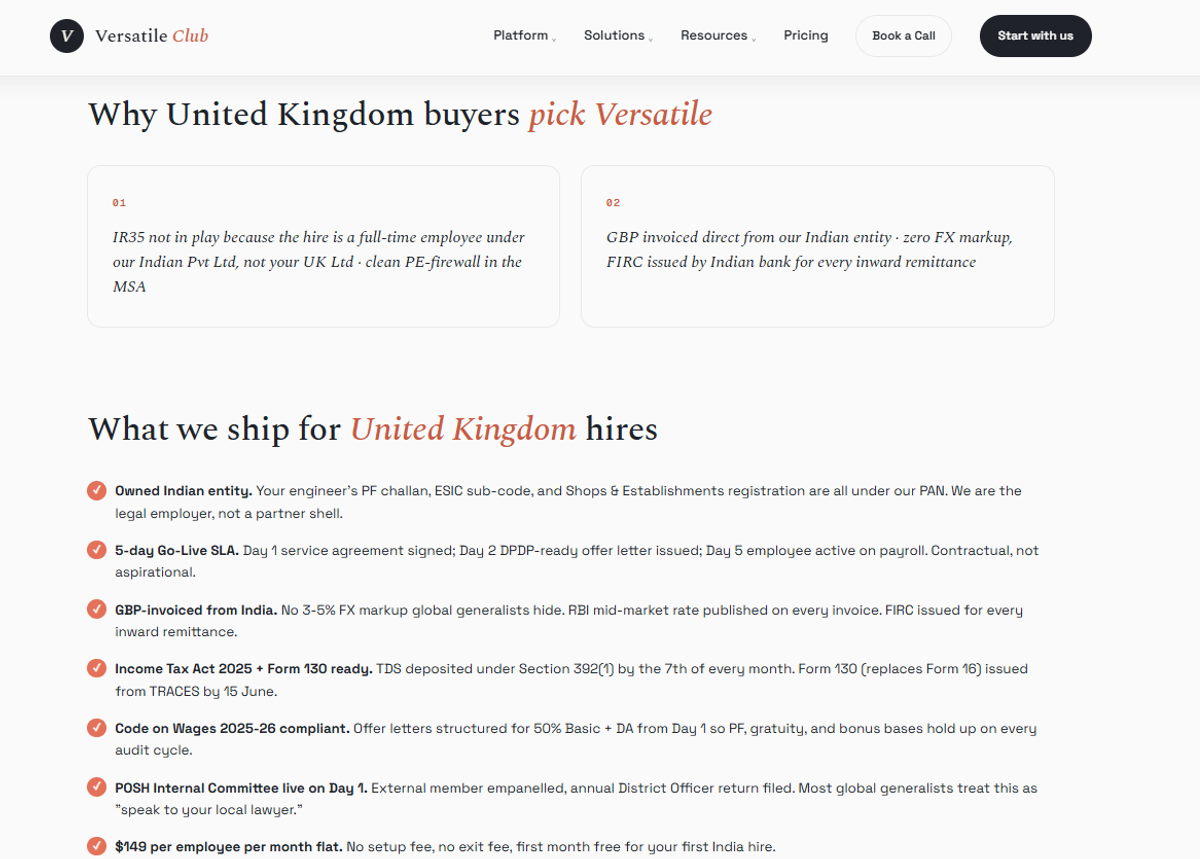
Versatile Club is an India-only employer of record and contract-to-hire provider for US and UK companies. It employs your India team through its own registered Indian company, Foo Falcon Technologies Pvt Ltd. The PF registration, ESIC code, and Shops and Establishments licences belong to that entity, not to a third-party partner.
The company started as a contract-to-hire business placing engineers, designers, and operations staff. EOR runs on that same payroll and compliance infrastructure. We say openly that EOR is the newer service, because the entity and the filings are what carry the risk.
🧰 Core Services
India employer of record on an owned entity, covering all 28 states and 8 union territories.
Full statutory administration: PF, ESI, TDS, professional tax, gratuity accrual, POSH, and full-and-final settlement.
Contract-to-hire and direct recruiting with culture-fit screening across 50 behavioural parameters.
USD invoicing from a single Indian entity, with challan confirmations and TDS receipts each month.
90-day Success Coach onboarding monitoring and a 6-month replacement guarantee on placements.
🤔 Why Companies Consider Versatile Club
Most buyers arrive with one of two problems. Either they are making a first India hire and refuse to spend 12 to 18 months on a subsidiary, or they already sit on a global platform and their India filings feel thin.
The decision logic is usually cost plus accountability. At $149 per employee per month flat, the fee sits far below the $400 to $599 band the global platforms charge. And the person answering your WhatsApp message owns the entity your employee is filed under.
👤 Ideal Customer Profile
Company size: Seed to Series C, 10 to 400 total employees.
Geography: United States and United Kingdom headquarters.
India team size: 1 to 30 employees, hiring in Bengaluru, Hyderabad, Pune, or remote across states.
Hiring need: engineering, product, AI, design, marketing, or operations roles.
Decision maker: founder, VP People, or finance lead.
⚠️ Not a fit: multi-country EOR needs, B2C consumer hiring, or enterprise procurement that requires SOC 2 or ISO 27001 as a gate. Versatile Club holds neither certification today.
💰 Commercial Model
Versatile Club charges $149 per employee per month, flat, with no salary-band tiers. Setup is $0, exit is $0, and the first month is free. Invoices are issued in USD from the Indian entity at the mid-market FX rate, with no markup on the employee's salary cost.
The onboarding SLA is 5 business days and sits in the service agreement. Statutory registrations for PF, ESI, and professional tax begin on day 4, and payroll goes live on day 5. Contract-to-hire is priced at 20 to 30 percent of annual salary, billed only after the hire completes day 90.
⭐ Customer Reviews
"We used Versatile to hire our first employee in India after months of putting it off because the compliance side seemed like a mess. Sagar replied to our form in about four hours with a draft offer letter already attached. The hire was onboarded in four days. First USD invoice landed clean: no FX markup, no setup fee, no surprises."
Verified User in Information Technology and Services Versatile Club G2 Verified Review
"The dashboard could be a little more self-serve. A couple of times I wanted to pull a report or a doc myself and ended up just messaging my contact instead. They always answered fast, so it wasn't a real problem, but I'd love to click around and find things on my own."
Angad S., Founder Versatile Club G2 Verified Review
That second review is fair, and I am not going to argue with it. Self-serve reporting is where we are behind the funded platforms. Where my head is right now is that founders under 30 India employees trade dashboards for a same-day answer, though I might be reading my own sample too generously.
2. Deel: Best for Teams That Need 24/7 Support and a Deep Integration Catalog
🏢 Overview
Deel is the largest global employment platform in the category, covering roughly 150 countries. It offers EOR, contractor management, global payroll, and equipment provisioning in one interface. India is one market inside that footprint, served through a mix of owned and local partner entities.
For a company hiring in eight countries at once, that breadth is the product. Deel also holds SOC 2 Type II and ISO 27001, which clears most enterprise procurement checklists.
🧰 Core Services
EOR employment across roughly 150 countries.
Contractor onboarding, classification checks, and mass payouts.
Global payroll consolidation for companies with their own entities.
200+ integrations with HRIS, accounting, and identity tools.
Immigration and visa support in selected markets.
🤔 Why Companies Consider Deel
The buying reason is usually coverage plus safety. One contract covers Brazil, Germany, India, and the Philippines, and your board recognises the name. Support runs 24/7, which matters when your India payroll question lands at 11pm California time.
✅ The platform is genuinely easy to use, and setup takes minutes for contractors. ✅ The integration catalog removes real reconciliation work for finance teams. ❌ India depth is the trade-off, because compliance attention is spread across every country on the map. ✅ Enterprise certifications and indemnification language satisfy legal review. ❌ Support quality drops once a case needs a local statutory answer, which is the pattern G2 reviewers describe most often.
👤 Ideal Customer Profile
Company size: Series B and above, 100 to 5,000 employees.
Geography: global headquarters, distributed workforce.
India team size: any, but usually under 20 percent of total headcount.
Hiring need: multi-country hiring where India is one of five or more markets.
Decision maker: VP People, Head of Total Rewards, or procurement.
💰 Commercial Model
Deel prices India EOR at roughly $599 per employee per month, with a setup fee of around $500 and one month's notice on exit. Contractor management is billed separately per contractor. Currency conversion carries a markup that reviewers report as material, and Deel's own pricing page is the only reliable source for current tiers. For a like-for-like view of what the same hire costs on each model, compare the employer of record India cost breakdown.
⭐ Customer Reviews
"I appreciate the ease of setup with Deel; it took me only a few minutes, making the process straightforward. I dislike how expensive Deel's transaction fees are, especially when moving money from the Deel account to my bank. It's not one of the cheapest services available."
Maria M., Freelancer Deel Hire G2 Verified Review
"Often the CS doesn't seem to have answers, which leads me to emails back and forth on my case which don't always answer the question and something I was looking for the answer to in 20 minutes becomes a 4 day process, or needs to be consulted with by multiple team members who aren't available except for at 3:00am my time."
Verified User in Computer Software Deel Hire G2 Verified Review
"We had to carefully manage our agreement and had to constantly remind them of the fees agreed so that we weren't over charged. Everything was VERY time consuming. It took three months to onboard our first 3 individuals."
Verified User in Information Technology and Services Deel Hire G2 Verified Review
Versatile Club's read is that Deel is not badly built, it is differently built: a platform priced for 150 countries cannot staff India the way an India-only operator does, and the four-day answer on a statutory question is the visible edge of that maths.
3. Remote: Best for Buyers Who Rank Entity Ownership Above Price
🏢 Overview
Remote is a global employment platform that runs its own legal entities in roughly 80 countries. It sells EOR, contractor management, global payroll, and equipment logistics. The pitch is straightforward: fewer third parties between you and your employee.
For India buyers, Remote's appeal is structural rather than commercial. If your legal team objects to partner shells, Remote answers that objection in most of its markets. Buyers weighing the same structural question against an India specialist often start with a Remote alternative comparison.
🧰 Core Services
EOR employment through wholly owned entities across roughly 80 countries.
Contractor management with classification support.
Global payroll for companies that already hold local entities.
Intellectual property and invention assignment protections built into contracts.
Benefits administration and equipment provisioning.
🤔 Why Companies Consider Remote
The decision logic is usually legal risk, not price. A general counsel who has read one partner-entity indemnity clause tends to push hard for owned entities. Remote is the cleanest answer to that specific question.
✅ Owned entities reduce the number of parties holding your employment liability. ✅ IP assignment language is among the strongest in the category. ❌ Support runs through a ticket queue, and Trustpilot reviewers complain there is no phone route. ✅ Documentation and reporting are detailed enough for audit files. ❌ At around $599 per employee per month, India costs the same as Germany, which rarely reflects the work involved.
👤 Ideal Customer Profile
Company size: Series B and above, 150 to 2,000 employees.
Geography: US or UK headquarters, hiring in five or more countries.
India team size: 5 to 50 employees.
Hiring need: engineering and product roles where IP ownership is contested.
Decision maker: general counsel, VP People, or Head of Talent.
💰 Commercial Model
Remote prices India EOR at approximately $599 per employee per month, with a setup fee of around $299 and one month's notice on exit. Pricing does not vary by Indian salary band. Current tiers should be confirmed against Remote's own pricing page before you sign.
4. Multiplier: Best Mid-Priced Hybrid for Asia-Pacific Plus India Coverage
🏢 Overview
Multiplier is a global EOR with a stronger Asia-Pacific footprint than most competitors. It hires through a mix of owned and local partner entities depending on the country. India sits inside that mixed model.
The product covers employment contracts, payroll, benefits, and expense management in one dashboard. Onboarding is advertised at around seven days.
🧰 Core Services
EOR employment across 150-plus countries with an Asia-Pacific focus.
Contractor onboarding and payments.
Benefits and insurance administration in supported markets.
Expense and time-off management inside the platform.
Multi-currency payroll processing.
🤔 Why Companies Consider Multiplier
Buyers usually land here on price. At roughly $400 per employee per month, Multiplier undercuts Deel and Remote while keeping global coverage. For a Series A team hiring in India, Singapore, and Indonesia at once, that arithmetic works. Teams that later narrow their focus to one market tend to reassess against a Multiplier alternative built for India only.
✅ Mid-market pricing with no setup fee and a two-week exit window. ✅ Asia-Pacific coverage is genuinely deeper than most US-built platforms. ❌ Support is email-led through a CSM, and G2 reviewers have questioned local labour-law knowledge. ✅ The platform handles India statutory filings in-app rather than by spreadsheet. ❌ Invoicing defaults to local currency in some markets, which adds FX work for a US finance team.
👤 Ideal Customer Profile
Company size: Seed to Series B, 30 to 300 employees.
Geography: US, UK, or Singapore headquarters.
India team size: 3 to 25 employees, usually alongside other Asian markets.
Hiring need: engineering, support, and operations roles across two to six countries.
Decision maker: founder, COO, or People Ops lead.
💰 Commercial Model
Multiplier prices EOR at approximately $400 per employee per month, with no setup fee and a two-week exit notice. Contractor management is billed separately. Confirm India-specific FX policy in writing, because currency handling varies by market.
5. Rippling: Best When India Payroll Must Sit Inside One HR and IT System
🏢 Overview
Rippling is a workforce management platform that started in US payroll and HR, then added global EOR. Its distinguishing feature is scope: payroll, devices, app access, and identity management run off one employee record.
For India hiring, Rippling is chosen less for India depth and more for consolidation. If a laptop, a Google account, and a payslip should all trigger from one onboarding action, that is the draw. The trade-off is set out in more detail across the Rippling alternatives for India comparison.
🧰 Core Services
Global EOR employment through owned and partner entities.
US and global payroll on a single employee record.
Device management and app provisioning tied to onboarding and offboarding.
Identity and access management.
Benefits administration and time tracking.
🤔 Why Companies Consider Rippling
The buying reason is vendor consolidation, not India expertise. IT and People Ops share one system, so offboarding actually removes access on the day it should.
✅ Single system of record removes real reconciliation work between HR and IT. ✅ Support runs 24/7, which suits US teams with India employees. ❌ India EOR is a newer line inside a broad product, so statutory depth is thinner than an India specialist. ✅ Access controls and audit logs help with DPDP Act 2023 data-handling requirements. ❌ India EOR pricing is not published, which slows down budget approval.
👤 Ideal Customer Profile
Company size: Series B and above, 100 to 3,000 employees.
Geography: US headquarters, distributed teams.
India team size: 5 to 50 employees.
Hiring need: roles where device and access control matter as much as payroll.
Decision maker: Head of IT, VP People, or CFO.
💰 Commercial Model
Pricing for Rippling's India EOR is not publicly disclosed and is quoted per customer. Global EOR pricing in the category generally sits in the $500 to $650 band per employee per month. Ask for the setup fee, exit terms, and FX treatment in the same quote.
6. Globalization Partners: Best for Enterprise Procurement With Heavy Legal Review
🏢 Overview
Globalization Partners, known as G-P, is one of the oldest providers in the category. It runs owned entities across most of its markets and sells to enterprise buyers with formal vendor processes. India is a mature market in its network.
The product is built for legal review rather than self-serve signup. Contracts, indemnities, and country-specific guidance are the core deliverable.
🧰 Core Services
EOR employment through owned entities in most supported countries.
Country-specific employment contract drafting and legal guidance.
Global payroll and benefits administration.
Contractor engagement and classification review.
Enterprise reporting and cost modelling tools.
🤔 Why Companies Consider Globalization Partners
Enterprise buyers pick G-P when procurement, legal, and audit all need to sign off. The track record and documentation depth clear those reviews faster than a younger vendor.
✅ Long operating history with owned entities reduces partner-chain risk. ✅ Legal documentation satisfies formal enterprise procurement checklists. ❌ Pricing at around 15 percent of salary makes senior India hires expensive, with a practical floor near $1,500 per employee per month. ✅ Onboarding usually runs 5 to 10 days in established markets. ❌ The enterprise model brings account-management layers, so simple India questions travel through several people.
👤 Ideal Customer Profile
Company size: Series C and above, 500-plus employees.
Geography: US, UK, or EU headquarters with global operations.
India team size: 20 to 200 employees.
Hiring need: multi-country expansion with formal legal sign-off.
Decision maker: procurement, general counsel, or Chief People Officer.
💰 Commercial Model
G-P prices EOR at roughly 15 percent of the employee's salary, with a practical minimum near $1,500 per employee per month. Setup and administrative fees are substantial and negotiated per contract. Custom quote applies for most India engagements. Modelling that against a fixed monthly fee is easier with the EOR versus entity calculator.
⭐ Customer Reviews
"We had to carefully manage our agreement and had to constantly remind them of the fees agreed so that we weren't over charged. It took three months to onboard our first 3 individuals. We made the initial decision to move away from Papaya because they are not an EOR but Deel did not meet the commitments they had made and so we decided to more away to Globalization Partners."
Verified User in Information Technology and Services Deel Hire G2 Verified Review
That quote is a Deel review, not a G-P review. I include it because it shows the actual switching path enterprise buyers take, and because the reviewer names why Papaya was ruled out first.
7. Papaya Global: Best for Consolidating Payroll Across Many Existing Entities
🏢 Overview
Papaya Global is a payroll and payments platform first, with EOR offered alongside it. Its strength is aggregating payroll data and payments across companies that already own entities in several countries.
For India, that distinction matters. If you already have an Indian subsidiary, Papaya can run payroll through it. If you do not, check the EOR cover carefully. Companies in the first camp usually compare it against managed payroll options run from within India.
🧰 Core Services
Global payroll consolidation across existing legal entities.
Cross-border payments infrastructure with licensed rails.
EOR employment in supported markets.
Workforce cost analytics and reporting.
Benefits and contractor payment administration.
🤔 Why Companies Consider Papaya Global
The buyer is usually a finance leader with payroll running in six countries and no single view of cost. Papaya's reporting layer answers that.
✅ Payments and payroll data consolidation is genuinely strong for multi-entity groups. ✅ Cost analytics suit CFO reporting and headcount planning. ❌ One G2 reviewer left Papaya specifically because "they are not an EOR," which flags the model boundary. ✅ Licensed payment rails reduce settlement risk on large payroll transfers. ❌ India EOR pricing is not published, so budget approval needs a sales cycle.
👤 Ideal Customer Profile
Company size: Series C and above, 300-plus employees.
Geography: global headquarters with several owned entities.
India team size: 20-plus employees, usually inside an existing Indian entity.
Hiring need: payroll consolidation rather than a first India hire.
Decision maker: CFO, Controller, or Global Payroll Manager.
💰 Commercial Model
Pricing for Papaya Global is not publicly disclosed for India EOR and is issued as a custom quote. Payroll-only engagements are priced per employee per month on a separate scale. Confirm whether your India engagement is EOR or payroll-only before signing, because the liability differs. The distinction is unpacked in the India payroll compliance guide.
8. Payoneer (formerly Skuad): Best for Contractor-Heavy Teams Paying Across Borders
🏢 Overview
Skuad is now part of Payoneer, a cross-border payments company. The combined offer covers contractor payments, global payroll, and EOR employment across a wide country list including India.
Payment infrastructure is the strongest part of the stack. India EOR runs largely through local partner arrangements, which is the gap a Skuad alternative with its own Indian entity closes.
🧰 Core Services
Contractor onboarding, invoicing, and mass payouts.
EOR employment across 160-plus countries.
Multi-currency payment rails and receiving accounts.
Compliance documentation for contractor classification.
Benefits administration in supported markets.
🤔 Why Companies Consider Payoneer
Most buyers here have 20 contractors in eight countries and two employees. Payments are the daily problem, and employment is the occasional one.
✅ Cross-border payment rails are mature and cheap at volume. ✅ Contractor documentation reduces misclassification exposure. ❌ India EOR sits on a partner-entity model, so statutory accountability passes through another company. ✅ Pricing for India EOR has been published at around $199 per employee per month, which is competitive. ❌ India-specific depth on state professional tax and Labour Code wage structuring is limited compared with a specialist.
👤 Ideal Customer Profile
Company size: Seed to Series B, 20 to 200 workers.
Geography: US, UK, or EU headquarters.
India team size: 1 to 10 employees plus contractors.
Hiring need: mixed contractor and employee workforce across many countries.
Decision maker: founder, Head of Finance, or Operations lead.
💰 Commercial Model
Skuad's India EOR has been listed at approximately $199 per employee per month, covering India and other Asia-Pacific markets. Contractor management is priced separately per contractor. Confirm current tiers with Payoneer directly, since the product moved under new ownership. Teams running mostly contractors should also price a contractor of record arrangement.
9. Pebl (formerly Velocity Global): Best for Regulated Industries Needing Visa and Immigration Support
🏢 Overview
Pebl, previously Velocity Global, offers EOR employment, immigration support, and global payroll across a wide country network. It uses a mix of owned and partner entities.
Immigration and mobility services are the differentiator. Buyers with visa-dependent hires or regulated workforces often shortlist it for that reason alone. For India-only requirements, the trade-offs are laid out in the Velocity Global alternatives in India comparison.
🧰 Core Services
EOR employment across a broad country network.
Immigration, visa, and global mobility support.
Global payroll and benefits administration.
Contractor engagement and classification review.
Compliance advisory for regulated sectors.
🤔 Why Companies Consider Pebl
The buying reason is usually a visa case rather than a payroll case. Very few EOR providers handle immigration in-house, and that scarcity drives the shortlist.
✅ Immigration and mobility services are genuinely rare in this category. ✅ The country network covers markets that smaller providers skip. ❌ Recent G2 reviewers describe onboarding errors, contract start-date mistakes, and a portal that is hard to use. ✅ Compliance advisory suits regulated industries with documentation duties. ❌ One reviewer reported a two-week onboarding delay caused by document misreading, which is a real risk on time-limited contracts.
👤 Ideal Customer Profile
Company size: Series B and above, 100-plus employees.
Geography: US, UK, or EU headquarters.
India team size: 5 to 40 employees.
Hiring need: roles involving visas, relocation, or regulated compliance duties.
Decision maker: Global Mobility lead, VP People, or general counsel.
💰 Commercial Model
Pricing for Pebl is not publicly disclosed and is issued as a custom quote. Category benchmarks for comparable global providers sit in the $500 to $650 per employee per month range. Ask specifically whether immigration support is included or billed separately.
⭐ Customer Reviews
"I encountered many frustrations with the onboarding, and continue to find the portal difficult to use. My contract had the wrong start date and other errors. The way annual leave is recorded is strange, it automatically logs weekend days, so this has incorrectly logged my leave. The portal also is not optimised for mobile use."
Verified User in Non-Profit Organization Management Pebl (formerly Velocity Global) G2 Verified Review
"I like the clear and detailed instructions, the helpful communication from Dominik Ksiazak, and the platform. Despite providing all required legal documents in a timely and transparent manner, the onboarding process was delayed for over two weeks due to repeated misreading and misinterpretation of standard employment verification materials."
Verified User in Non-Profit Organization Management Pebl (formerly Velocity Global) G2 Verified Review
🧾 What the pricing spread actually tells you
Read the nine commercial models together and a pattern shows up. The published fee ranges from roughly $199 to about $1,500 per employee per month for the same statutory work in the same country.
Versatile Club's read is that the spread is not buying India compliance depth, it is buying country count and enterprise paperwork, and I say that as the operator who files the same PF challan either way. Where I hold back is on insurance: the $599 platforms carry business insurance that Indian providers, including us, do not.
Versatile Club charges $149 per employee per month flat, with $0 setup, $0 exit, and the first month free, and files PF, ESI, TDS, and professional tax under its own Indian EOR registrations. For buyers who need five or more countries or a SOC 2 certificate today, one of the eight providers above is the correct call.
Q2. How Did We Score These 9 Providers Against India Requirements?
Each provider scored out of 100 across five weighted criteria: India Entity Model and Compliance Depth (25%), Pricing Transparency and Commercial Model (20%), Onboarding Speed and Support Model (20%), Talent and Retention Support (20%), and Customer Validation via G2, Capterra, and Reddit (15%). Scores convert to stars in 20-point bands, so 81 to 100 earns five stars and 0 to 20 earns one.
🏗️ Why entity model carries the heaviest weight
Entity model gets 25 percent because it decides where liability sits. A partner-only provider signs your employee to a third company you never contracted with. If that partner files a provident fund challan late, the penalty lands on a chain you cannot see.
I weighted it this way because every unrecoverable problem I have seen in six years was structural, not a missing feature. Dashboards get built. Partner handoffs do not get unwound. The structural difference is set out on our India compliance page.
📐 The weighting, criterion by criterion
| Criterion | Weight | What it measures |
| India Entity Model and Compliance Depth | 25% | Own entity versus partner shell; PF, ESI, TDS, professional tax, gratuity, POSH, DPDP readiness |
| Pricing Transparency and Commercial Model | 20% | Published fee, setup fee, exit fee, salary bands, FX markup, invoice clarity |
| Onboarding Speed and Support Model | 20% | Days to live payroll, whether the SLA is contractual, and who answers |
| Talent and Retention Support | 20% | Recruiting, culture-fit vetting, onboarding monitoring, replacement guarantee |
| Customer Validation | 15% | G2, Capterra, and Reddit evidence, weighted by review volume |
Versatile Club is measured on the same rubric as every other provider here, including the criteria where we lose points.
⭐ How scores become stars
| Score | Stars |
| 81 to 100 | ⭐⭐⭐⭐⭐ |
| 61 to 80 | ⭐⭐⭐⭐ |
| 41 to 60 | ⭐⭐⭐ |
| 21 to 40 | ⭐⭐ |
| 0 to 20 | ⭐ |
Ratings were not averaged from marketing pages. Each provider's entity model, published pricing, and support window were checked against its own documentation.
🔍 What third-party evidence we used
Three validation layers sat behind the scores. Everest Group's Employer of Record Solutions PEAK Matrix assessed 29 EOR providers and tiered them as Leaders, Major Contenders, and Aspirants, which gave an analyst-grade cross-check on category position.
Review data was weighted by volume, not just rating. A 4.9 built on 29 reviews is weaker evidence than a 4.8 built on 10,000. Statutory claims were checked against the source notification rather than a vendor blog.
⚠️ Where this rubric disqualifies us
Versatile Club launched EOR in 2026 and holds neither SOC 2 Type II nor ISO 27001 today. That costs us points on Customer Validation and rules us out of procurement processes where a certificate is a gate.
Three buyer types should not shortlist us at all. Companies needing five or more countries, B2C consumer hiring operations, and enterprise teams above 100 India employees with formal security review will be better served by a provider on this list.
🧭 What the rubric deliberately ignores
Country count is absent, and that is intentional. A provider covering 185 countries is not more useful to a company hiring only in Bengaluru. Global platforms cover 90 to 150 countries and spread India expertise across all of them.
Versatile Club's 5-day onboarding SLA is written into the service agreement rather than the marketing page, which is why it scored on Onboarding Speed and a competitor's advertised 24-hour claim did not. The day-by-day sequence is published under how it works.
Q3. Where Does Each Provider Win and Break for India Hiring?
Choose Versatile Club for India-only hiring on an owned entity at $149 flat. Choose Deel or Rippling when you need 24/7 support and deep integrations. Choose Remote for the widest set of wholly owned entities, Multiplier as the mid-priced hybrid at roughly $400, Papaya for payroll consolidation, and Payoneer, Pebl, or G-P for genuine multi-country breadth.
🗺️ The one-line verdict on all nine
| Provider | Choose it if | Stay on RemoFirst if |
| Versatile Club | India is your only hiring market and you want the entity owner accountable | You hire across five or more countries |
| Deel | You need 24/7 support and 200-plus integrations | Your India team is under five people and cost matters |
| Remote | Your legal team rejects partner entities outright | You will not pay $599 for one India hire |
| Multiplier | You hire across India plus Southeast Asia | You need USD invoicing without FX work |
| Rippling | Payroll, devices, and app access must run off one record | You already have an HRIS you like |
| Globalization Partners | Procurement and general counsel must sign off formally | Senior salaries make 15 percent of pay unaffordable |
| Papaya Global | You already own entities and need one payroll view | You need true EOR, not payroll administration |
| Payoneer (Skuad) | Contractors outnumber employees | You need deep state-level India compliance |
| Pebl (Velocity Global) | You have visa or relocation cases | Recent onboarding reviews concern you |
💸 What the fee spread actually buys
The published range runs from roughly $149 to about $1,500 per employee per month for identical statutory work. Provident fund at 12 percent of Basic plus dearness allowance, ESI at 3.25 percent employer share, and gratuity accrual at 4.81 percent do not change by vendor. The full build-up is broken down in the cost of hiring in India guide.
Versatile Club charges $149 flat regardless of salary band, with $0 setup, $0 exit, and the first month free, and invoices in USD from one Indian entity so there is no FX line to reconcile. Deel has been reported at 3 to 5 percent currency markup, and other platforms at 2 to 10 percent.
🧾 The state-level test that separates them
Ask any provider one question. Do you hold live registrations in Maharashtra, Karnataka, and Tamil Nadu, or can you support hiring there?
Those states behave differently. Maharashtra needs dual PTRC and PTEC registration with monthly slab filing. Karnataka runs a monthly professional tax cycle plus Shops and Establishments renewal. Tamil Nadu files twice a year with a labour welfare fund contribution.
🗣️ What buyers say in their own words
"Often the CS doesn't seem to have answers, which leads me to emails back and forth on my case which don't always answer the question and something I was looking for the answer to in 20 minutes becomes a 4 day process."
Verified User in Computer Software Deel Hire G2 Verified Review
"I encountered many frustrations with the onboarding, and continue to find the portal difficult to use. My contract had the wrong start date and other errors."
Verified User in Non-Profit Organization Management Pebl (formerly Velocity Global) G2 Verified Review
"Versatile's Employer of Record India service made this seamless contracts, PF, ESI, TDS, and payroll all handled in one place. Invoicing in USD meant zero exchange rate surprises."
Vedant T., Founder Versatile Club G2 Verified Review
📦 The fragmented stack nobody prices in
Most India setups end up with four vendors: one for payroll, one for EOR, one for insurance, and one for laptops. Reconciling four invoices is where finance teams lose their month-end. Consolidating the payroll leg alone is covered under managed payroll.
Versatile Club handles hiring, employment, payroll, benefits, and equipment logistics on one contract, which is the consolidation argument Deel makes globally and we make for one country.
⚖️ Where the honest limits sit
Versatile Club's read is that the standard advice gets this backwards: buyers are told to optimise for country count, when most of them hire in one country and need depth there. Though I hold this loosely on one point. The $599 platforms carry business insurance that Indian providers, including us, do not, and for a VC-backed buyer that can be the deciding factor.
Q4. Why Do Teams Outgrow RemoFirst Once India Becomes the Main Market?
RemoFirst is the genuine cost leader at $199 per employee per month across 185-plus countries with a free contractor tier, which makes it a sensible first move for a multi-country pilot. Teams outgrow it when India becomes the main market, because it runs a partner-only entity model, publishes a 24/5 rather than 24/7 support window, and spreads compliance attention across every country it covers.
✅ What RemoFirst genuinely does well
Credit where it belongs. RemoFirst is the cheapest mainstream EOR, and its contractor tier costs nothing, which suits a founder testing three markets at once.
The platform is clean and the pricing is published, which is more than several $599 competitors manage. If India is one of eight countries on your map, switching is probably not your problem.
⏰ The moment the switch gets triggered
It rarely starts with price. It starts with the third payroll question that nobody answers before the deadline.
A US founder messaged me on WhatsApp at 11pm her time, three days before payroll, asking why her Bengaluru engineer's provident fund challan had not landed. That question has a four-hour shelf life, not a four-day one.
"Poor communication on issues and complete ignorance of deadlines set by Deel themselves. Extremely slow speed in resolving HR and payroll issues. On top of that, my salary was not paid on time this month."
Daryna R., Employee Deel Hire G2 Verified Review
💰 Run the India math, not the global math
The standard argument says the roughly $400 monthly gap between a budget EOR and a premium one equals about 18 hours of People Ops time, and flips at 10 to 15 employees. That maths was built on generic global admin.
Recompute it on India overhead and it flips sooner. Monthly PF and ESI challan cycles, state professional tax calendars, gratuity accrual at 4.81 percent, and Form 130 season all land on someone's desk. Run your own numbers on the India salary calculator before you commit.
📊 What a cheap fee does not cover
| India task | Frequency | What happens if it slips |
| PF and ESI challan filing | Monthly | Interest, damages, employee grievance |
| Professional tax filing | Monthly or biannual by state | State penalty, registration risk |
| TDS deposit | By the 7th monthly | Interest plus late-fee exposure |
| Gratuity accrual at 4.81% | Continuous | Audit catch-up and understated liability |
| Form 130 issuance | Annual | Employee tax filing blocked |
Versatile Club shows the PF and ESI challan numbers plus TDS receipts in the monthly pack, because "we filed it" is not evidence an auditor accepts. The reporting standard is explained in the India payroll compliance guide.
🧭 This is a market-focus problem, not a support problem
A platform covering 150 countries cannot know that West Bengal changes its rules more often than its government changes. That is not incompetence, it is arithmetic on where attention goes.
India stopped being a cheap-labour footnote. NASSCOM and Zinnov put India's offshore technology centre revenue at $98.4 billion in FY26, near the level earlier forecast for 2030. Teams planning at that scale usually read the GCC setup in India guide next.
"We used Versatile to hire our first employee in India after months of putting it off because the compliance side seemed like a mess. Sagar replied to our form in about four hours with a draft offer letter already attached. The hire was onboarded in four days."
Verified User in Information Technology and Services Versatile Club G2 Verified Review
🤔 Where I could be wrong
Versatile Club's data points toward the switch happening around 8 to 10 India employees, though I might be reading my own sample too strongly. Our clients self-selected by caring about India depth before they called us.
Versatile Club answers the support question differently: Sagar Chainani is on WhatsApp directly, so there is no CSM rotation and no ticket queue between you and the person accountable for your payroll run. That is sustainable at our current scale, and I will say so plainly when it stops being. If you would rather talk it through, tell us what you are building in India.
Q5. What Does an India Employee Actually Cost Beyond the EOR Fee?
The platform fee is the small number. Employer-side cost adds provident fund at 12 percent of Basic plus dearness allowance on a ₹15,000 ceiling (₹1,800 monthly), employee state insurance at 3.25 percent employer share, gratuity accruing at 4.81 percent, and state professional tax. Since 21 November 2025, Basic plus DA must be at least 50 percent of remuneration, which raises all three.
💰 The statutory stack, itemised
Four employer charges sit on top of salary. Provident fund (PF) is the retirement contribution, capped at ₹1,800 per month on the ₹15,000 wage ceiling. Employee state insurance (ESI) is the medical scheme, at 3.25 percent employer and 0.75 percent employee, and applies only to wages up to ₹21,000 per month.
Gratuity accrues at 4.81 percent of Basic plus DA from month one. Professional tax (PT) is a state levy, commonly ₹200 per month in Karnataka. Versatile Club accrues gratuity from the first payroll rather than at exit, because catching up 18 months later is how audit findings start. The full statutory scope sits on our India compliance page.
📐 A worked example on a ₹20 lakh CTC
| Component | Basis | Annual cost |
| Basic plus DA | 50% of ₹20,00,000 | ₹10,00,000 |
| Employer PF | ₹1,800 per month on the ceiling | ₹21,600 |
| ESI | Not applicable above ₹21,000 monthly wages | ₹0 |
| Gratuity accrual | 4.81% of Basic plus DA | ₹48,100 |
| Professional tax (Karnataka) | ₹200 per month | ₹2,400 |
| Employer statutory total | - | ₹72,100 |
That is roughly $860 a year at current rates. Buyers agonise over a $20 monthly sticker gap between platforms, which is $240 a year. The statutory layer is about 3.5 times larger, and it moves when the wage definition moves. Model your own role on the India salary calculator before you sign anything.
⚠️ The ₹21,000 EPF rumour, corrected
Plenty of HR blogs say the PF wage ceiling is rising to ₹21,000. It has not. On 29 May 2026, the Ministry of Labour and Employment re-fixed the ceiling at ₹15,000 under the Code on Social Security, 2020.
The statutory monthly contribution stays capped at ₹1,800, unchanged since September 2014. Versatile Club models a ₹21,000 scenario for clients anyway, because the code now allows a change by notification alone. Ask your provider in writing whether repricing would pass through to you.
🧾 What the invoice mechanics actually do to your close
Two things decide whether India payroll reconciles cleanly. The first is currency. If the invoice arrives in rupees, someone rebuilds it in dollars every month, and reported FX markups in this category run from 2 to 10 percent. The mechanics are unpacked in the how to pay employees in India guide.
The second is goods and services tax reporting. Under Notification No. 10/2023-Central Tax, businesses above ₹5 crore in annual turnover must report invoices to the government portal. Ask whether your provider crosses that threshold, because it changes your accounts-payable trail.
🏢 Pricing the entity route honestly
The subsidiary alternative is not just registration cost. Foreign investment must be reported through the Reserve Bank's FIRMS portal, with Entity Master registration and Form FC-GPR filings under the Single Master Form framework. Compare both paths side by side with the EOR versus entity calculator.
Add ongoing MCA filings, an auditor, and a company secretary. In practice, founders spend $50,000-plus and 12 to 18 months before the first engineer writes code. Versatile Club employs that engineer inside its own Indian entity in five business days instead, which is a different trade, not a free one.
⏰ One date to protect
Tax deducted at source (TDS) must be deposited by the 7th of each month. Miss it and interest starts, regardless of who caused the delay.
Versatile Club sends the monthly pack with per-employee statutory breakdown, PF and ESI challan numbers, and TDS receipts in USD, so month-end close needs no reconstruction. My view is that a provider unwilling to show challan numbers is asking you to trust a claim you could simply verify. The reporting cadence is described under managed payroll.
Q6. How Do You Verify a Provider's India Compliance Before Signing?
Ask for the Indian corporate identity number (CIN) plus PF and ESIC registration numbers, then verify them on the MCA and EPFO portals. Then test four things: live registrations in every state you hire in, Basic plus DA at 50 percent on recent payslips, Form 130 issuance under section 395(4) of the Income-tax Act 2025, and a data-processing addendum naming every sub-processor.
🏗️ Check 1: Who actually employs your engineer
Providers fall into three models. Owned entity means the provider is the legal employer. Partner-only means a third Indian company you never contracted with holds the employment. Hybrid means it varies by country, and India is often the partner side.
Ask for the CIN and look it up on the MCA portal. Versatile Club employs through Foo Falcon Technologies Pvt Ltd, and we hand over the registration numbers before anyone asks. A structural claim you cannot verify is a marketing claim. Our own model is documented on the EOR services in India page.
🗺️ Check 2: Live registrations, not "we can support"
India is not one payroll jurisdiction. The wording matters here, so ask for live registrations in the specific states you hire in.
| State | What it demands |
| Maharashtra | Dual PTRC and PTEC registration, monthly slab filing, annual return |
| Karnataka | Monthly professional tax plus Shops and Establishments renewal |
| Tamil Nadu | Biannual professional tax in June and December, plus labour welfare fund |
| West Bengal | Frequent rule changes that need active monitoring |
| Delhi | No professional tax, but strict Shops and Establishments enforcement |
| Telangana | PTRC enrolment with its own deadlines |
Versatile Club holds registrations across all 28 states and 8 union territories, which came from running contract-to-hire payroll in these states, not from a global compliance playbook.
📋 Check 3: Is the provider current on 2025-26?
Three changes separate current providers from stale ones. The four Labour Codes commenced on 21 November 2025, resetting the wage base that PF and gratuity are calculated on.
Form 16 became Form 130 under section 395(4)(a) of the Income-tax Act, 2025, read with Rule 215 of the Income-tax Rules, 2026. The DPDP Rules were notified as G.S.R. 846(E) on 13 November 2025. Ask Versatile Club, or any provider, for the data-processing addendum plus the sub-processor list that touches employee Aadhaar, PAN, bank, and salary data.
🛡️ Check 4: Who owns POSH?
The Sexual Harassment of Women at Workplace Act, 2013 puts the duty on the employer. Section 4 requires an Internal Committee at every office with 10 or more employees.
Section 21 requires an annual report to the District Officer by 31 January. Penalties under section 26 start at ₹50,000 and escalate on repeat. Versatile Club constitutes the Internal Committee for its India employees and files that report, so ask any provider to name the external member. Teams without in-house HR usually pair this with HR consulting support.
⚖️ Check 5: Permanent establishment is not cured by an EOR
An employer of record does not automatically create permanent establishment (PE), which is a taxable presence in India. It also does not automatically prevent one.
Exposure turns on whether anyone in India habitually concludes contracts for you. Indian rulings between July 2025 and March 2026, including Hyatt International in the Supreme Court and Booking.com B.V. at ITAT Delhi, drew that line. Confirm in writing that no India-based worker holds contract-signing authority, and read your treaty's dependent-agent clause with your tax advisor. The structural trade-offs are compared in the EOR versus entity in India analysis.
🧾 The one question that ends the sales pitch
Ask for last month's PF and ESI challan numbers and the TDS deposit receipt. Filed work has receipt numbers. Asserted work has adjectives.
Versatile Club's read is that the category has trained buyers to evaluate dashboards when they should be evaluating challans, and that swap is exactly how gratuity goes un-accrued for 18 months before an auditor finds it.
Q7. How Do You Switch Off RemoFirst and Choose the Right Alternative?
Plan two to four weeks per employee with no employment gap. Serve notice, confirm the new provider's owned entity, map each PF universal account number for continuity, time the cutover to a month-end payroll boundary to avoid mid-year Form 130 fragmentation, re-verify gratuity carry-over, re-issue compliant contracts, then reconcile the final PF and ESI challans.
⏰ The seven-step migration runbook
Read your notice terms first. Most global providers require one month's notice, so the clock starts before anything else moves.
Verify the new entity. Confirm the CIN and PF registration belong to the provider, not a partner, so liability does not move sideways.
Map every PF universal account number (UAN). Continuity protects the employee's retirement record, and a broken UAN is the complaint that reaches your CEO.
Cut over at a month-end payroll boundary. A mid-month switch splits the year's tax certificate, and your employee gets two partial Form 130s.
Re-verify gratuity carry-over. Ask both providers for the accrued figure in writing, because the numbers rarely match on the first pass.
Re-issue employment contracts. New employer means new contracts, including intellectual property assignment and Labour Code wage structuring.
Reconcile the final challans. Get the last PF, ESI, and TDS receipts from the outgoing provider before you close the account.
Versatile Club runs steps 2 through 7 as one project with the client, and payroll goes live on day 5 of the new employment under the contractual SLA. The day-by-day sequence is published under how it works.
👤 Scenario 1: Your first one to three India hires
Pick an India specialist with an owned entity. At this size, statutory accuracy and response time decide everything, and you have no HR bandwidth to absorb a partner handoff. Most teams at this stage start with the startup hiring path.
Skip the global platforms until you actually hire outside India. Versatile Club charges $149 flat with $0 setup and the first month free, so a trial costs you one month of your incumbent's notice.
"We used Versatile to hire our first employee in India after months of putting it off because the compliance side seemed like a mess. Sagar replied to our form in about four hours with a draft offer letter already attached."
Verified User in Information Technology and Services Versatile Club G2 Verified Review
🧩 Scenario 2: Ten to a hundred India employees on a fragmented stack
Consolidate. Four vendors for payroll, EOR, insurance, and laptops is four invoices and four blame surfaces.
Ask each shortlisted provider for state registration proof and challan-level reporting. Versatile Club layers culture-fit screening across 50 behavioural parameters, a 90-day Success Coach, and a 6-month replacement guarantee on placements, which is the retention gap most EOR contracts leave open. The screening method is explained through our recruitment service.
"The dashboard could be a little more self-serve. A couple of times I wanted to pull a report or a doc myself and ended up just messaging my contact instead."
Angad S., Founder Versatile Club G2 Verified Review
🏢 Scenario 3: Enterprise procurement or genuine multi-country hiring
Stay with a global platform. If SOC 2 Type II or ISO 27001 is a procurement gate today, or you hire in five or more countries, Deel, Remote, Rippling, or Globalization Partners is the correct call. Buyers in that bracket should read the enterprise hiring page before ruling India specialists in or out.
Versatile Club holds neither certificate yet and operates only in India by design, and I say that on the first call rather than the fifth. Cross-check your shortlist against Everest Group's EoR PEAK Matrix tiering before you sign.
"There majority of their support team is helpful, but are often constrained by internal limitations. It took three months to onboard our first 3 individuals."
Verified User in Information Technology and Services Deel Hire G2 Verified Review
🔮 What I think happens next
My working hypothesis is that India stops being a row on the global EOR map within two years, and becomes its own category. Owned-entity operators in one country will take the India revenue.
I could be wrong about the timeline, and business insurance is the reason: the $599 platforms carry it, and Indian providers do not. If you are weighing that trade for a real role right now, message me on WhatsApp and tell me what you are hiring for, or send the role details across.
FAQs
Is RemoFirst a good EOR for hiring employees in India?
RemoFirst works well for a multi-country pilot and works less well once India becomes your main hiring market. It is the cheapest mainstream employer of record at roughly $199 per employee per month, covers 185-plus countries, and offers a free contractor tier.
Three structural limits matter for India buyers:
- Partner-only entity model. Your employee is legally employed by a third Indian company you never contracted with, so statutory liability travels through a chain you cannot inspect.
- Support window. RemoFirst publishes 24/5 support, while Deel and Rippling publish 24/7. Indian statutory deadlines, like the 7th-of-the-month TDS deposit, do not wait for Monday.
- Spread attention. Compliance depth is divided across every country on the map, which is arithmetic rather than incompetence.
If India is one of eight markets on your org chart, switching is probably not your problem. If India is the only country you hire in, the entity question decides everything else. Versatile Club employs India teams through its own registered Indian entity with PF, ESIC, and Shops and Establishments registrations across all 28 states and 8 union territories, which is the structural contrast to a partner shell. You can see how the two models differ on our EOR services in India page.
Which RemoFirst alternative is best if we only hire in India?
For India-only hiring, an India-native provider with its own Indian entity beats a global generalist on every axis except country count. Global platforms cover 90 to 150 countries and spread India expertise across all of them.
Here is how the shortlist splits by situation:
- India only, 1 to 30 employees: an owned-entity India specialist, because statutory accuracy and response time decide outcomes at this size.
- India plus four or more countries: Deel, Remote, or Rippling, for 24/7 support and integration breadth.
- Enterprise procurement with a SOC 2 or ISO 27001 gate: Globalization Partners or Remote.
- Existing Indian subsidiary needing payroll consolidation: Papaya Global.
The test that separates providers is state-level coverage. Ask whether they hold live registrations in Maharashtra, Karnataka, and Tamil Nadu, not whether they can support hiring there. Maharashtra needs dual PTRC and PTEC registration with monthly slab filing, Karnataka runs a monthly professional tax cycle, and Tamil Nadu files twice a year with a labour welfare fund contribution.
Versatile Club charges $149 per employee per month flat with no salary bands, $0 setup, $0 exit, and the first month free, and we publish the full commercial terms on our pricing page rather than gating them behind a call.
How much does an India employee actually cost beyond the EOR fee?
The platform fee is the smaller number. Employer-side statutory cost sits on top of salary and moves independently of which vendor you pick.
The four charges are:
- Provident fund: 12 percent of Basic plus dearness allowance, capped at Rs 1,800 per month on the Rs 15,000 wage ceiling.
- Employee state insurance: 3.25 percent employer and 0.75 percent employee, applicable only to wages up to Rs 21,000 per month.
- Gratuity: accrues at 4.81 percent of Basic plus dearness allowance from month one.
- Professional tax: a state levy, commonly Rs 200 per month in Karnataka.
On a Rs 20 lakh CTC with Basic plus DA at 50 percent of remuneration, employer statutory cost totals roughly Rs 72,100 a year. That is about 3.5 times the $240 annual sticker gap buyers agonise over between platforms. Since 21 November 2025, the Labour Codes require Basic plus DA to be at least 50 percent of remuneration, which raises all three contributions.
Versatile Club accrues gratuity from the first payroll rather than at exit, and the monthly USD pack itemises every statutory component per employee with challan numbers attached. You can model your own role using our India salary calculator.
Does hiring through an EOR in India create permanent establishment risk?
No, not by itself. An employer of record makes the worker its own legal employee, which removes most fixed-place and employment-based exposure. It also does not automatically prevent permanent establishment, which is a taxable presence in India.
Exposure turns on commercial authority, not payroll mechanics. The questions that matter are:
- Does anyone in India habitually negotiate or conclude customer contracts on your behalf?
- Does any India location function as your fixed place of business?
- What does your home-country treaty say about dependent agents and service permanent establishment?
Indian rulings between July 2025 and March 2026 redrew this boundary, including Hyatt International in the Supreme Court and Booking.com B.V. at ITAT Delhi, where a Rs 3,960 crore demand was set aside. Read those tests with your own tax advisor rather than relying on a vendor summary.
The honest framing is that an EOR is a managed-risk structure, not a no-risk one. No provider can indemnify you out of permanent establishment if your India lead is closing revenue. Versatile Club keeps the employment relationship inside its own Indian entity and states that limit plainly on the compliance page, because a claim you cannot verify is a marketing claim.
How do we switch from RemoFirst to another India EOR without breaking payroll?
Plan two to four weeks per employee with no employment gap. The migration is a project, not a form submission, and the India-specific risks are the ones global providers rarely name.
Run it in this order:
- Read your notice terms first. Most providers require one month's notice, so that clock starts before anything else moves.
- Verify the incoming entity. Confirm the corporate identity number and PF registration belong to the provider, not a partner.
- Map every PF universal account number. Broken continuity damages the employee's retirement record and becomes the complaint that reaches your CEO.
- Cut over at a month-end payroll boundary. A mid-month switch splits the annual tax certificate, leaving your employee with two partial Form 130s.
- Re-verify gratuity carry-over. Ask both providers for the accrued figure in writing, because the numbers rarely match first time.
- Reconcile the final challans. Collect the last PF, ESI, and TDS receipts before closing the old account.
Versatile Club writes a 5-day onboarding SLA into the service agreement, initiates PF, ESI, and professional tax registrations on day 4, and runs live payroll on day 5, with the day-by-day sequence published under how it works. With $0 setup and the first month free, a trial costs one month of your incumbent's notice.