Table of contents (12)
Papaya Global India Pricing: EOR Fee, Deposit, Implementation, Minimums
Q1. What does Papaya Global actually charge for an India hire in 2026?
A US founder messaged me on WhatsApp at 11:40 pm her time. Her board wanted an India hiring budget by Friday. She had a Papaya Global quote sitting in her inbox with one number in it, no deposit line, and no setup line. That gap, between the quoted rate and the first real invoice, is what this piece closes.
Papaya Global publishes no India specific EOR rate. Independent sources place it between $499 and $770 per employee per month as of August 2026. G2 lists $499, EOR Select verified $599 against Papaya's own site in July 2026, and review teardowns split $650 Full Service against $770 Premium. That is a 54% spread, so only a written quote settles it.
💰 Why your budget spreadsheet has a blank cell
You were asked for an India number, and the vendor's own site gives you none. Every one of Papaya's seven product cards renders a "Get a Quote" button instead of a price.
So you end up sourcing your budget from third party trackers that disagree with each other. I have watched founders build board decks on the lowest figure they could find, then get quoted 30% higher.
⚠️ Five competing figures, each with a date
| Reported rate | Source and date |
| From $499 per employee/month | G2 vendor listing, June 2026 |
| $499 to $599 per employee/month | Gloroots reviews, March 2026 |
| From $599 per employee/month | EOR Select, verified against Papaya's site 12 July 2026 |
| $599 to $750 per employee/month | whichpayroll, June 2026 |
| $650 Full Service, $770 Premium | eorHQ Nov 2025, employsome May 2026 |
Versatile Club sits in that same comparison at $149 per employee per month, flat, with no salary slabs. One review flagged the vendor conflict outright, noting that broker sites claim $599 to $650 while the vendor listing says $499.
⏰ The price history nobody publishes
Trackers rarely date their numbers, which is why they rot. Papaya's India figure reads $650 in late 2025, then $499 after a June 2026 page update, then $599 on a July 2026 verification, with $770 still cited for the premium tier.
Versatile Club dates every competitor figure it publishes to the day it was checked, because an undated price is a guess. My planning advice is blunt: model Papaya at $650, not $499. If you want the like for like alternatives view, the Papaya Global alternatives in India breakdown carries the same dating discipline.
⭐ Which of the seven products is your quote?
Papaya's line up runs from $3.50 per transaction to $770 per employee per month across roughly seven products, in three different billing units. Contractor management is commonly cited at $30 per contractor per month, Payroll Plus from $29, and Agent of Record from $200.
Ask Versatile Club to read your Papaya quote line by line and name the SKU, because "global payroll" and "EOR" are priced nothing alike. A contractor and Agent of Record engagement in India is a different product from full employment.
"Doing the bare minimum to hire an employee in Italy. We've moved on to another EOR serving us much better, night and day, in terms of service and transparency. Papaya is significantly overpriced."
— Verified User in Civic & Social Organization, Papaya Global - G2 Verified Review
"Papaya are more expensive but more 'full service'. MAke Sure they have actual entities in those countries not 3rd parties."
— u/anonymous, r/humanresources Reddit Thread
Versatile Club publishes $149 per employee per month before any call happens, so the number in your board deck is the number on your invoice.
Q2. Why does a page headed "Say goodbye to hidden fees" publish no prices?
Papaya's pricing page carries the H2 "Say goodbye to hidden fees" and a meta description promising transparent, scalable pricing plans, while publishing zero figures. All seven cards show "Get a Quote". There is no currency, no billing period, no tier ladder, and no FAQ on the page. Deel, Remote, Multiplier, and Wisemonk each publish at least one number.
🔍 What the page says against what the page renders
I pulled the full page on 24 August 2026 to check whether this was a rendering fault. It was not. All 17 feature bullets on the payments card, all 15 on the EOR card, all 8 platform features, and every testimonial extracted cleanly.
The prices genuinely are not there. The only pricing signal on the entire page is "Digital wallet (first wallet free)", which implies the second wallet costs something undisclosed.
❌ Three contradictions worth reading twice
Versatile Club's read is that these three gaps matter more than any feature list on the page.
- Pillar one says "No surprise fees or hidden markups", yet the FX spread and setup fee are both recorded as not published by an independent audit.
- The EOR card says "No deposit needed", while reviews report one to two months of salary held per employee.
- The intro claims pricing is "transparent", on a page with no prices at all.
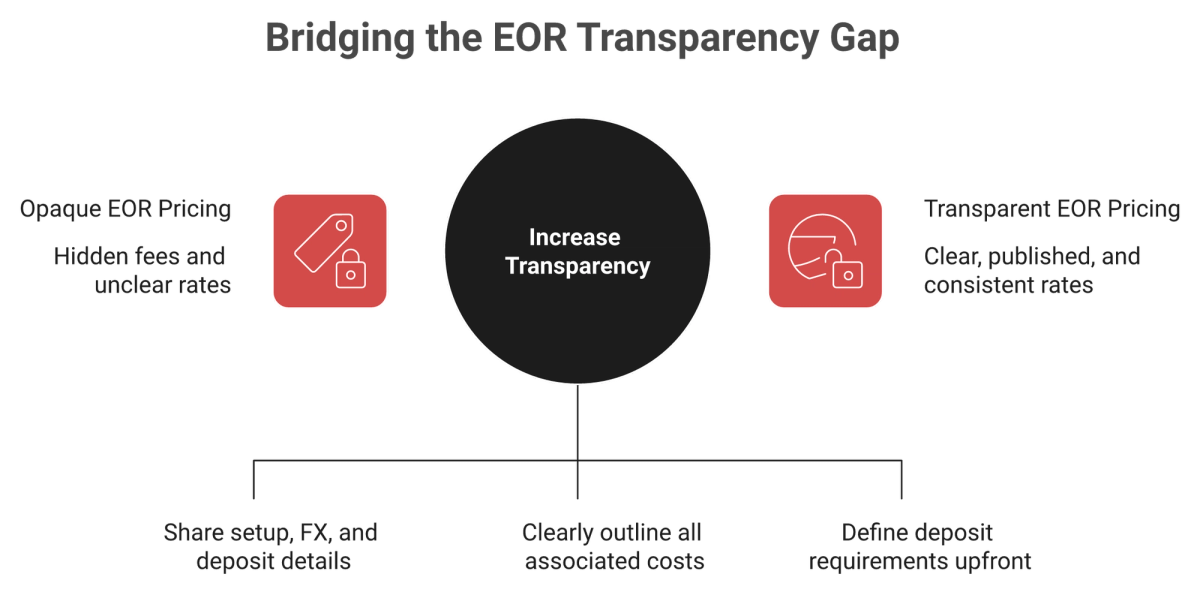
⚠️ Quote gating is a pricing strategy, not an oversight
Here is the part the category avoids saying. When a price only exists inside a sales call, the price becomes partly a function of how you behave in that call.
Funded companies get quoted differently from bootstrapped ones. Papaya scores 67 out of 100 on the EOR Select index, with deposit, setup, offboarding, FX markup, and minimum term all logged as undisclosed.
✅ What to evaluate instead of the dashboard tour
Skip the platform demo on your first call. Evaluate three things that actually move your invoice: who legally owns the employing entity in India, what the FX policy is in writing, and which state registrations the provider holds itself. Our India compliance coverage page lists those registrations rather than describing them.
Versatile Club measures its own transparency by a simple test, which is whether a buyer can compute their annual cost from the website without talking to anyone. My honest hedge: quote gating is not proof of overcharging, and enterprise deals do genuinely vary. It is proof that you carry the burden of discovery.
💸 The cost of the discovery burden
Every undisclosed line is unpaid work handed to your finance team. I have seen a controller spend two weeks reconstructing a vendor's FX margin from twelve months of invoices.
That is time your close does not have. Ask for the numbers before you ask for the demo, or model the spend yourself with the EOR versus entity calculator.
Versatile Club publishes its rate, its $0 setup fee, its $0 exit fee, and its first month free term in writing, so the call is about your hire rather than your price.
Q3. Does Papaya Global require a security deposit for India employees?
Papaya's page states "No deposit needed" on the EOR card and "No deposit required" on the contractor card. Independent reviews report Papaya EOR engagements carrying a one to two month security deposit per employee, and a transparency audit records the deposit policy as not published. Versatile Club takes no security deposit, because it employs your India hires on its own registered Indian entity.
💸 The line that breaks a seed stage cash plan
A deposit is not a fee. It is working capital you park with a vendor for the life of the engagement.
For a company with 14 months of runway, that distinction is academic. The cash is gone from your account either way.
⚠️ Three sources, three different answers
Versatile Club's audit of the live page found the deposit claim stated twice, on two separate product cards. Against that sit two independent readings.
| Source | Deposit position |
| Papaya pricing page, 24 Aug 2026 | "No deposit needed" |
| Employsome and Peorient reviews | 1 to 2 months salary per employee |
| EOR Select disclosure audit | Not published |
A G2 reviewer describes the practical end of this. Their deposit came back late, and the credit memo came back later.
"Papaya held our deposit return over a month past the due date we agreed on. They have continued withholding a credit memo over 45 days beyond the payment date without reason and have not given a payment timeline."
— Verified User in Civic & Social Organization, Papaya Global - G2 Verified Review
"Security Deposits: Equivalent to 0-3 months of salary (refundable). Setup Fees: $500-2,000 per employee (one-time charge)."
— u/anonymous, r/eorpeo Reddit Thread
💰 What two months actually locks up
Assume ₹87 to the dollar. A two month deposit scales straight off CTC, so senior hires hurt most.
| Annual CTC | Two month deposit | Approx. USD |
| ₹20 lakh | ₹3.33 lakh | $3,830 |
| ₹30 lakh | ₹5.00 lakh | $5,750 |
| ₹50 lakh | ₹8.33 lakh | $9,580 |
Versatile Club runs this same calculation for buyers before they sign anywhere, using their real CTC bands rather than a sample. Three senior engineers at ₹50 lakh means nearly $29,000 sitting with a vendor, which is why the true cost of an employer of record in India deserves a line by line read.
✅ Four clauses to demand in writing
After six years of India engagements, this is the language I insist on. Ask Versatile Club, or any provider, to put all four in the agreement itself, not in an email.
- Deposit amount, expressed in months of CTC, per employee.
- Who holds it, and in which entity's bank account.
- The refund trigger, with a day count from the employee's last working day.
- Interest treatment, if any, while it is held.
My read is that deposits exist for a structural reason, not a greedy one. A partner entity fronts real statutory liability it cannot claw back from a foreign parent, so it asks you to pre fund the risk.
Versatile Club takes no security deposit, because the employing entity is ours. Foo Falcon Technologies Pvt Ltd holds the PF, ESIC, and Shops and Establishments registrations directly, which is the basis of our India EOR service.
Q4. What setup, offboarding, minimum-term and annual-minimum commitments apply?
Setup fees apply per multiple Papaya reviews, and setup or termination charges exist as add-ons. A disclosure audit records setup fee, offboarding fee, and minimum term as undisclosed. Enterprise contracts reportedly carry annual minimums above $100,000, and onboarding is mandatory sales led with no self serve path. Versatile Club charges $0 to start, $0 to exit, and holds no minimum headcount.
📋 The four commitments that outlive your first invoice
Recurring fees get scrutinised. One time and term commitments get skimmed, then they bind you for a year.
There are four to check on any India quote: the setup fee, the offboarding fee, the minimum term with its exit notice, and the annual contract minimum.
⚠️ Disclosed against reported, marked honestly
Versatile Club appears in this table beside the alternatives, with the disputed rows labelled as disputed rather than smoothed over.
| Commitment | Papaya Global | Versatile Club |
| Setup fee | Not published; reported to apply (disputed) | $0 |
| Offboarding fee | Not published | $0 |
| Minimum term | Not published | None |
| Annual minimum | $100,000+ reported on enterprise contracts | None |
| Onboarding | "Get started in weeks" on page; 3 to 7 days reported | 5 business days, contractual |
| Self serve path | None; sales led onboarding mandatory | Direct founder contact |
Note the timing wording. The only time related commitment on Papaya's entire pricing page is "Get started in weeks", and that is an onboarding duration, not a billing period. Our own five day onboarding process is written into the agreement instead.
💰 The annual minimum is a qualification test
A $100,000 floor is roughly 13 employees at $650. If your India plan is three hires, you are not in that tier, and no negotiation fixes tier mismatch.
Versatile Club measures fit the opposite way, treating a single engineer in Bengaluru as a real account with the first month free. I could be reading the minimums too strongly, since they are reported rather than published. Ask for the floor in writing and you will know within a day, and seed to Series B teams should ask first.
❌ What overcharging looks like in practice
Buyers on other global platforms describe policing agreed fees themselves. That is the failure mode undisclosed terms create.
"We had to carefully manage our agreement and had to constantly remind them of the fees agreed so that we weren't over charged. Everything was VERY time consuming. It took three months to onboard our first 3 individuals."
— Verified User in Information Technology and Services, Deel Hire - G2 Verified Review
"It's also incredibly helpful for obtaining our monthly invoices and detailed cost breakdowns directly through the platform. We've noticed that response times can sometimes be very slow when we require clarifications."
— Cherry H., Payroll Manager, Papaya Global - G2 Verified Review
✅ Your self disqualification test
Answer three questions before your next call. Is India your only hiring country? Are you under 20 India hires? Do you need a start date inside two weeks?
Three yeses mean the premium enterprise tier is the wrong shelf for you. That is not a knock on Papaya, whose payments rails and mass onboarding genuinely suit multi country programmes.
An offboarding fee is a switching cost engineered at signature. Read the exit clause before you read the entry rate, and if you are already mid contract, the guide to switching EOR providers in India sets out the sequence.
Versatile Club charges $0 to start and $0 to leave, holds no minimum headcount or annual commitment, and writes a five business day onboarding SLA into the service agreement itself. Send us the quote you are holding and we will mark it up line by line.
Q5. Which add-ons inflate the India invoice above the base rate?
Two charges sit above the headline rate. India is reported to carry a country complexity surcharge of $100 to $300 per employee per month, alongside Brazil and the Middle East. Papaya advertises "competitive FX rates" without publishing a spread, and audits record its markup as not published. Versatile Club invoices in USD from its own Indian entity at the mid market rate.
💸 The surcharge that arrives after the quote
A country complexity surcharge is an extra monthly fee for markets the provider finds harder to service. India sits on that list with Brazil and the Middle East, at a reported $100 to $300 per employee per month.
Run the arithmetic and a $599 quote lands past $750. That is a 25% swing on a number your board already approved.
⚠️ Where the FX spread actually hides
FX markup is the gap between the rate your invoice uses and the interbank mid market rate. It never appears as a line item, because it is baked into the conversion itself.
Versatile Club measures this the only honest way, by comparing the invoice rate against the mid market rate on the same date. Category markups run 2% to 10%, and Deel is commonly reported at 3% to 5%, which is why the Deel alternative comparison starts with currency, not features.
💰 What a 4% spread costs you per year
Assume ₹87 to the dollar and a 4% spread on salary conversion alone.
| Annual CTC | USD equivalent | Cost of 4% spread | Versatile Club |
| ₹20 lakh | $22,990 | $920 per year | No conversion leg |
| ₹30 lakh | $34,480 | $1,380 per year | No conversion leg |
| ₹50 lakh | $57,470 | $2,300 per year | No conversion leg |
At ₹30 lakh, the spread costs more than the annual fee difference between two vendors. I have watched CFOs negotiate $50 off the monthly rate while leaving $1,380 on the table. Run your own numbers with the India salary calculator before you accept a quote.
❌ What the invoice trail looks like when it breaks
Reviewers describe reconciliation pain, not headline pricing pain. That gap is the whole point of this section.
"Papaya missed invoicing us for a month, causing audit issues and requiring escalation to their CFO. For a while, they insisted we had paid an invoice we never received or paid."
— Verified User in Civic & Social Organization, Papaya Global - G2 Verified Review
"Low cost providers sometimes have hidden fees. The other more established providers have clearer pricing but can be more expensive."
— u/anonymous, r/remotework Reddit Thread
✅ The two line email that settles it
Ask Versatile Club, or any provider, to answer these two lines in writing before you sign anything.
- Which rate source do you use for INR conversion, and on which date is it fixed?
- What margin, in basis points, do you add to that rate?
A vendor that answers both in a sentence is not marking you up much. A vendor that redirects to "competitive rates" is telling you the margin matters to them.
My honest hedge here: a 4% spread is a category estimate, not a Papaya disclosure. Papaya's actual India spread is unpublished, so the number is a planning assumption you should replace with their written answer.
⏰ Why this shows up at month end, not at signature
Statutory contributions can add 20% to 40% in markets like India, and those flow through the same invoice. Stack a surcharge, a spread, and a passthrough, and the variance lands on your controller three weeks after payroll. Our managed payroll service exists because that variance is where trust dies.
Versatile Club invoices in USD directly from its Indian entity at the mid market rate, so there is no surcharge line and no conversion margin between you and your engineer's salary.
Q6. Which India statutory costs sit outside the fee, and how did the Labour Codes change them?
No EOR fee includes India's statutory employer costs. Provident fund is 12% of Basic plus DA against a ₹15,000 monthly wage ceiling. ESI adds a 3.25% employer share on wages up to ₹21,000. Gratuity accrues at 4.81% of Basic plus DA from month one, and TDS must be deposited by the 7th of the following month. Together these add roughly 20% to 25% above salary.
💰 The platform fee is the smallest line on your invoice
Buyers spend weeks negotiating $50 off a monthly rate. Then a statutory load of 20% or more lands on the same invoice, unnegotiated.
Provident fund, or PF, is India's retirement savings scheme. ESI is state health insurance. Both are employer obligations, and no provider absorbs them.
📋 Each contribution, with its ceiling and its deadline
Versatile Club files each of these under its own registrations, so these figures come from challans (payment receipts) rather than a partner's summary.
| Item | Rate | Ceiling or base | Deadline |
| PF (employer) | 12% | Basic plus DA, ₹15,000 ceiling | 15th monthly |
| ESI (employer) | 3.25% | Wages up to ₹21,000 | 15th monthly |
| ESI (employee) | 0.75% | Wages up to ₹21,000 | 15th monthly |
| Gratuity accrual | 4.81% | Basic plus DA, from month one | On exit, accrued monthly |
| TDS | Per income tax slab | Gross salary | 7th of following month |
| Professional tax | State slabs | Varies by state | State specific |
Professional tax, or PT, is a state level payroll tax. Karnataka runs a monthly cycle. Maharashtra needs two registrations, PTRC and PTEC. Tamil Nadu files twice a year. The India payroll compliance guide sets out each cycle state by state.
⚠️ What the Labour Codes actually changed in 2025 and 2026
All four Labour Codes came into force on 21 November 2025 through gazette notifications S.O. 5319(E) to S.O. 5322(E). The Rules under all four Codes were then gazetted in May 2026, completing the rollout.
The rule that hits your invoice is the wage definition. Basic plus DA must now be at least 50% of CTC, which lifts the base for PF and gratuity on high CTC hires.
✅ Two 2026 notifications worth knowing
The EPF Scheme, 2026 was notified on 29 June 2026 under the Code on Social Security, 2020. It retained the ₹15,000 wage ceiling, made contributions above ₹1,800 voluntary, and set 12% annual interest on delayed employer payments.
Versatile Club's read is that the reported ₹25,000 ceiling is not law yet. Cabinet approval is pending and no gazette notification has issued, so plan on ₹15,000.
⏰ What to do with this before your next payroll run
Two actions, both doable this week.
- Rebuild your CTC structures so Basic plus DA clears 50%, then recompute PF and gratuity accrual.
- Ask your provider, in writing, whether it repriced its statutory passthrough after the May 2026 Rules.
I have seen providers quietly keep old percentage assumptions for months. The variance surfaces in an audit, not in a dashboard.
💸 A worked example at ₹30 lakh CTC
Basic plus DA at 50% is ₹15 lakh, or ₹1.25 lakh monthly. PF caps at ₹1,800 employer contribution because of the ₹15,000 ceiling. Gratuity accrues at 4.81% of ₹1.25 lakh, roughly ₹6,000 monthly.
Ask Versatile Club to run this build up against your real offer letters before you compare vendor quotes. The fee gap between providers is often smaller than the accrual you forgot, as the full cost of hiring in India shows.
Versatile Club itemises every statutory line on one USD invoice, covering PF, ESI, professional tax, TDS, and gratuity accrual, so your controller reconciles a single document at month end.
Q7. What compliance deliverables are you buying, and what liability stays yours?
The fee should buy named deliverables: monthly PF and ESI challans, professional tax filings per state, TDS deposits by the 7th, and the annual tax certificate. That certificate is now Form 130 under section 395(4)(a) of the Income-tax Act, 2025, replacing Form 16. Versatile Club issues Form 130 on the statutory due date under its own registrations. What stays yours: DPDP processor duties, POSH coverage, and permanent establishment exposure.
📋 The monthly artefact list to demand
Ask for documents, not dashboard screenshots. A challan is a stamped government payment receipt, and it either exists or it does not.
Versatile Club's client engagements surface the same pattern every quarter, where buyers discover they never asked for the artefacts. The list is short.
- PF electronic challan cum return (ECR) with the wage base per employee.
- ESI contribution challan.
- State professional tax payment proof, per state of employment.
- TDS deposit challan, by the 7th of the following month.
- Payslips showing Basic, DA, and allowance split.
⚠️ Form 16 to Form 130 is a live signal
Under section 395(4)(a) of the Income-tax Act, 2025, the deductor must issue a certificate specifying tax deducted and deposited. The forms are renumbered 130, 131, 132, and 133, replacing Forms 16, 16A, 16B, and 16C.
Ask Versatile Club, or any provider, to show a sample Form 130 template. A provider still shipping a Form 16 layout has not migrated its payroll system, which matters if you outsource payroll in India rather than run it yourself.
❌ What no EOR fee transfers away from you
This is the part vendors skip in the sales cycle. Three exposures stay with your company regardless of who signs the employment contract.
- DPDP obligations. The Digital Personal Data Protection Act, 2023 and the Rules published by MeitY govern employee personal data. You need a written processor addendum naming the EOR, with breach notification timelines.
- POSH coverage. The Sexual Harassment of Women at Workplace Act, 2013 requires an Internal Committee. Confirm in writing whose committee covers your India employees in practice.
- Permanent establishment risk. PE means a tax presence created by how you operate, not by what you signed. Direct the work too closely and you can create exposure your EOR contract does not erase.
✅ Two clauses in-house counsel should add
Versatile Club signs a DPDP processor addendum as standard, and I would ask for the same from any provider on the shortlist.
- Processor addendum: purpose limitation, sub processor disclosure, and a breach notification window in hours.
- Compliance artefact SLA: named documents, delivered by a stated day each month.
⏰ The co-employment trap to avoid entirely
US style co employment PEO does not exist under Indian labour law. There is no legal structure where your foreign company and a local provider jointly employ someone. If a vendor is selling you PEO services in India, read the contract before the brochure.
If a vendor uses PEO language for India, treat it as a vocabulary problem at best. What surfaces in Versatile Club's India engagements is that this confusion usually starts on the buyer's side, copied from a US playbook.
💰 Why state level depth beats a global template
Compliance is the floor, not the ceiling. Filing across Maharashtra, Karnataka, Tamil Nadu, and West Bengal teaches you things a global checklist cannot.
Karnataka wants enrollment within 30 days of joining. West Bengal changes rules often enough that last year's template fails this year. I could be biased by where our filings happen, but the pattern holds across every state we operate in.
Versatile Club holds PF, ESIC, and Shops and Establishments registrations across all 28 states and 8 union territories, so the filings and the Form 130 issuance happen under our own registrations. The compliance coverage page lists them by state.
Q8. Does Papaya Global own an Indian entity, or does India run through partners?
Papaya runs a hybrid model in India, combining its own processing with partner entities, rather than a wholly owned Indian employing entity. Its coverage claims vary across sources at 160 plus, 163, and 180 plus countries. Versatile Club employs India hires on its own registered Indian entity, Foo Falcon Technologies Pvt Ltd. When a third party is the legal employer, every correction travels through one more organisation than you can see.
⏰ Day 40, and the PF wage base is wrong
Here is the scene I get on WhatsApp most often. An engineer joined six weeks ago, and the PF contribution was computed on the wrong Basic plus DA split.
The fix itself takes ten minutes on the EPFO portal. The routing is what takes three weeks.
⚠️ Who actually signs the employment contract
In a partner model, the local entity is the legal employer. Your platform is the interface, and the contracting party sits behind it.
Versatile Club's read is that this single fact explains most India EOR complaints, including deposits, slow amendments, and vague liability answers. Ask who signs, and you learn more than any feature comparison gives you, which is the test applied across the best EOR providers in India.
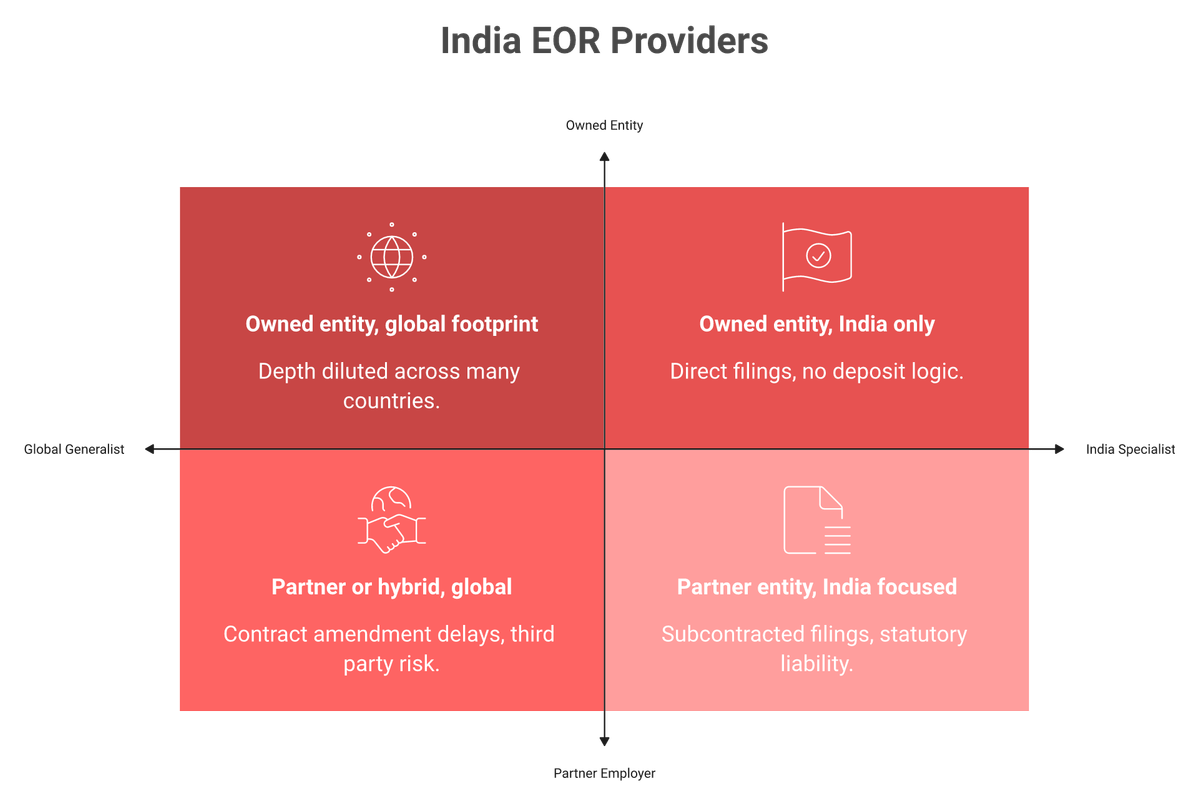
⭐ The three player comparison that matters
| Criterion | Papaya Global | Deel | Versatile Club |
| India employing entity | Hybrid, own plus partner | Local partner entities | Own entity, Foo Falcon Technologies Pvt Ltd |
| Countries | 160 plus claimed, 163 audited | 150 plus | India only, by design |
| India EOR fee | $599 to $770 per month | $599 per month | $149 per month, flat |
| Deposit | "No deposit needed" on page, 1 to 2 months reported | Reported | None |
| Support model | 24/7 ticket support | Ticket queue | Founder on WhatsApp |
Versatile Club appears in that table with the honest drawback attached, which is that India is the only country we cover.
❌ What buyers say about the partner chain
Three separate voices, all describing the same structural issue.
"We made the initial decision to move away from Papaya because they are not an EOR but Deel did not meet the commitments they had made."
— Verified User in Information Technology and Services, Deel Hire - G2 Verified Review
"They also subleased our contract to a 3rd party without letting me know in advance. Their communication of the situation was terrible."
— Guy B., Remote - G2 Verified Review
"Papaya are more expensive but more 'full service'. MAke Sure they have actual entities in those countries not 3rd parties."
— u/anonymous, r/humanresources Reddit Thread
✅ Three questions that reveal the real structure
Ask Versatile Club these too, and compare the answers side by side.
- Which legal entity name appears on the employment contract in India?
- Whose PF establishment code and ESIC code are my employees registered under?
- If a professional tax filing is late, which company pays the penalty?
Vague answers to question two are the tell. An owned entity operator knows its own codes. If you are weighing the partner route against your own subsidiary, the EOR versus entity comparison for India covers the liability trade off.
💰 Why the model drives the deposit, not the other way round
A partner entity fronts statutory liability it cannot recover from a foreign parent. So it asks for pre funding, which reaches you as a security deposit.
I think this is the quiet reason India EOR pricing looks the way it does. Own the entity and the deposit logic disappears.
Versatile Club employs your India hires on its own entity, which is why a professional tax correction is a WhatsApp message to the founder rather than a ticket routed to a subcontractor. See how the India EOR service is structured, or send us the quote you are comparing.
Q9. What is the all-in cost at 1, 5 and 20 India employees?
Model Papaya at $650, not $499. One hire at ₹30 lakh CTC runs about $7,800 a year in platform fees, plus a 20% to 25% statutory load, plus a one to two month deposit and an undisclosed setup fee. Twenty hires reach roughly $156,000 a year in fees alone. Versatile Club's flat $149 puts the same twenty employees at about $35,760.
📋 The assumptions, stated before the numbers
A cost model is only useful if you can audit it. Mine uses ₹87 to the dollar, a ₹30 lakh CTC engineer in Bengaluru, and annual billing.
Versatile Club builds every client model on three bands, ₹20 lakh, ₹30 lakh, and ₹50 lakh, because India salaries vary more than US buyers expect. Papaya's own published EOR range spans $499 to $770, so the mid point is the honest planning input.
💰 The build up at 1, 5, and 20 hires
Platform fees only, before salary and statutory contributions.
| Headcount | Papaya at $650 | Versatile Club at $149 | Annual gap |
| 1 | $7,800 | $1,788 | $6,012 |
| 5 | $39,000 | $8,940 | $30,060 |
| 20 | $156,000 | $35,760 | $120,240 |
Papaya's own escalation example makes the shape clear. Fifty employees at $599 cost nearly $30,000 a month, roughly $360,000 a year in platform fees before salaries. The same build up for other vendors sits in our employer of record cost breakdown.
💸 The swing items nobody puts in the model
Three lines move your total by thousands, and none are published.
- Country complexity surcharge. $100 to $300 per employee per month, or $1,200 to $3,600 a year per head.
- Security deposit. Two months at ₹30 lakh CTC locks about $5,750 per employee.
- FX spread. A 4% margin on salary conversion costs roughly $1,380 a year per employee.
Add all three to one hire and the best case to worst case band runs from $7,800 to nearly $19,000. Ask Versatile Club to build this band for your actual offer letters, not a sample profile.
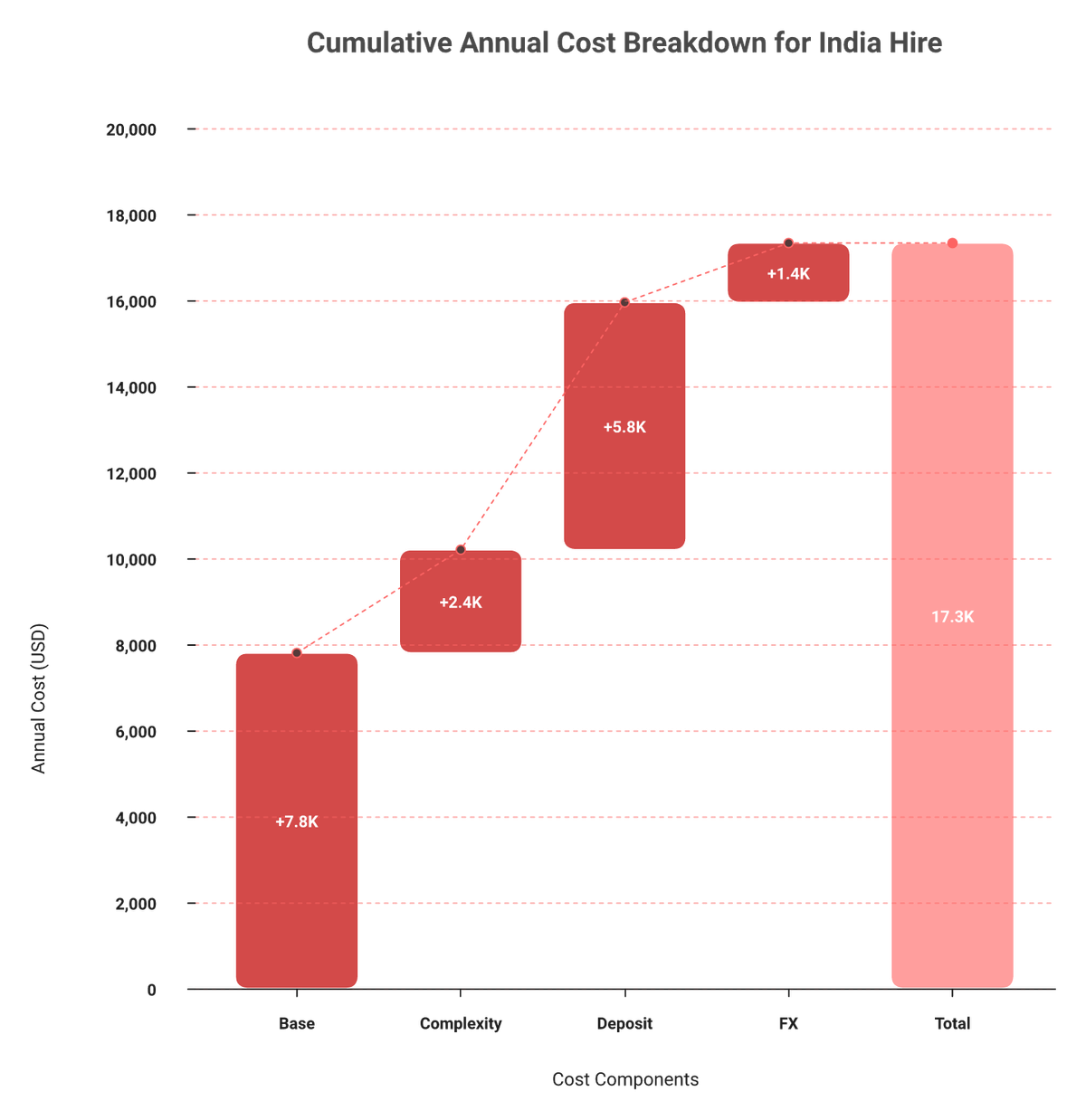
⚠️ Cost per rupee delivered to the employee
This is the metric I actually use. Divide annual platform fees by the salary that reaches the employee.
At ₹30 lakh, a $650 fee equals 22.6% of salary. Versatile Club's $149 equals 5.2% of the same salary, which is the number I would put in a board deck rather than the monthly rate. Our published pricing is the input for that calculation.
⏰ Where the crossover to your own entity sits
The arbitrage is real. A senior engineer at $220,000 in San Francisco compares against roughly $58,000 for the equivalent hire in Bengaluru, a gap near $162,000 a year.
Versatile Club's read is that price alone is the wrong reason to hire in India, and buyers who lead with cost churn fastest. What you go to India for is depth of talent that has fewer good places to apply.
✅ When an owned entity beats an EOR
Below roughly 15 India employees, EOR is almost always cheaper, even across three years. Above 20, the maths shifts toward incorporation. Model both paths in the EOR versus entity calculator before you commit capital.
Setting up your own Indian subsidiary costs upward of $50,000 and takes 12 to 18 months before the first hire lands. I would rather see a founder hire in five days, then convert at 20 heads with the data to justify it, which is the route mapped in the GCC setup in India guide.
Versatile Club's flat $149 puts twenty India employees at about $35,760 a year in fees, with no deposit, no setup charge, no surcharge, and no FX spread stacked on top.
Q10. How does Papaya Global's India pricing compare with the alternatives?
On published India rates: Versatile Club $149 flat, Wisemonk from $99 on slabs, Multiplier $400, Papaya Global $599 tracker verified to $770 list, Deel $599, and Remote $699 or $599 on annual billing. Papaya is the only one of the six publishing no figure on its own pricing page, and it scores 67 out of 100 on the EOR Select index.
⭐ The six provider comparison, structure first
Read the columns to the right of price. That is where your real cost lives.
| Provider | India rate | Own India entity | Deposit | Setup fee | Exit fee | Onboarding |
| Versatile Club | $149 flat | Yes, Foo Falcon Technologies Pvt Ltd | None | $0 | $0 | 5 days, contractual |
| Wisemonk | From $99, slabs to $399 | Yes, India native | Not published | Not published | Not published | 24 to 72 hours claimed |
| Multiplier | $400 | Partner model reported | Not published | Not published | Not published | 1 to 2 weeks |
| Deel | $599 | Partner entities in India reported | Reported | $500 reported | Not published | 7 to 14 days |
| Remote | $699, $599 annual | Partner model reported | Reported | Not published | Not published | 10 to 14 days |
| Papaya Global | $599 to $770 | Hybrid, own plus partner | 1 to 2 months reported | Reported | Not published | "Weeks" on page |
Versatile Club sits in row one with the honest drawback attached, which is that India is the only country covered.
❌ Where the sticker price misleads you
Wisemonk's $99 entry is genuinely lower than $149. I am not going to pretend otherwise, and the Wisemonk alternative comparison puts both structures side by side.
The catch is slab pricing, where the rate climbs with salary toward $399. A flat fee means the ₹80 lakh hire and the ₹12 lakh hire cost the same to administer.
⚠️ What buyers say about cheap versus clear
The category has a real suspicion about low prices, and it deserves a straight answer.
"As for the Employer of Record fee, some providers have a flat fee ($599/software developer/month is a standard), Lower than that usually means hidden markups."
— u/anonymous, r/eorfortech Reddit Thread
"India: $300-500/month. Hidden Costs to Consider. Setup Fees: $500-2,000 per employee (one-time charge)."
— u/anonymous, r/eorpeo Reddit Thread
"System integration is very helpful and makes the process much easier and more efficient. It's also incredibly helpful for obtaining our monthly invoices and detailed cost breakdowns directly through the platform."
— Cherry H., Payroll Manager, Papaya Global - G2 Verified Review
That Reddit suspicion is fair. Versatile Club's answer is structural rather than rhetorical, because owning the Indian entity removes the partner margin that forces $599 pricing.
✅ Which provider fits which headcount band
Scenario picks, stated plainly.
- One to five India hires, India only: an India specialist, on a flat fee with no deposit.
- Ten to fifty India hires plus two or three other countries: split the stack, India specialist plus a generalist.
- Fifteen plus countries, mass onboarding, enterprise BI: Papaya genuinely fits, and its payments rails are strong.
Ask Versatile Club to tell you when you are in band three. I would rather lose the deal than take a buyer who needs Latin America next quarter. If you are shortlisting inside band one, the ranked view sits in best EOR services in India.
Versatile Club leads this table because it is the only entry that is India only, owns its employing entity, and publishes a flat rate backed by a contractual onboarding SLA.
Q11. When is Papaya worth the premium, and when should you switch?
Papaya earns its premium when you run payroll across fifteen or more countries and need bank grade payment rails, mass onboarding of 1,000 plus workers, and enterprise analytics. It does not when India is your only country and you have fewer than twenty hires. Switch triggers are support latency, payroll errors, unresolved statutory corrections, and invoices you cannot reconcile.
✅ The case for Papaya, stated fairly
Papaya is built payments first. Its platform supports mass payments above 10,000 transactions, funding in 15 plus currencies, payouts in 130 plus, and 95% same day payment.
For a company unifying 18 countries, that infrastructure is the product. One testimonial on the page describes a 70% cut in onboarding time across 18 countries.
⚠️ Where India only buyers lose
A platform covering 160 plus countries spreads India depth thin. That shows up in state level work, not in the dashboard.
The premium tier also carries a reported $100,000 annual minimum, which prices out a three hire India plan entirely. For teams at that stage, our startup hiring model starts at one employee.
❌ The switch triggers that show up in reviews
Four patterns repeat across verified reviews of global providers.
- Onboarding that slips past the promised window.
- Support that rotates, so context resets every ticket.
- Statutory or benefits errors that need your own legal counsel.
- Invoices that arrive late, or not at all, creating audit findings.
"It took three months to onboard our first 3 individuals. They didn't seem to be able to navigate Visas or variations to employment contracts."
— Verified User in Information Technology and Services, Deel Hire - G2 Verified Review
"Our employee consulted with legal counsel because Papaya attempted not to pay out accrued PTO multiple times. We've had many, many customer service reps."
— Verified User in Civic & Social Organization, Papaya Global - G2 Verified Review
"Remote is terrible at drafting employment contracts. I ended up needing to stike a special deal to exit Remote's provident fund, because it was so badly administrated."
— Guy B., Remote - G2 Verified Review
⏰ The 12 hire tipping point, and the other path
Founders I speak to describe a clean threshold. Around 10 to 12 India hires, the per head fee starts to look worse than incorporation.
One team I know hit 12, opened their own entity, then migrated all 12 across. The other path is to keep the EOR as the on ramp and build a GCC (global capability centre) behind it, first engineer live in days, entity ready by month six. The trade off is laid out in EOR versus GCC in India.
💰 Migration mechanics, in order
Switching India employees is paperwork, not drama. Do it in this sequence.
- Confirm the new employer's PF establishment code, then file the UAN transfer for each employee.
- Close TDS for the part year, so Form 130 issuance is continuous across both employers.
- Complete full and final settlement, including gratuity accrual carried or paid out.
- Serve notice per the employment contract and the Industrial Relations Code.
I would run the transfer at a quarter boundary. Mid quarter switches create two partial Form 130s and a very unhappy accountant. The full sequence, with document templates, sits in the guide to switching EOR providers in India.
Versatile Club is India only by design, so if you need one vendor across fifteen countries, we will tell you to split the stack rather than sell depth we do not have elsewhere.
Q12. What should you get in writing before signing any India EOR quote?
Get nine things in writing: the India per employee rate, any country complexity surcharge, deposit months and refund trigger, setup fee, offboarding fee, minimum term and exit notice, FX rate source and margin, which statutory items are passthrough versus marked up, and which legal entity in India employs your people. Versatile Club answers all nine before signature. A vendor that will not answer in writing has answered.
📋 Why written beats verbal on India engagements
Verbal quotes drift. The rate you heard on a call in March becomes a different number in the July invoice, and nobody has the receipt.
Versatile Club's read is that this is the single cheapest risk control available to a buyer, and almost nobody uses it. One email, sent before signature, is worth more than any platform demo.
✅ The nine items, with what each protects
Ask for each answer as a number or a named entity, not a paragraph.
- India per employee rate. Annual and monthly billing, both stated.
- Country complexity surcharge. Yes or no, and the amount if yes.
- Deposit. Months of CTC, holder, refund trigger in days.
- Setup fee. Per employee or per account.
- Offboarding fee. Per employee, and when it applies.
- Minimum term and exit notice. Months, and the notice window.
- FX rate source and margin. Rate source, fixing date, basis points added.
- Statutory items. Which are passthrough at cost, which carry a margin.
- Employing entity. Legal name, PF code, ESIC code.
Papaya's transparency audit records five of these nine as not published, which is exactly why the list exists. Our onboarding process page answers items one through six before a call happens.
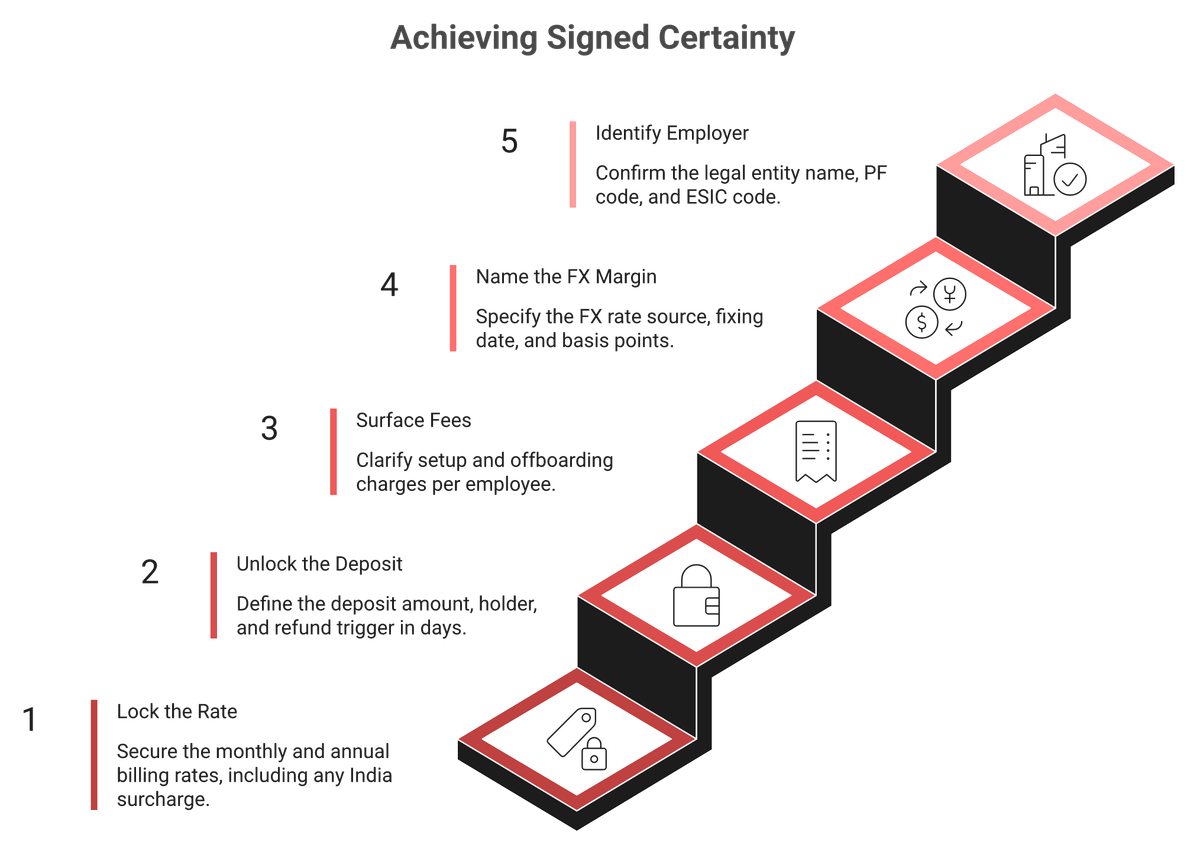
💸 A copy paste email you can send today
Send this to every shortlisted provider, including Versatile Club, and compare the replies side by side.
"Before we proceed, please confirm in writing: your India EOR rate per employee per month, any India surcharge, deposit months and refund terms, setup and offboarding fees, minimum term and exit notice, your INR rate source and margin in basis points, which statutory contributions are billed at cost, and the legal entity name plus PF and ESIC codes under which our employees will be registered."
⚠️ How to read the replies
Three signals tell you most of what you need.
- A same day answer with numbers means the provider has nothing to hide.
- A redirect to a call means at least one number is negotiable, so negotiate it.
- Silence on the entity question is the one I would not accept at any price.
Ask Versatile Club to mark up a competitor's quote against these nine lines. I do this on WhatsApp, usually in under an hour, and I will tell you when the other quote is genuinely better. If you are still deciding on the model itself, start with hiring in India without an entity.
⏰ What I think changes in the next two years
Here is the hypothesis I am sitting with. India stops being one country on a global EOR map and becomes its own category, the way AWS regions became a real procurement decision rather than a footnote.
If that holds, owned entity operators in one country take the India revenue global generalists treat as marginal. I could be wrong about the pace, and enterprise procurement moves slowly. Where my head is right now is that the pricing opacity documented in this article is the reason it happens.
Versatile Club answers all nine questions before you sign anything, with Sagar Chainani, founder, personally on WhatsApp, not a CSM rotation and not a ticket queue. Send over the quote you are holding and we will go through it line by line.
FAQs
How much does Papaya Global cost per employee per month in India?
Papaya Global does not publish an India specific EOR rate. Independent sources placed it between $499 and $770 per employee per month as of August 2026, which is a 54% spread across credible figures.
- $499 on the vendor's own G2 listing.
- $599 verified against Papaya's site in July 2026 and unchanged through August.
- $650 Full Service and $770 Premium in review teardowns.
- $599 to $750 in a separate June 2026 pricing analysis.
Our planning advice is blunt: model Papaya at $650, not $499, because the lower figure is a vendor listing rather than a quoted India rate. Papaya's wider line up spans $3.50 per transaction to $770 per employee per month across roughly seven products, so confirm which SKU your quote covers before you compare anything.
Versatile Club charges $149 per employee per month, flat, with no salary slabs, and publishes that rate on its India EOR pricing page before any call happens. For a full market view of what India employment actually costs, we break down every line item in our guide to the cost of an employer of record in India.
Does Papaya Global require a security deposit for India employees?
Papaya's pricing page states No deposit needed on the Employer of Record card and No deposit required on the contractor card. Independent reviews, however, report Papaya EOR engagements carrying a one to two month security deposit per employee, and one transparency audit records the deposit policy as not published.
That contradiction matters because a deposit is working capital, not a fee. Assuming ₹87 to the dollar, two months of salary locks up roughly:
- ₹20 lakh CTC: about $3,830 per employee.
- ₹30 lakh CTC: about $5,750 per employee.
- ₹50 lakh CTC: about $9,580 per employee.
Three senior engineers at ₹50 lakh means close to $29,000 sitting with a vendor for the life of the engagement. Before signing, insist on four clauses in the agreement itself: deposit months expressed as CTC, the holder and bank account, the refund trigger in days from the last working day, and interest treatment.
Versatile Club takes no security deposit, because the employing entity is ours and holds the PF, ESIC, and Shops and Establishments registrations directly. That structure is set out on our India EOR services page.
What setup, implementation, and minimum contract commitments does Papaya Global apply?
Setup fees apply according to multiple Papaya reviews, and setup or termination charges exist as add ons. An independent disclosure audit records the setup fee, the offboarding fee, and the minimum term as undisclosed, so none of the three can be verified from published sources.
- Enterprise contracts reportedly carry annual minimums above $100,000, roughly 13 employees at $650.
- Volume breakpoints on Payroll Plus exist but are not published.
- Onboarding is mandatory sales led, with no self serve path.
- The only time commitment on the pricing page is Get started in weeks, which is an onboarding duration rather than a billing period.
Read that $100,000 floor as a qualification test rather than a negotiating position. If India is your only hiring country and you are under twenty hires, you are not in that tier, and no discount fixes tier mismatch.
Versatile Club charges $0 to start, $0 to exit, holds no minimum headcount or annual commitment, and writes a five business day onboarding SLA into the service agreement itself. The sequence is documented step by step on our how it works page.
Are PF, ESI, and gratuity included in Papaya Global's India EOR fee?
No. India's statutory employer costs sit outside every EOR platform fee, including Papaya's, and typically add 20% to 25% above salary.
- Provident fund: 12% of Basic plus DA against a ₹15,000 monthly wage ceiling, deposited by the 15th.
- ESI: 3.25% employer share and 0.75% employee share on wages up to ₹21,000.
- Gratuity: accrues at 4.81% of Basic plus DA from month one.
- TDS: deducted per slab and deposited by the 7th of the following month.
- Professional tax: state slabs, with Karnataka monthly, Maharashtra needing PTRC and PTEC, and Tamil Nadu filing twice a year.
The Labour Codes changed the base these are calculated on. All four came into force on 21 November 2025, the Rules were gazetted in May 2026, and Basic plus DA must now be at least 50% of CTC, which lifts the PF and gratuity base on high CTC hires. The EPF Scheme, 2026 retained the ₹15,000 ceiling, so ignore the un notified ₹25,000 reports.
Versatile Club itemises PF, ESI, professional tax, TDS, and gratuity accrual on one USD invoice, and our India payroll compliance guide explains each filing cycle.
Is Papaya Global worth the premium for India only hiring, or should you use an India specialist?
Papaya earns its premium when you run payroll across fifteen or more countries and need bank grade payment rails, mass onboarding of 1,000 plus workers, and enterprise analytics. Its platform supports payouts in 130 plus currencies, funding in 15 plus, and 95% same day payment, which genuinely suits a multi country programme.
It stops making sense when India is your only country and you have fewer than twenty hires. A platform covering 160 plus countries spreads India depth thin, and Papaya operates a hybrid model here, combining its own processing with partner entities rather than a wholly owned Indian employing entity.
Watch for these switch triggers:
- Onboarding that slips past the promised window.
- Rotating support, so context resets every ticket.
- Statutory or benefits errors that need your own legal counsel.
- Invoices that arrive late, creating audit findings.
Versatile Club is India only by design, so if you need one vendor across fifteen countries we will tell you to split the stack instead. If you are ready to move, our guide to switching EOR providers in India covers PF transfers, Form 130 continuity, and full and final settlement in order.