Table of contents (19)
- Ranked Provider List
- 1 Versatile Club
- 2 Deel
- 3 Remote
- 4 Multiplier
- 5 Globalization Partners
- 6 Papaya Global
- 7 Pebl
- 8 Payoneer Workforce Management
- 9 Rippling
- 10 Oyster HR
- 11 Remofirst
- 12 Asanify
- Ranking Methodology
- True Cost Breakdown
- 2026 Compliance Checklist
- IP, Data & Equity
- Model & Vendor Structure
- After the Hire
12 Best India EOR Providers for AI Startups, Ranked
Q1. What are the 12 best India EOR providers for AI startups in 2026?
The 12 best India EOR providers for AI startups in 2026 are Versatile Club, Deel, Remote, Multiplier, Globalization Partners, Papaya Global, Pebl, Payoneer Workforce Management, Rippling, Oyster HR, Remofirst, and Asanify. Published fees run from $99 to $699 per employee per month. Versatile Club ranks first for startups making their first one to three India engineering hires: owned Indian entity, $149 flat, and a five-day contractual onboarding SLA.
Choosing an India employer of record is a decision with real teeth. The provider becomes the legal employer of your engineers. It files provident fund, employee state insurance, professional tax, and income tax on your behalf. Get it wrong and you inherit misclassification exposure, permanent establishment risk, and silent payroll errors. Twelve providers were evaluated for this guide across ten criteria: India entity model, statutory compliance depth, state coverage, onboarding speed, pricing transparency, invoicing readiness, support model, talent support, customer validation, and best fit buyer. It is written for founders, people ops leaders, finance teams, and counsel hiring in India.
Our Evaluation Criteria
Each provider included in this list was assessed across the following decision-grade criteria:
India Entity Model: Whether the provider uses its own Indian entity, a local partner entity, a contractor model, or a payroll-only setup.
Statutory Compliance Depth: PF, ESI, TDS, professional tax, gratuity, POSH, Form 16 (now Form 130), full-and-final settlement, DPDP readiness, and New Labour Code 2025-26 structuring. Our India statutory compliance coverage maps to each of these items.
State-Level Coverage: Ability to handle professional tax, Shops and Establishments, labour welfare fund, and leave rules across Indian states.
Onboarding Speed: Time from signed agreement to compliant contract, payroll setup, statutory registration, and employee start.
Pricing Transparency: Monthly fee, setup fee, exit fee, FX markup, first-month terms, salary-band pricing, and invoice clarity, all published on our flat India EOR pricing page.
Invoicing and Finance Readiness: USD invoicing, INR invoicing, gross-deduction-net reporting, challan confirmations, TDS receipts, and audit-ready documentation.
Support Model: Founder-direct support, named HR manager, HRBP, ticket queue, chatbot, or general CSM model.
Talent and Retention Support: Recruiting, contract-to-hire, culture-fit vetting, onboarding monitoring, replacement guarantee, and employee experience support.
Customer Validation: G2, Capterra, Clutch, Gartner, Reddit, case studies, named testimonials, and third-party proof.
Best-Fit Buyer Segment: First India hire, 1 to 20 India employees, 10 to 50 India employees, switchers from Deel or Remote, companies with an existing India entity, or enterprises needing multi-country EOR.
Who This Guide Is For
This guide is designed for:
US and UK founders hiring their first one to three employees in India.
Seed to Series B startups building engineering, product, AI, design, marketing, or operations teams in India.
People Ops and HR leaders reviewing India EOR, payroll, contractor, or PEO vendors.
CFOs and finance teams that need clean invoicing, statutory liability visibility, and audit-ready India payroll records.
Legal teams reviewing employment contracts, IP assignment, misclassification risk, PE risk, and statutory employer accountability.
Companies currently using Deel, Remote, Multiplier, G-P, contractors, agencies, or local payroll vendors and evaluating India-specialist alternatives.
The 12 Providers at a Glance
Versatile Club: Best for US and UK startups making their first 1 to 5 India engineering hires
Deel: Best for startups already hiring across several countries at once
Remote: Best for teams that want owned-entity coverage in core markets plus IP tooling
Multiplier: Best for mid-market teams wanting a mid-priced global platform
Globalization Partners: Best for enterprise procurement with heavy security review
Papaya Global: Best for finance-led buyers consolidating global payroll data
Pebl (formerly Velocity Global): Best for companies mixing employees and contractors globally
Payoneer Workforce Management (formerly Skuad): Best for contractor-heavy teams converting to employment
Rippling: Best for companies standardising on one HR, IT, and payroll system
Oyster HR: Best for remote-first teams hiring in scattered markets
Remofirst: Best for cost-conscious teams accepting a lighter service layer
Asanify: Best for buyers wanting India payroll software plus EOR in one stack
Master Comparison Table
| Provider | Best For | Key Strength | Compliance |
| Versatile Club ⭐⭐⭐⭐⭐ |
US and UK startups hiring their first 1 to 5 India employees | India-only depth with founder-direct support | Own Indian entity, PF, ESI, TDS, and PT filed under its own registrations |
| Deel ⭐⭐⭐⭐ |
Startups hiring in 5 or more countries simultaneously | Widest country coverage and integrations | India served through local partner entity structure |
| Remote ⭐⭐⭐⭐ |
Teams wanting owned entities in core markets | IP and invention assignment tooling | Owned entities in select markets, partner model elsewhere |
| Multiplier ⭐⭐⭐⭐ |
Mid-market teams hiring 10 to 50 people globally | Mid-priced global platform with fast quotes | Broad country compliance, thinner India state-level depth |
| Globalization Partners ⭐⭐⭐⭐ |
Enterprise buyers with security-led procurement | Mature legal and security documentation | Enterprise certifications, percentage-of-salary model |
| Papaya Global ⭐⭐⭐½ |
Finance teams consolidating global payroll reporting | Payments and payroll data consolidation | Payroll-first compliance posture, partner-led in India |
| Pebl (formerly Velocity Global) ⭐⭐⭐½ |
Companies mixing employees and contractors | Flexible worker classification support | Global compliance framework, India via partners |
| Payoneer Workforce Management (formerly Skuad) ⭐⭐⭐½ |
Contractor-heavy teams converting to employment | Contractor to employee conversion path | Contractor and EOR hybrid compliance coverage |
| Rippling ⭐⭐⭐⭐ |
Companies standardising HR, IT, and payroll | Device, app, and payroll in one system | Strong US compliance core, India EOR newer |
| Oyster HR ⭐⭐⭐½ |
Remote-first teams in scattered markets | Clear self-serve onboarding flows | Partner-entity model in most Asian markets |
| Remofirst ⭐⭐⭐½ |
Cost-conscious teams with simple needs | Low published entry pricing | Partner-entity model, lighter service layer |
| Asanify ⭐⭐⭐⭐ |
Buyers wanting India payroll software with EOR | India payroll product plus EOR bundle | India-focused statutory coverage with payroll tooling |
1. Versatile Club: Best for US and UK Startups Making Their First 1 to 5 India Hires
🏢 Overview
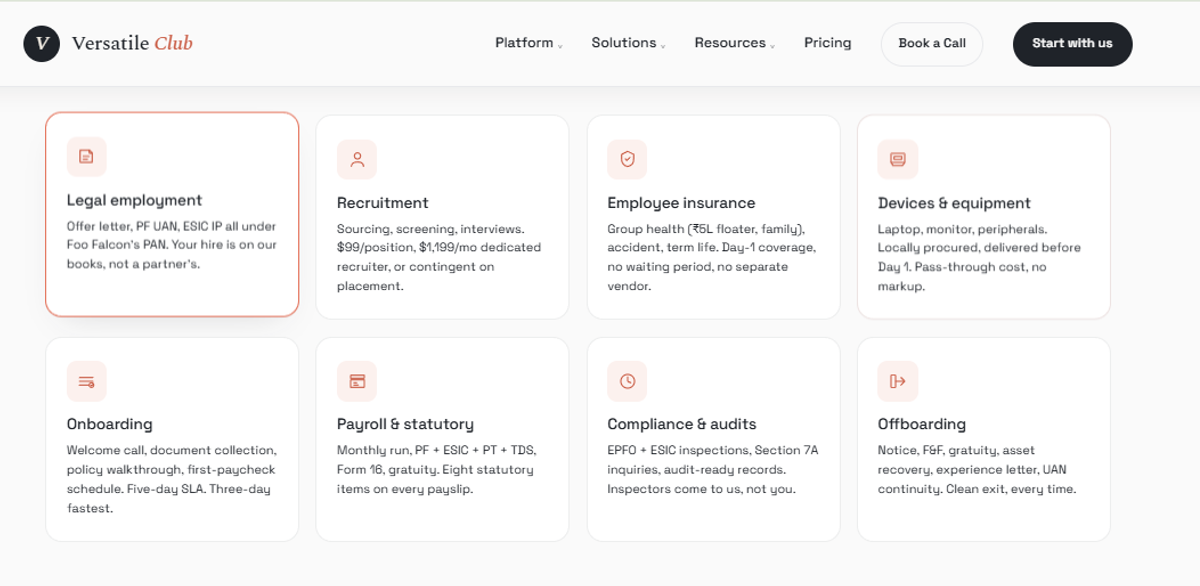
Versatile Club is an India-only employer of record built on top of six years of contract-to-hire operations for US and UK companies. The Indian entity that employs your engineer is ours. PF, ESI, TDS, and professional tax are filed under our own registrations, not a partner's.
I started this business placing engineers, designers, and ops staff across Bengaluru, Hyderabad, and Pune. The compliance muscle came from running real payroll, not from a global playbook.
🧾 Core Services
India EOR employment on an owned Indian entity, with compliant contracts and IP assignment
Multi-state statutory filings: PF, ESI, professional tax, TDS, gratuity accrual, and POSH setup
Single USD invoice issued directly from the Indian entity, with challan and TDS receipts attached
Contract-to-hire recruiting with culture-fit screening across 50 behavioural parameters
Retention layer: 90-day Success Coach and a 6-month replacement guarantee on C2H placements
🤔 Why Companies Consider Versatile Club
The buying reason is usually narrow. A founder has a term sheet, a hiring plan due this quarter, and no Indian entity. Setting up a subsidiary takes 12 to 18 months and tens of thousands in fees, which is why the EOR versus entity decision lands where it does.
Versatile Club solves that in five business days, with the price published flat. Finance teams pick us for a second reason. One USD invoice from one Indian entity means there is no FX leg left to mark up.
👤 Ideal Customer Profile
Seed to Series B B2B SaaS, AI, fintech, or devtools companies in the US, UK, Canada, or Australia
Global headcount of 5 to 100, with an India team going from 0 to 5, or 10 to 50 when switching
Buying trigger: first India engineering hire, or unresolved payroll errors on a global platform
Decision maker: founder or CTO at the early stage, VP People or CFO at Series A to C
Poor fit: multi-country EOR needs, B2C consumer hiring, or 100+ India teams requiring SOC 2 or ISO 27001 at procurement
💰 Commercial Model
Pricing is $149 per employee per month, flat, with no salary-band slabs. There is no setup fee and no exit fee, and the first month is free. Contract-to-hire is priced at 20% to 30% of annual salary, charged only after the hire completes day 90.
FX policy is mid-market rate with no markup, because the invoice originates from the Indian entity itself. ⚠️ One honest trade-off: heavy enterprise procurement customisation takes longer than the five-day SLA. Model your own numbers with the EOR vs entity calculator.
⭐ Customer Reviews
"Versatile's Employer of Record India service made this seamless contracts, PF, ESI, TDS, and payroll all handled in one place. Invoicing in USD meant zero exchange rate surprises. Five-day onboarding, zero late payslips."
Vedant T., Founder, Digital Marketing Agency Versatile Club G2 - Verified Review
"Sagar replied to our form in about four hours with a draft offer letter already attached. The hire was onboarded in four days. First USD invoice landed clean: no FX markup, no setup fee, no surprises."
Verified User in Information Technology and Services Versatile Club G2 - Verified Review
"The dashboard could be a little more self-serve. A couple of times I wanted to pull a report or a doc myself and ended up just messaging my contact instead."
Angad S., Founder, Moonshot Versatile Club G2 - Verified Review
That last one is fair, and it is the honest limitation of a service-led model. Versatile Club's read is that founders at one to five India hires trade dashboard polish for a human who answers on WhatsApp. Buyers at 50 heads will weigh that differently, and I might be reading the crossover point a little early.
2. Deel: Best for Startups Already Hiring Across Several Countries
🌍 Overview
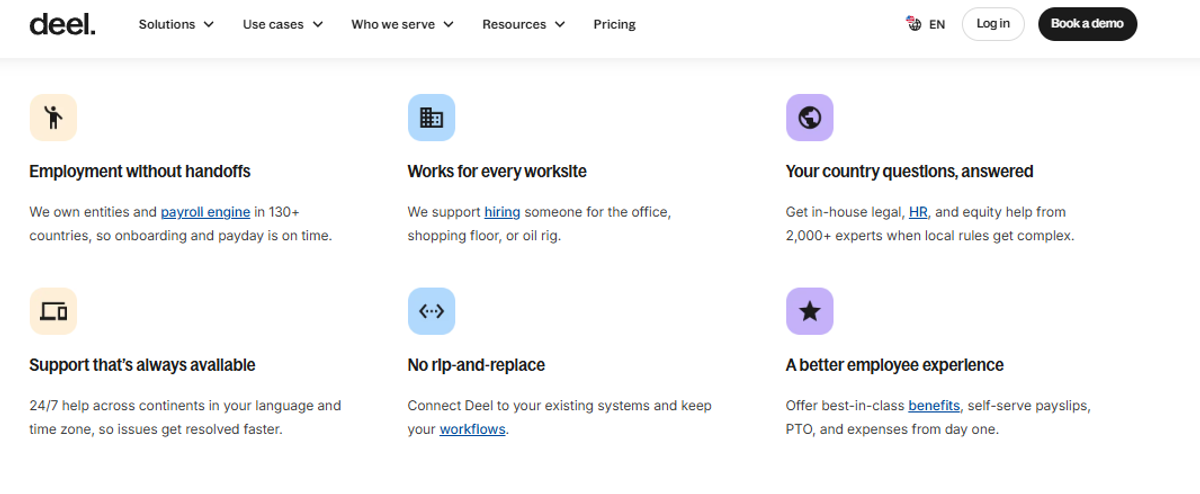
Deel is a global employment platform covering 150 countries or more, with EOR, contractor management, payroll, and immigration services in one product. For India specifically, coverage runs through the local-partner entity structure most global generalists use.
That structure is the trade-off. You gain 150 countries under one contract. You add a legal link you never signed with, which is the core argument in our Deel alternative breakdown.
🧾 Core Services
Multi-country EOR employment and contractor management in a single dashboard
Global payroll consolidation with strong HRIS and accounting integrations
Immigration and visa support services
Equipment procurement and device management add-ons
Contractor payment rails with card and wallet options for workers
🤔 Why Companies Consider Deel
The decision logic is breadth and brand safety. If you are hiring in India, Poland, Brazil, and Canada this year, one vendor beats four. Procurement teams also lean on Deel's certifications and its size.
The cost of that breadth shows up in India depth. Ask which Karnataka professional tax cycle applies and the answer often routes through a partner. ❌ Support runs through ticket queues and CSM email rather than a named India compliance owner.
👤 Ideal Customer Profile
Series B and later companies hiring in five or more countries at once
Global headcount above 100, with India as one market among many
People Ops or procurement-led buying, with security questionnaires in the cycle
Teams that value platform integrations over India state-level compliance depth
💰 Commercial Model
Deel's standard EOR pricing sits around $599 per employee per month, roughly four times the flat India-specialist rate. Contractor management is priced separately per worker. Reviewers also report transfer fees on payouts and currency conversion charges on card spend.
💸 Independent India cost comparisons flag deposits near one month of gross salary plus FX markups on top of the platform fee. Our India EOR cost guide shows where those lines land on a real invoice.
⭐ Customer Reviews
"I find Deel to be absurdly expensive. They charge a high amount of fees for transferring money to my bank account. Additionally, using their card incurs fees for purchases in another currency."
Juan Camilo O., 1/5 Deel - G2 Verified Review
"I find the pricing of Deel to be quite terrible for me. Previously, I was paid directly by my employer without any additional costs. Now, I'm required to pay a monthly fee. The initial setup process was also very challenging."
Verified User in Translation and Localization, 0.5/5 Deel - G2 Verified Review
The same reviewers rate the interface highly, and that matches what I see. Deel is easy to use and genuinely strong at breadth. ✅ If your next four hires sit in four countries, buy Deel and stop reading comparison posts.
3. Remote: Best for Teams Wanting Owned-Entity Coverage in Core Markets
🌍 Overview
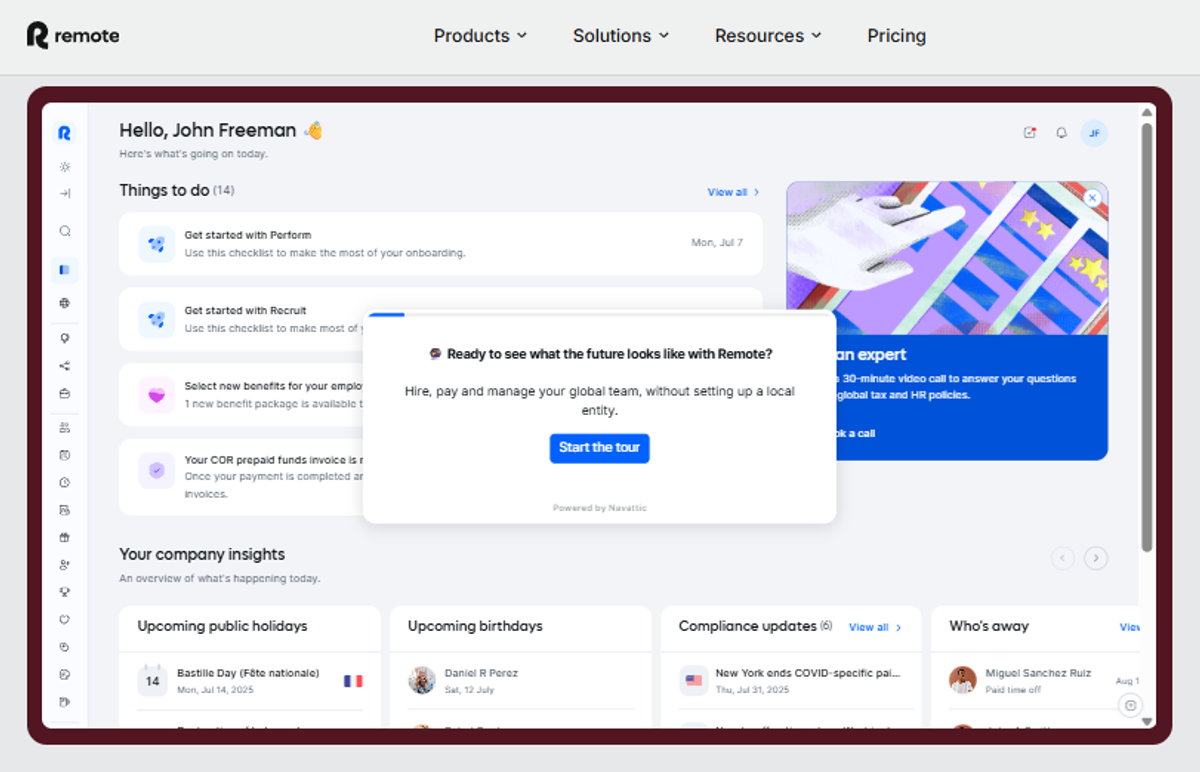
Remote is a global employment platform offering EOR, contractor management, payroll, and equity support across a wide country list. It owns entities in several core markets and leans on partners elsewhere. India sits inside that mixed model.
Remote is also one of the few generalists that markets IP and invention assignment tooling directly at engineering-heavy buyers. Our Remote alternative comparison breaks down where that model helps and where it does not.
🧾 Core Services
Multi-country EOR employment with standardised contracts
Contractor management and conversion to employment
Global payroll and benefits administration
IP and invention rights assignment tooling for technical hires
Equity and stock option support for cross-border employees
🤔 Why Companies Consider Remote
The pull is credibility plus IP hygiene. Legal counsel at an AI startup wants the invention assignment clause handled once, cleanly, in every country. Remote packages that well.
❌ The gap shows at India state level. Professional tax cycles differ by state, and Maharashtra runs dual PTRC and PTEC registrations. Generalist platforms rarely surface that detail before your first filing month, which is why our India payroll compliance guide names each cycle.
👤 Ideal Customer Profile
Series A to C companies with 50 to 500 global employees
Hiring in three or more countries, India included
Engineering-led hiring where IP assignment is a board-level question
People Ops or legal counsel driving vendor selection
💰 Commercial Model
Remote's EOR pricing sits around $599 per employee per month, roughly in line with Deel. Contractor management is billed separately. Onboarding timelines for India typically run 10 to 14 days once documents are collected.
⚠️ Ask whether India employment runs through Remote's own entity or a partner. The answer changes who carries statutory liability.
4. Multiplier: Best for Mid-Market Teams Wanting a Mid-Priced Global Platform
🌍 Overview
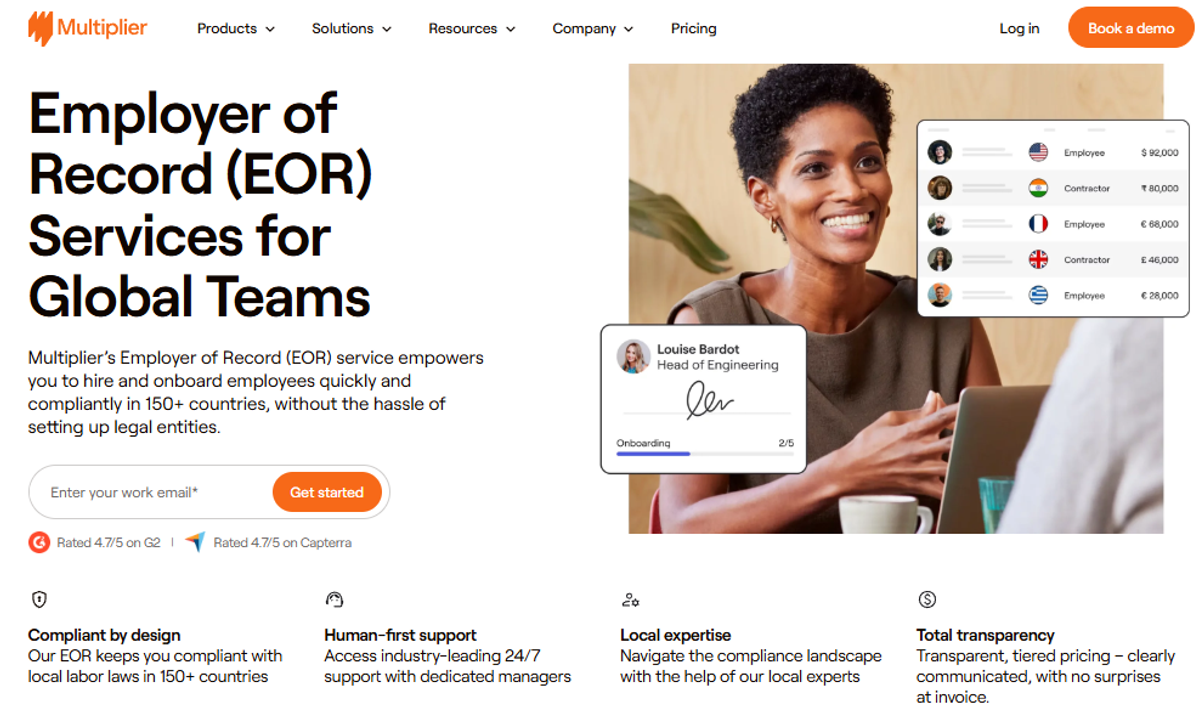
Multiplier is a global EOR and contractor platform covering 100-plus countries, positioned below Deel and Remote on price. It serves mid-market teams that want breadth without enterprise pricing.
India is one of its higher-volume markets, which helps. The compliance layer still runs on a global template rather than an India-first one, a difference we unpack in our Multiplier alternative analysis.
🧾 Core Services
EOR employment across 100-plus countries
Contractor onboarding and payments
Global payroll consolidation and expense handling
Benefits and insurance administration by country
Employee onboarding workflows and document collection
🤔 Why Companies Consider Multiplier
Price and speed of quoting. A People Ops lead can get a country quote quickly and close procurement without a long security review. That matters when you are hiring in four markets this quarter.
❌ The limitation is depth per country. Labour Code restructuring under the 2025 rules requires basic plus dearness allowance to be at least 50% of wages. Global templates often miss that until an audit flags it.
👤 Ideal Customer Profile
Companies with 50 to 300 global employees hiring in multiple regions
India team of 5 to 30 alongside other Asian or European markets
Budget-conscious buyers who still want a platform, not a service firm
HR or finance leader owning the vendor relationship
💰 Commercial Model
Multiplier's EOR pricing sits around $400 per employee per month, below the $599 generalist standard. Contractor management carries a separate per-worker fee. India price trackers place the broader market band at $99 to $699 per employee monthly.
5. Globalization Partners: Best for Enterprise Procurement With Heavy Security Review
🌍 Overview
Globalization Partners, usually written as G-P, is one of the oldest global employment providers. It sells to enterprise buyers with formal procurement, security questionnaires, and legal review cycles.
G-P's documentation maturity is genuinely strong. Its commercial model is also the least founder-friendly on this list, which is the core of our Globalization Partners alternatives for India breakdown.
🧾 Core Services
EOR employment across 180-plus countries
Enterprise-grade legal, security, and data protection documentation
Global payroll and benefits administration
Compliance advisory and country-entry consulting
Integrations with enterprise HRIS platforms
🤔 Why Companies Consider G-P
Procurement safety. When a 500-person company needs SOC 2 and ISO 27001 evidence before signing, G-P clears that bar without friction. That alone wins deals at the enterprise end.
❌ The percentage-of-salary pricing punishes senior hires. An AI engineer on a high Indian salary costs far more through a percentage model than a flat fee. ⚠️ Onboarding also stretches longer because legal review is thorough by design.
👤 Ideal Customer Profile
Enterprises with 500-plus global employees and formal procurement
India teams of 50 to several hundred
Security and legal certifications required before contract signature
Head of Global Mobility, procurement, or general counsel as decision maker
💰 Commercial Model
G-P prices EOR at roughly 15% of the employee's annual salary rather than a flat monthly fee. That scales against you as salaries rise. Setup and minimum contract terms are typically negotiated per account.
6. Papaya Global: Best for Finance Teams Consolidating Global Payroll Data
🌍 Overview
Papaya Global is a payroll and payments platform with EOR attached, built for finance-led buyers. Its strength is data consolidation across many countries in one reporting layer.
The India experience is payroll-first. Employment compliance runs through in-country partners in most markets, unlike a single-country managed payroll setup.
🧾 Core Services
Global payroll consolidation and workforce cost reporting
EOR employment through in-country partner networks
Cross-border payments infrastructure and payment rails
Benefits administration and cost analytics
Audit and reporting exports for finance teams
🤔 Why Companies Consider Papaya Global
CFO logic drives this one. A controller closing month-end wants one dataset for 15 countries, not 15 spreadsheets. Papaya delivers that reporting layer well.
❌ For a five-person India team, that machinery is overbuilt. You are paying for global consolidation you will not use. ⚠️ Partner-led employment also means India statutory questions route through a third party, a pattern we cover in our Papaya Global alternatives for India guide.
👤 Ideal Customer Profile
Companies with 200-plus employees across 10 or more countries
Finance-led buying, with CFO or controller as primary owner
India as one of many payroll geographies, not the main one
Teams already running consolidated global reporting
💰 Commercial Model
Papaya Global prices per employee per month with tiered payroll and EOR plans, quoted per account. Public India-specific EOR rates are not disclosed in the source set for this guide. Treat it as a custom quote.
7. Pebl (formerly Velocity Global): Best for Companies Mixing Employees and Contractors
🌍 Overview
Pebl, previously Velocity Global, provides EOR, contractor management, and global immigration support. It targets companies with mixed worker types across many countries.
The classification flexibility is real. India depth follows the standard partner-entity pattern, which our Velocity Global alternatives in India comparison examines line by line.
🧾 Core Services
EOR employment across a broad country list
Contractor engagement and compliance classification support
Immigration and visa advisory services
Global benefits and payroll administration
Worker misclassification risk assessment
🤔 Why Companies Consider Pebl
Mixed-workforce reality. Many AI startups run a few full-time engineers plus contract data annotators or research consultants. One vendor covering both reduces admin.
❌ The trade-off is India specificity. Misclassification in India turns on control, exclusivity, and integration into the business. Generic classification frameworks do not always map cleanly onto Indian practice, as our independent contractor versus EOR comparison shows.
👤 Ideal Customer Profile
Companies with 100-plus workers split between employees and contractors
Multi-country footprint with India as one node
Legal or People Ops leader concerned about classification exposure
Teams needing visa or mobility support alongside employment
💰 Commercial Model
Pebl quotes EOR and contractor management per worker, per country, on request. Public India pricing is not disclosed in the source set for this guide. Expect a custom quote with annual commitment terms.
8. Payoneer Workforce Management (formerly Skuad): Best for Contractor-Heavy Teams Converting to Employment
🌍 Overview
Payoneer Workforce Management, previously Skuad, combines contractor payments with EOR employment across 100-plus countries. It sits inside Payoneer's cross-border payments business.
For teams already paying Indian contractors through Payoneer, the conversion path is short. Buyers comparing options often start with our Skuad alternative page.
🧾 Core Services
Contractor onboarding, invoicing, and cross-border payments
EOR employment in 100-plus countries
Contractor to employee conversion workflows
Local benefits and payroll administration
Multi-currency payment rails
🤔 Why Companies Consider Payoneer Workforce Management
Continuity of payment rails. If your two India engineers already invoice you through Payoneer, converting them to compliant employment feels like a settings change, not a migration.
❌ The compliance layer is thinner than the payments layer. Provident fund is a 12% employer contribution, and employee state insurance splits 3.25% employer and 0.75% employee. Those mechanics need an owner, not a payment rail, which is the point of our contractor to employee conversion guide.
👤 Ideal Customer Profile
Startups with 10 to 100 global workers, mostly contractors today
India team of 2 to 15 currently paid as freelancers
Founder or ops lead handling vendor decisions directly
Companies motivated by misclassification cleanup
💰 Commercial Model
Pricing follows a per-contractor and per-employee monthly structure, quoted on request. Independent India price trackers list it inside the lower fee tier alongside other India-focused providers. Verify the exact India band in writing before signing.
9. Rippling: Best for Companies Standardising HR, IT, and Payroll
🌍 Overview
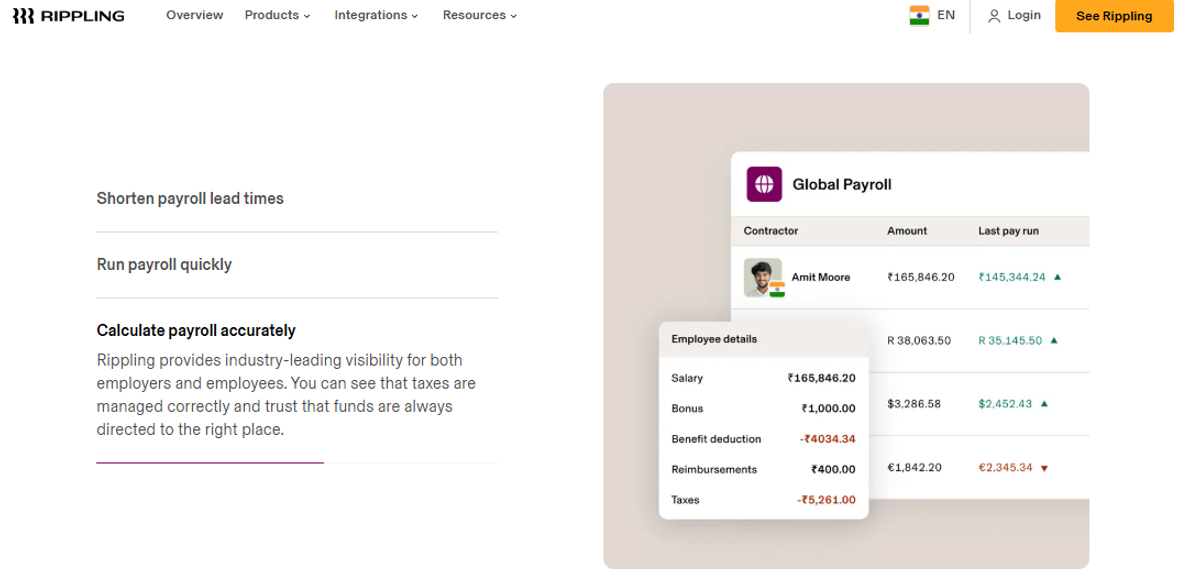
Rippling is a workforce management platform combining HR, IT device management, app provisioning, and payroll. Its global EOR product is newer than its US payroll core.
For engineering teams, the device and access control layer is the real draw. Our guide to equipping remote employees in India covers the same ground from an India-first angle.
🧾 Core Services
HR, payroll, and benefits in one system of record
Device procurement, shipping, and remote lock or wipe
App provisioning and access management for new hires
Global EOR employment and contractor payments
Workflow automation across onboarding and offboarding
🤔 Why Companies Consider Rippling
Security and speed of setup. An AI startup handing a laptop to a Bengaluru engineer wants disk encryption, app access, and offboarding wipe handled centrally. Rippling does that better than any India specialist.
❌ India statutory depth is the weaker half. Professional tax, Shops and Establishments renewals, and labour welfare fund vary by state. A platform-first vendor tends to abstract those away, which is why our Rippling alternatives for India comparison exists.
👤 Ideal Customer Profile
Companies with 50 to 500 employees standardising on one HR and IT stack
Security-conscious engineering teams issuing company hardware
India team of 5 to 50 alongside a larger US base
IT lead or head of operations influencing the decision
💰 Commercial Model
Rippling prices modularly, with a base HR platform fee plus per-module and per-employee charges. Global EOR is quoted separately per country. India-specific EOR pricing is not publicly disclosed in the source set for this guide.
10. Oyster HR: Best for Remote-First Teams Hiring in Scattered Markets
🌍 Overview
Oyster HR is a global employment platform built around remote-first companies. Its self-serve onboarding flows and cost calculators are clear and easy to use.
Coverage in most Asian markets, India included, runs through partner entities. For an India-only view of the same math, use our India salary calculator.
🧾 Core Services
EOR employment across 100-plus countries
Contractor management and payments
Self-serve hiring cost calculators by country
Benefits selection and administration
Time off and compliance policy templates
🤔 Why Companies Consider Oyster HR
Ease of evaluation. A founder can model the cost of a Bengaluru hire in a browser tab without a sales call. That transparency earns trust early in the buying cycle.
❌ Calculator clarity is not the same as filing accuracy. Gratuity accrues at 4.81% of basic plus dearness allowance, and that liability compounds quietly. Ask who tracks it monthly, a question our Oyster alternatives for India guide puts to every vendor.
👤 Ideal Customer Profile
Fully remote companies with 20 to 200 employees across many countries
One or two hires per country rather than a concentrated India team
Founder or head of remote owning vendor choice
Buyers who prefer self-serve over service-led relationships
💰 Commercial Model
Oyster HR publishes per-employee monthly EOR pricing with annual and monthly billing options. India-specific rates and any deposit requirements are not detailed in the source set for this guide. Confirm deposits before signing.
11. Remofirst: Best for Cost-Conscious Teams Accepting a Lighter Service Layer
🌍 Overview
Remofirst competes on price in the global EOR market, with published entry rates well below the $599 generalist standard. It covers a wide country list through partner entities.
The value trade is explicit. You pay less and get less service depth, a trade our Remofirst alternatives for India comparison quantifies.
🧾 Core Services
Low-cost EOR employment across 180-plus countries
Contractor management at a low per-worker rate
Basic payroll and benefits administration
Equipment provisioning through partners
Visa and immigration support in select markets
🤔 Why Companies Consider Remofirst
Cash discipline. A seed-stage founder with 14 months of runway feels the difference between $99 and $599 per employee every single month. That is a legitimate reason to shortlist it.
❌ Support runs lighter, and India compliance questions can take days. ⚠️ Cheap becomes expensive when a provident fund challan is filed late and interest accrues.
👤 Ideal Customer Profile
Seed to Series A companies with tight runway
One to five hires per country, simple salary structures
Founder-led buying with no procurement process
Teams comfortable owning some compliance follow-up themselves
💰 Commercial Model
Remofirst publishes low entry pricing per employee per month, and India price trackers place it in the lower fee tier for India EOR. Deposits, surcharges, and FX handling should be confirmed in writing, because independent cost comparisons show these lines moving the real total materially. Our India EOR cost breakdown shows where each line lands.
12. Asanify: Best for Buyers Wanting India Payroll Software Plus EOR
🌍 Overview
Asanify is an India-focused HR and payroll product with EOR services layered on top. It suits buyers who want statutory payroll tooling and employment in one place.
Unlike the generalists, its compliance logic is built for Indian rules first. That puts it closer to the India-specialist EOR category than to a global platform.
🧾 Core Services
India payroll processing with statutory calculations
EOR employment for companies without an Indian entity
Provident fund, employee state insurance, professional tax, and TDS filings
Employee self-serve portal, payslips, and tax declarations
Contractor management and global payments in select markets
🤔 Why Companies Consider Asanify
Product plus service in one India stack. A company that already has an Indian entity can use the payroll software, then use EOR for hires in states where it lacks registration.
❌ The service layer is smaller than an enterprise platform's. ⚠️ Buyers wanting a named compliance owner for every filing month should ask exactly who that person is.
👤 Ideal Customer Profile
Companies with 10 to 100 India employees, with or without a local entity
Buyers wanting payroll software rather than a pure service relationship
India-based HR or finance manager as day-to-day owner
Teams consolidating payroll tooling and EOR under one vendor
💰 Commercial Model
Asanify publishes India payroll and EOR pricing per employee per month, and India price trackers list it in the lower fee tier for EOR. Software and EOR are priced as separate lines. Confirm which statutory filings are included at each tier.
💰 How to Choose in One Line
Three rules cover most buyers. Hiring in five or more countries, buy a generalist. Hiring only in India at one to twenty heads, buy an India specialist. Optimising purely for sticker price, accept a lighter service layer and plan to chase filings yourself.
Versatile Club sits in the second bucket, employing your engineers on its own Indian entity at $149 flat per month, with a five-day contractual onboarding SLA, no setup or exit fee, and the first month free. I answer WhatsApp myself, which is the whole point of the model. If you want the mechanics before a call, our how it works page walks through the five days step by step.
Q2. How did we rank these India EOR providers for AI startups?
Each provider was scored on five weighted criteria: India entity model and compliance depth (25%), pricing transparency and commercial model (20%), onboarding speed and support model (20%), AI-talent and retention support (20%), and customer validation from G2, Capterra, and Reddit (15%). Scores of 0 to 20 earn one star, 21 to 40 two, 41 to 60 three, 61 to 80 four, and 81 to 100 five.
⚖️ Why Entity Model Carries the Heaviest Weight
Entity model gets 25% because it decides who is legally liable. When your India hire touches proprietary model weights and training data, the employment contract chain matters more than the dashboard.
A partner-entity chain adds a company you never signed with. Versatile Club weights this criterion highest because contract changes stall exactly there, and liability blurs when two firms share the paperwork. Our India EOR service runs on a single owned entity for that reason.
📊 The Rubric and Its Evidence Sources
| Criterion | Weight | How it was evidenced |
| India entity model and compliance depth | 25% | Statutory registration proof, contract language, named state filing cycles |
| Pricing transparency and commercial model | 20% | Live pricing pages with capture dates, published fee bands |
| Onboarding speed and support model | 20% | Published SLAs, support channel, review-reported timelines |
| AI-talent and retention support | 20% | Recruiting scope, culture-fit screening, replacement terms |
| Customer validation | 15% | G2, Capterra, and Reddit review volume and complaint patterns |
Talent support earns a full 20% for a specific reason. NASSCOM's July 2026 research found only 23% of India's early-career engineers qualify as AI-native, against roughly two thirds who are merely AI-proficient. Scarce talent makes retention a pricing input, not a soft benefit, which is why our guide to hiring AI and ML engineers in India leads with retention.
🔍 Where the Scores Came From, Not From
Scores came from documents, not vendor claims. Pricing pages were captured on a date. Contract language was read where clients shared it. Review text was read in full, including the one-star ones.
Versatile Club measures onboarding by the contractual five-day SLA rather than a marketing range, because a number you cannot enforce is not a measurement. Where a provider disclosed nothing, this guide says so instead of estimating. The published rate sits on our pricing page with no salary-band slabs behind it.
⚠️ The Conflict, Stated Plainly
I run one of the twelve companies on this list, and it sits at number one. That is a conflict, so here is the reasoning. Versatile Club scores five stars on India entity ownership, flat published pricing, and the five-day SLA, and scores lowest on multi-country coverage because India is the only country we operate in.
Three categories where this list should not send you to us:
Multi-country EOR in one contract, where a generalist genuinely wins
B2C consumer hiring at volume, which is outside our operating scope
Enterprise teams above 100 India heads requiring SOC 2 or ISO 27001 at procurement
⭐ What Reviewers Confirmed and Contradicted
"The dashboard could be a little more self-serve. A couple of times I wanted to pull a report or a doc myself and ended up just messaging my contact instead."
Angad S., Founder, Moonshot Versatile Club G2 - Verified Review
"The initial setup process was also very challenging; it took several days and involved a lot of emails, with issues arising at every step."
Verified User in Translation and Localization, 0.5/5 Deel - G2 Verified Review
Both reviews cost their vendor points. That is the test of a rubric: it has to be able to hurt you.
Versatile Club's ranking rests on registration proof and contract terms, not on scale claims we have not earned. I would rather lose a deal on the SOC 2 question than win it by fudging the rubric.
Q3. What does it really cost to employ an AI engineer in India through an EOR?
India EOR management fees run $99 to $699 per employee monthly in 2026, but the fee is the smaller number. FX markups of 2% to 10%, security deposits near one month's gross, and India surcharges move the real total. Versatile Club charges $149 flat with no setup fee and no exit fee, which makes the all-in number visible before signature.
💰 The Published-Fee Illusion
Every comparison page leads with a monthly fee, and every buyer anchors on it. That number is the part vendors control and disclose. The rest arrives on invoice three.
Independent India cost comparisons show the gap clearly. Platform fees, undisclosed tiers, and surcharges push the real monthly cost well past the headline across six providers. Our India EOR cost breakdown itemises each of those lines.
💸 The Four Hidden Lines
FX spread: 2% to 10% on the salary conversion, charged invisibly inside the exchange rate
Security deposit: often about one month of gross salary, held for the contract's life
Statutory add-ons: insurance top-ups, equipment handling, and benefits administration billed separately
Offboarding charges: exit fees and final settlement processing on a hire that lasted four months
Versatile Club's invoice originates from its own Indian entity in USD, so there is no separate FX leg left to mark up. I send a sample invoice before anyone signs, because that single document kills most pricing anxiety. If you want the mechanics first, our how it works page shows the billing sequence.
⚠️ The 2026 Provident Fund Reset Most Pricing Pages Missed
Employer cost math changed in mid-2026. Under the Employees' Provident Funds Scheme, 2026, mandatory provident fund contributions are capped at ₹1,800 per month on the ₹15,000 statutory wage ceiling. Contributions above that ceiling became voluntary, and employer matching on the excess is optional.
That matters most for expensive hires. A senior AI engineer on ₹40 lakh no longer carries an automatic 12% employer provident fund charge on full wages. Most India EOR pricing pages still model it the old way, a gap our cost of hiring in India analysis corrects.
📊 The Cost Stack, Bengaluru Versus San Francisco
| Line item | Senior engineer, Bengaluru | Senior engineer, San Francisco |
| All-in annual cost | About $58,000 | About $220,000 |
| EOR management fee | $149 per month flat (Versatile Club) | Not applicable |
| Generalist EOR fee | $400 to $599 per month | Not applicable |
| Statutory employer burden | PF capped at ₹1,800 monthly, ESI 3.25% employer share | Payroll taxes plus benefits |
The delta is roughly $162,000 a year for one hire. Two hires cover a founder's entire India experiment, including the vendor fee. Model your own numbers with the India salary calculator.
✅ The Structuring Lever Nobody Mentions
Take-home pay is a retention tool, and salary structure changes it without raising cost. National Pension System contributions under Section 80CCD can cut a high earner's tax liability by 20% to 25%. Gross cost to you stays flat.
"First USD invoice landed clean: no FX markup, no setup fee, no surprises."
Verified User in Information Technology and Services Versatile Club G2 - Verified Review
"I find Deel to be absurdly expensive. They charge a high amount of fees for transferring money to my bank account."
Juan Camilo O., 1/5 Deel - G2 Verified Review
Versatile Club publishes the flat $149 fee, gives the first month free, and charges nothing to set up or exit. I would rather you compare that against a $599 fee plus a deposit than take my word for the difference.
Q4. Which India compliance obligations must your EOR own in 2026?
Your EOR must own provident fund and employee state insurance registration and remittance, professional tax in every state you hire in, TDS deposited by the 7th monthly, gratuity accrual, POSH committee compliance, and full-and-final settlement. Under the Labour Codes effective 21 November 2025, basic plus dearness allowance must be at least 50% of total wages. From 1 April 2026, Form 130 replaces Form 16.
🧾 The Federal Layer
Five federal items run every month. Provident fund at a 12% employer contribution, employee state insurance split 3.25% employer and 0.75% employee, and TDS deposited by the 7th of the following month.
Gratuity accrues at 4.81% of basic plus dearness allowance from day one, and it is a real liability on your books. POSH means a constituted Internal Committee, not a policy PDF. Our India compliance coverage lists each filing and its owner.
🗺️ The State Layer Where Generalists Slip
Professional tax, called PT, is a state tax with different rules in each state. This is where a global playbook breaks.
| State | What actually happens |
| Maharashtra | Dual registration (PTRC and PTEC), monthly slab filing, annual returns |
| Karnataka | Monthly PT plus Shops and Establishments renewal, enrolment within 30 days of joining |
| Tamil Nadu | Biannual PT filing plus labour welfare fund |
| Delhi | No PT, but strict Shops and Establishments compliance |
| West Bengal | Frequent rule changes requiring active monitoring |
Versatile Club holds these registrations directly from six years of contract-to-hire payroll across Bengaluru, Hyderabad, and Pune. Ask a global platform which Karnataka PT cycle applies, then watch the answer arrive three days later from a partner entity. Our India payroll compliance guide names every cycle by state.
⚠️ The 2026 Regulatory Reset
Three changes make most India EOR listicles factually stale. First, all four Labour Codes took effect on 21 November 2025, fixing the wage definition and the 50% rule. Second, the Employees' Provident Funds Scheme, 2026, capped mandatory contributions at ₹1,800 monthly.
Third, the Income-tax Act, 2025 renumbered the forms. Form 16 becomes Form 130 and Form 16A becomes Form 131 under section 395(4)(a), effective 1 April 2026. Data duties changed too, with the DPDP Rules, 2025 notified on 13 November 2025 under G.S.R. 846(E) and phasing in through 2027. Our 2026 guide to paying employees in India reflects each of these changes.
❌ Why This Traces Back to Registrations
Misclassification and Permanent Establishment risk both come back to one question. Who holds the registration under which your engineer is employed and taxed?
If the registrations sit with a partner you never contracted with, your evidence chain in an audit has a gap. That gap is what diligence lawyers find in year two, and it is the core argument in our EOR versus entity comparison for India.
✅ Five Questions to Email Every Shortlisted Provider
Do you own the Indian entity employing my staff, or is it a partner entity? Send the registration numbers.
Which states hold your professional tax and Shops and Establishments registrations today?
Have you restructured your offer template for the basic-plus-DA 50% rule under the Labour Codes?
Will my employees receive Form 130 for FY 2026-27, and by what date?
Do you default high-salary hires to the ₹1,800 provident fund cap or voluntary top-up, and who decides?
Versatile Club files provident fund, employee state insurance, professional tax, and TDS under its own registrations in the states where we employ, and restructures every offer to the 50% wage rule before the offer letter leaves. I keep the filing calendar myself, which is why the answers above take minutes, not days. If you are switching providers mid-year, our guide to switching EOR providers in India covers the handover sequence.
Q5. Does an India EOR protect your IP, model data and equity grants?
Only if the contract chain is complete. The EOR's India employment agreement must assign all work product, including AI-assisted and AI-generated output, to your parent company rather than the EOR. Indian law recognises no AI author, so express written assignment is the only reliable route. ESOPs are granted by your parent, with the EOR handling perquisite-stage TDS via Form 130 on exercise.
🔗 The Three-Link Chain and Where It Breaks
Intellectual property, meaning code, models, and documentation, travels along a chain. Your parent company contracts the EOR. The EOR employs the engineer.
If link two assigns work product to the EOR instead of to you, your cap table owns nothing. Versatile Club employs on its own Indian entity, so the chain has two links rather than three, with no partner sitting in the middle. Our EOR services run on that single-entity structure by design.
🤖 Why AI Output Needs Its Own Clause
Indian copyright law requires a human author, and it does not recognise an AI system as one. Output produced with heavy model assistance therefore needs explicit contractual assignment.
Contractors are the sharper risk. Absent a written assignment, an Indian contractor retains copyright in what they create. Employment agreements handle this by default only when the clause names AI-assisted work, a distinction our independent contractor versus EOR comparison sets out in full.
🔐 What DPDP Means for Your Employee and Training Data
The Digital Personal Data Protection Act, 2023 is India's privacy law, and its Rules were notified on 13 November 2025 under MeitY Notification G.S.R. 846(E). Enforcement is staggered, not immediate.
| Phase | Effective date | What it covers |
| Immediate | 13 November 2025 | Definitions and Data Protection Board provisions |
| Phase two | 13 November 2026 | Rule 4 obligations |
| Phase three | 13 May 2027 | Rules 3 and 5 to 16, including notice and breach duties |
Ask your provider for a DPDP schedule inside the master services agreement. Versatile Club shares the employment template and that schedule before signature, so counsel reviews the actual wording rather than a summary. Our India compliance page lists the statutory items that sit alongside it.
💰 How ESOPs Actually Work Through an EOR
Your parent company grants the options. The EOR is not the grantor and should never appear on the grant letter.
On exercise, the perquisite value becomes taxable salary in India. The EOR deducts tax at source and reports it on Form 130, the certificate that replaced Form 16 from 1 April 2026 under section 395(4)(a) of the Income-tax Act, 2025. Cross-border share transactions also trigger FEMA reporting, so loop in your India counsel early. Our 2026 guide to paying employees in India covers the withholding mechanics.
✅ Five Clauses to Redline Before You Sign
Assignment of all work product to the named parent entity, including AI-assisted and AI-generated output
Moral rights waiver and a present assignment, not a promise to assign later
Confidentiality covering model weights, training data, and customer data
Data processing schedule mapped to the DPDP staggered dates
Survival of assignment and confidentiality after termination or provider switch
Ask Versatile Club for the unredacted employment template at the shortlist stage, not after the term sheet. I redline the AI-output clause on every AI-startup contract now, and two years ago almost nobody asked for it. None of this is legal advice, so have your own counsel read the final wording.
Versatile Club assigns work product directly to your parent company from its own Indian entity, with no partner shell in the assignment path. Where my head is right now is that IP diligence, not price, becomes the deciding question for AI startups within 18 months. Tell me if your last diligence round already went that way, or send it over to us and we will read the clause with you.
Q6. EOR, contractors, PEO or a subsidiary, which model should an AI startup use?
An India EOR puts your engineer on compliant local payroll in about five business days. A subsidiary takes 12 to 18 months. Contractor payments invite misclassification, weak IP assignment, and Permanent Establishment risk. Versatile Club commits its five-day onboarding SLA contractually, and US-style co-employment PEO does not legally exist under Indian labour law.
⏰ The Timeline Problem Nobody Budgets For
You raised a round, and the hiring plan says three India engineers this quarter. Incorporating an Indian subsidiary takes 12 to 18 months before the first offer letter, plus tens of thousands in legal and registration costs.
That is why founders search for an EOR at 11pm. The decision is rarely about elegance. It is about a hiring plan with a date on it, which is the whole premise of hiring in India without an entity.
⚠️ PE Risk, Misclassification, and the PEO Myth
Permanent Establishment, or PE, means the tax authority treats your foreign company as having a taxable presence in India. Paying contractors who work only for you, under your direction, is one route there.
The misclassification test in Indian practice turns on control, exclusivity, and integration into the business. Traditional US co-employment PEO has no legal basis in India, so any "India PEO" pitch without your own subsidiary is an EOR wearing the wrong label. Our EOR versus PEO explainer shows why the words matter here.
📊 The Four Models, Compared Honestly
| Model | Time to first hire | Who is the legal employer | Main risk |
| Owned-entity EOR (Versatile Club) | 5 business days | The EOR's own Indian entity | India-only coverage |
| Partner-entity EOR (most globals) | 7 to 14 days | A third-party partner entity | Liability spread across two firms |
| Contractors | Days | Nobody, they are self-employed | Misclassification, PE, weak IP title |
| Own subsidiary | 12 to 18 months | You | Cost, MCA filings, audit overhead |
❌ The Invisible Third Party
Most global platforms serve India through local partner entities rather than their own. You sign with a US or Singapore entity. Your engineer is employed by an Indian company you never contracted with.
Contract changes then travel through two legal teams. When a provident fund query lands, the escalation path has an extra hop, which is exactly how a two-day answer becomes a week. Buyers weighing the trade-off usually start with our Deel alternatives in India comparison.
⏰ What Five Days Actually Looks Like
| Day | What happens |
| 1 | Service agreement signed |
| 2 | Offer letter issued to the candidate |
| 3 | Employment contract executed |
| 4 | PF, ESI, and professional tax registrations initiated for the employee |
| 5 | Payroll live |
Claims of 24 to 72 hours usually mean the contract is signed, not that statutory registrations are complete. Versatile Club puts the five-day SLA in the contract rather than the landing page, because an unenforceable number is marketing, not a commitment. The full sequence sits on our how it works page.
"The initial setup process was also very challenging; it took several days and involved a lot of emails, with issues arising at every step."
Verified User in Translation and Localization, 0.5/5 Deel - G2 Verified Review
"Sagar replied to our form in about four hours with a draft offer letter already attached. The hire was onboarded in four days."
Verified User in Information Technology and Services Versatile Club G2 - Verified Review
✅ When an Aggregator Is the Right Answer
Hiring in eight countries this year? Buy a generalist and stop comparing. One contract across many markets beats specialist depth you will only use in one.
Versatile Club is India-only by design, which is a limitation worth naming out loud. What I think shifts by 2028 is that India stops being one row on a global EOR map and becomes its own buying category. Push back on me if your experience says otherwise.
Q7. What happens after the hire, retention, culture and the entity crossover?
Compliance is the floor, not the ceiling. Most failed India hires are culturally misfit rather than illegally employed, and only 23% of India's early-career engineers qualify as AI-native. Below roughly 15 India employees, EOR still wins on three-year cost. Versatile Club backs placements with a 90-day Success Coach and a 6-month replacement guarantee.
😐 The Compliant Hire That Still Failed
A founder tells me the last agency delivered a technically qualified engineer who never clicked with the team. Payroll was perfect. The working relationship was not.
That pattern shows up repeatedly in Versatile Club's client conversations before a switch. Compliance was never the failure point, and nobody had named the real one. Our contract-to-hire model exists to test fit before the full-time commitment.
🗣️ Two Moments That Explain Most Misfires
An American product lead once asked his India counterpart whether moving a date up would cause problems. The answer was "probably wouldn't." The lead heard yes. The engineer had said no, politely, in high-context language.
Another manager described an engineer messaging her for permission before every dinner break. His reason was simple. He was her subordinate, and that felt correct to him.
⚠️ Deference Read as Incompetence
Hierarchical conditioning gets misread by Western colleagues as weak technical judgement. Reluctance to challenge a manager becomes "they just want to be told what to do."
I want to be careful here. Plenty of younger Bengaluru startup engineers will object that this describes a workplace they have never worked in, and they are right about their own teams. Both realities coexist inside the same city. Our culture fit quiz exists to surface which reality your team actually needs.
✅ Three Protocols That Fix It This Week
Stop asking closed questions. Replace "are you on schedule?" with "where are we on the schedule?"
Run one-on-one prep calls before group meetings, so dissent surfaces privately first.
Send a written recap of what you think was agreed, and ask for corrections in writing.
Versatile Club screens candidates against 50 behavioural parameters before shortlisting, because scarce AI-native talent makes a mis-hire expensive twice over. Compliance never once saved a bad match in my experience. Teams hiring deep technical roles can start with our guide to hiring AI and ML engineers in India.
"The team is really competent, but there were a few time zone misunderstandings that caused slight delays in the initial phase."
Setu C. Versatile Club G2 - Verified Review
"They help with talent acquisition and management. In a growing AI era finding the right talent has gotten more difficult."
Mukul S. Versatile Club G2 - Verified Review
💰 When Your Own Entity Starts Winning
| India headcount | Cheaper option over three years | Why |
| 1 to 15 | EOR | Incorporation, audit, and compliance retainers dominate at low volume |
| 20 to 30 | Crossover zone | Fixed entity costs spread across enough salaries |
| 30-plus | Own entity or capability centre | Per-head EOR fees exceed fixed overhead |
The clean sequence is first engineer live in days on EOR, entity or capability centre planned by month six. Employment continuity, the provident fund UAN, and gratuity accrual all need mapping during transfer, and our GCC setup in India guide covers that handover.
Versatile Club charges no exit fee, so graduating to your own Indian entity costs notice and paperwork rather than a penalty. I tell founders the crossover number even though it ends the engagement, because hiding it only delays the conversation by a year. If you are sitting near 20 India heads right now, run it through the EOR vs entity calculator and I would genuinely like to hear how the math looks on your side.
FAQs
What is the best EOR for AI startups hiring in India in 2026?
It depends on how many countries you hire in, not on which brand is largest. We split the market into three honest buckets.
- India only, 1 to 20 employees: an India specialist wins on compliance depth, price, and support responsiveness.
- Five or more countries at once: a global generalist such as Deel, Remote, or Multiplier is genuinely the correct choice.
- Enterprise procurement with SOC 2 or ISO 27001 as a gate: Globalization Partners and similar platforms clear that bar fastest.
For AI startups specifically, the deciding factors are rarely dashboard features. They are who legally employs your engineer, who holds the provident fund and professional tax registrations, and who assigns AI-assisted work product to your parent company.
Versatile Club employs your India engineers on its own Indian entity at $149 per employee monthly, flat, with a five-day contractual onboarding SLA and no setup or exit fee. We are India-only by design, so if you need eight countries under one contract we will tell you to buy a generalist instead.
Start by comparing entity models rather than sticker prices on our EOR services in India page, then ask every shortlisted vendor for their registration numbers in writing.
How much does it actually cost to employ an AI engineer in India through an EOR?
India EOR management fees run from $99 to $699 per employee per month in 2026. The fee is the smaller part of the bill.
- FX spread: 2% to 10% buried inside the exchange rate on salary conversion.
- Security deposit: often around one month of gross salary, held for the contract term.
- Statutory add-ons: insurance top-ups, equipment handling, and benefits administration billed separately.
- Offboarding charges: exit fees and final settlement processing.
All in, a senior engineer in Bengaluru costs roughly $58,000 a year against about $220,000 in San Francisco, a delta near $162,000 for one hire.
Employer burden also changed in 2026. Under the Employees' Provident Funds Scheme, 2026, mandatory provident fund contributions are capped at ₹1,800 monthly on the ₹15,000 wage ceiling, and above-ceiling contributions became voluntary. Most vendor pricing pages still model provident fund on full wages.
Versatile Club charges $149 flat with no salary-band slabs, no setup fee, no exit fee, and the first month free, and the invoice is issued in USD from our own Indian entity so there is no FX leg left to mark up. Run your own numbers first with our India salary calculator.
Who owns the IP and AI-generated code created by an engineer employed through an India EOR?
Your parent company owns it only if the contract chain is complete. Intellectual property travels along three links: your company contracts the EOR, and the EOR employs the engineer.
If the employment agreement assigns work product to the EOR rather than to your parent entity, your cap table owns nothing. Two clauses matter most:
- Present assignment of all work product to the named parent entity, not a promise to assign later.
- Explicit coverage of AI-assisted and AI-generated output, because Indian copyright law requires a human author and does not recognise an AI system as one.
Contractors are the sharper risk. Absent a written assignment, an Indian contractor retains copyright in what they create, which is why misclassified engineers create diligence problems years later.
Add a data processing schedule too. The DPDP Rules, 2025 were notified on 13 November 2025 under G.S.R. 846(E), with Rule 4 obligations from 13 November 2026 and the notice and breach duties from 13 May 2027.
Versatile Club employs on its own Indian entity and assigns work product, including AI-assisted output, directly to your parent company, with the employment template shared before signature. Compare the structural difference on our EOR services page, then have your own counsel read the final wording.
Does an India EOR still issue Form 16, and what changed in 2026?
No. From 1 April 2026, the salary tax certificate is Form 130 under section 395(4)(a) of the Income-tax Act, 2025, and Form 16A becomes Form 131. Any vendor still promising Form 16 for FY 2026-27 is working from stale documentation.
Three other changes reset India employer obligations in the same window:
- Labour Codes effective 21 November 2025: basic plus dearness allowance must be at least 50% of total wages, which forces a rewrite of most offer structures.
- Employees' Provident Funds Scheme, 2026: mandatory contributions capped at ₹1,800 monthly, employer matching above the ceiling now optional.
- DPDP Rules, 2025: staggered obligations on employee data through 2027.
The federal monthly rhythm is unchanged: provident fund at a 12% employer contribution, employee state insurance split 3.25% employer and 0.75% employee, TDS deposited by the 7th, and gratuity accruing at 4.81% of basic plus dearness allowance.
Versatile Club restructures every offer to the 50% wage rule before the offer letter leaves and files provident fund, employee state insurance, professional tax, and TDS under its own registrations. Our India payroll compliance guide lists every filing with its due date.
When should an AI startup switch from an EOR to its own Indian entity?
Below roughly 15 India employees, an EOR is almost always cheaper than a subsidiary even across three years. Incorporation, statutory audit, compliance retainers, and payroll tooling are fixed costs that dominate at low volume.
- 1 to 15 India employees: stay on EOR.
- 20 to 30 employees: the crossover zone, where fixed entity costs start spreading across enough salaries.
- 30-plus employees: your own entity or a capability centre usually wins.
Incorporating takes 12 to 18 months before the first offer letter, so the practical sequence is first engineer live in days on an EOR, with the entity or capability centre planned by month six.
Three items need mapping during transfer: employment continuity, the provident fund UAN, and accrued gratuity. Exit fees are the trap, because a provider that charges you to leave has priced in your inertia.
Versatile Club charges no exit fee, so graduating to your own Indian entity costs notice and paperwork rather than a penalty, and we tell founders the crossover number even though it ends the engagement. Model the three-year comparison yourself with our EOR vs entity calculator before you commit either way.