Table of contents (16)
- Verdict at a Glance
- True India Cost
- Entity Ownership Test
- Wage Structuring Rules
- Statutory Filing Stack
- POSH, DPDP, E-Invoicing
- Misclassification and PE Risk
- Onboarding, Support, IP
- EOR vs Own Entity
- India EOR Shortlist
- ⭐ Versatile Club
- ⭐ Wisemonk
- 💰 Multiplier
- ⏰ Remote
- ❌ Deel and G-P
- Compliance RFP Checklist
Remote vs Multiplier (2026): Which EOR Handles Indian Compliance Better?
Q1. Remote vs Multiplier for India in 2026: which one should you actually pick?
For India-only hiring, Multiplier wins on price (from about $400 per month, $0 setup, and below $300 at 25 or more seats), while Remote wins on USD invoicing and its IP posture ($599 per month annual, $699 monthly, $299 setup). Neither is India-first. Remote onboards in 10 to 14 days on a ticket queue. Multiplier onboards in 7 days and invoices in INR by default.
The $199 question hides the real one
A US founder pinged me on WhatsApp at 11pm her time last quarter. She had two tabs open, Remote and Multiplier, and one question: is the extra $199 a month worth it?
Wrong question. Hiring your first engineer in India looks simple until you try to do it from San Francisco. The price gap is small. One mis-structured provident fund base costs more, which is why EOR services in India should be judged on statutory depth first.
⭐ The three-way comparison, including an India-only option
| Criteria | Remote | Multiplier | Versatile Club |
| EOR fee per employee | $599/mo annual, $699 monthly | From ~$400/mo | $149/mo |
| Setup fee | $299 | $0 | $0 |
| Deposit | None reported | Refundable deposit reported | None |
| Countries covered | 90+ | 100+ | India only |
| India entity model | Disputed across sources | Disputed across sources | Owned Indian entity |
| Onboarding | 10 to 14 days | 7 days | 5-day contractual SLA |
| Default invoicing | USD | INR | USD from India |
| Support path | Ticket queue | CSM email | Founder on WhatsApp |
Versatile Club appears here as a row, not a verdict. Read it the same way you read the other two, alongside our published EOR pricing.
💰 What buyers say once the invoice arrives
"They were dishonest about the level of support provided... Instead they have email support with a 3-day SLA. Responses are unacceptably slow. Separately, their payroll is still supported by manual processes, and twice we've had near catastrophic errors."
— Juliette D., People Operations Leader Remote - G2 Verified Review
"They also introduced some new deposits and fees that weren't originally in our contract and ultimately ended up increasing our EOR costs."
— Verified User in Information Technology and Services Multiplier Employer of Record - G2 Verified Review
Both platforms sit above 4.5 on G2 overall, with Remote at 4.6 from 3,800 plus reviews and Multiplier at 4.7 from roughly 1,470. The critical reviews are the ones worth reading. They tell you what breaks.
⚠️ Three scenarios, three different answers
One or two India hires, no other country. Neither global platform is built for you. Pick an owned-entity India specialist, and hold the vendor to a written onboarding SLA. Founders at this stage usually start with our guidance on hiring in India without an entity.
10 to 30 India seats, plus two or three other countries. Multiplier on cost, Remote if USD invoicing matters more to your controller than the fee gap.
India is your only country, permanently. Country count becomes a vanity metric. Depth across professional tax, provident fund, and state Shops and Establishments rules decides your audit outcome.
✅ Where my read might be wrong
I could be off on this. Versatile Club's client data skews toward Seed to Series B founders making their first one to five India hires, so my sample under-represents 100-plus headcount buyers. If you need SOC 2 or ISO 27001 as a procurement gate, the global platforms clear that bar and we do not yet.
Versatile Club operates in one country only, invoices in USD from its own Indian entity, and contracts a 5-day onboarding SLA with no setup fee and no exit fee. First month is free.
Q2. What does one India hire really cost: sticker fee versus landed cost?
Sticker price is the smallest line on the invoice. Remote lists $599 per month annual plus $299 setup with no deposit. Multiplier starts near $400 with no setup fee, but reportedly requests a refundable deposit and invoices in INR. Versatile Club prices EOR at $149 per employee per month, invoiced in USD from India, which removes the FX spread from the buyer's side entirely.
The quote that moves after you sign
Every CFO I speak to has the same story. The quote came in at one number. The first three invoices came in higher.
Two things cause it: fees that were not in the original contract, and currency conversion nobody priced. Both show up in any honest breakdown of employer of record cost in India.
💸 The landed-cost build for one Bengaluru engineer
Take a senior software engineer at $58,000 all-in, against $220,000 for the same role in San Francisco. That is a $162,000 annual saving per role, and it only survives if the invoice is clean.
| Cost line | What it is | Typical value |
| Platform fee | Per employee per month | $149 to $599 |
| Setup fee | One time | $0 to $299 |
| Deposit | Refundable, cash locked up | 0 to 1 month salary |
| Provident fund | Employer contribution | 12% of wages |
| ESI | Employer share | 3.25% (employee 0.75%) |
| Gratuity | Accrues from month one | 4.81% of Basic plus DA |
| FX spread | On INR-invoiced payroll | 1% to 2% per cycle |
Versatile Club measures landed cost this way for every prospect, line by line, before a contract is signed. It is the only method I trust, because the statutory lines move faster than pricing pages do.
⏰ Where the FX spread quietly wins
Multiplier's default India invoicing is in INR. Your parent company absorbs conversion markup on every monthly cycle.
Run 10 seats at roughly $71,000 a year in platform fees versus $85,000 on Remote. Now add 1.5% conversion on the full payroll value, not just the fee. The gap you negotiated for three weeks disappears, and the same maths drives the EOR versus entity calculator.
⭐ What buyers report on billing
"I experienced several invoice errors, which added confusion to management and required my initiation for them to be addressed... A critical issue arose when an uncommunicated change in their pricing model clashed with our existing master service agreement."
— Micah P., Founder Multiplier Employer of Record - G2 Verified Review
"Invoicing in USD meant zero exchange rate surprises. The compliance rigour is genuinely impressive every statutory filing reviewed before submission. Five-day onboarding, zero late payslips."
— Vedant T., Agency Founder Versatile Club G2 - Verified Review
Balance matters here. Versatile Club's own reviews are not uniformly glowing either. One client flagged early time-zone delays before the process settled, which is fair and worth naming.
✅ Two things to do before you sign
Ask each vendor for a sample invoice in your billing currency, with statutory lines itemised. Then ask, in writing, whether deposits or pre-payment invoices can change mid-contract.
If the answer arrives as prose instead of a number, treat that as the finding. Anyone comparing quotes should also read how payroll outsourcing in India is billed.
Versatile Club charges no setup fee and no exit fee, bills one USD invoice from its Indian entity, and gives the first month free.
Q3. Do Remote and Multiplier own their Indian entity, or rent one?
Public sources contradict each other. One ranking page lists Multiplier as direct-owned in India, another describes it as partner-backed across most Indian states, and Remote is variously described as owned or as using local partner entities. That contradiction is the finding. Versatile Club employs every India hire on its own registered entity, Foo Falcon Technologies Private Limited, with provident fund, ESI, TDS, and professional tax filed under its own registration numbers.
Most buyers think the pricing page answers this. It does not.
Here is the flaw in the standard evaluation. Buyers compare features, then assume the vendor whose logo is on the contract is the employer.
Often it is not. A partner entity signs the employment contract in India while the platform handles the interface, a pattern worth checking against any Multiplier alternative you shortlist.
⚠️ The conflict, laid out plainly
| Source | Remote in India | Multiplier in India |
| India EOR comparison table | Owned entity | Direct owned |
| India-focused founder comparison | Local partner entity | Partner-backed in most states |
| Vendor-facing scorecard | Owned entities, 90-plus markets | Owned entities, 100-plus |
I am not going to resolve this from a blog post, and neither should you. Versatile Club's read is that the standard advice gets this backwards. You do not verify entity ownership by reading marketing. You verify it from a filing.
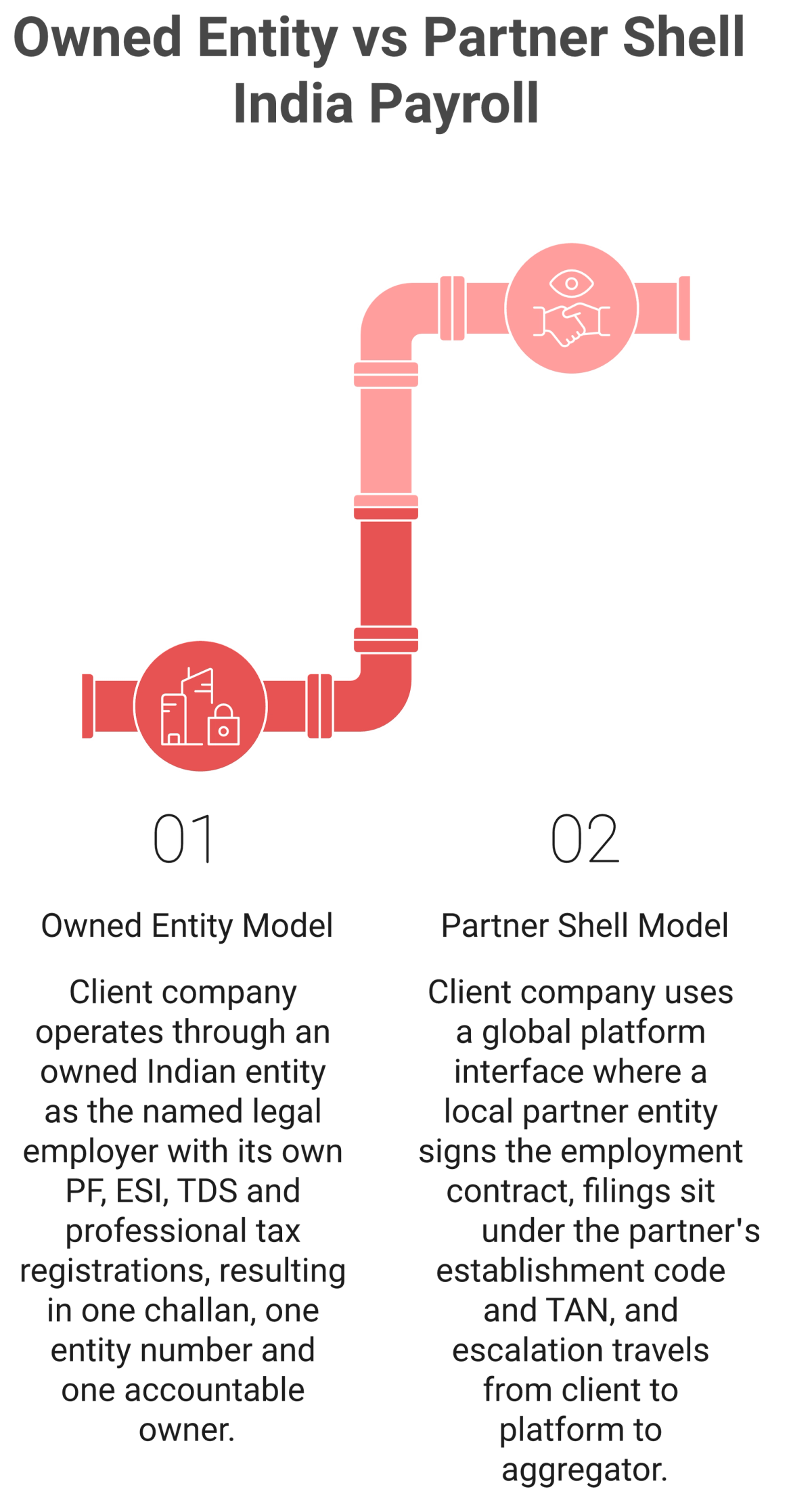
💰 Why a partner shell changes your position
If a third party is the legal employer, your engineer's provident fund sits under that party's establishment code. Their TDS deposits go against that party's TAN.
You are now two steps from the challan. When a filing is late, you raise a ticket with a platform that raises a query with an aggregator.
That is the part no pricing page discloses. Versatile Club holds provident fund, ESI, professional tax, and TAN registrations directly, so every challan carries one entity's number and one accountable owner, which is the basis of our India compliance coverage.
⭐ What surfaces in real audits
What surfaces in Versatile Club's client engagements is a pattern I did not expect six years ago. The compliance question almost never arrives during sales. It arrives during a bank audit, a due-diligence request, or a resignation with a final settlement dispute.
At that moment the buyer needs three artefacts fast: the employment contract, the provident fund passbook entry, and the Form 130 for the year.
✅ The four-item verification you can run this week
Ask each vendor, in writing, for these four things about the entity that will legally employ your hire.
Corporate Identification Number, verifiable on the MCA portal.
EPFO establishment code, searchable on the EPFO employer database.
GSTIN on the invoicing entity.
TAN under which salary TDS is deposited.
If a vendor supplies a name and not a number, you have your answer. If the numbers belong to a company you have never heard of, you have a partner shell.
I hold this position with one caveat. Ownership models change as platforms mature, and a vendor that used a partner in 2024 may have incorporated since. Ask for current filings, not a claim about history.
Versatile Club employs every hire on its own Indian entity, with provident fund, ESI, TDS, and professional tax filed under Versatile's own registrations.
Q4. Can a global payroll template handle India's 2026 wage rules?
Often not. Under the Code on Wages, in force from 21 November 2025, Basic plus dearness allowance must be at least 50% of total remuneration, and standardised global templates routinely allowance-load Indian salaries to suppress the provident fund and gratuity base. Versatile Club restructured every live India cost-to-company breakup to that 50% standard and shows the corrected version before the offer letter goes out.
What actually changed in the definition of wages
Indian salary structures used to be a puzzle with a loophole. Employers kept Basic low and piled the rest into allowances.
Provident fund and gratuity are calculated on Basic plus dearness allowance. Keep that small, keep statutory cost small. Anyone running numbers should sanity-check them against a India salary calculator.
⭐ The same salary, structured two ways
Take one hire at INR 25,00,000 cost to company. The delta is not cosmetic.
| Line | Old-style structure | Compliant structure |
| Basic plus DA | INR 7,50,000 (30%) | INR 12,50,000 (50%) |
| Allowances | INR 17,50,000 | INR 12,50,000 |
| Gratuity accrual at 4.81% | INR 36,075 | INR 60,125 |
| Gratuity liability over 5 years | Lower, understated | Correctly provisioned |
Versatile Club runs this comparison at offer stage for every India role, because retrofitting a structure after the first payroll means arrears on the corrected base, not a clean edit.
💰 The provident fund election nobody discloses
Here is the second half, and it is newer. Under the Employees' Provident Funds Scheme 2026, notified 29 June 2026, mandatory contribution stays capped at INR 1,800 a month, calculated on the INR 15,000 statutory wage ceiling.
Contributions above that ceiling are now voluntary. Employer matching above it is optional.
So "12% of salary" is no longer a rule. It is an election your vendor makes on your behalf, and it moves employer cost by double digits, which is exactly why payroll compliance in India cannot be templated globally.
⚠️ Why global templates fail this specific test
A global payroll engine treats allowances as a lever it can pull in any country. In India, allowance structure is a statutory base, not a preference.
That is the abstraction problem in one sentence. It is the same reason AWS runs regional infrastructure instead of one global region. Depth is local or it is not depth.
I will hedge this honestly. Versatile Club's data points one way here, drawn from restructuring live breakups across Bengaluru, Hyderabad, and Pune, though I might be reading the failure rate too strongly. I have not audited a Remote or Multiplier India payslip myself.
✅ Two written requests to send this week
Send both vendors the same two questions. Written answers only, no calls.
Share a post-Code cost-to-company breakup for one live offer, showing Basic plus DA as a percentage of total remuneration.
State whether provident fund defaults to the INR 15,000 ceiling or to full wages, and whether the employer matches above the ceiling.
The first tells you if their template is current. The second tells you your real employer load. Ask Versatile Club the same two questions, and hold all three answers side by side.
Versatile Club restructured every live India cost-to-company breakup to the Basic plus DA at 50% standard and shares the corrected breakup with clients before any offer is released, as set out in our onboarding process.
Q5. Who files your PF, ESI, TDS and professional tax, and under whose registration?
Filings happen under the employing entity's registration numbers, not yours. Provident fund and ESI go monthly, TDS is deposited by the 7th, and professional tax varies by state. From 1 April 2026, the salary TDS certificate is Form 130 under Income Tax Rules 2026 Rule 215, with Form 131 replacing 16A and Form 138 replacing 24Q. Versatile Club files each of these under its own registrations.
The filing you never see until a notice arrives
Nobody calls me about a challan that worked. A challan is the payment receipt for a statutory deposit like provident fund or tax.
They call when a notice lands. By then the deadline passed two cycles ago, which is the failure mode India payroll compliance is meant to prevent.
⏰ The monthly calendar your vendor owns
| Obligation | What it covers | Deadline | Statute |
| Provident fund (PF) | 12% employer contribution | 15th monthly | EPF Scheme 2026 |
| ESI | 3.25% employer, 0.75% employee | 15th monthly | ESI Act 1948 |
| TDS deposit | Tax deducted from salary | 7th monthly | Income-tax Act 2025 |
| Form 138 | Quarterly salary TDS return | Quarterly | Rules 2026 |
| Form 130 | Annual salary TDS certificate | 15 June | Rule 215(1) |
| Professional tax | State-level payroll tax | Varies by state | State acts |
Versatile Club measures vendor readiness with one test on this table. Ask for a sample Form 130. A vendor still producing "Form 16" language is running last year's template.
⚠️ Why state variance breaks a global playbook
India is not one payroll jurisdiction. Professional tax is a small state tax on salaried income, and the rules differ everywhere.
Maharashtra needs two registrations, PTRC for employees and PTEC for the entity, with monthly slab filing plus an annual return. Karnataka runs monthly professional tax and a separate Shops and Establishments renewal, which is why payroll outsourcing in Bengaluru looks different from Pune.
Delhi charges no professional tax at all, yet enforces Shops and Establishments registration strictly. Versatile Club holds provident fund, ESI, professional tax, and Shops and Establishments registrations directly, which is why a Pune hire and a Bengaluru hire follow different filing calendars under one contract.
⭐ What clients notice after month three
"The compliance side is the real reason I'd recommend them though. PF, tax, the statutory filings, all the stuff I genuinely did not want to learn, they just handle it and keep it correct every month."
— Angad S., Founder Versatile Club G2 - Verified Review
"Frequent paycheck errors: My pay has been incorrect on at least four occasions... Every issue, no matter how urgent, takes 3 to 10 business days to resolve."
— Kenneth P., Employee on EOR Payroll Multiplier Employer of Record - G2 Verified Review
Balance is fair here. One Versatile Club client flagged that our dashboard is less self-serve than a global platform's, and he messaged his contact instead of pulling reports himself.
✅ Six questions that need a number, not a sentence
Send these to every vendor on your shortlist. Written answers only, and keep them beside your notes on managed payroll services.
What is the EPFO establishment code for the employing entity?
What TAN is salary TDS deposited under?
Which states hold active professional tax registrations?
Who signs the Form 138 quarterly return?
On what date is Form 130 issued to employees?
Which entity name appears on the Shops and Establishments certificate?
Versatile Club holds its own provident fund, ESI, professional tax, and TAN registrations across multiple Indian states, so every challan carries one entity's number rather than a partner's.
Q6. Which India obligations do global comparisons leave out: POSH, DPDP and e-invoicing?
Three obligations no rival comparison names. POSH requires an Internal Committee at 10 or more employees, annual Form L filing, and carries an INR 50,000 penalty. DPDP Rules 2025 (G.S.R. 846(E)) phase substantive duties to 13 May 2027, with penalties up to INR 250 crore. GST e-invoicing applies from INR 5 crore turnover. Versatile Club names the owner of each in the contract.
The three lines your MSA probably leaves blank
Read your draft master service agreement again. Most EOR contracts I review assign payroll, tax, and benefits cleanly.
Then they go quiet on three things: POSH, data protection, and invoicing format. Our published compliance scope names all three.
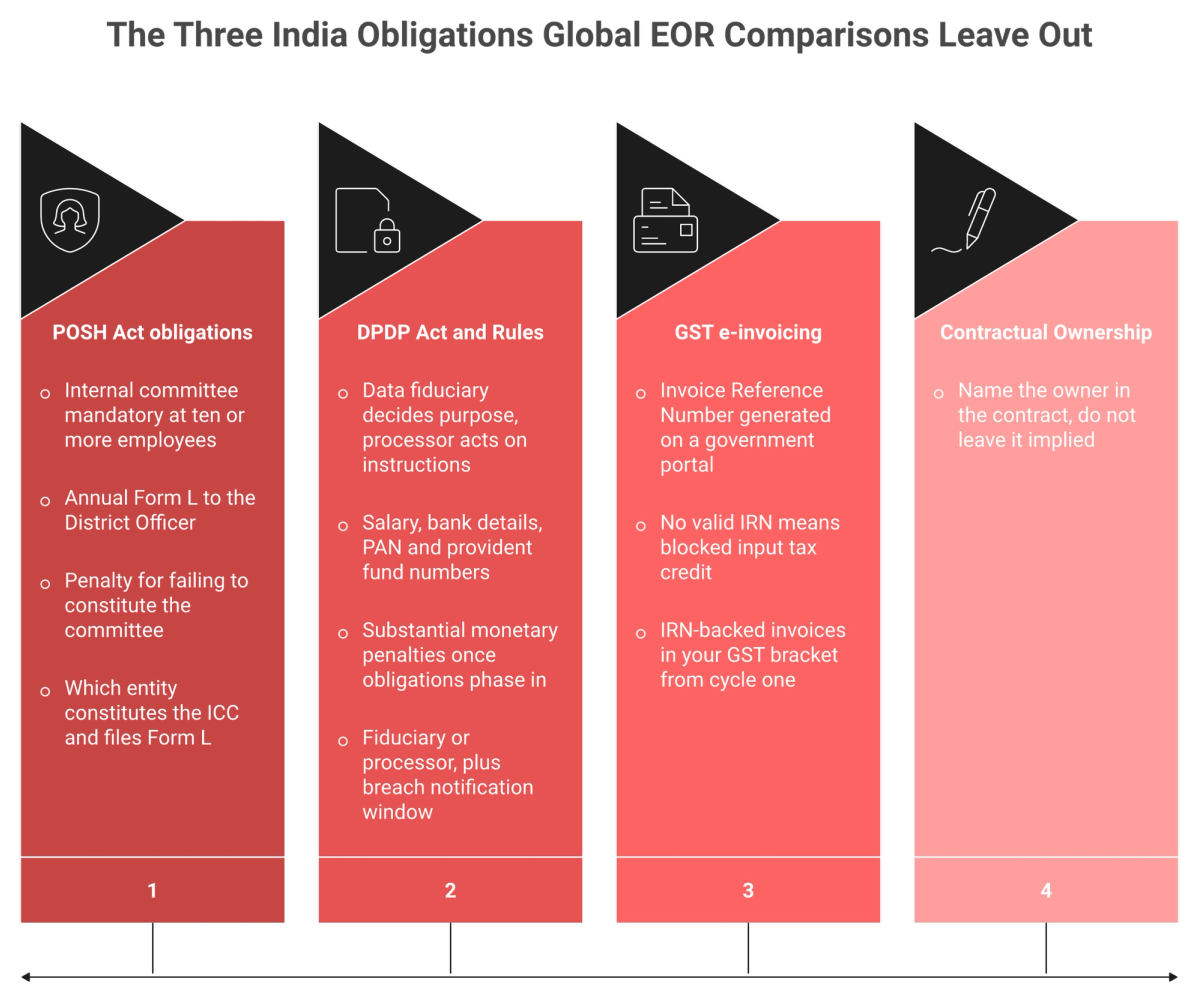
⚠️ POSH: who actually constitutes the committee
POSH is the Sexual Harassment of Women at Workplace Act, 2013. It requires an Internal Committee, or ICC, at any workplace with 10 or more employees.
Here is the awkward part in an EOR setup. The vendor is the legal employer. You manage the person day to day.
So whose committee hears a complaint from your Bengaluru engineer? Versatile Club constitutes and maintains the ICC under its own entity, and files the annual Form L with the District Officer, because an ICC cannot be assembled mid-complaint.
✅ DPDP: fiduciary or processor, decided in writing
DPDP is the Digital Personal Data Protection Act, 2023, with rules notified on 13 November 2025 as G.S.R. 846(E). It splits duties between a data fiduciary, who decides why data is processed, and a processor, who acts on instructions.
Payroll data is personal data. Salary, bank details, PAN, and provident fund numbers all qualify.
The rules phase in, with substantive obligations from 13 May 2027 and penalties reaching INR 250 crore. Ask Versatile Club, or any vendor, to state its role in writing and to attach a breach-notification runbook to the agreement.
💰 E-invoicing: the format your finance team must accept
GST e-invoicing means invoices carry an Invoice Reference Number, or IRN, generated on a government portal. It is mandatory from INR 5 crore aggregate turnover, with a 30-day reporting window for larger filers.
This sounds administrative until your controller cannot claim input tax credit. An invoice without a valid IRN creates a reconciliation problem at close, and it is one reason buyers audit employer of record cost line by line.
Versatile Club issues IRN-backed invoices from its Indian entity, which matters because the invoice and the employment both sit under the same registration.
⭐ Where my read differs from the category
Versatile Club's read is that the category has this backwards. Vendors compete on country count and platform screenshots.
The obligations that actually generate penalties are unglamorous and local. I hold that view with one caveat: I am an operator, not your lawyer, so confirm ICC composition and DPDP roles with Indian counsel before signing.
✅ Three clauses to add before signature
Add these as named clauses, not assumptions.
POSH clause. Which entity constitutes the ICC, and who files Form L annually.
DPDP clause. Fiduciary and processor roles, plus a breach-notification window.
Invoicing clause. IRN-backed e-invoices in your GST bracket from cycle one.
Versatile Club constitutes and maintains the Internal Committee under its own entity, and names the POSH, DPDP, and e-invoicing owner in the contract instead of leaving it implied.
Q7. Does either platform actually absorb misclassification and PE risk?
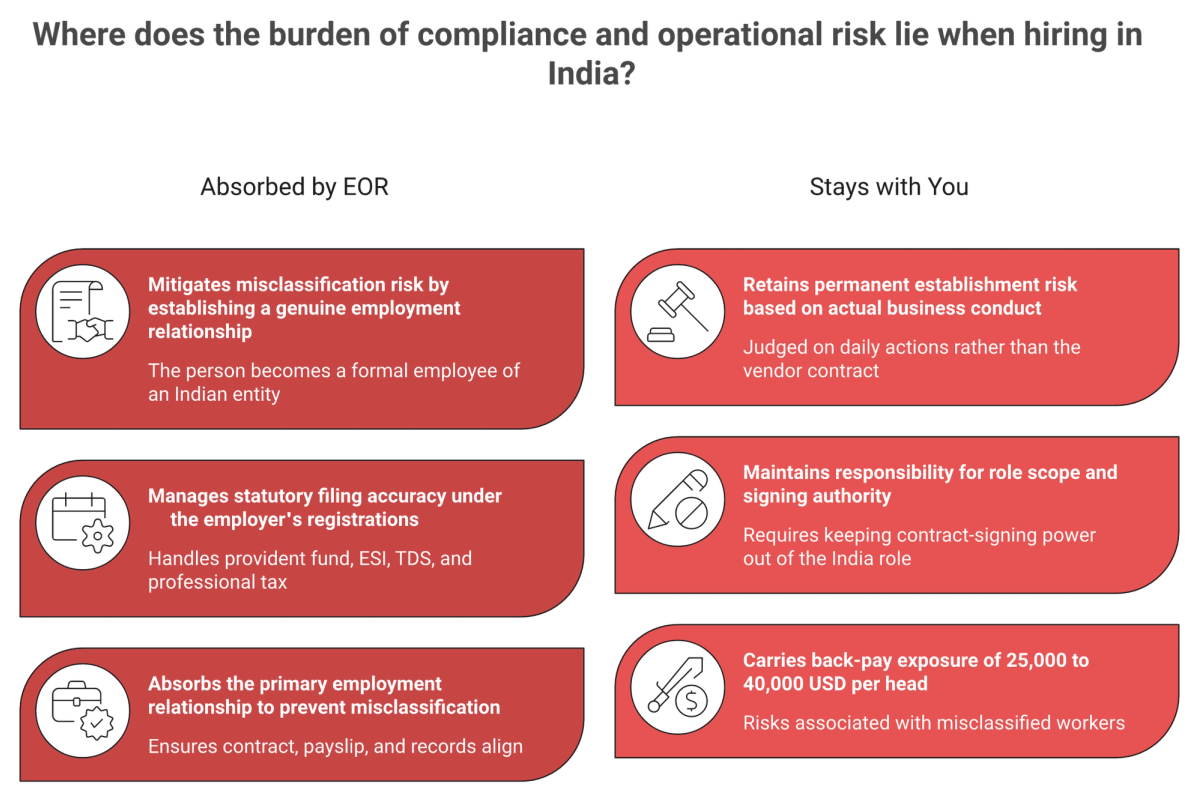
An EOR removes misclassification risk by making someone a real employee of a real Indian entity. It does not remove permanent establishment risk, which turns on conduct. If your India hire habitually concludes contracts for you, no vendor clause fixes that. Back-pay exposure for misclassifying a full-time employee as a contractor runs roughly $25,000 to $40,000 per head.
The two risks buyers keep merging into one
Founders ask me one question and mean two. "Does the EOR protect me?"
Classification and permanent establishment are separate risks. One is contractual. The other is behavioural, and the distinction sits at the centre of the independent contractor versus EOR decision.
❌ The contractor arrangement that looks fine until HR arrives
Most first India hires start as contractors. It is cheap, fast, and quietly wrong when the person works full time under your direction.
A People Ops leader joins, reviews the arrangement, and realises the person should have been an employee all along. That is the moment the exposure becomes visible, and the fix is documented in our guide to converting a contractor to an employee in India.
An EOR fixes this cleanly. Versatile Club employs each hire directly on its Indian entity, so the contract, payslip, and provident fund record all describe the same relationship.
⚠️ Permanent establishment turns on authority, not paperwork
Permanent establishment, or PE, means your foreign company is treated as having a taxable presence in India. It is judged on what people actually do.
Indian rulings in 2025 and 2026 tightened this. The Supreme Court in Hyatt International (July 2025) widened fixed-place PE analysis. The Delhi tribunal in Booking.com B.V. (February 2026) set aside a large demand where the arrangement was genuinely third-party.
Two more decisions matter here. RGA International (Mumbai tribunal, July 2025) addressed anti-fragmentation, and CIT v. Clifford Chance (Delhi High Court, December 2025) dealt with service PE.
✅ The scoping rule that actually reduces exposure
Write the role description around delivery, not deal-making. Engineering, design, support, and operations are safer scopes than sales authority.
Do not let an India-based hire sign customer contracts. Do not let them negotiate final terms.
Versatile Club scopes every EOR role away from contract-signing authority at offer stage, which is the practical step that keeps a delivery hire from reading as a dependent agent.
⭐ The category correction nobody makes
Here is the thing the category avoids saying. Traditional US-style co-employment PEO does not legally exist under Indian labour law.
If you do not own a registered Indian subsidiary, a co-employment model is not available to you. EOR is the only legal bridge, and any vendor pitching PEO for India without your own entity is describing something that is not there, a point we set out at length in EOR versus PEO.
I could be reading the PE trend too strongly. What surfaces in Versatile Club's client engagements is that PE questions arrive from tax advisors during diligence, not from founders during vendor selection, so my sample is skewed toward companies already being examined.
✅ Three clauses to check before you sign
Read for these three, then ask counsel to confirm.
Employer of record clause. Which entity is the legal employer, named with its registration.
Indemnity scope. Whether misclassification indemnity covers pre-existing contractor periods.
Authority limits. Written confirmation that the hire holds no contract-signing power.
Versatile Club employs each hire directly on its Indian entity and documents role scope in the employment contract, which is what separates a delivery hire from a dependent agent in an assessment.
Q8. When payroll breaks, who answers: ticket queue, CSM email, or a named human?
Remote's published support path is email with a three-day service level, per an April 2026 G2 reviewer who rated it 0.5 out of 5 after two near-catastrophic payroll errors. Multiplier appears as CSM email in some tables and dedicated CSM in others. Versatile Club contracts a 5-day onboarding SLA and routes escalations to the founder on WhatsApp.
The 14th of the month, 11pm her time
A US founder messaged me at 11pm her time, three days before payroll. Her Bengaluru engineer's provident fund challan had not landed in her inbox.
She did not need a knowledge base article. She needed someone with filing authority to check the EPFO portal and reply.
⏰ What the onboarding numbers actually mean
Remote commits to roughly 10 to 14 days for India onboarding. Multiplier lands closer to 7 days, which is why buyers weighing a Remote alternative start with speed.
Versatile Club contracts a 5-day onboarding SLA in the agreement itself, and one client reported a four-day turnaround with the draft offer letter attached within about four hours of first contact. Speed on paper matters less than speed written into the contract.
| Support dimension | Remote | Multiplier | Versatile Club |
| Onboarding window | 10 to 14 days | 7 days | 5-day contractual SLA |
| Escalation path | Ticket queue, email SLA | CSM email or dedicated CSM, sources differ | Founder on WhatsApp |
| IP assignment | IP Guard marketed as standard | Standard IP clause | Assignment in employment contract |
❌ What the critical reviews reveal
"They were dishonest about the level of support provided. We specifically explained we required phone-level support for urgent matters, but that is not available. Instead they have email support with a 3-day SLA."
— Juliette D., People Operations Leader Remote - G2 Verified Review
"Founder is just a call away. Extremely helpful in resolving all our queries. The process is super smooth to setup India EOR."
— surbhi m., Founder Versatile Club G2 - Verified Review
"The team is really competent, but there were a few time zone misunderstandings that caused slight delays in the initial phase."
— Setu C., Operations Lead Versatile Club G2 - Verified Review
That last one is a fair hit. Versatile Club runs support out of India, so a US west coast client sometimes waits for our morning.
⚠️ The limit I will name out loud
Founder-on-WhatsApp works at our current scale. It will not work forever, and I would rather say that than pretend otherwise.
Versatile Club will need a structured support tier as headcount grows. Right now you talk to the person who built the company, and that is a stage-specific advantage, not a permanent one.
✅ Put the escalation path in the MSA
Sales decks describe support. Contracts define it.
Ask for three things in writing before signature: a named escalation contact, a response window in hours for payroll and filing issues, and confirmation that the responder holds filing authority. Buyers already mid-contract should read our guide on switching EOR provider in India.
Then ask where intellectual property assignment sits. It should be inside the employment contract with the Indian entity, not only in your agreement with the platform.
Versatile Club contracts a 5-day onboarding SLA and routes payroll escalations to the founder directly, which is why one reviewer reported every payroll or provident fund question answered by a real person, usually same day.
Q9. At what headcount does EOR stop making sense, and can you exit cleanly?
It is a range, not a number. Some operators flip to their own Indian subsidiary around 10 to 12 hires. Others stay on EOR past 30, because a captive entity means 12 to 18 months of setup, FC-GPR filings with the Reserve Bank of India, and permanent compliance headcount. Versatile Club charges no exit fee, so the decision stays a maths problem rather than a penalty problem.
The board question that arrives too early
Your board sees a line item. Twelve India seats at a per-employee fee, every month, forever.
The question sounds obvious. Why not just open a subsidiary? Anyone asking it should first read our breakdown of EOR versus entity in India.
🌉 Think bridges, not buildings
An EOR is a suspension bridge. It is light, quick to put up, and you can take it down.
A wholly owned Indian subsidiary is the Golden Gate. Permanent, expensive, and correct once traffic justifies it.
The mistake I see is building the Golden Gate for four cars. Versatile Club has onboarded first hires in five contractual days, which is the honest comparison against a 12 to 18 month incorporation timeline.
💰 The tipping point nobody agrees on
| Input | EOR path | Own entity path |
| Time to first hire | 5 to 14 days | 12 to 18 months |
| Upfront cost | $0 to $299 setup | $50,000 plus, typically |
| Per-seat cost | $149 to $599 monthly | Salary plus in-house compliance |
| Statutory filings | Vendor's registrations | Yours, permanently |
| Exit cost | Zero to punitive, read the clause | Not applicable |
| Break-even estimate | Flexible to 30 plus seats | Often cited at 10 to 12 hires |
Read that last row honestly. One sourced analysis puts the flip at 10 to 12 hires, while other growth models keep EOR viable past 30. Model your own numbers with the EOR versus entity calculator.
⚠️ Why the question keeps arriving earlier
India stopped being a back-office decision. The Zinnov and NASSCOM landscape report counts 2,117 global capability centres in India, worth USD 98.4 billion in FY2026.
NASSCOM puts the wider tech sector at USD 315 billion in FY26, growing 6.1%. So more US and UK companies hit meaningful India headcount faster than their finance model predicted, which is why GCC setup in India now enters the conversation at Series B rather than Series D.
✅ Four inputs to model before you decide
Run these four numbers, not three.
Fully loaded seat cost. Fee, statutory load, deposits, and FX spread.
Compliance headcount. One India payroll and compliance person, salaried.
Incorporation runway. Legal, registrations, and FC-GPR reporting under FEMA.
Exit terms. What it costs to move employees off the EOR to your entity.
Versatile Club prices the transition as a plan rather than a fee, because a client who outgrows us should be able to leave with their team intact.
⭐ Where I argue against my own revenue
Versatile Club's read is that the standard advice gets the framing wrong on both sides. Cost arbitrage is a weak reason to hire in India, and premature incorporation is an expensive one.
What you actually go to India for is talent density, specifically deeply trained engineering and analytical talent. I might be over-indexing on that, since my sample is Seed to Series B founders, not enterprises with existing captives.
Versatile Club charges no setup fee and no exit fee, so moving your team onto your own Indian entity costs you a transition plan rather than a penalty clause, as set out on our pricing page.
Q10. Which India EOR fits your stage: five options ranked by compliance depth?
Ranked on India statutory depth rather than country count: Versatile Club (India-only, owned entity, USD invoicing, 5-day SLA), Wisemonk (India specialist, small team), Multiplier (cheapest global, INR default), Remote (USD invoicing, ticket-queue support), and Deel or G-P (widest coverage, thinnest India depth). Versatile Club operates in one country only. If India is your only country, country count is a vanity metric.
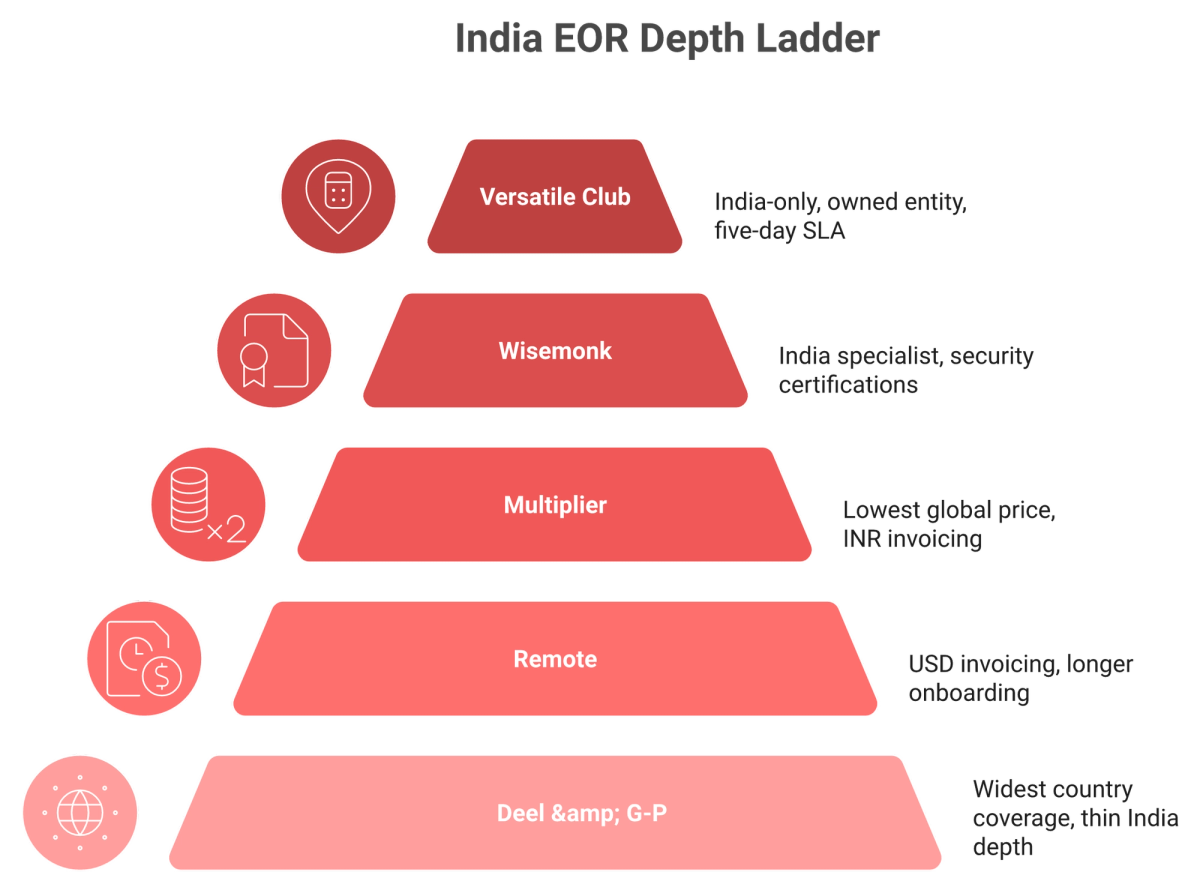
1. ⭐ Versatile Club
✅ India-only operator running its own registered Indian entity, with provident fund, ESI, and Shops and Establishments registrations held directly.
✅ $149 per employee per month, USD invoiced from India, no setup fee, no exit fee, first month free.
❌ No SOC 2 or ISO 27001 certification yet, which blocks some enterprise procurement gates.
✅ 5-day contractual onboarding SLA, 90-day Success Coach, and a 6-month replacement guarantee on contract-to-hire placements.
❌ Support runs on India hours, so a US west coast client sometimes waits for our morning.
Not for you if: you need five or more countries, or you are a B2C consumer business hiring at volume.
"The process was straightforward, the Support team was easy to work with, and the candidates' quality met our expectations."
— Verified User in Venture Capital and Private Equity Versatile Club G2 - Verified Review
2. ⭐ Wisemonk
✅ India-native EOR with a $99 entry price anchor and six years operating.
✅ SOC 2 and ISO 27001 certified, which clears most security reviews.
❌ Reviewers report slower query turnaround, attributed to team size.
✅ Structured onboarding with organised documentation.
❌ No published replacement guarantee or founder-direct support model.
"I've noticed that their support/query responses can occasionally take a bit longer sometimes, likely due to a relatively small team."
— Verified User in Financial Services Wisemonk - G2 Verified Review
Buyers weighing this option usually end up on our Wisemonk alternative page next.
3. 💰 Multiplier
✅ Cheapest global option for India, from about $400 per month with no setup fee.
✅ Roughly 7-day onboarding, faster than most global peers.
❌ Default India invoicing in INR, pushing FX spread to your parent company.
✅ 4.7 out of 5 on G2 from roughly 1,470 reviews.
❌ Multiple reviewers report added deposits and invoice errors mid-contract.
Not for you if: your controller cannot absorb currency variance monthly. The India-specific trade-offs are covered in our Multiplier alternatives for India guide.
4. ⏰ Remote
✅ USD invoicing by default, which simplifies month-end close.
✅ Owned entities across 90 plus markets and IP protections marketed as standard.
❌ 10 to 14 day India onboarding, with a $299 setup fee.
✅ 4.6 out of 5 on G2 from 3,800 plus reviews.
❌ Email support with a three-day service level and no phone escalation.
If the fee structure is your sticking point, compare it against our note on Remote pricing.
5. ❌ Deel and G-P
✅ Widest country coverage, useful if India is one of many markets.
✅ Mature platforms with deep integration libraries.
❌ India depth is thin at the multi-state and labour-code level.
✅ Strong for buyers standardising one vendor globally.
❌ Support ownership is inconsistent once an issue crosses teams.
"I dislike how expensive Deel's transaction fees are, especially when moving money from the Deel account to my bank."
— Maria M., Freelance Contractor Deel Hire - G2 Verified Review
✅ The routing rule in one line each
First India hire, Seed to Series B: an owned-entity India specialist, with the SLA written into the contract. Our EOR for startups page covers this path.
Series A to C People Ops, 10 to 100 India staff: India specialist for depth, global platform only if you hire in four or more countries.
Enterprise, 100 plus India headcount with SOC 2 as a procurement gate: shortlist the global platforms or Wisemonk, not us.
Versatile Club ranks first here because India is the only country it operates in, with an owned Indian entity, USD invoicing from India, a 5-day onboarding SLA, and a 6-month replacement guarantee.
Q11. What should you put in writing before you sign either contract?
Twelve questions, each answerable with a number or a document. Employing entity CIN, provident fund establishment code, TAN, GSTIN, Basic plus DA structure on a live offer, provident fund election, sample Form 130, Form 138 calendar, POSH committee owner, DPDP processor terms, billing currency and deposit, plus onboarding SLA and exit fee. Versatile Club answers all twelve in writing before contract.
The sales call where every answer sounded fine
I have sat on the other side of these calls for six years. Every vendor sounds compliant on a call.
Prose is easy. Registration numbers are not, which is the whole premise of our India EOR service.
✅ The twelve-question checklist
| Question | Statutory anchor | Acceptable evidence |
| Which entity employs the hire? | Companies Act 2013 | CIN, verifiable on MCA |
| Provident fund establishment code? | EPF Scheme 2026 | Code on EPFO portal |
| Salary TDS deposited under which TAN? | Income-tax Act 2025 | TAN number |
| GSTIN on the invoicing entity? | CGST Act 2017 | GSTIN |
| Basic plus DA as a share of remuneration? | Code on Wages 2019 | Breakup on a live offer |
| Provident fund election used? | EPF Scheme 2026 | Ceiling or full-wage, in writing |
| Sample salary TDS certificate? | Rule 215(1), Rules 2026 | A Form 130 specimen |
| Quarterly return calendar? | Rules 2026 | Form 138 filing dates |
| Who constitutes the POSH committee? | POSH Act 2013, s.4 | Named entity and Form L filer |
| Data fiduciary or processor? | G.S.R. 846(E) | Clause plus breach runbook |
| Billing currency and deposit terms? | FEMA 1999 | Sample invoice |
| Onboarding SLA and exit fee? | Contractual | Named days, named amount |
Versatile Club measures vendor readiness by exactly this list, because every row maps to a filing that generates a penalty when it slips.
⚠️ How to actually run it
Send it in writing to every shortlisted vendor. Do not accept a call as the answer.
After any call, send a short email repeating what you heard. If something is unclear, say so plainly instead of reading between the lines.
Ask Versatile Club the same twelve questions you send Remote and Multiplier, and compare the three replies side by side. Our published compliance documentation covers most of the twelve rows already.
⭐ What I think changes next
Where my head is right now is that India stops being one row on a global EOR map. It becomes its own category, and owned-entity operators in a single country take India revenue from the generalists.
I could be wrong about the pace. Versatile Club's client mix skews early stage, so I see the switch earlier than a CFO at a 500-person company would.
If you are staring at two open tabs and a payroll date, send me the twelve answers you got back, or just message the team directly. I will tell you which vendor is bluffing and which one is simply less relevant to your stage.
Versatile Club answers all twelve questions in writing before any contract is signed, including the 5-day onboarding SLA, the provident fund election used, and the 6-month replacement guarantee.
FAQs
Is Multiplier cheaper than Remote for hiring in India?
On sticker price, yes. Multiplier starts near $400 per employee per month with no setup fee, while Remote lists $599 monthly on annual billing ($699 month-to-month) plus a $299 setup fee. At 25 or more seats, Multiplier can fall below $300.
The gap narrows fast once you model landed cost:
- Deposits. Multiplier reportedly requests a refundable deposit, which locks up cash. Remote does not.
- FX spread. Multiplier's default India invoicing is in INR, so your parent absorbs 1% to 2% conversion on the full payroll value, not just the fee.
- Statutory load. Provident fund at 12% of wages, ESI at 3.25% employer share, and gratuity accruing at 4.81% of Basic plus DA sit on top of either fee.
Versatile Club prices India EOR at $149 per employee per month, invoiced in USD directly from its own Indian entity, with no setup fee and no exit fee. We publish the full arithmetic rather than a range on our EOR pricing page. Before signing with anyone, ask for a sample invoice in your billing currency with statutory lines itemised. If the answer arrives as prose instead of a number, treat that as the finding.
Do Remote and Multiplier own their Indian entities, or do they use local partners?
Public sources contradict each other, and that contradiction is the finding. One India EOR comparison lists Multiplier as direct-owned in India. Another describes it as partner-backed across most Indian states. Remote is variously described as running owned entities in 90-plus markets, or as using local partner entities in India.
Why it matters practically:
- If a third party is the legal employer, your engineer's provident fund sits under that party's establishment code.
- Salary TDS deposits go against that party's TAN, not the platform's.
- When a filing slips, you raise a ticket with a platform that raises a query with an aggregator you cannot audit.
You do not verify entity ownership by reading marketing. You verify it from a filing. Ask each vendor, in writing, for four things about the entity that will legally employ your hire: the Corporate Identification Number verifiable on the MCA portal, the EPFO establishment code, the GSTIN on the invoicing entity, and the TAN used for salary TDS.
Versatile Club employs every India hire on its own registered Indian entity, with provident fund, ESI, TDS, and professional tax filed under its own registration numbers, as documented in our India compliance coverage.
Which EOR handles Indian statutory compliance better in 2026?
Neither Remote nor Multiplier is built India-first, and the 2026 rule changes expose that. Three tests separate a current template from a stale one.
- Wage structuring. Under the Code on Wages, in force from 21 November 2025, Basic plus dearness allowance must be at least 50% of total remuneration. Global templates routinely allowance-load Indian salaries, which understates the provident fund and gratuity base.
- Provident fund election. The EPF Scheme 2026, notified 29 June 2026, caps mandatory contribution at INR 1,800 monthly on the INR 15,000 wage ceiling. Above-ceiling contribution is now voluntary, and employer matching is optional, so "12% of salary" is a vendor choice, not a rule.
- Tax artefacts. From 1 April 2026, Form 130 replaces Form 16, Form 131 replaces 16A, and Form 138 replaces 24Q under Income Tax Rules 2026.
Then there is state variance. Maharashtra requires dual PTRC and PTEC registration with monthly slab filing, Karnataka runs monthly professional tax plus a Shops and Establishments renewal, and Delhi charges no professional tax but enforces registration strictly.
Versatile Club holds provident fund, ESI, professional tax, and Shops and Establishments registrations directly across Indian states, which is how our India EOR service keeps a Pune hire and a Bengaluru hire on different filing calendars under one contract.
Does using an EOR in India remove misclassification and permanent establishment risk?
It removes one and reduces the other. An EOR eliminates misclassification risk by making the person a genuine employee of a genuine Indian entity, with a matching contract, payslip, and provident fund record. Back-pay exposure for treating a full-time employee as an independent contractor runs roughly $25,000 to $40,000 per head, so this is the expensive risk to close first.
Permanent establishment, or PE, is different. PE means your foreign company is treated as having a taxable presence in India, and it turns on conduct rather than paperwork.
- If your India-based hire habitually concludes contracts on your behalf, no vendor clause fixes that.
- Indian rulings tightened the test in 2025 and 2026, including Hyatt International at the Supreme Court and Booking.com B.V. at the Delhi tribunal.
- The practical control is scoping: keep roles in engineering, design, support, or operations, and withhold contract-signing authority.
One category correction worth naming: traditional US-style co-employment PEO does not legally exist under Indian labour law, so without your own Indian subsidiary, EOR is the only legal bridge. Our comparison of EOR versus PEO sets out why. Confirm ICC composition, indemnity scope, and authority limits with Indian counsel before signing.
When should we stop using an EOR in India and open our own entity?
It is a range, not a number, and the honest answer depends on trajectory rather than headcount alone. Some operators flip to a wholly owned Indian subsidiary around 10 to 12 hires. Others stay on EOR past 30 seats.
Model four inputs before deciding:
- Fully loaded seat cost. Platform fee, statutory load, deposits, and FX spread.
- Compliance headcount. One salaried India payroll and compliance person, permanently.
- Incorporation runway. Typically 12 to 18 months and $50,000 plus, including registrations and FC-GPR reporting under FEMA.
- Exit terms. What it costs to transfer employees off the EOR onto your entity.
That last input decides more cases than the fee comparison does. If transferring your team triggers a penalty, your EOR is a lock-in rather than a bridge. Read the clause before you sign, not when you outgrow it.
Context matters too. India now hosts 2,117 global capability centres worth USD 98.4 billion, so companies reach meaningful India headcount earlier than their finance model predicted. Versatile Club charges no setup fee and no exit fee, so the switch stays a maths problem. Run your own numbers on the EOR versus entity calculator before committing capital.